
Welcome to Hyperion Records, a British classical label devoted to presenting high-quality recordings of music of all styles and from all periods from the twelfth century to the twenty-first.
Hyperion offers both CDs, and downloads in a number of formats. The site is also available in several languages.
Please use the dropdown buttons to set your preferred options, or use the checkbox to accept the defaults.


| Mary Bevan (soprano), Joseph Middleton (piano)» More |
We have no way of knowing whether Schubert took his German songs to Salieri. Legend has it that it was Hagars Klage which had first aroused the old boy’s interest in Schubert, but it has also been assumed that the ballads after this were composed behind his back. If so, it is an extraordinary coincidence that the two texts match up in such a way, and in such close chronological proximity. One would be delighted to imagine the following scenario: Schubert takes Salieri his first sketches of Der Taucher; the Italian is interested and impressed, although he insists that he does not know enough about German to help with pieces of this kind – he is only prepared to mark the exercises in Italian; but he suddenly remembers that Mestastasio wrote a text about the stormy sea, and sets it forthwith as Schubert’s next exercise.
Another explanation of the coincidence is that Schubert had been lent a number of books containing Metastasio texts, and that he was permitted to make his own text selections for his exercises. This was almost certainly the case with the large number of Schiller exercises for vocal trio written in 1813, and it may have extended, after a while, to the Italian texts. Having embarked on Der Taucher, and being forced to break off from it in order to prepare a new exercise for Salieri, it would have been quite understandable if Schubert had been drawn to this turbulent and watery poem.
from notes by Graham Johnson © 1999
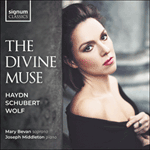 Haydn, Schubert & Wolf: The divine muse Haydn, Schubert & Wolf: The divine museStudio Master: SIGCD606Download onlyStudio Master FLAC & ALAC downloads available  After the success of their debut disc, ‘Voyages’, Mary Bevan and Joseph Middleton present their second recital disc exploring Lieder in German and Italian by Schubert, Haydn and Wolf. The programme is woven around songs inspired by the ‘muses’ of ...» More |
 Schubert: The Complete Songs Schubert: The Complete SongsCDS44201/4040CDs Boxed set + book (at a special price) — Temporarily out of stock  ‘This would have been a massive project for even the biggest international label, but from a small independent … it is a miracle. An ideal Christ ... ‘Please give me the complete Hyperion Schubert songs set—all 40 discs—and, in the next life, I promise I'll "re-gift" it to Schubert himself … fo ...» More |