
Welcome to Hyperion Records, a British classical label devoted to presenting high-quality recordings of music of all styles and from all periods from the twelfth century to the twenty-first.
Hyperion offers both CDs, and downloads in a number of formats. The site is also available in several languages.
Please use the dropdown buttons to set your preferred options, or use the checkbox to accept the defaults.

| John Mark Ainsley (tenor), Malcolm Martineau (piano)» More |
In 1910 Fauré confessed that he had never set Hugo successfully. Even if this is the case by the composer’s own highest standards, it is difficult to see why the composer thought that Puisque j’ai mis ma lèvre was less worth publishing than, say, his Rêve d’amour. In the middle of the song one might point out a slightly awkward corner (at the end of the music for verse 3, and the first few lines of verse 4). If the musical transitions here are less than ideally smooth, these small flaws are surely outweighed by the elegance of the accompaniment (an early essay in the madrigal style with left-hand staccati suggesting a plucked lute) and the graceful vocal line which encourages a tenor to charm the ear with his mezza voce. The cool poise of Fauré’s song announces a madrigal style that was to be revisited for the rest of his career. The swooning eroticism of Reynaldo Hahn’s setting of the same words (in his second recueil) suggests a lover almost drunk with rapture. This may be true to Hugo, but it is not Fauré’s temperament, and as he got older he realized how much happier he was with less fiery collaborators.
from notes by Graham Johnson © 2005
En 1910, Fauré avoua n’avoir jamais vraiment réussi à mettre Hugo en musique. Même si tel est le cas au regard de ses critères les plus élevés, on comprend mal pourquoi il trouva Puisque j’ai mis ma lèvre moins digne d’être publiée que, disons, Rêve d’amour. Signalons, au milieu de la mélodie, un tournant quelque peu maladroit (à la fin de la musique de la strophe 3 et des premiers vers de la strophe 4) et, si les transitions musicales sont tout sauf idéalement coulantes, ces petits défauts sont assurément compensés par l’élégance de l’accompagnement (essai de jeunesse dans le style madrigalesque avec des staccati à la main gauche évoquant un luth pincé), mais aussi par la gracieuse ligne vocale qui incite un ténor à nous charmer l’oreille de son messa voce. Le calme équilibre de cette mélodie annonce un style de madrigal auquel Fauré devait revenir toute sa carrière durant. L’érotisme en pâmoison de la mise en musique que Reynaldo Hahn fit des mêmes mots, dans son second recueil, insinue un amant presque ivre d’extase—une suggestion qui, pour être peut-être vraie chez Hugo, ne correspond absolument pas au tempérament d’un Fauré qui, l’âge venant, comprit d’ailleurs combien il était plus heureux avec des auteurs moins enflammés.
extrait des notes rédigées par Graham Johnson © 2005
Français: Hypérion
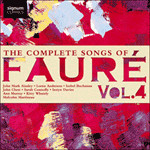 Fauré: The Complete Songs, Vol. 4 Fauré: The Complete Songs, Vol. 4Studio Master: SIGCD681Download onlyStudio Master FLAC & ALAC downloads available  With soloists John Mark Ainsley, Iestyn Davies, Isobel Buchanan, Lorna Anderson, Sarah Connolly, Ann Murray, John Chest and Kitty Whately (in Fauré's challenging cycle 'La bonne chanson'), this volume concludes Malcolm Martineau's delightful compe ...» More |