
Welcome to Hyperion Records, a British classical label devoted to presenting high-quality recordings of music of all styles and from all periods from the twelfth century to the twenty-first.
Hyperion offers both CDs, and downloads in a number of formats. The site is also available in several languages.
Please use the dropdown buttons to set your preferred options, or use the checkbox to accept the defaults.

Scarlatti’s (tempo) directions seem to have but little bearing on the actual speed at which the piece is to be taken; rather they serve as indications of rhythmic character. Most Scarlatti pieces are commonly taken too fast. A Presto, for example, may not necessarily refer to tempo. Never does it indicate a pseudo-virtuoso exhibition of mere dexterity. On the other hand it may better be interpreted as lively and alert, capable of immediate response to nuances of wit or to lightning changes of expression. Although Scarlatti is a keyboard virtuoso of the most spectacular kind, the antics of his keyboard technique and the velocity of his pulse are counterbalanced by vocal line, harmonic nuance, and sharply chiseled rhythmic detail that should be respected in the performer’s choice of tempo.
This sonata is full of gestures: the descending arpeggio, for instance, both opens and closes each section, gaining in emphasis each time. The right hand dispatches a sequence of mini scales (don’t forget to use the Baroque fingering of crossing the fourth finger over the fifth to begin the subsequent broken chord). Then the left hand begins to leap about, commented on by the right. The Bs suddenly are flattened giving a different colour. Then a pedal point, unusually in the right hand, is placed over a dancing, ascending scale in the left. The second section has more of the same but remains for longer in minor mode. It’s a piece in which the physical pleasure of the dance is felt in the hand movements.
from notes by Angela Hewitt © 2026
Les indications (de tempo) de Scarlatti semblent n’avoir qu’une influence limitée sur le véritable mouvement dans lequel la pièce doit être jouée; elles servent plutôt à donner le caractère rythmique. La plupart des pièces de Scarlatti sont jouées généralement trop vite. Un presto, par exemple, peut ne pas se référer nécessairement au tempo. Ce n’est pas non plus une indication correspondant à une démonstration de pseudo virtuosité. Par contre, il peut mieux s’interpréter comme quelque chose de vif et d’alerte, capable de traduire immédiatement les nuances de caractère ou les changements d’éclairage en matière d’expression. Bien que Scarlatti ait été un virtuose du clavier des plus impressionnants, les facéties de sa technique et la vélocité de sa pulsation sont contrebalancées par des lignes vocales, des nuances harmoniques et des détails rythmiques finement ciselés que doit respecter l’interprète dans le choix du tempo.
Cette sonate regorge de gestes: l’arpège descendant, par exemple, ouvre et ferme à la fois chaque section, prenant à chaque fois de l’emphase. La main droite expédie une séquence de mini gammes (n’oubliez pas d’utiliser le doigté de l’ère baroque consistant à passer l’annulaire au-dessus du petit doigt pour commencer l’accord brisé qui suit). Ensuite, la main gauche se met à sautiller, ce sur quoi la main droite fait des commentaires. Les si sont soudain bémolisés donnant une couleur différente. Puis une pédale, exceptionnellement à la main droite, est placée sur une gamme ascendante dansante à la main gauche. La seconde section est du même acabit mais reste plus longtemps en mode mineur. C’est une pièce dans laquelle le plaisir physique de la danse se ressent dans les mouvements des mains.
extrait des notes rédigées par Angela Hewitt © 2026
Français: Marie-Stella Pâris
Scarlattis (Tempo-)Angaben scheinen nur wenig Einfluss auf die tatsächliche Geschwindigkeit zu haben, in der das Stück gespielt werden soll; vielmehr dienen sie als Hinweise auf den rhythmischen Charakter. Die meisten Scarlatti-Stücke werden gemeinhin zu schnell gespielt. Ein „Presto“ bezieht sich beispielsweise nicht unbedingt auf das Tempo. Es bezeichnet niemals eine pseudo-virtuose Zurschaustellung reiner Fingerfertigkeit. Vielmehr lässt es sich besser als lebhaft und aufmerksam interpretieren—in der Lage, sofort auf geistreiche Nuancen oder blitzschnelle Ausdruckswechsel zu reagieren. Obwohl Scarlatti ein Tastenvirtuose der spektakulärsten Art ist, werden die Kapriolen seiner Tastentechnik und die Schnelligkeit seines Pulses durch die Gesangslinie, die harmonischen Nuancen und prägnanten rhythmischen Details ausgeglichen, die der Interpret bei der Wahl des Tempos berücksichtigen sollte.
Diese Sonate ist voller Gesten: das absteigende Arpeggio beispielsweise eröffnet und beendet jeden Abschnitt und gewinnt dabei jedes Mal an Nachdruck. Die rechte Hand spielt eine Abfolge von Miniskalen (dabei darf man nicht vergessen, den barocken Fingersatz anzuwenden, bei dem der vierte Finger über den fünften gekreuzt wird, um den folgenden gebrochenen Akkord einzuleiten). Dann beginnt die linke Hand zu springen, was von der rechten kommentiert wird. Die Hs werden plötzlich erniedrigt, was eine andere Klangfarbe erzeugt. Dann wird ein Orgelpunkt—ungewöhnlicherweise in der rechten Hand—über eine tanzende, aufsteigende Tonleiter in der linken Hand gelegt. Der zweite Abschnitt ist ähnlich, bleibt aber länger in Moll. Es ist ein Stück, in dem man die körperliche Freude am Tanz in den Handbewegungen spürt.
aus dem Begleittext von Angela Hewitt © 2026
Deutsch: Viola Scheffel
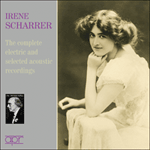 Irene Scharrer - The complete electric and selected acoustic recordings Irene Scharrer - The complete electric and selected acoustic recordingsAPR60102CDs for the price of 1 — Download only  ‘If [Irene Scharrer]'s remembered from her recordings it’s really only the one, and that was ironically the last she made, Litolff’s Scherzo from the ...» More |
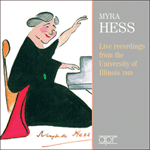 Myra Hess - Live recordings from the University of Illinois, 1949 Myra Hess - Live recordings from the University of Illinois, 1949APR73063CDs Download only Two complete recitals recorded at Illinois University on 17 and 18 March 1949 and some bonus recordings originally broadcast on 7 March 1937. Almost all the works included in this programme are new additions to the Myra Hess discography.» More |
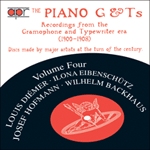 The Piano G & Ts, Vol. 4 - Diémer, Eibenschütz, Hofmann & Backhaus The Piano G & Ts, Vol. 4 - Diémer, Eibenschütz, Hofmann & BackhausAPR5534Download only |