
Welcome to Hyperion Records, a British classical label devoted to presenting high-quality recordings of music of all styles and from all periods from the twelfth century to the twenty-first.
Hyperion offers both CDs, and downloads in a number of formats. The site is also available in several languages.
Please use the dropdown buttons to set your preferred options, or use the checkbox to accept the defaults.

| Marc-André Hamelin (piano), Les Violons du Roy, Bernard Labadie (conductor)» More |
The D major Concerto is both more melodically attractive and more tautly organized than the two earlier works. Like Mozart in his Viennese concertos, Haydn here infuses the concerto’s traditional ritornello design, based on the alternation of solo and tutti, with the drama and dynamism of sonata form. Except in the finale, Haydn does not work with Mozart’s profusion of themes. His scale, as usual, is more compact. But the opening Vivace has plenty of melodic contrast to offset the crisp, clear-cut main theme which galvanizes the whole movement. The ‘tapping’ figure of three crotchets in bar two proves especially fertile, above all in the rapidly modulating development, where it is bandied about between various string groups against the soloist’s broken semiquaver figuration.
While the first movement works equally well on harpsichord or piano, the musing, ornate Un poco adagio, in A major, cries out for the dynamic shadings possible only on a touch-sensitive instrument. In this delicately orchestrated movement (sustained oboes and horns add a soft gloss to the opening tutti), Haydn creates poetry from the simplest material. The central episode, slipping immediately from E major to E minor, expands a repeated triplet figure first heard near the beginning into an exquisite dialogue between keyboard and strings.
It was surely the finale that sealed the concerto’s popularity in Haydn’s lifetime, as the composer doubtless calculated it would. Haydn had already hinted at the Tokay-flavoured Hungarian gypsy style in the G major Keyboard Concerto, and mined it more extensively in pieces like the finale of Symphony No 47 in G major and the minuet and finale of the D major String Quartet Op 20 No 4. But this Rondo all’ungarese outdoes all comers in its mingled flamboyant exoticism and zany humour. The main tune, which initially sounds like a ‘normal’ Haydn finale theme, has been identified as a dance from Bosnia or Croatia. From the moment the tune is repeated in the ‘wrong’ key of E minor, with stinging grace notes, the music grows progressively more delirious. The first episode whirls fragments of the main theme through a frenetic sequence of modulations, audacious even by Haydn’s standards. A contrasting theme sounds like a paprika-infused ‘Three Blind Mice’, made faintly ominous with trills, while a later episode seems to transplant an impassioned operatic aria to the wildness of the Hungarian puszta.
from notes by Richard Wigmore © 2013
Le Concerto en ré majeur est mélodiquement plus séduisant et organisé avec davantage de tension que les deux œuvres précédentes. Comme le Mozart des concertos viennois, Haydn insuffle au traditionnel schéma de ritornello du concerto (fondé sur une alternance solo/tutti) le drame et le dynamisme de la forme sonate. Sauf dans le finale, il élude la profusion thématique mozartienne, dans un cadre, comme d’habitude, plus resserré. Le Vivace inaugural n’en déborde pas moins de contrastes mélodiques pour contrebalancer le thème principal clair et net qui galvanise l’ensemble du mouvement. La figure «tapotante» de trois noires, à la mesure deux, s’avère particulièrement féconde, surtout dans le développement qui module rapidement, où elle circule entre divers groupes de cordes, contre la figuration en doubles croches arpégées du soliste.
Si le premier mouvement fonctionne aussi bien au clavecin qu’au piano, l’Un poco adagio rêveur, orné, en la majeur exige les nuances dynamiques possibles uniquement sur l’instrument sensible au toucher. Dans ce mouvement subtilement orchestré (hautbois et cors tenus confèrent un doux éclat au tutti inaugural), Haydn crée de la poésie avec le plus simple des matériaux. L’épisode central, qui glisse immédiatement de mi majeur à mi mineur, développe une figure en triolets répétée entendue d’abord vers le début, dans un exquis dialogue entre le clavier et les cordes.
Ce fut certainement le finale qui scella la popularité de ce concerto du vivant de Haydn (lequel avait tout fait pour)—il y retrouve le hungarisme tzigane, à la saveur de tokay, qu’il avait effleuré dans son Concerto pour clavier en sol majeur et qu’il explora plus à fond dans des pages comme le finale de sa Symphonie nº 47 en sol majeur ou le menuet et finale de son Quatuor à cordes en ré majeur op. 20 nº 4. Mais ce Rondo all’ungarese est suprême d’exotisme flamboyant teinté d’humour loufoque. L’air principal, qui sonne d’abord comme un thème de finale haydnien «normal», a été identifié comme étant une danse bosniaque ou croate. Dès l’instant où cet air est repris dans la «fausse» tonalité de mi mineur, avec ses petites notes cinglantes, la musique se met à délirer de plus en plus. Le premier épisode fait tournoyer des fragments du thème principal à travers une série de modulations frénétique, audacieuse même pour Haydn. Un thème contrastif s’apparente à un «Three Blind Mice» au paprika, que des trilles rendent vaguement lugubres, tandis qu’un épisode ultérieur semble transplanter une fervente aria d’opéra dans la vaste puszta hongroise.
extrait des notes rédigées par Richard Wigmore © 2013
Français: Hypérion
Das Konzert in D-Dur ist sowohl melodisch attraktiver als auch straffer organisiert als die beiden früheren Werke. Ebenso wie Mozart es in seinen Wiener Konzerten handhabte, durchdringt Haydn die traditionelle Ritornell-Anlage, der das Alternieren von Solo- und Tutti-Abschnitten zugrunde liegt, mit der Dramatik und Dynamik der Sonatenform. Mit Ausnahme des Finales arbeitet Haydn nicht mit einem Überfluss von Themen, wie es bei Mozart der Fall ist. Seine Anlage ist, wie üblich, kompakter gehalten. Doch im eröffnenden Vivace ist reichlich melodisches Kontrastmaterial enthalten, das dem frischen, fest umrissenen Hauptthema, welches den gesamten Satz antreibt, gegenübergestellt wird. Die „Klopf-Figur“ der drei Viertel in Takt 2 stellt sich als besonders ergiebig heraus, insbesondere in der rasch modulierenden Durchführung, wo sie immer wieder auftaucht, wenn verschiedene Streichergruppen gegen die gebrochenen Sechzehntelfigurationen des Soloinstruments gesetzt sind.
Während der erste Satz gleichermaßen für Cembalo und Klavier geeignet ist, verlangt das nachdenkliche, verzierte Un poco adagio in A-Dur förmlich nach den dynamischen Schattierungen, die nur auf einem anschlagsempfindlichen Instrument möglich sind. In diesem grazil orchestrierten Satz (ausgehaltene Oboen und Hörner sorgen im Anfangstutti für einen weichen Glanz) bringt Haydn aus dem schlichtesten Material Poesie hervor. Im mittleren Abschnitt, der sofort von E-Dur nach e-Moll gleitet, wird eine wiederholte Triolenfigur, die erstmals zu Beginn zu hören war, in einen exquisiten Dialog zwischen Soloinstrument und Streichern ausgedehnt.
Zu Haydns Lebzeiten begründete sicherlich das Finale die Popularität des Konzerts—und der Komponist hatte das zweifellos entsprechend kalkuliert. Bereits im G-Dur-Konzert hatte Haydn auf den vom Tokajer durchzogenen ungarischen Zigeunerstil angespielt und ihn in Stücken wie dem Finale der Symphonie Nr. 47 in G-Dur und dem Menuett und Finale des Streichquartetts in D-Dur, op. 20 Nr. 4, noch stärker zutage gebracht. Doch dieses Rondo all’ungarese übertrifft mit seinem extravaganten Exotismus und irrsinnig anmutenden Humor alle anderen. Die Hauptmelodie, die zunächst wie ein „normales“ Haydn’sches Finalthema klingt, ist als bosnischer oder auch kroatischer Tanz identifiziert worden. Ab dem Moment, wenn die Melodie in der „falschen“ Tonart e-Moll mit stechenden Vorhalten wiederholt wird, bewegt sich die Musik zunehmend ins Rauschhafte. Im ersten Abschnitt wirbeln Fragmente des Hauptthemas durch eine frenetische Sequenz von Modulationen, die sogar für Haydns Verhältnisse waghalsig sind. Ein kontrastierendes Thema klingt wie ein von Paprika durchdrungener Kinderreim, der durch die Triller etwas unheilvoll wirkt, während in einem späteren Abschnitt eine leidenschaftliche Opernarie in die Wildnis der ungarischen Puszta verpflanzt worden zu sein scheint.
aus dem Begleittext von Richard Wigmore © 2013
Deutsch: Viola Scheffel
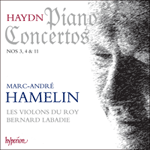 Haydn: Piano Concertos Nos 3, 4 & 11 Haydn: Piano Concertos Nos 3, 4 & 11Studio Master: CDA67925Studio Master FLAC & ALAC downloads available  Marc-André Hamelin is acclaimed as one of today’s greatest Haydn pianists thanks to his three dazzling albums of the sonatas. Now he has recorded the composer’s three most popular concertos. This release is the fruit of a partnership with the awar ...» More |