Welcome to Hyperion Records, a British classical label devoted to presenting high-quality recordings of music of all styles and from all periods from the twelfth century to the twenty-first.
Hyperion offers both CDs, and downloads in a number of formats. The site is also available in several languages.
Please use the dropdown buttons to set your preferred options, or use the checkbox to accept the defaults.


| Tamsin Waley-Cohen (violin), Huw Watkins (piano)» More |
A hint of the spacious Impressionism of Respighi’s orchestral writing can be heard in the wide-ranging piano theme that opens the Andante espressivo in E major, the emotional heart of the work. The violin then weaves a tranquil melody over a varied version of the piano theme, before the music becomes more animated (a section marked Appassionato, in triple time). The opening idea anchors much of what follows, working towards a massive climax before returning to the serenity of the opening.
The finale begins with a stern statement of the Passacaglia theme on which it is based, marked by powerful dotted rhythms. What follows is a brilliantly inventive exploration of the musical possibilities of both the form—a Baroque variation structure that had already inspired composers as different as Brahms (the finale of the Fourth Symphony) and Ravel (the slow movement of the Piano Trio)—and the theme itself. Respighi’s music here is entirely original (with a fondness for unusual phrase lengths—even in the theme, which is two bars longer than we might expect), but his model was certainly Brahms: the last movement of the Fourth Symphony has a very similar tempo marking (Brahms’s is Allegro energico e passionato), takes a comparably free and creative approach to writing variations on a ground bass, and ends with a faster, muscular coda that dramatically reaffirms the minor key.
The first performance of the B minor Sonata was given in Bologna on 3 March 1918, played by Respighi’s old teacher, Federico Sarti, with the composer himself at the piano. Respighi was delighted, writing to his old friend (a fellow-pupil in Sarti’s class) Arrigo Serato: ‘Inni! Non faccio per dire, ma abbiamo suonato bene. Io compreso!’ (‘Praise be! I shouldn’t say so, but we played it well. Me included!’). It was published by Ricordi the following year and soon enjoyed international success. Bronislaw Huberman, with pianist Paul Frankel, gave a recital in Chicago on 24 January 1923 which included an early American performance. It was described by Edward Moore in the Chicago Daily Tribune as being of interest for several reasons: ‘Quite outside of its own merits, which were many, this sonata served to indicate how the new generation of Italian composers is labouring to get away from the theory that Italian music means Italian opera … Respighi has written rather a good sonata … conceived along broad lines and on large ideas.’ The music of this Sonata is highly individual, demonstrating a more concentrated and intimate kind of instrumental mastery than does his more public, more spectacular orchestral music.
from notes by Nigel Simeone © 2012
On peut entendre un peu du vaste impressionnisme de l’écriture orchestrale de Respighi dans l’ample thème pianistique qui ouvre l’Andante espressivo en mi majeur, le cœur émotionnel de l’œuvre. Puis le violon tisse une mélodie tranquille par-dessus une version variée du thème pianistique, avant que la musique s’anime davantage (une section marquée Appassionato, en mesure ternaire). L’idée inaugurale fixe en grande partie ce qui va suivre, travaillant à un massif apogée pour ensuite retrouver la sérénité initiale.
Le finale part sur une austère énonciation du thème de passacaille sur lequel il repose, marqué par de forts rythmes pointés. S’ensuit une exploration brillamment inventive des possibilités offertes par la forme—une structure de variation baroque qui avait déjà inspiré des compositeurs aussi différents que Brahms (le finale de la Symphonie nº 4) et Ravel (le mouvement lent du Trio avec piano)—comme par le thème. Respighi signe ici une musique totalement originale (avec une tendresse pour les longueurs de phrase peu communes—y compris dans le thème, deux mesures plus long que ce que l’on pourrait attendre), même si Brahms fut certainement son modèle: le dernier mouvement de la Symphonie nº 4 a une indication de tempo très similaire (Allegro energico e passionato, nous dit Brahms), adopte une même approche, relativement libre et créative, des variations sur une basse contrainte, et s’achève sur une coda vigoureuse, plus rapide, qui réaffirme avec théâtralité le ton mineur.
La Sonate en si mineur fut créée le 3 mars 1918 à Bologne par Federico Sarti, le vieux maître de Respighi. Ravi—il tenait le piano—, ce dernier écrivit à son vieil ami (et condisciple dans la classe de Sarti), Arrigo Serato: «Inni! Non faccio per dire, ma abbiamo suonato bene. Io compreso!» («Dieu merci! Je ne devrais pas le dire, mais nous l’avons bien jouée. Moi y compris!»). L’œuvre, publiée par Ricordi l’année suivante, connut bientôt un succès international. Le 24 janvier 1923, lors d’un récital à Chicago, Bronislaw Huberman et le pianiste Paul Frankel en donnèrent une des premières exécutions américaines. Dans le Chicago Daily Tribune, Edward Moore la trouva intéressante à plus d’un titre: «En dehors de ses mérites propres, qui furent nombreux, cette sonate permit de montrer combien la nouvelle génération de compositeurs italiens travaille pour s’affranchir de la théorie qui fait rimer musique italienne et opéra italien … Respighi a écrit une assez belle sonate … conçue selon des lignes larges et des idées amples.» La musique de cette Sonate est personnelle entre toutes et atteste une maîtrise instrumentale plus concentrée, plus intime que dans les pages orchestrales davantage populaires et spectaculaires de Respighi.
extrait des notes rédigées par Nigel Simeone © 2012
Français: Hypérion
Anklänge an den weitgespannten Impressionismus von Respighis Orchesterschaffen sind im breit angelegten Klavierthema hörbar, mit dem das Andante espressivo in E-Dur einsetzt—das emotionale Herzstück des Werks. Anschließend entfaltet sich eine besinnliche Melodie in der Geige, begleitet von einer variierten Fassung des Klavierthemas, ehe die Musik lebhafter wird und ein mit Appassionato bezeichneter Abschnitt im Dreiertakt erklingt. Der weitere Ablauf basiert größtenteils auf dem Anfangsgedanken des Satzes und steigert sich zu einem gewaltigen Höhepunkt, um dann zur Abgeklärtheit des Beginns zurückzukehren.
Das Finale setzt mit einer strengen Vorstellung des zugrundeliegenden Passacagliathemas ein, das von kräftigen punktierten Rhythmen geprägt ist. In der Folge erkundet Respighi auf wunderbar erfindungsreiche Weise die musikalischen Möglichkeiten sowohl der Form—eines barocken Variationsschemas, von dem sich schon so unterschiedliche Komponisten wie Brahms (Finale der vierten Sinfonie) und Ravel (langsamer Satz des Klaviertrios) hatten inspirieren lassen—als auch des Themas selbst. Seine Musik ist hier vollkommen eigenständig (und zeugt von einer Vorliebe für ungewöhnliche Phrasenlängen—sogar das Thema ist zwei Takte länger, als man erwarten würde), sein Vorbild aber war zweifellos Brahms: Der letzte Satz der vierten Sinfonie trägt eine ganz ähnliche Tempovorzeichnung (bei Brahms: Allegro energico e passionato), zeigt einen vergleichbar freien und kreativen Umgang mit Variationen über einem Bassostinato und schließt mit einer energischen Coda in schnellerem Tempo, in der die Molltonart dramatisch bekräftigt wird.
Die Uraufführung der h-Moll-Sonate fand am 3. März 1918 in Bologna statt, gespielt von seinem einstigen Lehrer Federico Sarti und mit dem Komponisten selbst am Klavier. Respighi war begeistert und schrieb an seinen alten Freund Arrigo Serato (einen Mitschüler aus Sartis Klasse): „Inni! Non faccio per dire, ma abbiamo suonato bene. Io compreso!“ („Halleluja! Man will es ja nicht sagen, aber wir haben gut gespielt. Sogar ich!“). Im Jahr darauf erschien das Werk bei Ricordi, und schnell war es auch im Ausland erfolgreich. Bronislaw Huberman gab am 24. Januar 1923 mit dem Pianisten Paul Frankel ein Konzert in Chicago, bei dem die Sonate eine ihrer ersten Aufführungen in Amerika erlebte. Edward Moore urteilte im Chicago Daily Tribune, sie sei in mehrfacher Hinsicht interessant: „Ganz abgesehen von den Vorzügen des Werks an sich, die zahlreich waren, machte die Sonate deutlich, wie sehr die italienischen Komponisten der neuen Generation sich von der Auffassung zu befreien suchen, italienische Musik bedeute italienische Oper … Respighi hat eine durchaus beachtliche Sonate geschrieben … breit angelegt und auf ausgedehnten Ideen beruhend.“ Die musikalische Gestaltung der Sonate ist überaus eigenständig und zeigt eine stärker in sich gekehrte und intime Beherrschung des instrumentalen Genres als seine nach außen gerichtete und publikumswirksame Orchestermusik.
aus dem Begleittext von Nigel Simeone © 2012
Deutsch: Arne Muus
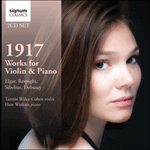 1917 1917Studio Master: SIGCD3762CDs Download onlyStudio Master FLAC & ALAC downloads available  Rising-star violinist Tamsin Waley-Cohen is joined by the eminent pianist-composer Huw Watkins in a diverse programme of works composed as the Great War drew to a close. These works are all conceived as absolute music, albeit, in the case of the E ...» More |