
Welcome to Hyperion Records, a British classical label devoted to presenting high-quality recordings of music of all styles and from all periods from the twelfth century to the twenty-first.
Hyperion offers both CDs, and downloads in a number of formats. The site is also available in several languages.
Please use the dropdown buttons to set your preferred options, or use the checkbox to accept the defaults.


| Pavel Kolesnikov (piano)» More |
The spasmodic rhythm of the C major No 2, with its off-beat accents in the right hand and timpani thuds in the left, is soon offset by a smooth and shadowy section in the minor, with fleeting left-hand triplets. This, however, turns out not to be the real trio, which, when it arrives, features staccato ascending scales in thirds.
The following number, in F major, is a gentle piece in pastoral style whose theme has a second half that charmingly echoes the first from a comparatively distant D major. Much more incisive is the fifth Bagatelle, which has lightning-quick semiquaver triplets for both hands which are continued by the left hand beneath the broader melody of the minor-mode middle section. The last piece of the series is a dazzling Presto in the expanded scherzo form, with the trio appearing twice between three statements of the scherzo itself, that came to be a hallmark of Beethoven’s symphonic style from the Razumovsky string quartets Op 59 and the Fourth Symphony onwards.
The two jewels of the set are, perhaps, the much more relaxed and lyrical fourth and sixth numbers. The melody in the first of these is inextricably woven into the two upper strands of the texture, but towards the end it moves down into the bass, and then into the tenor voice. As for the sixth Bagatelle, Beethoven wanted its gentle melody played with a speech-like quality. Following an embellished version of the melody which is in essence a variation, the piece comes to a close with chains of slowly descending thirds above a syncopated pedal-note that moves progressively downwards by octaves, allowing the music to fade away into the distance, in a pastoral atmosphere.
from notes by Misha Donat © 2012
Le rythme spasmodique de la Bagatelle nº 2 en ut majeur, avec ses accents sur les temps faibles à la main droite et ses bruits sourds de timbales à la main gauche, est bientôt compensé par une section fluide et mystérieuse en mineur, avec des triolets rapides à la main gauche. Mais il s’avère que ce n’est pas le véritable trio; lorsqu’il survient, celui-ci se présente avec des gammes ascendantes staccato en tierces.
Le numéro suivant, en fa majeur, est un doux morceau de style pastoral; la seconde moitié de son thème se fait l’écho de la première de façon charmante depuis une tonalité relativement éloignée, ré majeur. La cinquième Bagatelle est beaucoup plus incisive avec ses triolets de doubles croches rapides comme l’éclair aux deux mains, que prolonge la main gauche sous la mélodie plus large de la section centrale en mineur. La dernière pièce de ce recueil est un Presto éblouissant en forme élargie de scherzo, le trio apparaissant deux fois entre trois expositions du scherzo lui-même, ce qui deviendra une caractéristique du style symphonique de Beethoven à partir des quatuors à cordes Razoumovski, op. 59, et de la Symphonie nº 4.
Les deux joyaux du recueil sont peut-être la quatrième et la sixième Bagatelles, beaucoup plus détendues et lyriques. La mélodie de la quatrième est inextricablement tissée dans les deux fils supérieurs de la texture mais, vers la fin, elle descend à la basse, puis passe dans la voix de ténor. Quant à la sixième, Beethoven voulait que sa douce mélodie soit jouée avec une certaine expression parlée. Après une version ornée de la mélodie qui est par essence une variation, le morceau se termine avec un enchaînement de tierces descendant doucement sur une pédale syncopée qui s’abaisse progressivement en octaves, permettant à la musique de s’éteindre au loin, dans une atmosphère pastorale.
extrait des notes rédigées par Misha Donat © 2012
Français: Marie-Stella Pâris
Das folgende Stück steht in F-Dur und ist ein sanftmütiges pastorales Werk, dessen erste Themenhälfte in der zweiten in anmutiger Weise im relativ weit entfernten D-Dur wiederholt wird. Deutlich prägnanter ist die fünfte Bagatelle, in der blitzschnelle Sechzehnteltriolen für beide Hände erklingen, die dann von der Linken unterhalb der längeren Melodie des Mittelteils in Moll weitergeführt werden. Das letzte Stück dieses Opus’ ist ein brillantes Presto in ausgedehnter Scherzo-Form, in der das Trio zweimal zwischen drei Auftritten des Scherzos selbst erklingt; diese Anlage wurde ab den Rasumowsky-Quartetten op. 59 und der 4. Symphonie zu einem Charakteristikum des symphonischen Stils Beethovens.
Die beiden Juwelen in diesem Zyklus sind vielleicht Nr. 4 und Nr. 6, die beide deutlich entspannter und lyrischer angelegt sind. Die Melodie der vierten Bagatelle ist untrennbar mit den beiden oberen Oberstimmen der Textur verwoben, gegen Ende jedoch bewegt sie sich nach unten in die Bass- und dann in die Tenorstimme. Die sanfte Melodie des sechsten Stücks hingegen sollte so aufgefasst werden, als würde sie gesprochen. Nach einer verzierten Version der Melodie, die praktisch eine Variation ist, geht das Stück mit langsam absteigenden Terzketten über einem synkopierten Orgelpunkt zu Ende, der oktavenweise in die Tiefe steigt und es der Musik erlaubt, allmählich in pastoraler Art und Weise zu verhallen.
aus dem Begleittext von Misha Donat © 2012
Deutsch: Viola Scheffel
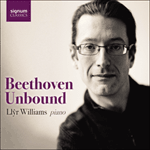 Beethoven: Beethoven Unbound Beethoven: Beethoven UnboundStudio Master: SIGCD52712CDs Download onlyStudio Master FLAC & ALAC downloads available  A comprehensive new cycle of the Beethoven sonatas recorded live at London's Wigmore Hall during the pianist's epic fourth rendition of these masterpieces .» More |
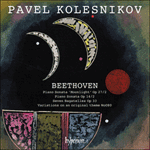 Beethoven: Moonlight Sonata & other piano music Beethoven: Moonlight Sonata & other piano musicStudio Master: CDA68237Studio Master FLAC & ALAC downloads available  The ‘Moonlight’ sonata sounds newly minted in this remarkable reading, Pavel Kolesnikov’s hallmark virtues of ‘intelligence, sensitivity and imagination’ (Gramophone) guaranteeing a very special Beethoven recital indeed.» More |
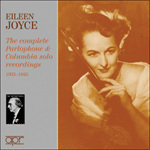 Eileen Joyce - The complete Parlophone & Columbia solo recordings Eileen Joyce - The complete Parlophone & Columbia solo recordingsAPR75025CDs Download only  ‘Listening to Joyce is strangely addictive. One cannot wait, as it were, to read the next chapter. She shares with Kreisler and Tauber the same unteac ... ‘The quality that comes across in these performances is the sheer joy of playing. Joyce possessed a formidable technique and an interpretative mind th ...» More |