When we listen to Phinot’s double-choir motets and Lamentations, it is soon apparent that the composer’s main objective is to create musical structures rather than to respond to a liturgical requirement. By far the largest of these is
Incipit oratio Jeremiae prophetae, a multi-sectional as well as polychoral composition. Phinot departs from the standard practice of Renaissance Lamentation settings in not composing music for the Hebrew letters that begin each verse; rather, the four middle sections comprise a continuous narrative of the first eight verses of the book’s fifth chapter. Phinot contrasts an upper-voice section (‘Pupilli facti sumus’) with a lower (‘Cervicibus minabamur’), creating an alternative division of the eight voices to the usual one between two SATB choirs. His control of the sonorous possibilities of eight-part writing is seen most effectively at the beginning of the final narrative section (‘Patres nostri peccaverunt’), where the full choir returns in force after the two reduced-voice sections.
from notes by Roger Jacob & Stephen Rice © 2009
À écouter ses motets à double chœur et ses Lamentations, on comprend vite que Phinot cherchait avant tout non pas tant à satisfaire des exigences liturgiques qu’à forger des structures musicales. La plus vaste de ces œuvres est, et de loin,
Incipit oratio Jeremiae prophetae, une composition polychorale à plusieurs sections. Phinot se démarque de la pratique habituelle des Lamentations renaissantes en s’abstenant de mettre en musique les lettres hébraïques ouvrant chaque verset; chez lui, les quatre sections médianes comprennent une narration continue des huit premiers versets du cinquième chapitre du livre. Par son opposition section à voix aiguës («Pupilli facti sumus»)/section à voix graves («Cervicibus minabamur»), il offre une alternative à la traditionnelle division des huit voix entre deux chœurs SATB. Il maîtrisait les possibilités sonores de l’écriture à huit parties, et cela transparaît d’une manière particulièrement impressionnante au début de la dernière section narrative («Patres nostri peccaverunt»), quand le grand chœur revient en force après deux sections à voix réduites.
extrait des notes rédigées par Roger Jacob & Stephen Rice © 2009
Français: Hypérion
Wenn wir die doppelchörigen Motetten und Klagelieder Phinots hören, so wird es bald deutlich, dass es dem Komponisten in erster Linie darum ging, musikalische Strukturen zu formen, und nicht so sehr darum, den Ansprüchen der Liturgie gerecht zu werden. Bei weitem das umfangreichste dieser Werke ist das
Incipit oratio Jeremiae prophetae, eine mehrteilige und auch mehrchörige Komposition. Phinot weicht von der Renaissance-Standardpraxis bei Klageliedervertonungen insofern ab, als dass er für die Buchstaben des hebräischen Alphabets zu Beginn der Verse keine Musik komponiert. Stattdessen bilden die vier Mittelteile eine durchgehende Erzählung der ersten acht Verse des fünften Kapitels des Buches. Phinot stellt eine Passage für Oberstimmen („Pupilli facti sumus“) einer Passage für Unterstimmen („Cervicibus minabamur“) gegenüber und unterteilt damit die acht Stimmen anders als sonst, wenn mit zwei SATB-Chören gearbeitet wird. Seine Kontrolle über die klanglichen Möglichkeiten einer achtstimmigen Struktur wird zu Beginn des letzten Teils der Erzählung deutlich („Patres nostri peccaverunt“), wo der gesamte Chor eindrucksvoll nach den beiden Teilen mit reduzierten Stimmen wiederkehrt.
aus dem Begleittext von Roger Jacob & Stephen Rice © 2009
Deutsch: Viola Scheffel


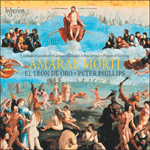 Amarae morti