
Welcome to Hyperion Records, a British classical label devoted to presenting high-quality recordings of music of all styles and from all periods from the twelfth century to the twenty-first.
Hyperion offers both CDs, and downloads in a number of formats. The site is also available in several languages.
Please use the dropdown buttons to set your preferred options, or use the checkbox to accept the defaults.

| London Symphony Orchestra, Sir Colin Davis (conductor)» More |
Repeated emphasis on the introduction’s alien C flat gives a tangy, chromatic flavour to the Vivace assai’s sweeping tuttis. Most striking, though, is the way the popular-style second subject, breezing in like an afterthought, gradually usurps the musical narrative. After dominating the development (which slips almost immediately to C major), it virtually crowds out the main theme from the recapitulation, generating one of those exhilarating expansions that led Tovey, rather misleadingly, to equate Haydn’s recapitulations with Beethoven’s codas.
‘The effect of the wind instruments in the second movement was enchanting’, wrote the Morning Chronicle, a reference to the beautiful contrapuntal elaboration of the opening theme by flute, oboes and bassoon. Set in the luminous, ‘third-related’ key of G major, this is music at once tender and exalted, with a dramatic, even anguished, development and a recapitulation that works the serene second theme to a disturbing climax replete with military-style fanfares. The powerfully symphonic minuet continues the work’s ‘mediant’ tendency by setting its wistful Ländler trio in C major. Clarinets then oversee a subtle lead-back to the E flat of the minuet. The finale, initiated by another irresistibly catchy tune, is a tour de force of kaleidoscopic orchestral colouring (the ‘second subject’ fragments the melody between instruments, like a comical mini-concerto for orchestra) and contrapuntal brilliance. The young Beethoven, who learnt far more from Haydn than he ever admitted, was so impressed with the scintillating fugato at the centre of the movement that he copied it out for study.
from notes by Richard Wigmore © 2009
Une insistance réitérée sur l’ut bémol étranger de l’introduction confère un fort goût chromatique aux larges tuttis du Vivace assai. Toutefois, ce qui nous saisit surtout, c’est la manière dont le second sujet en style populaire, entré en coup de vent comme une pensée après coup, usurpe peu à peu la narration musicale. Après avoir dominé le développement (lequel glisse presque immédiatement vers ut majeur), il expulse pratiquement de la reprise le thème principal, générant l’une des plus grisantes expansions qui amenèrent Tovey, assez fallacieusement, à faire des réexpositions haydniennes un équivalent des codas beethovéniennes.
«L’effet des instruments à vent dans le deuxième mouvement fut enchanteur», nota le Morning Chronicle à propos du splendide développement contrapuntique du premier thème (flûte, hautbois et basson). Écrite dans la lumineuse tonalité «avec rapport de tierce» de sol majeur, cette musique est à la fois tendre et exaltée, avec un développement dramatique, voire angoissé, et une réexposition qui travaille le serein second thème jusqu’à un climax perturbateur, truffé de fanfares en style militaire. Le menuet puissamment symphonique poursuit la propension «médiante» de l’œuvre, avec un mélancolique trio à la Ländler, en ut majeur. Puis les clarinettes surveillent le subtil retour au mi bémol du menuet. Le finale, initié par un autre air irrésistiblement accrocheur, est un tour de force de couleur orchestrale kaléidoscopique (le «second sujet» fragmente la mélodie entre les instruments, comme un mini-concerto comique pour orchestre), teinté d’éclat contrapuntique. Le jeune Beethoven, qui apprit bien plus de Haydn qu’il voulut jamais l’admettre, fut si impressionné par le fugato scintillant au cœur de ce mouvement qu’il le copia pour l’étudier.
extrait des notes rédigées par Richard Wigmore © 2009
Français: Hypérion
Die wiederholte Betonung des tonartfremden Ces der Introduktion gibt den dramatischen Tuttis des Vivace assai ein herbes chromatisches Aroma. Am bemerkenswertesten ist jedoch die Art und Weise, wie das zweite Thema in populärem Stil, das wie ein nachträglicher Einfall hereinbraust, nach und nach die musikalische Handlung übernimmt. Nachdem es die Durchführung dominiert (die fast sofort nach C-Dur rückt), verdrängt es das Hauptthema praktisch ganz aus der Reprise und regt eine jener aufregenden Enfaltungen an, die dazu führten, dass Tovey eher irreführend Haydns Reprisen mit Beethovens Codas verglich.
„Die Wirkung der Bläser im zweiten Satz war bezaubernd“, schrieb der Morning Chronicle, eine Anspielung an die herrliche kontrapunktische Verarbeitung des Anfangsthemas in Flöte, Oboe und Fagott. Diese Musik in der leuchtenden „terzverwanden“ Tonart G-Dur, ist gleichzeitig zart und erhaben, mit einer dramatischen, sogar gequälten Durchführung und einer Reprise, die das heitere zweite Thema zu einem verstörenden Hohepunkt voll militärischer Fanfaren steigert. Das kraftvoll-symphonische Menuett setzt die „Medianten“-Tendenz des Werks fort, indem es sein wehmütiges Ländler-Trio in C-Dur setzt. Die Klarinetten leiten dann eine dezente Rückführug zum Es des Menuetts an. Das Finale, das von einer weiteren unwiderstehlich eingänglichen Melodie eingeleitet wird, ist eine Tour de force kaleidoskopischer Orchesterfarben (das „Zweite Thema“ fragmentiert die Melodie zwischen den Instrumenten wie ein komisches Minikonzert für Orchester) und kontrapunktischer Brillanz. Der junge Beethoven, der viel mehr von Haydn lernte als er je zugab, war von dem schillernden Fugato in der Mitte des Satzes so beeindruckt, dass er es kopierte, um es zu studieren.
aus dem Begleittext von Richard Wigmore © 2009
Deutsch: Renate Wendel
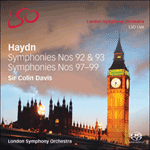 Haydn: Symphonies Nos 92-3 & 97-9 Haydn: Symphonies Nos 92-3 & 97-9Studio Master: LSO07022CDs Download onlyStudio Master FLAC & ALAC downloads available  Sir Colin Davis was long recognized as a pre-eminent Haydn interpreter. During his Indian summer with the orchestra he recorded both 'The Creation' and 'The Seasons' for LSO Live. The symphonies presented here were recorded in 2011 during this sam ...» More |