
Welcome to Hyperion Records, a British classical label devoted to presenting high-quality recordings of music of all styles and from all periods from the twelfth century to the twenty-first.
Hyperion offers both CDs, and downloads in a number of formats. The site is also available in several languages.
Please use the dropdown buttons to set your preferred options, or use the checkbox to accept the defaults.

It is possible, for example, to analyse the first movement as a sonata form with the inverted reprise that is so characteristic of Chopin (compare the Ballades). But equally it is possible to hear it as a double cycle where figurative patterns are followed by cantilenas. Moreover, just as Nocturnes are embedded in the first movement in this way, so another Nocturne is trapped within the Scherzo and yet another haunts the middle section of the funeral march. In neither of these inner movements does the central song feel like a natural outgrowth of the flanking sections. It remains remote from them, strengthening our impression of a series of contrasted, relatively self-contained musical worlds juxtaposed rather than smoothly joined. And in this reading the notorious finale assumes the character of a baroque-like Étude or Prelude (compare Nos 14 and 19 from the Op 28 Preludes). This in no way diminishes the powerful affective quality of the sequence, where the funeral march yields first to the detached, otherworldly song of its ‘trio’, and then to the disintegrative, harmonically elusive, and purposefully insubstantial finale. But it does reinforce (in a positive way) the gist of Schumann’s observation. The components of this work are formally separated, albeit thematically linked.
from notes by Jim Samson © 2009
Ainsi le premier mouvement peut-il être analysé comme une forme sonate dotée de la reprise inversée si typiquement chopinienne (voyez les Ballades). Mais il peut tout autant être perçu comme un double cycle, où des schémas figuratifs sont suivis de cantilènes. De la même manière que les Nocturnes sont enchâssés dans le premier mouvement, un autre Nocturne est piégé dans le scherzo et un autre encore hante la section médiane de la marche funèbre. Jamais, dans ces mouvements internes, le chant central ne semble une excroissance naturelle des sections latérales; il demeure éloigné d’elles, renforçant notre impression d’une série d’univers musicaux contrastés, relativement autonomes, juxtaposés plutôt que uniment liés. Vu sous cet angle, le célèbre finale revêt un caractère d’Étude ou de Prélude façon baroque (voyez les nos 14 et 19 des Préludes op. 28). Ce qui n’amoindrit en rien la puissante qualité affective de la séquence où la marche funèbre cède d’abord devant le chant détaché, éthéré, de son «trio» puis devant le finale désagrégateur, harmoniquement insaisissable et délibérément insubstantiel. Mais cela renforce (positivement) le fond de la remarque de Schumann: les composantes de cette œuvre sont formellement séparées mais thématiquement liées.
extrait des notes rédigées par Jim Samson © 2009
Français: Hypérion
Es ist zum Beispiel möglich, den ersten Satz als Sonatenhauptsatzform mit umgekehrter Reprise, die für Chopin so charakteristisch ist, zu analysieren (vgl. auch die Balladen). Ebenfalls kann man hier jedoch einen Doppelzyklus heraushören, in dem auf Figurationsmuster Kantilenen folgen. Und genauso wie Nocturnes in den ersten Satz eingefügt sind, so ist noch ein Nocturne im Scherzo eingefangen und ein weiteres spukt durch den Mittelteil des Trauermarschs. Weder in dem einen noch im anderen Innensatz entwickelt sich das zentrale Lied auf natürliche Weise aus den es umgebenen Passagen. Es ist gewissermaßen distinkt und so verstärkt sich der Höreindruck, dass es sich hier um eine Reihe von verschiedenartigen, relativ eigenständigen, nebeneinander gestellten musikalischen Welten handelt und nicht eben ineinander übergehende Passagen. Mit dieser Interpretation im Hinterkopf nimmt das berüchtigte Finale den Charakter einer barockähnlichen Etüde oder eines Préludes an (vgl. Nr. 14 und 19 aus den Préludes op. 28). Dies schwächt die stark affektive Eigenschaft der Reihenfolge keineswegs; hier wird der Trauermarsch zunächst von dem losgelösten, jenseitigen Lied des „Trio“ fortgeführt, und dann von dem aufgelösten, harmonisch schwer fassbaren und absichtlich substanzlosen Finale. Hier findet sich, allerdings in positiver Weise, das Wesentliche von Schumanns Beobachtung wieder. Die Bestandteile dieses Werks sind formal getrennt, aber thematisch miteinander verbunden.
aus dem Begleittext von Jim Samson © 2009
Deutsch: Viola Scheffel
 Arthur de Greef - Solo and concerto recordings Arthur de Greef - Solo and concerto recordingsAPR74014CDs Download only  Belgian pianist Arthur de Greef studied with Franz Liszt and also became a close friend of Grieg, who strongly admired his playing. He was a mainstay of the HMV catalogue in the 1920s and this set brings together for the first time his complete re ...» More |
 Chopin: Piano Sonatas Nos 2 & 3 Chopin: Piano Sonatas Nos 2 & 3CDA67706  The great Marc-André Hamelin turns his attention to two mainstays of the Romantic repertoire: Chopin’s Piano Sonatas Nos 2 and 3. The results are simply staggering: playing of matchless brilliance and consummate artistry, stunningly recorded. The ...» More |
 Chopin: Piano Sonatas Nos 2 & 3 Chopin: Piano Sonatas Nos 2 & 3Studio Master: 4870958Download onlyStudio Master FLAC & ALAC downloads available  Described in 1840 by Robert Schumann as comprising ‘four unruly children smuggled under this name into a place they could not otherwise have penetrated’, Chopin’s Piano Sonata No 2 is now a stalwart of the repertoire, and for this new recording by ...» More |
 Chopin: Préludes, Piano Sonata No 2 & Scherzo No 2 Chopin: Préludes, Piano Sonata No 2 & Scherzo No 2Studio Master: CDA68194Studio Master FLAC & ALAC downloads available A selection of Chopin’s greatest and most popular works in luminous performances from Cédric Tiberghien.» More |
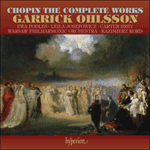 Chopin: The Complete Works Chopin: The Complete WorksCDS44351/6616CDs Boxed set (at a special price) — Download only Since his triumph as winner of the 1970 Chopin International Piano Competition, Garrick Ohlsson has established himself worldwide as a musician of magisterial interpretive and technical prowess. This monumental recording project—first instigated by t ...» More |
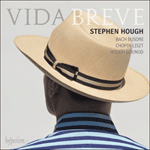 Vida breve Vida breveStudio Master: CDA68260Studio Master FLAC & ALAC downloads available Piano sonatas by Chopin (No 2) and Hough (No 4) are the twin peaks of a typically stimulating recital which—as always from Stephen Hough—spans centuries and styles with assurance. How often do Liszt’s ‘Funérailles’ and Gounod’s ‘Ave Maria’ share t ...» More |
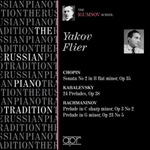 Yakov Flier - Chopin, Kabalevsky & Rachmaninov Yakov Flier - Chopin, Kabalevsky & RachmaninovAPR5665Download only |
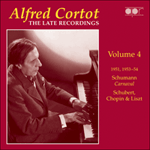 Alfred Cortot – The Late Recordings, Vol. 4 - Schumann, Schubert, Chopin & Liszt Alfred Cortot – The Late Recordings, Vol. 4 - Schumann, Schubert, Chopin & LisztAPR5574Download only 'Bryan Crimp has done Cortot proud, prompting one to wonder whether there was ever a pianist of greater human richness and coruscating vitality' (Gram ...» More |
 Irene Scharrer - The complete electric and selected acoustic recordings Irene Scharrer - The complete electric and selected acoustic recordingsAPR60102CDs for the price of 1 — Download only ‘If [Irene Scharrer]'s remembered from her recordings it’s really only the one, and that was ironically the last she made, Litolff’s Scherzo from the ...» More |
 The earliest French piano recordings The earliest French piano recordingsAPR73183CDs Download only This set brings together some of the earliest and rarest piano recordings ever made, not just in France, but worldwide, and includes the complete solo recordings of all the pianists featured except Wurmser. The French office of the Gramophone Comp ...» More |
 The Piano G & Ts, Vol. 2 - Alfred Grünfeld, Raoul Pugno & Natalia Janotha The Piano G & Ts, Vol. 2 - Alfred Grünfeld, Raoul Pugno & Natalia JanothaAPR5532Download only |
 Vladimir Horowitz - The complete solo European recordings Vladimir Horowitz - The complete solo European recordingsAPR60042CDs for the price of 1 — Download only |