Unusually short in terms of notated length,
Miserere mei, Deus is note for note the very dissonant. That this should be so is not altogether surprising when one considers the opportunities for expressive dissonance offered—to composers of the Renaissance and many other periods—by penitential texts. Peculiar to Monte’s setting is the speed with which he creates the mood—the beginning of the second bar has a harsh suspension between the two highest voices, but even before that the syncopation and descending scale of the top voice indicate penitence—but also his ability to change the mood gradually yet unmistakeably. A case in point is the phrase ‘et in umbra alarum tuarum sperabo’ (‘and under the shadow of your wings I shall hope’), where the prevailing sonorities of D minor, A minor and G minor from the first section eventually yield to F major, prepared by a long pedal on C. (This is not to say that Monte or his contemporaries thought in terms of modulation as did later composers; the effect of opening out into a new territory is clearly present, however, underlined by other devices such as increasing rhythmic vitality.)
from notes by Stephen Rice © 2008
Pour ce qui est de la longueur notée,
Miserere mei, Deus est note pour note très dissonante. Ce qui n’a absolument rien de surprenant quand on songe aux opportunités de dissonance expressive que les textes pénitentiels offrent aux compositeurs de la Renaissance (comme de bien d’autres époques). De Monte, lui, se singularise et par la vitesse à laquelle il crée une atmosphère—le début de la deuxième mesure a une dure suspension entre les deux voix les plus aiguës, mais avant même que la syncope et la gamme descendante de la voix supérieure indiquent la pénitence—et par son aptitude à la changer de manière progressive mais bien perceptible. Ce qu’illustre remarquablement la phrase «et in umbra alarum tuarum sperabo» («et à l’ombre de tes ailes, j’espérerai»), où les sonorités dominantes de ré mineur, la mineur et sol mineur de la première section s’inclinent finalement devant fa majeur, préparé par une longue pédale sur ut. (Ce qui ne veut pas dire que de Monte et ses contemporains pensaient en termes de modulation comme leurs successeurs; l’effet consistant à déboucher sur un nouveau territoire n’en est pas moins clairement présent, comme le souligne, entre autres, une vitalité rythmique croissante.)
extrait des notes rédigées par Stephen Rice © 2008
Français: Hypérion
In Bezug auf seine Länge in Noten ist
Miserere mei, Deus, ein kürze Werk, Ton für Ton am dissonantesten. Das überrascht nicht allzu sehr, wenn man die Gelegenheiten für expressive Dissonanz bedenkt, die Bußtexte bieten—nicht nur den Komponisten der Renaissance sondern auch anderer Perioden. Für Montes Vertonung bezeichnend ist, wie schnell er die Stimmung erzeugt—der Anfang des zweiten Taktes enthält einen krassen Vorhalt zwischen den beiden höchsten Stimmen, aber schon vorher deuten die Synkopierung und absteigende Phrase der Oberstimme Bußstimmung an—aber auch seine Fähigkeit, die Stimmung langsam aber unverkennbar zu ändern. Ein Beispiel dafür ist die Phrase „et in umbra alarum tuarum sperabo“ („und unter dem Schatten deiner Flügel will ich hoffen“), wo die im ersten Teil vorherrschenden Klänge von d-Moll, a-Moll und g-Moll, von einem langen Orgelton auf C vorbereitet, allmählich F-Dur weichen. (Das heißt nicht, dass Monte oder seine Zeitgenossen wie spätere Komponisten in Modulationen dachten; der Effekt, in ein neues Territorium zu gelangen, ist jedoch deutlich und wird durch andere Mittel wie die Steigerung rhythmischer Vitalität unterstrichen.)
aus dem Begleittext von Stephen Rice © 2008
Deutsch: Renate Wendel


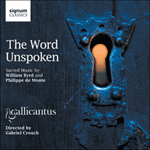 Byrd & Monte: The Word Unspoken