
Welcome to Hyperion Records, a British classical label devoted to presenting high-quality recordings of music of all styles and from all periods from the twelfth century to the twenty-first.
Hyperion offers both CDs, and downloads in a number of formats. The site is also available in several languages.
Please use the dropdown buttons to set your preferred options, or use the checkbox to accept the defaults.
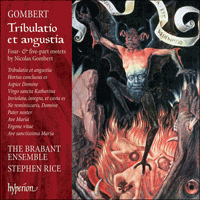


This is The Brabant Ensemble’s third disc for Hyperion. Under their director, eminent musicologist Dr Stephen Rice, they continue to excavate jewels of the sixteenth-century choral repertoire which have until now remained under-performed and under-represented in music history. Their natural and instinctive performing style, which foregrounds the essential vocal qualities of this music, unlike the instrumental tone of other early music choirs, brings these beautiful and complex works abundantly to life.
Gombert’s motets are the heart of his writing and this selection of them allows the range of his musical accomplishments to fully emerge. Often seen as written in penance for heinous crimes committed by the composer, many of them are settings of various texts of penitence, sorrow and yearning for deliverance from punishment. Images such as the ‘hellish lake’ in Tribulatio et angustia are dramatically explored. Also on this disc are motets for the adulation of the Blessed Virgin Mary, which surprisingly demonstrate an especially intensified and dissonant musical style, showing the almost erotic level of devotion suggested in some of the greatest art of this period.

Several themes are notable when considering Gombert’s motets as a group. Most obvious is that of penitential writing, for which this composer is particularly known. Several commentators have linked the high incidence of penitential motets to the best-known episode in Gombert’s life, namely his dismissal from Imperial service and exile to the high seas ‘stupro pueri principalis’ (literally, for the violation of a boy in the Emperor’s service—that the boy in question was a chorister is not documented, though the inference of modern writers that this was so is highly plausible). Indeed, it has been argued that the entirety of Gombert’s first book of four-part motets (published in Venice by the Scotto firm in 1539) took the form of an extended penance for his crime, since the volume contains not only a preponderance of sorrowful pieces but also references to deliverance from watery punishment. The motet Aspice Domine on the present recording is taken from this book: additionally, the five-part Tribulatio et angustia and Ne reminiscaris, Domine both explore similar themes. In Tribulatio et angustia, the writer asks God for deliverance ‘de lacu inferni et de luto faecis’. This phrase, which refers to Psalm 39, verse 3 (in the Vulgate numbering), is rather primly translated by Miles Coverdale in the Book of Common Prayer as ‘out of the horrible pit, out of the mire and clay’. How this image was viewed in early modern times is illustrated by the cover of this CD: the horror of souls in torment is heightened by the grotesqueness of their demonic torturer, whose extra face in its belly, like nothing created on earth, emphasizes the absence of God in the infernal kingdom.
It is clear that Gombert had good reason to be penitent: equally, the same commentator in whose writings we learn of the composer’s disgrace praised him for enduring his deserved punishment. Indeed, ‘with chained foot’ Gombert wrote music that eventually secured his release from captivity: it is not clear what is meant by these ‘swansongs’, though the impressive presentation manuscript in which Gombert’s modally ordered set of Magnificats is preserved at Madrid is a likely answer. Also unclear is the extent to which the crime has affected modern-day reception of Gombert’s music. As members of what has been described as the ‘post-Josquin generation’, or even of a ‘no-name generation’, Gombert and his contemporaries have until recently been significantly under-represented, both in the writing of music history, and on the concert platform and in the recording studio. In part this critical ambivalence arises from an understanding of Josquin Desprez as representing the generality of compositional style around 1500, whereas Josquin’s output—insofar as we can know which of the myriad pieces attributed to him are authentic—stands somewhat apart from that of his direct contemporaries in stylistic terms. (The paradox that Josquin’s music can simultaneously be unique and indistinguishable from that of imitators is explained partly by the belief that eclecticism is a feature of his style—making stylistic arguments as to attribution almost impossible to justify—and partly by our lack of detailed knowledge of the music of lesser names.) Composers such as La Rue, Jean Mouton (c1459–1522) and Jacob Obrecht (1457/8– 1505) produced music that, while it has many of the melodic and architectural features of Josquin’s, does not share the crystalline quality that the latter sometimes achieves through his extreme economy of means. Consequently, the following generation of Netherlanders, including Gombert, Willaert, and Jacquet of Mantua (1483–1559), whose achievement was to intensify the style prevailing in their youth with tighter imitation and more voices, are judged and found wanting by reference to an aesthetic goal at which they never aimed. The tide is beginning to turn a little—a process to which The Brabant Ensemble is pleased to contribute by recording more music of this generation—but it is undeniable that certain aspects of the repertory are still viewed as problematic, and as far as individual members of the generation go, none can be so problematic as the convicted child molester, Gombert. Despite this blemished history, it is to be hoped that Gombert’s music can stand, after 450 years, for the achievements of his time rather than his grievous transgressions.
Tribulatio et angustia is unusual within Gombert’s œuvre in being modelled on an earlier piece of the same name, perhaps by Philippe Verdelot (c1480–c1531), though more likely anonymous. Although relationships arise on occasion between Gombert’s music and that of other composers, it seems that for the most part the texts that he set, and his manner of doing so, were derived from a contemporary spirituality rather than having their roots in older traditions. The earlier piece is written in the loose contrapuntal style of the second decade of the century, which Gombert intensifies significantly, both by adding a fifth voice and working the melodic material in a much more thoroughgoing way. An instance of this process is found at the phrase ‘meditatio mea est’ (‘[for] my thoughts are [of your commandments]’), where the not especially sensitive word-setting by the earlier composer (emphasizing the unstressed fourth syllable of ‘meditatio’) is retained but rendered unimportant by the introduction of extra entries, so that at least one voice begins the phrase in each bar, obscuring the word-stress. The climax of the piece is found in the second part (not based on the earlier motet), where the terror of the ‘hellish lake’ is made audible by voices at the top of their range, descending a scale as if being dragged downwards into the inferno.
By contrast, the prayer for forgiveness Ne reminiscaris, Domine seems extremely restrained. Even this quiet plea for mercy is expressed in an intense way by Gombert, however. The phrase ‘Parce, Domine’ (‘Spare, Lord’), at the centre of the prayer, begins with an extremely static entry sung by sopranos and altos over a pedal note, and as the other voices enter with this melody the composer introduces large numbers of dissonant passing notes, on the beat, creating friction between the static and moving parts. The ending of the motet is resigned, as if to say that God may or may not forgive the sins in question, but that human action can no longer affect the situation.
Aspice Domine is unlike the two other penitential pieces in presenting a public rather than a private religion. It is thought to be related to one of the most infamous acts of the century, the Sack of Rome in 1527, where the troops of Gombert’s employer, the Emperor Charles V, took the city and pillaged it. In the motet the writer notes how ‘the city is made desolate’; the first half of the piece is highly dissonant, reflecting the devastation. In the second part, God is asked to surround the city with a protecting wall and defend it with the weapons of his power, and here Gombert provides much more consonant harmony, as if to indicate that the world will be put right with God’s help. If the theory concerning the motet’s political significance is correct, it was with the help of the Emperor, not God, that Rome was in future to be protected, provided of course that the Pope (the Medici Clement VII) paid considerably more attention to Charles V’s concerns in future.
Alongside the penitential element of Gombert’s writing stands an equally strong thematic link: devotion to the Blessed Virgin Mary. Four of the motets recorded here are of this type: Hortus conclusus es; Inviolata, integra, et casta es, Maria; Ave Maria; and Ave sanctissima Maria. The extent of Gombert’s involvement in setting such texts is indicated by the fact that numerous Marian antiphons, including Ave sanctissima Maria and also Ave regina caelorum, Salve regina, and Regina caeli, each receive multiple settings. This emphasis on Marian devotion is not at all surprising in the context of early sixteenth-century spiritual preoccupations: since the high Middle Ages the cult of the Virgin had been increasingly important, and musical settings in her honour had proliferated in the fifteenth century, and continued to do so until the more austere spirituality of the Reformers began to exert its influence even on the Catholic world. (At this point, Marian motets were sometimes retexted as Christological pieces, such as Gombert’s Sancta Maria, succurre miseris, which appears in some sources as O Jesu Christe, succurre miseris.)
In terms of Gombert’s music, a slightly surprising difference between the penitential motets and the Marian ones is that the latter are on occasion significantly more dissonant, and in particular contain more suspension-type dissonance (this is aurally the most obvious kind of dissonance, as compared with passing notes, for instance). It would appear that setting texts of this nature brought an especially intensified musical style from Gombert. This is most true of Hortus conclusus es, where Marian devotion is combined with the eroticism of the Song of Songs. The majority of the motet’s text is taken directly from the Song of Songs (4: 12), but the focus is brought directly onto the Blessed Virgin by altering the first phrase (‘Hortus conclusus es, soror mea, sponsa, fons signatus’) to read ‘You are an enclosed garden, mother of God, a sealed well’. The image of virginity is obvious; less clear is the identity of the speaker when the remainder of the text reads ‘arise, make haste, my beloved, and come’ (Song of Songs 2: 10). However the text is to be read, the musical setting is extraordinary: for the phrase ‘fons signatus’ (‘a sealed well’), Gombert creates a sequential chain lasting fully ten bars, climaxing with the entry of four voices in rapid succession at the top of their range, on ‘surge, propera’ (‘arise, make haste’); the sequence is then reversed on ‘amica mea’ (‘my beloved’). In addition to the heavy incidence of dissonance, with many double and even triple suspensions, this unique piece of writing brings a particular intensity to this short motet.
The four-voice setting of Virgo sancta Katherina is scored for three treble voices and one alto; although one or two other motets by Gombert are similarly written for boys’ voices, the others are graces for use at table, one ending memorably ‘prosit vobis, Domini!’ (‘good health to you, masters!’). In the restricted vocal compass of the present piece, Gombert makes use of pairs of voices, and a technique of which he was particularly fond is in evidence: the strategic repetition of a single pitch. All four voices enter on a high d", and this pitch is the top of the piece’s range for twenty-three bars, until the phrase ‘urbe Alexandrina’ takes the upper two voices as high as f". Homophony then proclaims St Catherine’s royal birth (‘she was the daughter of King Costas’), before an extended triple-time section, a rare occurrence in music of this period, in which prayers begin to be addressed to the saint. These supplications form the basis of a second homophonic section (‘famularum suscipe vota’), as if to make sure that the request can be clearly heard. Most unusually, the final ‘vota’ ends on a D major chord, with the ‘Amen’ providing, as it were, the resolution of a perfect cadence on the tonic. Were it not for the fact that Virgo sancta Katherina was published as early as 1534, one would imagine it to have been written much later, possibly well after Gombert’s lifetime.
Another piece that makes extensive use of pitch repetition is Ave sanctissima Maria. Here the prayer to the Virgin begins by listing various of her attributes: ‘mater Dei, regina caeli, porta paradisi, domina mundi, pura singularis’ (‘mother of God, queen of heaven, gate of paradise, ruler of the world, uniquely pure’). Gombert unites these statements by creating different but related motifs, each emphasizing the same pitch, and thus creating the effect of a single thought, expressed in different ways. The final section of the piece ends the disc with the invocation ‘et ora pro peccatis meis’ (‘and pray for [forgiveness of] my sins’), which is repeated twenty-seven times (a significant number, since it is the perfect 3 of the Trinity, raised to the power of itself); after the final cadence between soprano and tenor, Gombert writes an extended coda, in which the other three voices each repeat the phrase yet again, as if the prayer to the Virgin were continuing even as the piece ends. The devotional significance of this prayer is underlined by the indulgence of 11,000 years granted by Pope Sixtus IV, the builder of the Sistine Chapel and possibly the writer of the text, to anyone who said it devoutly.
Gombert’s setting of Inviolata, integra, et casta es, Maria is one among over twenty from the sixteenth century. At the head of this complex is the famous setting by Josquin Desprez, also in five parts: Gombert’s piece alludes obliquely to Josquin’s in its opening and (more obviously) at the phrase ‘O benigna, o Maria, o regina’ (‘Merciful Mary, queen’). Other settings make even closer reference to Josquin, including two—one of which is also attributed to Gombert but is unlikely to be his—that take the two canonic voices from Josquin’s motet and write entirely new settings around them. The shared basis for most Inviolata motets is a plainchant sequence melody, though the version found in modern chant books is evidently not the same as that known to Gombert and Josquin, since their motets begin with three repeated notes, whereas the modern version begins f-g-f-g-a. The monophonic setting of Inviolata presented on this recording is therefore newly written, based on the melodic material of Gombert’s motet (insofar as his thorough variation technique permits this to be isolated), conflated with a modern version of the chant taken from a Dominican antiphoner, which preserves aspects of the older melody.
The motets Pater noster and Ave Maria, which seem to have been intended as a pair, appearing together in almost all of their sources, are both based on well-known plainchants. The tone for the Lord’s Prayer would have been sung at most celebrations of Mass, and Gombert’s setting is suffused with the chant phrases, worked as usual in his flexible style of imitative counterpoint. It was performed in the nineteenth century by the pioneering musicologist François-Joseph Fétis (1784–1871), who stated that it was the equal of anything by Palestrina (high praise indeed at a time when the latter’s contrapuntal techniques were regarded as the ideal), and produced a deep impression on his audience. The Ave Maria similarly reworks its chant material, notably adapting the famous melody as it does so, with the second entry of the alto producing a chromatically altered version.
Ergone vitae is unlike any of the other pieces on this recording in being entirely secular in nature. It is a setting of a neo-Latin poem by the brilliant but short-lived Johannes Secundus (Jan Everaerts, 1511–36), on convalescing from an illness and rejecting the life of an invalid. Everaerts’s family were staunch supporters of Charles V—the poet’s father was made President of the States of Holland and Zealand, and finally President of the Council at Mechlin, one of the most important posts in the Netherlands—and it would seem that Johannes encountered Gombert at, or at least via, the court. Although still composed in imitative counterpoint, the motet displays a difference in style from the sacred pieces, with a more fluid attitude to the text, which is generally set in a less melismatic way, enhancing its audibility. The setting of the phrase ‘Sparge puer, resonante nervo’ (‘hurl, boy, with twanging bow-string’) is, if not madrigalian in its response to text, certainly more direct than Gombert was apt to be in an ecclesiastical setting. Just as in his French chansons an imitative style was harnessed to a lighter subject matter, here the secular subject occasions a less weighty setting than Gombert’s norm.
Stephen Rice © 2007
Plusieurs thèmes se dégagent quand on envisage les motets comme un tout. Le plus flagrant est celui de l’écriture pénitentielle, qui fait la célébrité de Gombert. Plusieurs commentateurs ont relié cette forte proportion de motets pénitentiels à l’épisode le plus fameux de la vie du compositeur: sa révocation du service impérial et son exil en haute mer «stupro pueri principalis» (littéralement, pour avoir violé un garçon au service de l’empereur. Ce garçon était-il choriste? Aucun document ne l’atteste, mais c’est ce qu’en déduisirent, sûrement à raison, les auteurs modernes). D’aucuns ont en effet avancé que tout le premier livre de motets à quatre parties (publié à Venise par la maison Scotto en 1539) avait été une vaste pénitence pour un Gombert désireux d’expier son crime. Et de fait, le volume renferme une majorité de pièces dolentes, mais aussi des références à la délivrance du châtiment par l’eau. Le motet Aspice Domine présenté ici provient de ce livre; ajoutons que les motets à cinq parties Tribulatio et angustia et Ne reminiscaris, Domine explorent des thèmes similaires. Dans Tribulatio et angustia, l’auteur demande à Dieu d’être délivré «de lacu inferni et de luto faecis»—une phrase qui renvoie au psaume 39, verset 3 (numérotation de la Vulgate) et que Miles Coverdale traduit, de manière assez compassée, dans le Book of Common Prayer par «out of the horrible pit, out of the mire and clay» («de la fosse horrible, de la boue et de la glaise»). La perception de cette image dans les premiers temps modernes est illustrée par la couverture de ce disque: l’horreur des âmes suppliciées est avivée par le grotesque de leur tortionnaire démoniaque, dont le visage ventral supplémentaire ne ressemble à rien de ce qui fut créé sur terre et exacerbe l’absence de Dieu au royaume de l’enfer.
À l’évidence, Gombert avait une bonne raison de se montrer pénitent et le commentateur dont les écrits nous apprennent la disgrâce du compositeur loua ce dernier pour avoir enduré son juste châtiment. Car, «les chaînes aux pieds», Gombert écrivit une musique qui, finalement, lui fit recouvrer la liberté: on ignore ce que ces «chants du cygne» signifièrent au juste, bien que l’on puisse voir une réponse probable dans l’impressionnant manuscrit de présentation conservé à Madrid et qui nous permet de découvrir l’agencement modal que Gombert appliqua à son corpus de magnificat. On ignore également dans quelle mesure le compositeur a, par son crime, affecté l’accueil moderne de sa musique. Membres de cette génération dite «post-josquinienne», voire «sans nom», Gombert et ses contemporains ont été, jusqu’à récemment, fort sous-représentés dans les écrits musicologiques, en concert et au disque. Cette ambivalence critique vient en partie de ce que Josquin Desprez a été tenu pour l’incarnation du style compositionnel des années 1500, alors que sa production—pour autant qu’on puisse savoir quelles pièces sont authentiques parmi toutes celle qui lui sont attribuées—est un peu à part comparé au style de ses contemporains immédiats. (Le paradoxe selon lequel sa musique serait à la fois unique et impossible à différencier de celle de ses émules s’explique tant par l’éclectisme supposé de son style—d’où la quasi-impossibilité de justifier les arguments stylistiques plaidant en faveur d’une attribution—que par notre manque de connaissance détaillée de la musique des petits maîtres.) Des compositeurs comme La Rue, Jean Mouton (env. 1459–1522) et Jacob Obrecht (1457/8–1505) produisirent une musique qui, pour présenter nombre des caractéristiques mélodico-architecturales de Josquin, n’arbore pas la qualité cristalline que ce dernier atteint parfois au prix d’une extrême économie de moyens. Les Néerlandais de la génération suivante—notamment Gombert, Willaert et Jacquet de Mantoue (1483–1559)—, qui intensifièrent le style en vogue dans leur jeunesse en recourant à des imitations resserrées et à plus de voix, sont donc jaugés et jugés insuffisants à l’aune d’une finalité esthétique à laquelle ils n’ont jamais aspiré. Les choses commencent à changer un peu—un processus auquel The Brabant Ensemble est ravi de contribuer en enregistrant davantage de musiques de cette génération—, même si, indéniablement, certains aspects de ce répertoire continuent d’être perçus comme problématiques; quant aux individus mêmes, aucun ne saurait être plus problématique que Gombert, reconnu coupable de pédophilie. Espérons que, quatre cent cinquante ans plus tard, et malgré ce passé entaché, Gombert verra sa musique incarner son époque plutôt que ses graves fautes personnelles.
Tribulatio et angustia détonne dans l’œuvre de Gombert en ce qu’il est modelé sur un Tribulatio et angustia antérieur, peut-être de Philippe Verdelot (env. 1480–env. 1531), mais plus sûrement anonyme. Bien que sa musique soit parfois liée à celle d’autres compositeurs, Gombert semble avoir choisi et mis en musique la plupart de ses textes selon une spiritualité contemporaine, sans ancrage dans des traditions plus anciennes. La pièce modèle adopte le style contrapuntique lâche des années 1520, que Gombert intensifie beaucoup par l’ajout d’une cinquième voix et par un travail plus soigné du matériau mélodique. Ce procédé transparaît à la phrase «meditatio mea est» («[car] mes pensées sont [tournées vers tes commandements]»), où la mise en musique, sans grande sensibilité, du premier compositeur (qui appuie sur la quatrième syllabe atone de «meditatio») est conservée mais rendue insignifiante par l’introduction d’entrées supplémentaires, si bien qu’une voix, au moins, commence la phrase à chaque mesure, opacifiant l’accentuation du mot. L’apogée de l’œuvre survient dans la seconde partie (qui ne repose pas sur le premier motet), laquelle matérialise la terreur du «lac infernal» par les voix au sommet de leur ambitus, descendant une gamme comme si elles étaient entraînées en enfer.
Par contraste, la prière de pardon Ne reminiscaris, Domine paraît extrêmement sobre. Mais, même cette paisible supplique de miséricorde, Gombert l’exprime avec intensité. La phrase «Parce, Domine» («Épargne, Seigneur»), au cœur de la prière, s’ouvre sur une entrée des plus statiques entonnée par les sopranos et par les altos sur une note de pédale; et, à mesure que les autres voix entrent avec cette mélodie, le compositeur introduit un grand nombre de notes de passage dissonantes, sur les temps de la mesure, provoquant une friction entre les parties statiques et mouvantes. La fin du motet est résignée, comme pour dire que Dieu peut ou non pardonner les péchés et que l’action de l’homme ne peut plus changer la situation.
Aspice Domine se démarque des deux autres pièces pénitentielles en présentant une religion plutôt publique que privée. Ce motet se rapporterait à l’un des actes les plus infâmes du siècle, le sac de Rome (1527), au cour duquel les troupes de l’employeur de Gombert, l’empereur Charles Quint, prirent la ville et la pillèrent. Le texte dit combien «la cité est faite désolation», une dévastation que reflète la forte dissonance de la première moitié de l’œuvre. Dans la seconde moitié, on demande à Dieu d’entourer la ville d’un rempart protecteur et de la défendre avec les armes de sa puissance—ici, Gombert opte pour une harmonie bien plus consonante, comme pour montrer que le monde sera remis d’aplomb avec l’aide de Dieu. Si la théorie concernant la résonance politique du motet est valable, ce fut avec l’aide de l’empereur, en non de Dieu, que Rome fut protégée, sachant, bien sûr, que le pape Clément VII (Jules de Médicis) fit dès lors bien plus attention aux affaires de Charles Quint.
Chez Gombert, l’élément pénitentiel de l’écriture s’accompagne d’un lien thématique tout aussi puissant: la dévotion à la Sainte Vierge. Quatre des motets enregistrés ici ressortissent à ce type: Hortus conclusus es; Inviolata, integra, et casta es, Maria; Ave Maria; et Ave sanctissima Maria. Gombert mit plusieurs fois en musique les mêmes antiennes mariales (dont Ave sanctissima Maria, Ave regina caelorum, Salve regina et Regina caeli), signe que ces textes le touchaient de près. Cette importance de la dévotion mariale n’a absolument rien de surprenant quand on connaît les préoccupations spirituelles du début du XVIe siècle: depuis le haut Moyen Âge, le culte d’hyperdulie n’avait cessé de croître, mais la prolifération de compositions mariales qu’avait connue le XVe siècle s’estompa lorsque la spiritualité, plus austère, des réformateurs influença jusqu’au monde catholique. (Les motets marials furent alors parfois requalifiés en pièces christologiques, avec un texte nouveau: Sancta Maria, succurre miseris de Gombert figure ainsi dans certaines sources sous le titre O Jesu Christe, succurre miseris.)
Chez Gombert, les motets marials se distinguent de manière un peu surprenante des motets pénitentiels: ils sont quelquefois beaucoup plus dissonants; plus précisément, ils renferment davantage de dissonances de type suspension (la dissonance la plus évidente sur le plan sonore, comparé aux notes de passage, par exemple). Il semblerait que ces textes-là aient inspiré à Gombert un style musical très intensifié, comme l’atteste surtout Hortus conclusus es, qui mêle dévotion mariale et érotisme du Cantique des cantiques. L’essentiel du texte provient d’ailleurs de cette dernière source (4: 12), même si la Sainte Vierge est d’emblée placée au centre par une modification de la phrase initiale («Hortus conclusus es, soror mea, sponsa, fons signatus»), changée en «Tu es un jardin clos, mère de Dieu, une fontaine scellée». Si l’image de la virginité est obvie, l’identité du narrateur, elle, est moins évidente dans le reste du texte, à «lève-toi, hâte-toi, ma bien-aimée, viens» (Cantique des cantiques, 2: 10). Mais quelle que soit la lecture qu’on fasse de ces paroles, la mise en musique est extraordinaire: pour les mots «fons signatus» («fontaine scellée»), Gombert crée une chaîne séquentielle de dix pleines mesures, qui culmine à «surge, propera» («lève-toi, hâte-toi»), où quatre voix au sommet de leur ambitus entrent en une succession rapide; puis la séquence est invertie à «amica mea» («ma bien-aimée»). Cette écriture unique, fort dissonante (doubles et triples suspensions en nombre), confère à ce court motet une intensité particulière.
Virgo sancta Katherina s’adresse à quatre voix: trois dessus et un alto; hormis un ou deux autres motets également pour voix de garçon, Gombert a écrit des grâces, qui, dans un cas, s’achèvent sur un mémorable «prosit vobis, Domini!» («santé à vous, maîtres!»). Dans l’ambitus restreint de Virgo sancta Katherina, il recourt à des paires de voix et à une technique dont il sera particulièrement friand: la répétition stratégique d’une seule hauteur de son. Les quatre voix entrent sur un ré4 aigu, une hauteur qui marque le summum de l’ambitus de la pièce pendant vingt-trois mesures, jusqu’à ce que la phrase «urbe Alexandrina» entraîne les deux voix supérieures vers un fa4. Puis l’homophonie proclame l’extraction royale de sainte Catherine («elle était la fille du roi Costas») avant une section ternaire prolongée—alors une rareté—, dans laquelle les premières prières sont adressées à la sainte. Ces suppliques forment la base d’une seconde section homophonique («famularum suscipe vota»), comme pour s’assurer une bonne audibilité de la requête. Par extraordinaire, le «vota» final s’achève sur un accord de ré majeur, l’«Amen» offrant, pour ainsi dire, la résolution d’une cadence parfaite sur la tonique. Virgo sancta Katherina fut publiée en 1534 mais semble bien plus tardif, voire postérieur à l’époque de Gombert.
Ave sanctissima Maria recourt, lui aussi, abondamment à la répétition de hauteur de son. Ici, la prière mariale s’ouvre sur une énumération des épithètes de la Vierge: «mater Dei, regina caeli, porta paradisi, domina mundi, pura singularis» («mère de Dieu, reine du ciel, porte du paradis, maîtresse du monde, singulièrement pure»). Pour unir toutes ces énonciations, Gombert crée des motifs différents mais apparentés, qui appuient chacun sur la même hauteur de son, d’où un effet de pensée unique, exprimée de diverses manières. La section finale de cette pièce clôt le disque sur l’imprécation «et ora pro peccatis meis» («et prie pour [le pardon de] mes péchés»), répétée vingt-sept fois (un chiffre d’importance puisqu’il est le trois parfait de la Trinité, élevé à sa propre puissance); passé la cadence finale entre soprano et ténor, Gombert écrit une coda prolongée, où chacune des trois autres voix répète de nouveau l’imprécation, comme si la prière à la Vierge perdurait une fois la pièce achevée. L’importance dévotionnelle de cette oraison est confirmée par l’indulgence de onze mille ans que le pape Sixte IV, bâtisseur de la chapelle Sixtine et possible auteur du texte, accorda à quiconque la dirait avec piété.
Le XVIe siècle compta une bonne vingtaine d’Inviolata, integra, et casta es, Maria, un édifice musical auquel contribuèrent Gombert et, surtout, Josquin Desprez. Gombert fait indirectement allusion au fameux motet josquinien (lui aussi à cinq parties) dans l’ouverture et, de manière plus flagrante, à la phrase «O benigna, o Maria, o regina» («Ô miséricordieuse, ô Marie, ô reine»). D’autres mises en musique renvoient plus directement encore à Josquin, dont deux qui font graviter autour des deux voix canoniques josquiniennes des compositions totalement nouvelles—une de ces œuvres est d’ailleurs attribuée, mais probablement à tort, à Gombert. La plupart des motets Inviolata ont pour base commune une mélodie de séquence en plain-chant, même si la version des cantionnaires modernes n’est, à l’évidence, pas celle que connaissaient Gombert et Josquin: leurs motets s’ouvrent sur trois notes répétées, là où la version moderne commence par fa2–sol2–fa2–sol2–la2. L’Inviolata monophonique du présent enregistrement propose donc une écriture inédite, fondée sur le matériau mélodique du motet de Gombert (pour autant que sa complexe technique de variation permette de l’isoler), amalgamé à une version moderne du plain-chant empruntée à un antiphonaire dominicain préservant les aspects de la mélodie la plus ancienne.
Les motets Pater noster et Ave Maria, qui semblent avoir été conçus comme un diptyque (ils figurent ensemble dans presque toutes les sources), reposent tous deux sur des plains-chants célèbres. Le ton destiné au Notre-Père était chanté à la célébration de la plupart des messes et Gombert inonde sa pièce de phrases en plain-chant, qu’il travaille, comme toujours, dans son style flexible de contrepoint imitatif. Pater noster fut exécuté au XIXe siècle par François-Joseph Fétis (1784–1871), musicologue novateur qui en fit l’égal d’une œuvre de Palestrina (alors fort prisé, ses techniques contrapuntiques étant perçues comme un idéal) et impressionna beaucoup son auditoire. L’Ave Maria retravaille, lui aussi, son matériau de plain-chant, adaptant notamment la fameuse mélodie, avec la seconde entrée de l’alto qui produit une version chromatiquement altérée.
Exclusivement profane, Ergone vitae se distingue de tous les autres motets de cet enregistrement en mettant en musique le poème néo-latin qu’un brillant auteur trop tôt disparu, Johannes Secundus (Jan Everaerts, 1511–1536), consacra à la convalescence et au rejet de la vie d’invalide. Les Everaerts étaient des féaux de Charles Quint—le père du poète fut nommé président des états de Hollande et de Zélande, avant de finir président du conseil de Malines, l’un des principaux postes de Pays-Bas—et Johannes aurait rencontré Gombert sinon à la cour, du moins par son biais. Quoique composé en contrepoint imitatif, ce motet se démarque des pièces sacrées par une fluidité accrue envers le texte, généralement mis en musique de manière moins mélismatique, ce qui le rend plus audible. Si elle n’apporte pas une réponse madrigalesque au texte, la mise en musique de la phrase «Sparge puer, resonante nervo» («projette, enfant, avec une corde de boyau résonante») est sans nul doute plus directe que ce que Gombert pouvait se permettre dans une composition ecclésiastique. Comme dans ses chansons françaises, où il appose un style imitatif à un sujet léger, Gombert applique ici au thème profane un traitement moins pesant qu’à l’accoutumée.
Stephen Rice © 2007
Français: Hyperion Records Ltd
Wenn man Gomberts Motetten als eine Einheit betrachtet, treten mehrere Themen zum Vorschein. Besonders deutlich ist das Thema der Buße, wofür der Komponist besonders gut bekannt ist. Mehrere Kommentatoren haben die hohe Anzahl der Bußmotetten mit der am besten bekannten Episode seines Lebens verknüpft—seiner Entlassung aus dem kaiserlichen Dienst und Vebannung ins Exil auf den Galeeren „stupro pueri principalis“ (buchstäblich „wegen der Schändung eines Knaben im Dienste des Kaisers“; ob es ein Chorknabe war, ist nicht dokumentiert, obwohl moderne Autoren folgern, dass dies plausibel ist). Es wurde sogar argumentiert, dass das ganze erste Buch vierstimmiger Motetten (1539 bei Scotto in Venedig veröffentlicht) die Gestalt einer ausgedehnten Buße für sein Vergehen annahm, da der Band nicht nur ein Übergewicht an betrübten Stücken enthält, sondern auch Verweise auf die Rettung von mit Wasser verbundenen Strafen. Die Motette Aspice Domine auf der vorliegenden Aufnahme stammt aus diesem Buch, und die fünfstimmigen Tribulatio et angustia und Ne reminiscaris, Domine erkunden beide ähnliche Themen. In Tribulatio et angustia bittet der Dichter Gott um Erlösung „de lacu inferni et de luto faecis“ („aus dem Höllenpfuhl, dem Morast von Kot“), was sich auf Psalm 39, Vers 3 bezieht. Wie dieses Bild in der Frühmoderne interpretiert wurde, wird auf der Titelillustration dieser CD gezeigt: der Schrecken der gequälten Seelen wird durch die Groteske ihres dämonischen Folterer verstärkt, dessen extra Gesicht in seinem Bauch—nichts auf Erden geschaffenem gleich—die Abwesenheit Gottes im höllischen Reich unterstreicht.
Dass Gombert Grund zur Buße hatte, ist offensichtlich; der gleiche Kommentator, in dessen Schriften wir von der Schande des Komponisten erfahren, pries ihn jedoch dafür, wie er seine wohl verdiente Strafe ertrug. Gombert schrieb sogar „mit angekettetem Fuß“ Musik, die ihm schließlich die Befreiung aus der Gefangenheit sicherte; es ist jedoch unklar, was mit diesen „Schwanengesängen“ gemeint ist, obwohl die eindrucksvolle Prachthandschrift, die in Madrid erhalten ist und Gomberts modal angeordnete Sammlung von Magnificats enthält, eine Antwort bieten könnte. In welchem Ausmaß sein Vergehen die moderne Rezeption von Gomberts Musik beeinträchtigte, ist ebenfalls unklar. Als Mitglieder der sogenannten „nach-josquinschen Generation“ oder sogar einer „namenlosen Generation“ waren Gombert und seine Zeitgenossen bis vor kurzem sowohl im musikgeschichtlichen Schrifttum als auch im Konzert und Aufnahmestudio erheblich unterrepräsentiert. Diese kritische Zwiespältigkeit entstand teilweise aus einem Missverständnis, dass Josquin Desprez den gängigen Kompositionsstil um 1500 repräsentierte, obwohl sein Œuvre—so weit wir wissen, welche der unzähligen Stücke, die ihm zugeschrieben sind, authentisch sind—sich stilistisch von den Werken seiner unmittelbaren Zeitgenossen abhebt. (Das Paradox, dass Josquins Musik gleichzeitig einzigartig und von der seiner Nachahmer ununterscheidbar sein kann, erklärt sich teilweise aus der Überzeugung, dass Eklektik ein Markenzeichen seines Stils ist—was stilistische Argumentation über eine genaue Zuschreibung nahezu unmöglich macht—und teils durch den Mangel an gründlicher Kenntnis der Musik geringerer Namen.) Komponisten wie La Rue, Jean Mouton (ca.1459–1522) und Jacob Obrecht (1457/58–1505) produzierten Musik, die zwar viele der melodischen und architektonischen Merkmale Josquins besitzt, aber nicht die transparente Qualität, die Josquin oft durch extreme Ökonomie der Mittel erreicht. Daher wurde die nachfolgende Generation der Niederländer, einschließlich Gombert, Willaert und Jachet de Mantoue (Jacques Colebault, 1483–1559), zu deren Errungenschaften gehörte, den in ihrer Jugend vorherrschenden Stil mit strengerer Imitation und mehr Stimmen zu intensivieren, durch den Vergleich mit einem ästhetischen Ziel, das sie nie anstrebten, beurteilt und für unzulänglich befunden. Das Blatt wendet sich jedoch langsam—ein Prozess, an dem das Brabant Ensemble gerne teilnimmt, indem es mehr Musik dieser Generation aufnimmt—aber es lässt sich nicht verleugnen, dass bestimmte Aspekte dieses Repertoires nach wie als problematisch angesehen werden, und in Bezug auf individuelle Mitglieder dieser Generation kann niemand problematischer sein als der für schuldig befundene Kinderschänder Gombert. Trotz seiner makelhaften Geschichte darf man hoffen, dass Gomberts Musik nach 450 Jahren als Vertreter für die Errungenschaften seiner Zeit statt für seine schlimmen Sünden stehen darf.
Tribulatio et angustia ist innerhalb Gomberts Œuvre insofern ungewöhnlich als es ein gleichnamiges früheres Stück, vielleicht von Philippe Verdelot (ca.1480–ca.1531), wahrscheinlich aber anonym, zum Vorbild hat. Obwohl gelegentlich zwischen Gomberts Musik und der anderer Komponisten Beziehungen auftauchen, scheint es, dass die Texte, die—und wie—er sie vertonte, größtenteils aus zeitgenössischer Spiritualität entsprangen statt in älteren Traditionen verwurzelt waren. Das frühere Stück ist im losen kontrapunktischen Stil des zweiten Jahrzehnts des Jahrhunderts gehalten, den Gombert durch die Hinzufügung einer fünften Stimme sowie der wesentlich gründlicheren Verarbeitung des melodischen Materials erheblich bereichert. Ein Beispiel für diesen Prozess findet sich in der Phrase „meditatio mea est“ („[denn] meine Gedanken sind [über deine Gebote]“), wo er die nicht besonders einfühlsame Textunterlegung des früheren Komponisten (die die unbetonte vierte Silbe von „meditatio“ hervorhebt) zwar beibehält, aber durch die Einführung zusätzlicher Einsätze unbedeutend macht, da in jedem Takt zumindest eine Stimme die Phrase beginnt, wodurch die Wortbetonung verschleiert wird. Der Höhepunkt des Stückes findet sich im (nicht auf der früheren Motette basierenden) zweiten Teil, wo der Schrecken des „Höllenpfuhls“ durch Stimmen an der höchsten Grenze ihres Umfangs hörbar gemacht wird, die dann stufenweise absteigen, als ob sie in das Inferno hinunter gezerrt werden.
Im Gegensatz dazu scheint Ne reminiscaris, Domine, ein Gebet um Vergebung, sehr zurückhaltend. Doch selbst diese stille Bitte um Erbarmen drückt Gombert intensiv aus: die Phrase „Parce, Domine“ („Schone, Herr“) in der Mitte des Gebets beginnt mit einem äußerst statischen Einsatz der Soprane und Alte über einem Orgelton, und wenn die anderen Stimmen mit dieser Melodie einsetzen, führt der Komponist eine große Zahl dissonanter Durchgangsnoten auf den betonten Taktschlägen ein, was Spannung zwischen den statischen und den sich bewegenden Stimmen erzeugt. Der Schluss der Motette ist resigniert, als ob er sagen wollte, dass Gott die jeweiligen Sünden vergeben mag oder nicht, die Handlung des Menschen aber die Situation nicht mehr beeinflussen kann.
Anders als die beiden Bußstücke präsentiert Aspice Domine eher eine öffentliche als eine private Religion. Es wird vermutet, dass es mit einer der berüchtigsten Taten des Jahrhunderts verbunden ist, dem Sacco di Roma von 1527, als die Truppen von Gomberts Dienstherrn Kaiser Karl V. die Stadt einnahmen und plünderten. In der Motette spricht der Dichter davon, wie „die Stadt verwüstet“ wurde, und die erste Hälfte des Stückes ist äußerst dissonant, um diese Verwüstung zu illustrieren. Im zweiten Teil wird Gott gebeten, die Stadt mit einem Schutzwall zu umgeben und mit den Waffen seiner Macht zu schützen; hier bietet Gombert beständigere Harmonien, als ob er andeuten wolle, dass mit Gottes Hilfe die Welt wieder eingerenkt werden könnte. Wenn die Theorie der politischen Signifikanz dieser Motette stimmt, war es durch die Hilfe des Kaisers, nicht Gottes, dass Rom in der Zukunft geschützt wurde, solange der Papst (Clemens VII., ein Medici) zukünftig den Belangen Karls V. wesentlich mehr Beachtung schenkte.
Neben dem Bußelement in Gomberts Schaffen gibt es noch eine gleichermaßen starke thematische Verbindung: die Verehrung der gebenedeiten Jungfrau Maria. Vier der hier aufgenommenen Motetten gehören zu diesem Typus: Hortus conclusus es; Inviolata, integra, et casta es, Maria; Ave Maria und Ave sanctissima Maria. Das Ausmaß von Gomberts Beteiligung an der Vertonung solcher Texte zeigt sich darin, dass er viele marianische Antiphone, einschließlich Ave sanctissima Maria sowie Ave regina caelorum, Salve regina und Regina caeli jeweils mehrfach vertonte. Dieser Schwerpunkt auf Marienverehrung ist im Kontext des vorherrschenden geistlichen Denkens im frühen 16. Jahrhunderts keine Überraschung: seit dem Hochmittelalter hatte der Marienkult zunehmend an Bedeutung gewonnen, und Musiksätze zu Ehren der Jungfrau hatten sich im 15. Jahrhundert stark vermehrt und nahmen weiter zu bis die strengere Spiritualität der Reformisten selbst auf die katholische Welt Einfluss nahm. (Zu diesem Zeitpunkt wurden marianische Motetten oft als christologische Stücke umgetextet; so erscheint zum Beispiel Gomberts Sancta Maria, succurre miseris in manchen Quellen als O Jesu Christe, succurre miseris.)
In Gomberts Musik findet sich ein eher überraschender Unterschied zwischen den marianischen und den Bußmotetten: die ersteren sind oft sehr viel dissonanter und enthalten insbesondere wesentlich mehr Vorhaltsdissonanzen (die, zum Beispiel im Vergleich zu Durchgangsnoten, am deutlichsten hörbar sind). Es scheint, dass solche Texte Gombert einen besonders verschärften Musikstil entlockten. Das trifft am stärksten auf Hortus conclusus es zu, wo die Marienverehrung mit der Erotik des Hohenliedes verbunden wird. Der Großteil des Textes ist direkt aus dem Hohenlied (4:12) entnommen, aber der Blickpunkt wird durch die Änderung der ersten Phrase („Hortus conclusus es, soror mea, sponsa, fons signatus“) zu „Ein verschlossener Garten bist du, Mutter Gottes, ein versiegelter Quell“ sofort auf die Heilige Jungfrau gerückt. Die Metapher für die Jungfräulichkeit ist offensichtlich, aber die Identität des Sprechers ist weniger klar, wenn der Text sagt: „Steh auf, eile, meine Freundin, und komm!“ (Hohelied 2:10). Wie man auch immer den Text interpretiert, die musikalische Vertonung ist außerordentlich: für die Phrase „fons signatus“ („ein versiegelter Quell“) kreiert Gombert eine zehn Takte lange Sequenzkette, die sich steigert bis vier Stimmen in ihrem höchsten Register auf „surge, propera“ („Steh auf, eile“) schnell aufeinander einsetzen; für „amica mea“ („meine Freundin“) wird der Prozess dann umgekehrt. Abgesehen vom erheblichen Gebrauch von Dissonanzen mit vielen Doppel- und sogar Tripelvorhalten verleiht die einzigartige Setzweise dieser kurzen Motette besondere Intensität.
Die vierstimmige Vertonung von Virgo sancta Katherina ist für drei Sopranstimmen und Alt gesetzt, und obwohl Gombert ein paar weitere, ähnlich für Knabenstimmen gesetzte Motetten schrieb, sind es Tischgebete, von denen eines sogar denkwürdig mit den Worten „prosit vobis, Domini!“ („euch zum Wohle, Herren!“) schließt. Innerhalb des beschränkten Stimmumfangs im vorliegenden Stück macht Gombert Gebrauch von Stimmpaaren und einer Technik, die er besonders liebte: der strategischen Wiederholung einer einzigen Tonhöhe. Alle vier Stimmen setzen auf dem hohen d" ein, das 23 Takte lang die höchste Note des Stückes bleibt, wenn die Phrase „urbe Alexandrina“ die beiden Oberstimmen bis nach f" hoch führt. Homophonie proklamiert dann die königliche Herkunft der Hl. Katherina („sie war die Tochter von König Costas“) gefolgt von einem in dieser Periode selten vorkommenden ausgedehnten Abschnitt im Dreiermetrum, in dem Gebete an die Heilige beginnen. Diese Bittgesuche bilden die Basis für einen zweiten homophonen Abschnitt („famularum suscipe vota“) als ob sicherzustellen, dass diese letzte Bitte deutlich zu hören ist. Das abschließende „vota“ endet auf einem ungewöhnlichen D-Dur-Akkord, und das „Amen“ liefert sozusagen die Auflösung einer perfekten Kadenz auf der Tonika. Wäre Virgo sancta Katherina nicht bereits 1534 veröffentlicht worden, könnte man glauben, dass es erst viel später, womöglich lange nach Gomberts Tode, geschrieben wurde.
Ein weiteres Stück, das vielfach von Tonrepetitionen Gebrauch macht, ist Ave sanctissima Maria. Das Gebet an die Jungfrau beginnt hier mit einer Auflistung ihrer verschiedenen Attribute: „mater Dei, regina caeli, porta paradisi, domina mundi, pura singularis“ („Mutter Gottes, Himmelskönigin, Pforte zum Paradies, Herrin der Welt, einzigartig Reine“). Gombert vereint diese Aussagen, indem er verschiedene, aber miteinander verwandte Motive erfindet, die jeweils die gleiche Note betonen und dadurch die Wirkung eines einzigen Gedankens erzielen, der auf verschiedene Weise ausgedrückt wird. Der Schlussabschnitt dieses Stückes beschließt diese CD mit der eindringlichen Bitte „et ora pro peccatis meis“ („und bitte für [die Vergebung] meiner Sünden“), die 27 Mal wiederholt wird (eine signifikante Zahl, da es die perfekte 3 der Dreieinigkeit im Quadrat darstellt); nach der Schlusskadenz zwischen Sopran und Tenor schreibt Gombert eine lange Coda, in der die übrigen drei Stimmen jeweils die Phrase wiederholen, als ob das Gebet an die Jungfrau selbst nach dem Ende des Stückes noch weitergeht. Die andächtige Bedeutung dieses Gebets wird durch den Ablass von 11.000 Jahren unterstrichen, den Papst Sixtus IV, der Erbauer der Sixtinischen Kapelle und womöglich der Autor des Textes, jedem gewährte, der es fromm sprach.
Gomberts Vertonung von Inviolata, integra, et casta es, Maria ist eine von über zwanzig dieses Textes aus dem 16. Jahrhundert. Diese Sammlung wird von der berühmten, ebenfalls fünfstimmigen Vertonung von Josquin Desprez angeführt, und Gomberts Stück spielt am Anfang indirekt undbei der Phrase „O benigna, o Maria, o regina“ („O Gütige, o Maria, o Königin“) offensichtlicher auf Josquins Werk an. Andere Vertonungen beziehen sich noch enger auf Josquin, einschließlich zweier—von denen eine Gombert zugeschrieben ist, aber höchstwahrschlich nicht von ihm stammt—die die beiden im Kanon geführten Stimmen aus Josquins Motette übernehmen und einen ganz neuen Satz um sie herum komponieren. Das gemeinsame Fundament für alle Inviolata-Motetten ist die Melodie einer Choralsequenz, obwohl die Version, die sich in modernen Choralbüchern findet, offensichtlich nicht die gleiche Melodie ist, die Gombert und Josquin kannten, da ihre Motetten mit drei gleichen Noten anfangen, während die moderne Version mit f-g-f-g-a beginnt. Der monophone Satz von Inviolata, der auf dieser Aufnahme gesungen wird, wurde also anhand des melodischen Materials in Gomberts Motette neu geschrieben (so weit es seine durchkomponierte Imitationstechnik erlaubte, es zu isolieren) und mit einer modernen Version des Chorals aus einem dominikanischen Antiphonar verschmolzen, die Aspekte der alten Melodie beibehält.
Die Motetten Pater noster und Ave Maria, die anscheinend als Paar gedacht sind, erscheinen in nahezu allen Quellen zusammen und basieren beide auf wohl bekannten Choralmelodien. Der Tonus für das Vaterunser wurde in den meisten Messfeiern gesungen und Gomberts Satz ist von Phrasen aus dem Choral durchzogen, die wie üblich in seinem flexiblen imitativen Kontrapunkt verarbeitet werden. Es wurde im 19. Jahrhundert vom musikwissenschaftlichen Pionier François-Joseph Fétis (1784–1871) aufgeführt, der behauptete, dass es allem, was Palestrina schrieb, gleich kam (hohes Lob in einer Zeit, in der Palestrinas Kontrapunkt-Technik als Ideal angesehen wurde) und hinterließ einen tiefen Eindruck bei seinem Publikum. Das Ave Maria verarbeitet sein Choralmaterial ähnlich, und adaptiert die berühmte Melodie denkwürdig, indem der zweite Einsatz des Alts eine chromatisch veränderte Fassung vorstellt.
Ergone vitae ist anders als die anderen Stücke auf dieser Einspielung von ganz und gar weltlicher Art. Es ist eine Vertonung eines neulateinischen Gedichts des brillanten, jung verstorbenen Poeten Johannes Secundus (Jan Everaerts, 1511–36) über die Genesung von einer Krankheit und der Absage an das Leben als Invalide. Everaerts’ Familie waren treue Anhänger Karls V.—der Vater des Dichters wurde Präsident der Staaten Holland und Seeland, später Vorsitzender des großen Rats von Mechelen, einer der bedeutendsten Posten in den Niederlanden—und es scheint, dass Johannes Gombert am Hofe oder zumindest durch den Hof begegnete. Obwohl auch in imitativem Kontrapunkt komponiert, weist die Motette einen von den geistlichen Stücken verschiedenen Stil auf, mit einer flüssigeren Einstellung zum Text, der generell weniger melismatisch gesetzt wird, um ihn verständlicher zu machen. Die Vertonung der Phrase „Sparge puer, resonante nervo“ („Schleudere, Knabe, mit schwirrender Bogensehne“) ist zwar noch nicht ganz madrigalisch, aber gewiss direkter als Gombert in einem kirchlichen Satz gewesen wäre. Wie in seinen französischen Chansons imitativer Stil für leichtere Sujets ausgenutzt wurde, so erfährt hier ein weltliches Thema eine weniger gewichtige Vertonung als es Gomberts Norm war.
Stephen Rice © 2007
Deutsch: Renate Wendel



