Welcome to Hyperion Records, a British classical label devoted to presenting high-quality recordings of music of all styles and from all periods from the twelfth century to the twenty-first.
Hyperion offers both CDs, and downloads in a number of formats. The site is also available in several languages.
Please use the dropdown buttons to set your preferred options, or use the checkbox to accept the defaults.
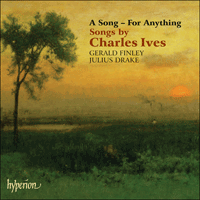

Charles Ives’s work as a pioneering polytonalist is perhaps better remembered today than his song output, but throughout his long composing life his most personal musical expressions are to be found in what may best be called the genre of the ‘art song’. These range from traditional ‘lieder’ (setting such familiar poets as Heinrich Heine and Nikolaus Lenau), through English-language ‘songs of the period’ (Kipling, Keats, Bulwer-Lytton), to pioneering ‘pop songs in the modern idiom’, often to texts of Ives’s own devising. All show a degree of craftsmanship which makes one wonder why many of these songs are not better known.
Ives admitted to a deep mistrust of singers—their insistence on ‘interpreting’ any given score frequently, he felt, betrayed its composer’s intentions: not so with Gerald Finley and Julius Drake. These peformances perfectly encapsulate a lost world, transporting the listener back to a world where a ‘sentimental ballad’ could happily share the stage with a pastiche on the ‘Battle Cry for Freedom’.
This is Gerald Finley’s first solo recital recording.

In fact, many of Ives’s songs began life as ‘songs without words’ – suggested by a specific text, and setting that text, but as purely instrumental pieces for a chamber ensemble, with one instrument taking the voice part. ‘The principal reason for this’, Ives wrote in his autobiographical Memos, ‘was because singers made such a fuss about the intervals, time, etc. … when they were arranged later for voice and piano, they were weakened in many cases, also simplified – which I should not have done. This is no way to write a song – but it’s the way I wrote some – take it or leave it, Eddy!’
The range of style and approach in Ives’s text-setting is startling – from simple, sentimental ballads to complex and strenuous philosophical discourses, sometimes encompassing the most dissonant and virtuosic piano parts, sometimes with the accompaniment pared down to an almost minimalist phrase-repetition. Even those composed in a superficially conventional or ‘polite’ tonal idiom usually contain harmonic, rhythmic or accentual surprises somewhere – because the vocabulary of the late-Romantic Lied (though it was a genre he well understood) was eventually inadequate for the way Ives felt poetry, and for what he was impelled to say about poetry in music.
A Song – For Anything (1892) was classed by Ives as a ‘Sentimental Ballad’; he claimed it was an illustration ‘of how inferior music is inclined to follow inferior words’ and vice versa. Its three verses are in fact three different texts – one a sentimental love poem, one a student apostrophe to Yale, and earliest of all (and best, according to Ives) a religious homily, originally sung in church as a kind of hymn. (Ives placed this text last in 114 Songs; in this recording, it is sung first.) The gentle, ardent When Stars are in the Quiet Skies (1891) has words by Lord Bulwer-Lytton. It was probably arranged in 1893 from a song of two years earlier, to a different text.
Memories: (A) Very Pleasant; (B) Rather Sad (1897) is quite a virtuoso performance. In the first section (marked ‘as fast as it will go’) Ives evokes the excitement of a night at the opera (including whistling), while the second is a concentrated exercise in nostalgia – and in the power of a simple tune (including humming). Berceuse, dated 1900, was in fact adapted about 1903 from a setting of the German text Wiegenlied, famous as ‘Brahms’s Lullaby’. A rapt meditation, its tonal shading might be felt too fine and sensitive for a conventional lullaby. There is nothing conventional about The Cage (1906), inspired by watching a pacing leopard in the menagerie at Central Park. The music that resulted became ‘In the Cage’, the first movement of Ives’s Set for Theatre Orchestra; this song version was made afterwards.
During his years of study at Yale University under Horatio Parker, Ives became acquainted, like any aspiring young American composer of his generation, with the standard Austro–German repertoire, including the Lieder of such song-composers as Brahms, Cornelius, Schumann and Franz. Their example inspired him to a number of German-language songs of his own, which he thought well enough of to print as part of 114 Songs. Of these songs, the beautiful Heine setting Ich grolle nicht, on a poem that Schumann had set in Dichterliebe, was composed by the end of March 1898. Du alte Mutter (1900) sets a German translation of a poem from the Norwegian, which had also been made the basis of a song by Edvard Grieg.
Feldeinsamkeit, though also dated 1900, was actually composed by November 1897. Brahms set this poem, by Hermann Allmers, as his Op 86 No 2, but Ives’s treatment is one of his most ravishing songs. Ives remembered with pride the established composer George W Chadwick’s visit to Horatio Parker’s Yale class: hearing Ives play over this setting, Chadwick said it was as good a song as Parker could write and almost as good as the Brahms, and composed from an ‘almost opposite approach … for the active tranquillity of the outdoor beauty of nature is harder to express than just quietude’. Weil’ auf mir (1902) is a slightly later evocation of the German Lied style, to a poem by Lenau that had been set by Robert Franz. The expansive, resonant Élégie, setting a poem by Louis Gallet that had been set by Massenet, is a parallel evocation of French chanson, dating from 1901.
Walking is dated 1902 (but it may be earlier); the words are by Ives. This is an important song in his development, somewhat experimental in its evocations of church bells and different rhythmic pulses over the regular ‘walking’ metre. The central piano interlude depicts a funeral in the valley while a dance goes on at a roadhouse higher up. The act of walking itself is seen as a symbol of the course of life.
Circumstantial evidence suggests that in the first decade of the twentieth century Ives composed three Rudyard Kipling songs, one of which was Tolerance, a setting from about 1906 of lines from Kipling’s poem The Fires. But Kipling was notoriously difficult about copyright. Ives had first heard the lines quoted in a lecture by President Hadley at Yale, and he incorporated the song into an ensemble piece called A Lecture by President Arthur Twining Hadley. When he came to publish Tolerance in 114 Songs the words were described as a quotation in Hadley’s lecture, without identifying the author. Thoreau (1915), uses quotations from the Transcendentalist philosopher as its text, and is an arrangement of material from the finale of Ives’s ‘Concord’ Piano Sonata, itself a more extended portrait of Thoreau and his contemporaries.
The Things our Fathers Loved (1917), subtitled ‘(and the greatest of these was Liberty)’, is one of Ives’s greatest songs, one of his crucial statements about what his music is about, and typically woven from a veritable tapestry of quotations of tunes, including ‘Dixie’, ‘My Old Kentucky Home’, ‘The Battle Cry of Freedom’ and ‘In the sweet Bye and Bye’. The date of composition is significant: Ives thought it was important to remember the values he felt were enshrined in these melodies, as America entered the Great War. Another and more explicit ‘war song’ from 1917 – though entirely un-warlike in character – is Tom Sails Away. Here the hallucinatory textures create a haze of childhood memories, shadowed by the consciousness of war in Europe. The popular song ‘Over there’ is referred to in the music, along with ‘Araby’s daughter’ and Ives’s great favourite, ‘Columbia, the Jewel of the Ocean’. The elegiac close suggests that the kid brother who has enlisted and taken ship for ‘over there’ will not return.
Serenity (1919), to a text by John Greenleaf Whittier, was arranged from a sketch of an ensemble ‘song’ earlier than May 1911 and may well be connected to Ives’s projected Whittier Overture, one of his ‘Men of Literature’ series. He suggested this trance-like piece was best sung as a unison chant, over its repetitive chiming accompaniment figure. The words of Like a Sick Eagle (1920) are the first five lines of John Keats’s sonnet On Seeing the Elgin Marbles. This is an arrangement of an ensemble ‘song without words’ sketched about 1906, though Ives seems to have associated the music with the time when his wife Harmony was hospitalized for termination of pregnancy in April 1909. The ‘weak and dragging’ descending figures, in accompaniment and voice, close on an ambiguous upward glance. The ‘rather short’ Ann Street (1921) paints an image of a hectic little thoroughfare between Broadway and Nassau in downtown Manhattan, and its endemic traffic congestion. Ives read the poem in the New York Herald for 12 January 1921.
Remembrance (1921) was written in 1906 as a ‘song without voice’ for cornet and chamber ensemble called The Pond. Ives once called it an ‘obvious picture’, and it is an elegy for his father – buried at Wooster Cemetery in his home town of Danbury, Connecticut (where the pond in question lies) – whose expressive cornet-playing was always an abiding memory. The cornet has the main melody, and Ives put words to it on the score. In 114 Songs he gave these words to the singer. He also added a superscription – two lines by Wordsworth: ‘The music in my heart I bore / Long after it was heard no more.’
The text of Swimmers (1921), from a poem by Louis Untermeyer, appeared in the July 1915 issue of Yale Review. Untermeyer, who had musical training, met Ives in about 1944 and was enthusiastic about his vehement and virtuosic setting: ‘It got immediately from the very first notes of the piano, the surge of the sea, the welling up of the waves and a great sense of movement. He took just part of the poem. All that I tried to do in words he was doing in sound.’ In contrast to the untamed sea, The New River (1921) paints a dissonant waterscape polluted by the din of modern man. Ives wrote this first in 1906 as a wordless ‘ensemble song’ with the title The Ruined River, then – after a visit in 1911 to one of his favourite rivers, which prompted the angry scrawl ‘Gas machine kills Housatonic!’ – into a piece for chorus and chamber orchestra, and finally into a song.
‘1, 2, 3’ (1921) seems to have originated in a 1906 ‘take-off’ for chamber orchestra, entitled Rube trying to walk 2 and 3!!. ‘Written as a joke, and sounds like one! … at 2.45 A.M.’, Ives wrote on the sketch. This music became the basis of his scherzo Over the Pavements, and in 1921 he adapted it for voice and piano in 114 Songs. In this rhythmic and metric study of two-against-three, the 3/8 time signature is continually subverted by the two-quaver figures in the bass, which tend to walk all over the bar lines. (The song might be regarded as a comic counterpart to Walking.)
West London (1921) is a piercing setting of a Matthew Arnold poem on the effects of poverty. The music stems from Ives’s never-finished Matthew Arnold Overture, another of his series of ‘Men of Literature’ overtures (of which only the Robert Browning Overture was ever completed). In the final bars of the song Ives quotes, off key, the hymn tune ‘There is a Fountain filled with Blood’.
In 1908 Ives and his wife Harmony took a Sunday morning walk along the Housatonic River near Stockbridge. Ives recalled that they ‘heard the distant singing from the church across the river. The mist had not entirely left the river bed, and the colours, the running water, the banks and elm trees were something that one would always remember’. He made a musical sketch, trying to capture this powerful impression of mist and waters, and in 1911 he worked this into a short-score draft. It became the finale, The Housatonic at Stockbridge, of his First Orchestral Set, Three Places in New England. In 1921 Ives recast the music for voice and piano, to words by Robert Underwood Johnson, in order to include it in 114 Songs. The Side Show, though dated 1921, originated in a piece Ives composed for a Yale Fraternity show in 1896, based on the then-popular song by Pat Rooney Snr, ‘Are You the O’Riley?’. It’s a kind of stumbling waltz, since it describes an old horse pulling a merry-go-round.
Yellow Leaves is one of Ives’s last songs, written in 1923; it exquisitely renders an autumn landscape. By contrast The Greatest Man (1921) is a folksy, affectionate setting of a poem Ives read in the New York Evening Sun for 7 June 1921. Like its author, Ives had idolized his father, so the boy’s sentiments struck a ready chord. Where the Eagle (1900) is a brief, visionary song concerned with the mysteries of death. Slugging a Vampire (1902) was originally composed to Rudyard Kipling’s poem Tarrant Moss, but as with Tolerance Kipling’s agreement was not forthcoming. So in 114 Songs Ives left most of the voice-part blank, then wrote his own text so the song could be reprinted in a collection of 19 Songs in 1935.
Charlie Rutlage is undated in 114 Songs – but the text comes from the 1920 edition of Cowboy Songs collected by John A Lomax. It was presumed anonymous at that time, but in the 1938 edition Lomax ascribed it to one D J ‘Kid’ O’Malley. The cowboy heaven is one of Ives’s many variations on musical evocations of the afterlife. But the stylistic range of this song far outstrips the normal requirements of a cowboy ballad, with its fanfares, clusters played with fists, and rhythmicized speech.
Finally, General William Booth Enters into Heaven (1914) is one of Ives’s supreme achievements in the field of song. Vachel Lindsay (1879–1931) made his name as the writer (and pyrotechnical performer) of a modern ballad poetry whose strenuous rodomontade established an ‘American rhythm’ dealing with indigenous and contemporary subjects. He gained widespread acclaim with the publication in 1913 of his first collection, of which General William Booth Enters into Heaven, in memory of the founder of the Salvation Army, was the title poem.
Ives seems to have come across the text in a review of Lindsay’s poetry published in the New York Independent on 12 January 1914, since he sets only the thirty-one lines quoted in that review. The poem’s musical possibilities – and also no doubt the fervour of its Gospel religion – clearly fired him, and he had soon composed a setting (he called it a ‘glory trance’) for voice and piano. This was not published in his collection of 114 Songs, maybe because the possibility of using larger forces was present from the beginning. Ives made some sketches towards a brass band version, and a male chorus form. In 1934 the composer John J Becker, one of Ives’s staunchest admirers, arranged General Booth for bass voice, chorus and chamber orchestra, in which form it has become best known. But it remains a stunning tour de force in the original song version.
Calum MacDonald © 2005
En réalité, quantité de mélodies de Ives furent d’abord des «romances sans paroles» – suggérées par un texte spécifique, qu’elles mettent en musique sous une forme purement instrumentale pour ensemble de chambre, avec un instrument assumant la partie vocale. «La principale raison à cela», écrivit le compositeur dans ses Memos autobiographiques, «c’était que les chanteurs faisaient tout un plat des intervalles, des mesures, etc. […] lorsque, plus tard, elles furent arrangées pour voix et piano, elles furent souvent affaiblies, simplifiées aussi – ce que je n’aurais pas fait. Ce n’est pas comme ça que l’on écrit une mélodie – mais c’est comme ça que j’en ai écrit quelques-unes – à prendre ou à laisser, Eddy!»
L’éventail des styles et des approches de la mise en musique ivesienne est saisissant – des simples ballades sentimentales aux discours philosophiques complexes, avec tantôt les parties pianistique les plus dissonantes et les plus virtuoses qui soient, tantôt un accompagnement réduit à une répétition de phrase quasi minimaliste. Même les pièces composées dans un idiome tonal en apparence conventionnel ou «poli» réservent généralement leur lot de surprises harmoniques, rythmiques ou accentuelles – car, en définitive, le vocabulaire du lied romantique tardif (genre qu’il comprenait pourtant bien) ne convenait ni à la manière dont Ives ressentait la poésie, ni à ce qu’il était poussé à dire sur la poésie en musique.
Le compositeur voyait en A Song – For Anything (1892) [«Un chant – Pour quelque chose»] une «ballade sentimentale», l’illustration «de la manière dont une musique inférieure est encline à suivre des paroles inférieures» et vice versa. Ses trois strophes sont en fait trois textes différents – un poème d’amour sentimental, une apostrophe d’étudiant à Yale et, le plus ancien de tous (le meilleur, aussi, selon Ives), une homélie religieuse originellement chantée dans l’église comme une sorte d’hymne. (Dans 114 Songs, ce texte vient en dernier; ici, il est chanté en premier.) La douce et ardente When stars are in the quiet skies (1891) [«Quand les étoiles sont dans les cieux paisibles»], sur des paroles de Lord Bulwer-Lytton, fut probablement arrangée en 1893 d’après une mélodie de 1891, mais sur un autre texte.
Memories: (A) Very Pleasant; (B) Rather Sad (1897) [«Souvenirs: (A) Très agréable; (B) Plutôt triste»] est une prestation des plus virtuoses. La première section (marquée «Aussi vite que possible») évoque l’excitation d’une nuit à l’opéra (sifflement inclus), tandis que la seconde se concentre sur la nostalgie – et sur le pouvoir d’un air simple (fredonnement inclus). Bien que datée de 1900, Berceuse fut, en réalité, adaptée (vers 1903) d’une mise en musique du Wiegenlied allemand, la fameuse «Berceuse de Brahms». La nuance tonale de cette méditation absorbée peut paraître par trop belle et sensible pour une berceuse conventionnelle. Rien de conventionnel, en revanche, dans The Cage (1906) [«La cage»], inspirée par l’observation d’un léopard arpentant la ménagerie de Central Park. Cette musique fut d’abord «In the Cage», le premier mouvement de Set for Theatre Orchestra; la présente mélodie ne vint que plus tard.
Pendant ses études à Yale, dans la classe d’Horatio Parker, Ives, comme tous les jeunes aspirants compositeurs américains de sa génération, se familiarisa avec le répertoire standard austro-allemand, notamment avec les lieder de gens comme Brahms, Cornelius, Schumann et Franz. Ces exemples lui inspirèrent un certain nombre de mélodies en allemand, qu’il jugea dignes de figurer dans 114 Songs, telle la splendide Ich grolle nicht composée à la fin de mars 1898 sur un poème de Heine également mis en musique par Schumann dans Dichterliebe. Du alte Mutter (1900) prend pour texte la traduction allemande d’un poème norvégien déjà mis en musique par Edvard Grieg.
Bien que datée de 1900, Feldeinsamkeit fut composée en novembre 1897. Ives traite ce poème d’Hermann Allmers, aussi mis en musique par Brahms (op. 86, no 2), d’une manière telle que cette mélodie est l’une de ses plus ravissantes. Il se souvint avec fierté du jour où George W. Chadwick vint visiter la classe d’Horatio Parker, à Yale: en entendant jouer Feldeinsamkeit, ce compositeur reconnu déclara qu’elle était aussi bonne que du Parker, presque aussi bonne que la version de Brahms, et qu’elle avait été composée dans une «approche quasi opposée … car l’active tranquillité de la beauté extérieure de la nature est plus ardue à exprimer que la simple quiétude». Weil’ auf mir (1902) est une évocation, légèrement postérieure, du lied allemand et de son style, sur un poème de Lenau déjà mis en musique par Robert Franz. Expansive et résonante, Élégie (1901) est une évocation parallèle de la chanson française, sur un poème de Louis Gallet déjà utilisé par Massenet.
Datée de 1902 (mais peut-être antérieure), Walking [«Marche»] (sur des paroles de Ives) marque un jalon dans le développement du compositeur – un rien expérimentale avec ses évocations de cloches d’église et ses différents battements rythmiques par-dessus le mètre à la «marche» régulière. L’interlude pianistique central dépeint un enterrement qui se déroule dans la vallée pendant que, plus haut, on danse dans une taverne. L’acte de marcher symbolise en soi le cours de la vie.
Selon des preuves circonstanciées, Ives aurait, dans la première décennie du XXe siècle, composé trois mélodies d’après Kipling, dont Tolerance (vers 1906), sur des vers tirés du poème The Fires. Or, tout le monde sait combien Kipling cédait peu volontiers ses droits. Ives, qui avait entendu ces vers pour la première fois lors d’une conférence du président Hadley, à Yale, incorpora cette mélodie dans une pièce d’ensemble intitulée A Lecture by President Arthur Twining Hadley. Puis, quand vint le moment d’intégrer Tolerance aux 114 Songs, il indiqua que ces paroles provenaient d’une citation faite par Hadley dans une de ses conférences, sans en identifier l’auteur. Thoreau (1915), fondée sur des citations du philosophe transcendantaliste, est un arrangement du matériau du finale de la Sonate pour piano «Concord», où Ives brosse un portrait davantage étoffé de Thoreau et de ses contemporains.
The Things our Fathers Loved (1917) [«Les choses que nos pères aimaient»], sous-titrée «(and the greatest of these was Liberty)» [«(et la plus grande était la liberté)»], est l’une des plus grandes mélodies de Ives, l’une de ses assertions cruciales sur ce qu’est sa musique, tissée, bien sûr, à partir d’une véritable tapisserie d’airs comme «Dixie», «My Old Kentucky Home», «The Battle Cry of Freedom» et «In the sweet Bye and Bye». La date de composition est importante: à l’heure où l’Amérique entrait dans la Grande guerre, Ives jugea bon de rappeler les valeurs qu’il voyait tout entières contenues dans ces mélodies. Autre «chant de guerre» plus explicite, mais nullement martial: Tom Sails Away (1917) [«Tom part en bateau»], où les textures hallucinatoires font naître une brume de souvenirs d’enfance, assombrie par la conscience de la guerre en Europe. La musique fait référence au chant populaire «Over There» [«Là-bas»], mais aussi à «Araby’s daughter» et à «Columbia, the Jewel of the Ocean», l’air préféré de Ives. La conclusion élégiaque laisse penser que le petit frère qui s’est enrôlé et a embarqué pour «là-bas» ne reviendra pas.
Arrangement d’un «song» pour ensemble esquissé avant mai 1911, Serenity (1919, texte de John Greenleaf Whittier) pourrait se rattacher à la Whittier Overture que Ives envisageait de composer dans le cadre de sa série «Men of Literature». Il suggéra que cette pièce hypnotique devait, pour le mieux, être chantée comme une psalmodie à l’unisson, par-dessus sa répétitive figure d’accompagnement carillonnante. Like a Sick Eagle (1920) [«Comme un aigle malade»], qui emprunte son texte aux cinq premiers vers du sonnet de John Keats, On Seeing the Elgin Marbles [«En voyant les marbres d’Elgin»], est l’arrangement d’une «romance sans paroles» ébauchée vers 1905, même si Ives semble avoir associé cette musique à l’hospitalisation de sa femme Harmony, pour une interruption de grossesse, en avril 1909. Les figures descendantes, «faibles et traînantes», à l’accompagnement et à la voix, terminent par un regard ambigu, tourné vers le haut. «Plutôt brève», Ann Street (1921) brosse le tableau d’une petite artère agitée entre Broadway et Nassau, dans le centre de Manhattan, avec ses embouteillages endémiques. Ives lut ce poème dans le New York Herald du 12 janvier 1921.
Remembrance (1921) [«Souvenir»] fut d’abord «The Pond» [«La mare»] (1906), une «chanson sans voix» pour cornet et ensemble de chambre qu’Ives qualifia, un jour, de «tableau manifeste» – c’est une élégie pour son père, inhumé à Wooster Cemetery, dans sa ville natale de Danbury, dans le Connecticut (là où se trouve la mare en question), ce père dont le jeu de cornet expressif fut un souvenir constant. Cet instrument se voit attribuer la mélodie principale, que Ives met en paroles sur la partition. Dans 114 Songs, ce texte, confié au chanteur, est surmonté de deux vers de Wordsworth: «La musique que je portai en mon cœur / Bien après qu’on ne l’entendit plus».
Extrait d’un poème de Louis Untermeyer, le texte de Swimmers (1921) [«Nageurs»] parut dans la Yale Review de juillet 1915. Untermeyer, qui avait une formation musicale, rencontra Ives vers 1944 et fut enthousiasmé par sa mise en musique véhémente, virtuose, «car tout de suite, dès les premières notes du piano, elle saisit la houle de la mer, le gonflement des vagues et un formidable sens du mouvement. Il [Ives] n’a pris qu’une partie du poème. Tout ce que j’avais essayé de faire en mots, il le faisait en sons.» Contrastant avec la mer indomptée, The New River (1921) [«La nouvelle rivière»] peint une marine dissonante, polluée par le tumulte de l’homme moderne. Tout commença en 1906 avec une «mélodie pour ensemble» sans paroles intitulée The Ruined River [«La rivière abîmée»], que Ives transforma – après être allé voir l’une de ses rivières préférées, en 1911, ce qui le poussa à ce griffonnage rageur: «L’engin à essence tue l’Housatonic!» – en une pièce pour chœur et orchestre de chambre puis, enfin, en une mélodie.
À l’origine, ‘1, 2, 3’ (1921) semble avoir été une «caricature» pour orchestre de chambre intitulée Rube trying to walk 2 and 3!! [«Le péquenot essayant de marcher 2 et 3!!»]. «Écrite comme une blague, et elle en a bien l’air! … à 2 heures 45 du matin», nota Ives sur l’esquisse. Après en avoir fait la base de son scherzo Over the Pavements, il l’adapta, en 1921, pour voix et piano dans 114 Songs. Cette étude rythmique et métrique du deux-contre-trois voit le signe de la mesure à 3/8 constamment subverti par les figures de deux croches à la basse, qui tendent à marcher sur les barres de mesure. (Cette musique peut être regardée comme le pendant comique de Walking.)
Pénétrante mise en musique d’un poème de Matthew Arnold sur les effets de la pauvreté, West London (1921) tire ses notes de la Matthew Arnold Overture, ouverture inachevée de la série ivesienne des «Men of Literature» (seule la Robert Browning Overture fut jamais terminée). Dans les dernières mesures, le compositeur cite, en marge de la mélodie principale, l’air de l’hymne «Il y a une fontaine remplie de sang».
Par un dimanche matin de 1908, Ives et sa femme Harmony partirent se promener sur les bords de la Housatonic River, près de Stockbridge. Ils avaient, se souvint Ives, «entendu le chant lointain s’échappant de l’église, de l’autre côté de la rivière. La brume n’avait pas complètement quitté le lit de la rivière, et les couleurs, l’eau qui coulait, les berges et les ormes, c’était une chose qu’on ne voulait jamais oublier». D’une première esquisse musicale tentant de saisir cette puissante impression de brume et d’eaux, Ives fit, en 1911, une ébauche sous forme de particelle qui devint The Housatonic at Stockbridge, le finale de son First Orchestral Set, Three Places in New England. En 1921, il refondit cette musique pour voix et piano, sur des paroles de Robert Underwood Johnson, en vue de l’inclure dans 114 Songs. The Side Show [«L’attraction foraine»] est datée de 1921, mais remonte à une pièce composée par Ives pour un spectacle de la Yale Fraternity donné en 1896 et fondée sur l’air, alors populaire, de Pat Rooney Sr, «Are You the O’Riley?». C’est une sorte de valse trébuchante – et pour cause: elle décrit un vieux cheval tirant un manège.
Yellow Leaves [«Feuilles jaunes»] (1923, parmi les dernières mélodies de Ives) traduit exquisément un paysage d’automne. A contrario, The Greatest Man (1921) [«Le plus grand homme»] est la mise en musique, bon enfant et tendre, d’un poème paru dans le New York Evening Sun du 7 juin 1921. Comme l’auteur de ces vers, Ives avait idolâtré son père, aussi les sentiments du garçon touchèrent-ils la corde sensible. Where the eagle (1900) [«Là où l’aigle»] est une mélodie brève, visionnaire, sur les mystères de la mort. Slugging a Vampire (1902) [«Rosser un vampire»] fut originellement composée sur un poème de Rudyard Kipling, Tarrant Moss, mais, comme pour Tolerance, l’accord du poète fit défaut. Dans 114 Songs, Ives laissa donc l’essentiel de la partie vocale vierge, avant d’écrire son propre texte pour que l’œuvre pût être réimprimée dans un recueil de 19 Songs, en 1935.
Charlie Rutlage figure sans date dans 114 Songs, mais son texte est tiré de l’édition de 1920 des Cowboy Songs collectées par A. Lomax, lequel le supposa d’abord anonyme avant de l’attribuer, dans l’édition de 1938, à un certain D. J. «Kid» O’Malley. Le paradis du cow-boy est l’une des nombreuses variations ivesiennes sur la vie après la mort. Cependant, les fanfares, les clusters exécutés avec les poings et la déclamation «rythmicisée» font que la gamme stylistique de cette mélodie surpasse largement les habituelles exigences d’une ballade de cow-boy.
Terminons avec General William Booth Enters into Heaven (1914) [«Le général William Booth entre au paradis»], l’une des mélodies suprêmes de Ives. Vachel Lindsay (1879–1931) devint célèbre pour avoir écrit (et interprété avec éclat) des ballades modernes, dont la vigoureuse rodomontade fonda un «rythme américain», sur des sujets américains contemporains. En 1913, la publication de son premier recueil lui valut une large reconnaissance, avec en poème-titre ce General William Booth Enters into Heaven, en mémoire du fondateur de l’Armée du Salut.
Ives semble avoir découvert ce texte le 12 janvier 1914, dans une critique du New York Independent consacrée à la poésie de Lindsay, sa mise en musique ne concernant que les trente et un vers cités par le journal. À l’évidence, les possibilités musicales offertes par ce poème – et aussi, sans nul doute, son évangélisme fervent – l’enflammèrent et, bien vite, une mise en musique pour voix et piano, qualifiée de «glory trance», vit le jour. L’œuvre ne fut pas publiée dans les 114 Songs, peut-être parce que Ives disposa tout de suite de forces plus importantes. Il fit quelques esquisses en vue de deux autres versions: une pour fanfare et une pour chœur d’hommes. En 1934, le compositeur John J. Becker, l’un des plus fervents admirateurs de Ives, arrangea General Booth pour voix de basse, chœur et orchestre de chambre, forme sous laquelle cette œuvre est la plus connue, même si la version mélodique originale demeure un incroyable tour de force.
Calum MacDonald © 2005
Français: Hypérion
Tatsächlich entstanden viele Lieder von Ives zuerst als „Lieder ohne Worte“: Ein bestimmter Text lieferte die Anregung. Ives vertonte dann den Text als reines Instrumentalstück für Kammerensemble, wobei ein Instrument die Gesangstimme übernahm. „Der Hauptgrund dafür“, schrieb Ives in seinen autobiographischen Memos [„Erinnerungen“], „lag darin, dass Sänger so viel Wind um die Intervalle, Rhythmus usw. machten … Wenn sie [die Instrumentalstücke] dann später für Gesang und Klavier bearbeitet wurden, erfuhren sie in vielen Fällen ein Abschwächung, also Vereinfachung – was ich nicht hätte tun sollen. So soll man kein Lied komponieren – doch schrieb ich einige auf diese Weise – mach, was du willst, Eddy!“.
Die Vielfalt an Stilen und Kompositionstechniken in Ives’ Textvertonungen ist erstaunlich – von einfachen, sentimentalen Balladen bis zu anstrengenden philosophischen Abhandlungen. Manchmal haben die Lieder äußerst dissonante und virtuose Klavierstimmen, manchmal wurde die Begleitung bis auf fast minimalistische Wiederholungsgesten vereinfacht. Selbst jene Lieder, die in einer oberflächlich konventionellen oder „höflichen“ Musiksprache komponiert wurden, halten gewöhnlich doch irgendwo Überraschungen in Sachen Harmonie, Rhythmus oder Artikulation parat – weil für Ives die Sprache des spätromantischen Liedes zur persönlichen Interpretation der poetischen Bilder und zum musikalischen Kommentar irgendwann unzureichend war (auch wenn er mit dieser Sprache sehr gut vertraut war).
A Song – For Anything (1892) [„Ein Lied – für alles“] wurde von Ives selbst als eine „sentimentale Ballade“ bezeichnet. Er behauptete, das Lied sei ein gutes Beispiel dafür, „wie schwache Musik dazu neigt, einem schwachen Text zu folgen, und anders herum. Die drei Verse sind eigentlich drei unterschiedliche Texte – einer ist ein sentimentales Liebesgedicht, einer ein feierliche Rede eines Studenten zu Ehren der Yale University, und der früheste (und nach Ives’ Meinung der beste) eine religiöse Homilie, die ursprünglich in der Kirche als eine Art Kirchenlied gesungen wurde. (Ives setzte diesen Text in den 114 Songs an letzte Stelle. Auf der hier vorliegenden CD wird er zuerst gesungen.) Das sanfte, inbrünstige When stars are in the quiet skies (1891) [„Wenn die Sterne an stillen Himmeln stehen“] beruht auf Worten von Lord Bulwer-Lytton. Das Lied entstand wahrscheinlich 1893 als eine Bearbeitung eines zwei Jahre zuvor komponierten und auf einem anderen Text beruhenden Liedes.
Memories: (A) Very Pleasant; (B) Rather Sad (1897) [„Erinnerungen: (A) Sehr angenehm; (B) Ziemlich traurig“] ist ein ziemlich virtuoses Werk. Im ersten Abschnitt (mit der Überschrift „so schnell wie möglich“) beschwört Ives die Aufregung an einem Abend in der Oper (einschließlich des Pfeifens). Der zweite Abschnitt ist dagegen eine konzentrierte Übung in Nostalgie – und in der Kraft einer einfachen Melodie (einschließlich des Summens). Das mit 1900 datierte Lied Berceuse entstand eigentlich erst um 1903. Hier wird der deutsche Text Wiegenlied vertont, der in Brahms’ Fassung allgemein bekannt ist. Ives’ Lied ist eine hingerissene Meditation, womöglich sind aber die harmonischen Schattierungen für ein konventionelles Wiegenlied zu clever und raffiniert. The Cage (1906) [„Der Käfig“] ist alles andere als konventionell. Das Lied entstand, nachdem Ives einen rastlos hin- und herwandernden Leoparden in einem Käfig in Central Park gesehen hatte. Aus diesen Beobachtungen resultierte die Musik für „In the Cage“ [„Im Käfig“], d.h. den ersten Satz aus Ives’ Set for Theatre Orchestra [„Serie für Theaterorchester“]. Die hier vorgestellte Liedfassung entstand danach.
In seiner Studienzeit an der Yale University bei Horatio Parker machte sich Ives wie viele andere ehrgeizige junge amerikanische Komponisten seiner Generation auch mit dem üblichen deutsch-österreichischen Repertoire vertraut, einschließlich der Lieder solcher bekannten Liederkomponisten wie Brahms, Cornelius, Schumann und Robert Franz. Ihr Vorbild regte Ives zu einer Reihe von eigenen deutschsprachigen Liedern an, die er offensichtlich als ausreichend gut befand, nahm er sie doch in seinen Band der 114 Songs auf. Unter diesen Liedern befand sich die wunderschöne Heine-Vertonung Ich grolle nicht. Sie wurde gegen Ende März 1898 komponiert. Schon Schumann hatte diesen Heine-Text in seiner Dichterliebe herangezogen. Du alte Mutter (1900) beruht auf einer deutschen Übersetzung eines Gedichtes aus Norwegen, das auch schon die Textgrundlage für ein Lied von Edvard Grieg bildete.
Das Lied Feldeinsamkeit ist ebenso mit 1900 datiert, entstand allerdings im November 1897. Brahms hatte in seinem op. 86, Nr. 2 das gleiche Gedicht von Hermann Allmers vertont. Ives’ Fassung zählt zu seinen entzückendsten Liedern. Mit Stolz erinnerte sich Ives an den Besuch des etablierten Komponisten George W. Chadwick in einer Unterrichtsstunde von Horatio Parker an der Yale University: Nachdem Ives dort sein Lied vorgespielt hatte, kommentierte Chadwick, das Lied könne wohl mit Parkers Liedern mithalten und wäre fast so gut wie das von Brahms. Ives’ Lied sei „von einem fast völlig anderen Gesichtspunkt“, komponiert worden, „…denn den aktiven Frieden der herrlichen feien Natur kann man nicht einfach durch leise Musik darstellen“. Weil’ auf mir (1902) ist eine zeitlich etwas nachhinkende Nachahmung des deutschen Liederstils und beruht auf einem Gedicht von Lenau, das zuvor schon von Robert Franz vertont wurde. Die ausgedehnte, volltönige Élégie, die auf einem Gedicht von Louis Gallet beruht, das schon Massenet einem Lied zugrunde gelegt hatte, ist eine entsprechende Nachahmung eines französischen Chansons und wurde 1901 komponiert.
Walking [„Wandern“] ist mit 1902 datiert (entstand aber womöglich früher). Die Worte sind von Ives. Walking ist ein wichtiges Lied in Ives’ Entwicklung und wirkt ziemlich experimentell mit seinen Anklängen an Kirchenglocken und mit den unterschiedlichen rhythmischen Pulsen über einem regelmäßig fortschreitenden („wandernden“) Taktschlag. Das Klavierzwischenspiel in der Mitte stellt ein Begräbnis im Tal dar, während in einem Gasthaus weiter oben ein Tanz stattfindet. Das Fortschreiten selber dient als Symbol für den Verlauf des Lebens.
Es gibt Indizien, die die Vermutung nahe legen, dass Ives im ersten Jahrzehnt des 20. Jahrhunderts drei Lieder auf Texte von Rudyard Kipling schrieb. Eines davon war Tolerance [„Toleranz“], eine Komposition von ca. 1906 auf Zeilen aus Kiplings Gedicht The Fires [„Die Feuer“]. Nun bereitete Kipling in Sachen Urheberrecht bekanntermaßen große Schwierigkeiten. Ives hatte die Zeilen zum ersten Mal in einer Vorlesung des Präsidenten Hadley an der Yale University gehört. Ives arbeitete das Lied später in ein Ensemblestück namens A Lecture by President Arthur Twining Hadley [„Eine Vorlesung des Präsidenten Arthur Twining Hadley“] um. Als Ives das ursprüngliche Lied Tolerance in den 114 Songs veröffentlichte, lieferte er als Zitatangabe nur Hadleys Vorlesung, ohne den eigentlichen Autoren zu nennen. Der Text in Thoreau (1915) beruht auf Zitaten des transzendentalistischen Philosophen im Titel. Ives übernahm und bearbeitete auch Material aus dem Schlusssatz seiner „Concord“-Klaviersonate, ein Werk, das Thoreau und seine Zeitgenossen ausführlicher porträtierte.
Das Lied The Things our Fathers Loved (1917) [„Die Dinge, die unsere Väter liebten“], mit dem Untertitel „und das größte davon war Freiheit“, zählt zu Ives’ hervorragendsten Liedschöpfungen und zu den besten Beispielen für sein kompositorisches Anliegen. Typisch für Ives besteht das Lied aus einem wahren Teppich aus ineinander geflochtenen Liedzitaten wie zum Beispiel „Dixie“, „My Old Kentucky Home“ [„Meine alte Heimat in Kentucky“], „The Battle Cry of Freedom“ [„Der Schlachtruf nach Freiheit“] und „In the Sweet Bye and Bye“ [„Im süßen Abschied“]. Das Kompositionsdatum ist von Bedeutung: Ives hielt es offensichtlich für wichtig, die Werte, die er in diesen Melodien verkörpert glaubte, gerade zu einem Zeitpunkt zu betonen, wo Amerika in den Ersten Weltkrieg eintrat. Tom Sails Away [„Tom segelt davon“] von 1917 ist ein weiteres und stärker ausgeprägtes „Kriegslied“ – auch wenn es seinem Charakter nach völlig unkriegerisch ist. Hier schaffen die halluzinatorischen musikalischen Texturen eine Wolke von Kindheitserinnerungen, die vom Wissen um den Krieg in Europa überschattet sind. In der Musik gibt es Anklänge an das Unterhaltungslied „Over There“ [„Dort drüben“], wie auch an „Araby’s Daughter“ [„Arabys Tochter“] und an Ives’ Lieblingslied „Columbia, the Jewel of the Ocean“ [„Columbia, das Schmuckstück des Ozeans“]. Das elegische Ende lässt vermuten, dass der minderjährige Bruder, der sich freiwillig zur Armee gemeldet hat und mit dem Schiff nach „over there“ [dort drüben] in See sticht, nicht mehr zurückkehren wird.
Serenity (1919) [„Gelassenheit“] beruht auf einem Text von John Greenleaf Whittier und ist eine noch vor Anfang Mai 1911 ausgeführte Bearbeitung einer Skizze für ein „Instrumentalensemblelied“. Es kann wohl sein, dass das Lied etwas mit Ives’ geplanter Whittier Overture, d. h. mit einer Ouvertüre aus Ives’ Werkreihe „Männer der Literatur“, zu tun hatte. Der Komponist empfahl, dass man dieses meditative Lied am besten wie einen einstimmigen gregorianischen Choral über die sich wiederholende glockenähnliche Begleitfigur singt. Die Worte zu Like a sick eagle (1920) [„Wie ein kranker Adler“] entsprechen den ersten fünf Zeilen aus John Keats’ Sonett On Seeing the Elgin Marbles [„Beim Betrachten der Elgin Marbles“ – der von Lord Elgin aus Athen nach London gebrachten antiken Marmorskulpturen]. Das hier vorgestellte Lied ist eine Bearbeitung eines instrumentalen „Liedes ohne Worte“, das ca. 1906 skizziert wurde. Ives scheint die Musik allerdings mit jener Zeit im April 1909 assoziiert zu haben, als seine Frau Harmony wegen einer Interruption im Krankenhaus lag. Die „schwachen und nachhinkenden“ musikalischen Gesten sowohl in der Begleitung als auch in der Gesangsstimme schließen sich einer zweideutig aufwärts gerichteten Bewegung an. Das „ziemlich kurze“ Lied Ann Street (1921) stellt eine hektische kleine Durchfahrtsstraße zwischen dem Broadway und der Nassau-Straße im Geschäftsviertel von Manhattan dar sowie einen dort stellenweise auftretenden Verkehrsstau. Ives las das Gedicht in der New York Herald vom 12. Januar 1921.
Remembrance (1921) [„Gedenken“] wurde 1906 als ein „Lied ohne Worte“ mit dem Titel The Pond [„Der Teich“] für Kornett und Kammerensemble komponiert. Ives nannte das Lied einmal eine „offensichtliches Bild“. Es ist eine Elegie für seinen Vater, der im Wooster-Friedhof in Ives’ Heimatstadt Danbury, Connecticut begraben liegt (wo sich der genannte Teich befindet). Ives erinnerte sich ein Leben lang an das ausdrucksstarke Kornettspiel seines Vaters. Das Kornett übernimmt im Lied die Hauptmelodie, die der Komponist in der Partitur mit einem Text versah. In den 114 Songs lässt Ives einen Sänger den Text singen. Ives stellte zudem dem Notentext zwei Zeilen von Wordsworth voran: „Ich trug die Musik in meinem Herzen / Noch lange, nachdem sie nicht mehr zu hören war“.
Der Text zu Swimmers (1921) [„Schwimmer“] stammt aus einem Gedicht von Louis Untermeyer, das 1915 in der Juli-Ausgabe der Yale Review erschien. Untermeyer, der selbst eine musikalische Ausbildung genossen hatte, traf Ives ungefähr 1944 und war hoch erfreut über dessen lebhafte und virtuose Vertonung, „weil sie gleich von der allerersten Note im Klavier die Brandung des Meeres, das Anschwellen der Wellen und ein starkes Gefühl der Bewegung erzielte. Er vertonte nur einen Teil des Gedichtes. Alles, was ich in Worten auszudrücken versuchte, gelang ihm, in Klängen darzustellen“. Im Gegensatz zum ungezähmten Meer, bildet The New River (1921) [„Der neue Fluss“] eine dissonante Wasserlandschaft musikalisch ab, die vom Lärm des modernen Menschen verschmutzt ist. Ives komponierte dieses Stück 1906. Zuerst war es ein wortloses „Lied für Instrumentalensemble“ mit dem Titel The Ruined River [„Der zerstörte Fluss“]. Aber nach einem Besuch eines seiner Lieblingsflüsse 1911, der zum empörten Ausruf „Gasmaschine tötet den Housatonic-Fluss!“ veranlasste, arbeitete Ives das Instrumentalstück in ein Werk für Chor und Kammerorchester entstand daraus schließlich die Fassung für Gesangstimme und Klavier.
„1, 2, 3“ (1921) scheint 1906 als eine „Parodie“ für Kammerorchester entstanden zu sein und hieß damals Rube trying to walk 2 and 3!! [„Rube versucht, 2 und 3 zu gehen!!“]. „Als ein Scherz geschrieben, und klingt auch wie einer! … 2.45 Uhr am Morgen“, schrieb Ives auf das Skizzenpapier. Diese Musik bildete die Grundlage für Ives’ Scherzo Over the Pavements [„Über die Bürgersteige“]. 1921 verwandelte der Komponist das Scherzo in ein Lied für Gesangsstimme und Klavier, das er seinen 114 Songs beifügte. In dieser rhythmisch-metrischen Studie, in der ein Zweier- gegen ein Dreiermetrum läuft, wird der 3/8-tel Takt ständig durch Zweiachtelgesten im Bass untergraben, die sich nicht um die Taktstriche zu kümmern scheinen. (Man könnte das Lied als ein komisches Gegenstück zu Walking interpretieren.)
West London (1921) ist eine bewegende Vertonung eines Gedichtes von Matthew Arnold über die Folgen der Armut. Die Musik stammt aus Ives’ niemals abgeschlossener Matthew Arnold Overture, eine der Ouvertüren aus Ives’ Werkreihe „Männer der Literatur“ (von denen nur die Robert Browning Overture abgeschlossen wurde). In den letzten Takten des Liedes zitiert Ives, in einer anderen Tonart wohlgemerkt, das geistliche Lied „There is a Fountain Filled with Blood“ [„Es ist ein Born, draus heil’ges Blut für arme Sünder quillt“].
An einem Sonntagmorgen 1908 spazierten Ives und seine Frau Harmony am Housatonic-Fluss in der Nähe von Stockbridge entlang. Ives erinnerte sich, wie sie „aus der Ferne das Singen in der Kirche über den Fluss hinweg hörten. Der Nebel hatte sich noch nicht vollständig aus dem Flussbett gehoben, und die Farben, das dahinfließende Wasser, die Böschungen und die Ulmen waren etwas, was man niemals vergessen wird“. Ives skizzierte ein paar musikalische Gedanken, in denen er versuchte, dieses beeindruckende Bild aus Nebel und Wasser einzufangen. 1911 schuf er daraus ein Particell, aus dem dann das abschließende Stück, The Housatonic at Stockbridge [„Der Housatonic-Fluss bei Stockbridge“], aus seinem Orchestertriptychon Orchestral Set No. 1 (Three Places in New England) [„Orchesterreihe Nr. 1 (Drei Orte in New England)“] entstand. 1921 schuf Ives daraus eine Fassung für Gesangsstimme und Klavier auf Worte von Robert Underwood Johnson, um sie den 114 Songs beizufügen. The Side Show [„Die Nebenveranstaltung“] ist zwar mit 1921 datiert, hat aber ihren Ursprung in einem Stück, das Ives 1896 für die Yale Fraternity Show [eine Veranstaltung der Studentenverbindung der Yale University] komponierte. Das Stück beruht auf dem damals beliebten Unterhaltungslied von Pat Rooney snr., „Are You the O’Riley?“ [„Sind Sie der O’Riley?“]. Das Lied ist eine Art wankender Walzer und beschreibt ein altes Pferd beim Ziehen eines Karussells.
Yellow Leaves [„Gelbe Blätter“] gehört zu Ives’ letzten Liedern und entstand 1923. In diesem Lied wird eine Herbstlandschaft wunderschön musikalisch abgebildet. Nicht minder schön und doch musikalisch völlig anders stellt sich The Greatest Man (1921) [„Der größte Mann“] dar. Dieses Lied ist eine volkstümliche, liebevolle Vertonung eines Gedichtes, das Ives in der New York Evening Sun vom 7. Juni 1921 gelesen hatte. Wie der Gedichtautor vergötterte auch Ives seinen Vater. Deshalb war der Komponist von den Gefühlen des Jungen im Gedicht so beeindruckt. Where the eagle (1900) [„Wo der Adler“] ist ein kurzes, ahnungsvolles Lied über die Geheimnise des Todes. Slugging a Vampire (1902) [„Einem Vampir ein Ding verpassen“] entstand ursprünglich als eine Vertonung des Gedichtes Tarrant Moss [„Tarrant-Moor“] von Rudyard Kipling. Aber wie bei Tolerance verweigerte Kipling seine Zustimmung. Deshalb ließ Ives den Großteil der Gesangsstimme in den 114 Songs ohne Text drucken. Später fügte er seinen eigenen Text hinzu. Dadurch konnte das Lied 1935 in der Sammlung 19 Songs erneut veröffentlicht werden.
Charlie Rutlage ist in den 114 Songs ohne Datum. Der Text kommt allerdings aus der 1920 veröffentlichten und von John A. Lomax zusammengetragenen Ausgabe von Cowboy Songs. Zu jener Zeit nahm man an, es handle sich hier um einen anonymen Autoren. In der Ausgabe von 1938 schrieb Lomax allerdings den Text D. J. „Kid“ O’Malley zu. Der Cowboy-Himmel ist eine von Ives’ zahlreichen Variationen über den Gedanken vom Leben nach dem Tod. Nun überschreitet das stilistische Spektrum in diesem Lied bei weitem die üblichen Anforderungen an eine Cowboyballade: Das Lied enthält Fanfaren, mit der Faust gespielte Cluster und rhythmisch vorgeschriebenes Rezitieren.
Abschließend kommt General William Booth Enters into Heaven (1914) [„General William Booth betritt den Himmel“]. Dieses Lied gehört zu Ives’ feinsten Errungenschaften im Liedgenre. Vachel Lindsay (1879–1931) schuf sich einen Namen als Schriftsteller (und sprachvirtuoser Rezitator) moderner Balladen. Seine anstrengende Rodomontade schuf einen „amerikanischen Rhythmus“, seine Texte beschäftigten sich mit einheimischen und zeitgenössischen Themen. Die Veröffentlichung seiner ersten Gedichtsammlung 1913 fand großen Beifall. Das in dieser Sammlung aufgenommene Gedicht General William Booth Enters into Heaven, das dem Gründer der Heilsarmee gedenkt, gab auch der Veröffentlichung als Ganzes ihren Namen.
Ives stieß wahrscheinlich auf den Text in einer Zeitungsrezension über Lindsays Gedichte, die in der New York Independent vom 12. Januar 1914 erschien, vertonte er doch nur die 31 Zeilen, die in der Rezension zitiert wurden. Das musikalische Potential des Gedichtes – und zweifellos auch der Eifer seiner Gospelreligion – scheinen Ives eindeutig angesprochen zu haben. Bald schrieb er eine Vertonung (er nannte sie eine „Ehrenekstase“) für Gesang und Klavier. Sie wurde nicht in seine Sammlung der 114 Songs aufgenommen, vielleicht weil Ives von Anfang an die Möglichkeit für eine Erweiterung auf ein größeres Ensemble sah. Ives begann, eine Fassung für Blechblaskapelle und eine für Männerchor zu skizzieren. 1934 schuf John J. Becker, einer von Ives’ treuesten Verehrern, eine Fassung für Bassstimme, Chor und Kammerorchester. In dieser Fassung fand das Werk seine weiteste Verbreitung. In seiner originalen Liedfassung bleibt es aber ein beeindruckender Kraftakt.
Calum MacDonald © 2008
Deutsch: Elke Hockings



