Welcome to Hyperion Records, a British classical label devoted to presenting high-quality recordings of music of all styles and from all periods from the twelfth century to the twenty-first.
Hyperion offers both CDs, and downloads in a number of formats. The site is also available in several languages.
Please use the dropdown buttons to set your preferred options, or use the checkbox to accept the defaults.
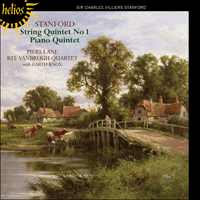

The RTÉ Vanbrugh Quartet, with the support of Garth Knox (viola) and Piers Lane (piano), continue their excellent survey of Stanford’s neglected chamber works with this recording of his String Quintet No 1 and Piano Quintet.
Growing up in his native Dublin in the 1850s and ’60s, Stanford was no stranger to high-quality chamber music, even if visits to Ireland’s capital by pre-eminent executants of the genre were sporadic. As a teenager he recalled with affection and excitement the solo recitals of Anton Rubinstein, Sigismund Thalberg and Charles Hallé, and string players such as Camillo Sivori, Ludwig Straus, Henry Vieuxtemps, Alfredo Piatti and of course Joseph Joachim, a friend of his father.
Stanford’s passion and mastery of the idiom are evident in the substantial catalogue of chamber music he produced throughout his life. His invigorating Piano Quintet dates from 1886 and transports its audience from melancholy introspection (the first two movements are in minor keys) to extrovert joy and optimism; the buoyant, richly scored String Quintet No 1—declared by Parry to be an ‘admirable piece of work’—introduces elaborate ornamental figurations resembling traditional Irish singing.

Two years later, in April 1879, the Piano Quartet No 1 in F major, Op 15, was completed, a work dedicated to the operatic impresario Ernst Frank who later produced Stanford’s grand opera The Veiled Prophet of Khorassan in Hannover in February 1881. This ambitious work was first given at the first series of Hans Richter’s ‘Festival Concerts’. The first, second and fourth of these concerts were for orchestra, but the third, on 8 May, was devoted entirely to chamber music and songs and was played by an ensemble that included not only the promoter of the Richter concerts, the violinist Hermann Franke, but also the pianist Xaver Scharwenka. Three years later the work was published in Germany by Bote & Bock, the firm who had published his Cello Sonata. The enthusiastic reception that had greeted the Piano Quartet, and the kudos gained by its London performance (and others that followed), encouraged Stanford to set his sights even higher to the epic genre of the piano quintet, a genre which had already established a reputation for heroic expression in the works of Schumann and Brahms.
By the mid-1880s Stanford was a composer of three operas (which had met with distinctly mixed success), two symphonies, songs, some highly original church music, as well as the chamber works mentioned above. Professionally his confidence and reputation, both nationally and internationally, had grown appreciably, and his standing as a conductor of the Cambridge University Musical Society and the Bach Choir (as well as guest appearances with the Philharmonic Society and other orchestras around the country) was also in the ascendant. It was at this crucial juncture, buoyed up by the high repute he enjoyed among his colleagues, that he began his grandest chamber work, the Piano Quintet in D minor Op 25. ‘I look forward to your Quintet with great interest’, wrote Joseph Joachim to Stanford on 7 February 1886; within four days Stanford had written back to his friend to confirm that he had already finished the first three movements and that the finale was already partially written. Joachim, a regular visitor to Cambridge and probably the most important musical influence in Stanford’s career, had always given much attention to the young Irish composer’s music. He had given advice to Stanford during the composition of an early student violin concerto in 1875 and, in 1876, had acted as an adjudicator for a symphony competition at the Alexandra Palace in which Stanford’s entry (his First Symphony) had won second prize. Their friendship had blossomed in the 1870s when Stanford was studying in Germany, and after Stanford’s return to Cambridge in January 1877 a professional relationship flourished, especially after the eyes of England had rested on Cambridge for the first English performance of Brahms’s First Symphony and Joachim’s honorary doctorate at the university. For his part, Stanford had always been an admirer of Joachim’s playing. He had heard him as a youngster in Dublin in the 1860s and later in Berlin when the Joachim Quartet had premiered Brahms’s String Quartet in B flat major, Op 67. It was therefore perhaps inevitable that Joachim would be the focus and dedicatee of several of Stanford’s works, but the fact that the first dedication was the Piano Quintet clearly revealed that the composer wished the work to act both as a major tribute and a lasting debt of gratitude to his mentor.
Stanford’s Piano Quintet was completed at the beginning of March 1886 and Joachim, who came to Cambridge that same month to play Beethoven’s Violin Concerto, was able to hear an informal play-through at Stanford’s home. It was first performed on 10 June 1886 under the aegis of the Cambridge University Musical Society at the Cambridge Guildhall when Stanford again appeared as the pianist. It was published not by a German firm but by Novello, who, in doing so, clearly believed that the work was an important one to have in their catalogue. Their business instincts served them well: the Quintet proved to be widely played in England and abroad, attracting pianists such as Hallé, Dannreuther, Heckmann and Coenen.
Clearly influenced by the ambitious scale of the quintets by Schumann and Brahms, Stanford conceived his work on a grand scale in which an overarching narrative – the first two movements in minor keys, the last two in major – transported his audience from melancholy introspection to extrovert joy and optimism. D minor was for Stanford a key of troubled rumination (his Second Symphony, subtitled ‘Elegiac’ and probably written in memory of his father, inhabits the same tonal world) and this is evident in the dark, almost sinister opening of the first movement, a massive, intellectual essay of Doric proportions which, like the first movement of Brahms’s F minor Quintet, Op 34, has a complex matrix of organically linked thematic motifs and tonal relationships. Within the highly polyphonic and at times dense texture, Stanford, with his insistence on the dominant and submediant steps of the scale (A–B flat – note especially the retrograde at the beginning of the development), almost seems to paraphrase Brahms’s similar preoccupation with the same structural motif in his own Piano Quintet; and the second subject suggests a tribute to Schumann both in the manner of its introduction by the solo cello and the accompanying harmony.
The movement ends with a glimmer of optimism, but for the jig-like Scherzo, in G minor, we are plunged back into a disturbing, demonic frame of mind, unsettled by the shifting metres, irregular phrase patterns and the fluid tonality. Temporary relief is provided by the simpler ‘folk-song’ style of the Trio which hovers between the dominants of G and B, but in the background disquieting undercurrents of the demonic jig lurk in the cello and viola.
With the slow movement, couched in B flat major (a significant motivic link with the first movement), the shadows begin to lift as the euphony of Stanford’s great gift for self-developing lyrical melody is given room to expand. Indeed, such is the richness of Stanford’s contrapuntal conception, one almost senses that, like Brahms in his quintet, the composer moves beyond the medium of string quartet and piano to one of orchestral grandeur, an impression reinforced by the massive architecture of the second subject (similar in its manner to the magnificent slow movement of Parry’s Piano Quartet, published in 1884). Later corresponding movements of Stanford’s third, fifth and sixth symphonies, which display an overwhelming mastery of melodic inspiration, suggest in fact that this movement may well have been an important template.
Building on the aspiration of the slow movement, the finale provides a grand, radiant conclusion in which D major, a key with such strong associations of joy and elation, has special significance. Here Stanford’s musical ideas have an invigorating muscularity and rhythmical drive, features which are emphasized in the second group and even more so in the enthralling developmental phase. This vitalizing energy, which serves to expel the gloom of the first half of the work, gives the movement a compelling sense of momentum, and to the work as a whole an aura of self-assurance that would infuse Stanford’s next large-scale instrumental work, the ‘Irish’ Symphony of 1887.
After the Piano Quintet, Stanford’s corpus of chamber music continued to flourish with major works for Hans von Bülow (the Piano Trio No 1, Op 35) and Alfredo Piatti (the Cello Sonata No 2, Op 39). In 1891 he produced his first two string quartets, Opp 44 and 45, which proved to be the beginning of a major cycle of eight works, several of them written with Joachim in mind and two them bearing his dedication (No 3, Op 64, for the Joachim Quartet, and No 5, Op 104, written in his memory). The quartets have been little known until the recent performances by the Allegri Quartet of the String Quartet No 1 during Stanford’s sesquicentenary year in 2002 and the recent recordings of the first and second quartets by the RTÉ Vanbrugh Quartet (on Hyperion CDA67434), which affirmed the extraordinarily high quality of the works both in terms of their material and idiomatic conception.
Stanford's two string quintets Opp 85 and 86 were also intended for performance by Joachim and his quartet colleagues. The String Quintet No 1 in F major Op 85 was finished in Malvern (where Stanford often holidayed) on 21 April 1903. The publishing company of Houghton and Co made the work available in parts (a more commercially feasible option often practised by publishers) but the score remained in manuscript. A set was sent to Joachim who was informed by the composer that the String Quintet No 2 in C minor, Op 86, was also being written ‘as a little tribute’ to the violinist’s sixtieth visit to England. The String Quintet No 1 was given its premiere by the Kruse Quartet with E Tomlinson (second viola) at a Popular Concert at St James’s Hall on 11 January 1904. Parry, who was often critical of Stanford’s music, called it an ‘admirable piece of work’. This and the Second Quintet (which was performed by the Joachim Quartet, first in Berlin and later in London on 5 May 1904) were among the last of Stanford’s works to be heard at St James’s Hall before it was demolished in 1905 (much to Stanford’s chagrin) to make way for the Piccadilly Hotel.
Conceived in three movements (like Brahms’s String Quintet No 1, Op 88, in the same key), the First Quintet begins with a buoyant, flowing, exultant Allegro, full of warmth and rich scoring (here, as in his orchestral scoring, Stanford shows a felicity gleaned largely from Mendelssohn, which so clearly distinguishes his style from the heavier manner of Brahms). The Andante drew critical attention for its assimilation of Irish traditional music. Drawing its elaborate ornamental figurations from the old style of singing from the south-west of Ireland (now referred to as ‘sean nós’), the movement is a lament which demands a good deal of rubato and liberal treatment of the metre. ‘[Kruse] played it very “free”’, Stanford pointed out to Joachim ‘and I think it gained by it greatly.’ Stanford elected to merge the scherzo and finale into one larger superstructure whose construction was governed by an overarching scheme of a theme and variations. The third movement itself consists of a series of expanding variations that moves from F major through D minor to D major. This shift to D facilitates an unexpected reprise of the slow movement which is restated almost operatically (Stanford marks it ‘quasi recit.’) above a tremolando accompaniment. After the memory of the lament has receded, the first viola breaks into a much more extended sonata movement in 9/8 time (characteristic of the ‘hop jig’) whose primary material is based on the original theme of the Andante. This is the finale proper and functions cleverly in several ways: first, it provides a fitting conclusion to the larger variation scheme; secondly, it functions subtly as a recapitulation of the F–D dialectic established in the earlier variations; and thirdly, it affords a telling conclusion to the broader architectonic contrast of the first two movements (also in F major and D minor respectively), a relationship Stanford surely wished us to grasp through two further allusions to the lament theme of the second movement in the recapitulation and coda.
Jeremy Dibble © 2005
Deux ans plus tard, en avril 1879, le Quatuor avec piano en fa majeur, op. 15 fut achevé et dédié à l’impresario d’opéra Ernst Frank, qui devait produire à Hanovre, en février 1881, le grand opéra de Stanford, The Veiled Prophet of Khorassan. Cet ambitieux Quatuor fut créé lors de la première série des «Festival Concerts» de Hans Richter, dont les premier, deuxième et quatrième concerts furent dévolus à l’orchestre, à la différence du troisième (8 mai), qui fut réservé à la musique de chambre et aux mélodies, avec un ensemble incluant l’organisateur des concerts Richter, le violoniste Hermann Franke, mais aussi le pianiste Xaver Scharwenka. Trois ans plus tard, cette œuvre fut publiée en Allemagne, par Bote & Bock, qui avait déjà édité la Sonate pour violoncelle de Stanford. L’accueil fut tellement enthousiaste, et l’exécution londonienne (et toutes celles qui suivirent) lui valut tant de lauriers que Stanford fut incité à placer la barre encore plus haut, jusqu’au quintette avec piano, un genre épique qui s’était déjà taillé une réputation d’expression héroïque avec Schumann et Brahms.
Au milieu des années 1880, Stanford avait composé trois opéras (au succés clairement mitigé), deux symphonies, des mélodies, de la musique liturgique fort originale, ainsi que les œuvres de chambre susmentionnées. Sa confiance et sa réputation professionnelles avaient connu une progression nationale et internationale appréciable, et sa renommée de chef de la Cambridge University Musical Society et du Bach Choir (il fut également chef invité de la Philharmonic Society et d’autres orchestres du pays) était, elle aussi, en pleine ascension. Ce fut à ce moment critique que, gonflé par la grande réputation dont il jouissait parmi ses pairs, il entreprit sa plus grandiose œuvre de chambre, le Quintette avec piano en ré mineur, op. 25. «J’attends votre Quintette avec grand intérêt», lui écrivit Joseph Joachim le 7 février 1886; quatre jours plus tard, Stanford récrivit à son ami pour lui confirmer que les trois premiers mouvements étaient terminés et que le finale était déjà en partie écrit. Joachim, qui se rendait régulièrement à Cambridge et qui exerça probablement la plus forte influence musicale sur la carrière de Stanford, avait toujours prêté une extrême attention à la musique de ce jeune compositeur irlandais, auquel il avait prodigué des conseils en 1875, durant la composition d’un concerto pour violon estudiantin. En 1876, il avait aussi été juge dans un concours de symphonies à l’Alexandra Palace, où la Symphonie no 1 de Stanford avait reçu le deuxième prix. Leur amitié s’éait épanouie dans les années 1870, alors que Stanford étudiait en Allemagne; puis une relation professionnelle fleurit après le retour de ce dernier à Cambridge (janvier 1877), après, surtout, que les yeux de l’Angleterre se furent posés sur cette ville pour la première anglaise de la Symphonie no 1 de Brahms et pour le doctorat honoris causa de Joachim. Stanford, lui, avait toujours admiré le jeu de Joachim, qu’il avait entendu, jeune homme, dans les années 1860, à Dublin, et, plus tard, à Berlin, où le Quatuor Joachim avait créé le Quatuor à cordes en si bémol majeur, op. 67 de Brahms. Peut-être était-il inévitable, dès lors, que Joachim fût le cœur et le dédicataire de plusieurs œuvres de Stanford, mais le fait que la première de ces dédicaces ait concerné le Quintette avec piano révèle à l’évidence combien le compositeur voulut cette pièce comme un hommage majeur, une dette de gratitude durable envers son mentor.
Le Quintette avec piano fut achevé au début de mars 1886 et Joachim put en entendre une exécution informelle chez Stanford, à Cambridge, où il vint jouer le Concerto pour violon de Beethoven, justement en mars 1886. Créé le 10 juin 1886 à la Cambridge Guildhall, sous l’égide de la Cambridge University Musical Society (avec, de nouveau, Stanford au piano), le Quintette fut publié non par une maison allemande mais par Novello qui, ce faisant, estimait à l’évidence qu’il s’agissait là d’une œuvre importante à avoir à son catalogue. Un instinct commercial qui fut payé de retour: le Quintette fut largement joué en Angleterre, mais aussi à l’étranger, attirant des pianistes comme Hallé, Dannreuther, Heckmann et Coenen.
Manifestement influencé par l’ambition des quintettes de Schumann et de Brahms, Stanford conçut son œuvre à grande échelle, une narration de toute importance – les deux premiers mouvements dans des tonalités mineures, les deux derniers en majeur – faisant passer l’auditoire de l’introspection mélancolique à la joie extravertie et à l’optimisme. Ré mineur était, pour Stanford, une tonalité de rumination soucieuse (sa Symphonie no 2, sous-titrée «Elegiac» et probablement écrite en souvenir de son père, baigne dans cet univers tonal), ce qu’atteste bien l’ouverture sombre, quasi sinistre, du premier mouvement, un massif essai intellectuel sur les proportions doriques qui, comme le premier mouvement du Quintette en fa mineur, op. 34 de Brahms, recèle une complexe matrice de motifs thématiques et de relations tonales organiquement liés. Au sein de cette texture extrêmement polyphonique et parfois dense, Stanford, en insistant sur les degrés de dominante et de sus-dominante de la gamme (la–si bémol – notez tout particulièrement la forme rétrograde au début du développement), semble paraphraser Brahms, préoccupé par ce même motif structurel dans son propre Quintette avec piano; quant au second sujet, il suggère un hommage à Schumann, perceptible et dans la manière dont il est introduit par le violoncelle solo, et dans l’harmonie accompagnante.
Le mouvement s’achève sur une lueur d’optimisme, mais le Scherzo de type gigue, en sol mineur, nous replonge dans une tournure d’esprit dérangeante, diabolique, aux mètres changeants, aux modèles de phrase irréguliers et à la tonalité fluide. Avec son style «folk-song» plus simple, le Trio, qui hésite entre les dominantes de sol et de si, nous procure un soulagement temporaire mais, en arrière-plan, d’inquiétants courants de la gigue diabolique menacent au violoncelle et à l’alto.
Avec le mouvement lent, formulé en si bémol majeur (un lien motivique important avec le premier mouvement), les ombres commencent de se déchirer lorsque le grand don euphonique de Stanford pour la mélodie lyrique autonome peut s’exprimer. En effet, le compositeur a une approche contrapuntique tellement riche qu’il en outrepasse presque, comme Brahms dans son Quintette, le medium du quatuor à cordes et du piano pour atteindre à une envergure orchestrale – une sensation renforcée par l’architecture massive du second sujet (identique, à sa façon, au splendide mouvement lent du Quatuor avec piano de Parry, publié en 1884). En fait, à voir l’écrasante maîtrise de l’inspiration mélodique qu’affichent les mouvements lents des troisième, cinquième et sixième symphonies de Stanford, on en vient à penser que le présent mouvement a fort bien pu être un gabarit essentiel.
S’appuyant sur l’aspiration du mouvement lent, le finale offre une conclusion grandiose, radieuse, où ré majeur – cette tonalité si fortement associée à la joie et à l’exaltation – revêt une importance particulière. Ici, les idées musicales de Stanford dévoilent une muscularité tonifiante et un élan rythmique renforcés dans le deuxième groupe et, plus encore, dans la captivante phase de développement. Cette énergie vivifiante, qui entend chasser les ténèbres de la première moitié de l’œuvre, confère au mouvement un irrésistible sens de l’élan et, au Quintette tout entier, une aura de confiance qui devait imprégner la prochaine pièce instrumentale à grande échelle de Stanford, l’«Irish» Symphony de 1887.
Après le Quintette avec piano, Stanford continua d’étoffer son corpus de musique de chambre avec des œuvres majeurs adressées à Hans von Bülow (le Trio avec piano no 1, op. 35) et à Alfredo Piatti (la Sonate pour violoncelle no 2, op. 39). En 1891, il produisit ses deux premiers quatuors à cordes, opp. 44 et 45, qui marquèrent le début d’un grand cycle de huit œuvres, dont plusieurs furent écrites en pensant à Joachim – deux lui sont d’ailleurs dédiées (no 3, op. 64 pour le Quatuor Joachim, et no 5, op. 104, composé à sa mémoire). Ces quatuors étaient méconnus avant les récentes interprétations du Quatuor à cordes no 1, joué par l’Allegri Quartet dans le cadre du cent cinquantième anniversaire de Stanford, en 2002, et avant les récents enregistrements des premier et deuxième quatuors réalisés par le RTÉ Vanbrugh Quartet (Hyperion CDA67434), qui affirmèrent l’extraordinaire qualité de ces œuvres sur le plan tant du matériau que de la conception idiomatique.
Les deux quintettes à cordes opp. 85 et 86 de Stanford furent également écrits pour Joachim et ses collègues de quatuor. Le Quintette à cordes no 1 en fa majeur, op. 85 fut achevé à Malvern (où le compositeur passa souvent ses vacances) le 21 avril 1903. La maison d’édition Houghton & Co. le proposa par parties (un choix commercialement plus tenable, souvent opéré par les éditeurs), mais la partition resta à l’état de manuscrit. Joachim en reçut une copie et apprit, par Stanford, que le Quintette à cordes no 2 en ut mineur, op. 86 était, lui aussi, conçu «comme un petit hommage» à son soixantième séjour en Angleterre. Le Quatuor Kruse, avec E. Tomlinson au second alto, créa le Quintette à cordes no 1 lors d’un Popular Concert à St James’s Hall le 11 janvier 1904. Souvent critique à l’égard de la musique de Stanford, Parry trouva que c’était là une «œuvre admirable». Comme le Quintette no 2 (également joué par le Quatuor Joachim d’abord à Berlin, puis à Londres, le 5 mai 1904), cette pièce fut l’une des dernières œuvres de Stanford entendues à St James’s Hall avant sa démolition (au grand dam du compositeur) pour céder la place au Piccadilly Hotel (1905).
Conçu en trois mouvements (comme le Quintette à cordes no 1, op. 88 de Brahms, dans la même tonalité), le Quintette no 1 s’ouvre sur un Allegro entraînant, fluide, exultant, débordant de chaleur et gorgé d’une écriture riche (ici, comme dans ses pages orchestrales, Stanford révèle une félicité largement glanée auprès de Mendelssohn – ce qui le démarque nettement de la manière brahmsienne, plus lourde). L’Andante présente une assimilation de la musique traditionnelle irlandaise qui attira l’attention de la critique. Avec ses figurations ornementales élaborées empruntées au vieux style de chant pratiqué dans l’Irlande du Sud-Ouest (ce que l’on appelle aujourd’hui le «sean nós»), ce mouvement est une lamentation qui requiert une bonne dose de rubato et un traitement libéral du mètre. «[Kruse] le joua très ‘libre’», fit remarquer Stanford à Joachim, «et je pense qu’il y a beaucoup gagné». Le compositeur choisit de fondre le scherzo et le finale en une superstructure élargie, à la construction dominée par un schéma très présent, tout en thèmes et variations. Le troisième mouvement consiste en une série de variations étoffées passant de fa majeur à ré majeur via ré mineur, une transition en ré qui facilite une reprise inattendue du mouvement lent, réénoncé de manière presque opératique (Stanford la marque «quasi recit.») par-dessus un accompagnement en tremolando. Une fois ce souvenir de la lamentation effacé, le premier alto entame un mouvement de sonate beaucoup plus développé, à 9/8 (caractéristique de la «hop jig»), dont le matériau essentiel repose sur un thème original de l’Andante. Il s’agit là du finale proprement dit, qui fonctionne intelligemment de plusieurs manières: primo, en offrant une conclusion adéquate au schéma de variations agrandi; secundo, en faisant subtilement office de reprise de la dialectique fa–ré instaurée dans les variations précédentes; et, tertio, en fournissant une conclusion évocatrice au contraste architectonique élargi des deux premiers mouvements (respectivement, eux aussi, en fa majeur et en ré mineur) – une relation que Stanford voulut certainement nous faire saisir par deux autres allusions au thème de la lamentation du deuxième mouvement, l’une à la reprise et l’autre à la coda.
Jeremy Dibble © 2005
Français: Hypérion
Zwei Jahre später, im April 1879, vollendete Stanford das Klavierquartett Nr. 1 in F-Dur, op. 15. Das Werk ist dem Opernimpresario Ernst Frank gewidmet, der später, im Februar 1881, Stanfords große Oper The Veiled Prophet of Khorassan in Hannover auf die Bühne brachte. Dieses ambitionierte Quartett wurde in der ersten Reihe von Hans Richters „Festkonzerten“ uraufgeführt. Das erste, zweite und vierte Konzert dieser Reihe waren für Orchester, aber das dritte, am 8. Mai, war ausschließlich der Kammermusik und dem Lied vorbehalten und wurde von einem Ensemble bestritten, dem nicht nur der Veranstalter der Richter-Konzerte, der Geiger Hermann Franke, sondern auch der Pianist Xaver Scharwenka angehörten. Drei Jahre später wurde das Werk in Deutschland von dem Verlag Bote & Bock, der zuvor bereits Stanfords Cellosonate herausgegeben hatte, veröffentlicht. Der Enthusiasmus, mit dem das Klavierquartett aufgenommen worden war, und das Ansehen, das ihm durch die Londoner Aufführung (und andere, die folgten) zuteil wurde, ermutigten Stanford dazu, seine Ziele noch höher zu stecken und sich dem epischen Genre des Klavierquintetts zuzuwenden, einem Genre, welches durch die Werke Schumanns und Brahms’ bereits als Inbegriff heroischen Ausdrucks galt.
Bis Mitte der 1880er hatte Stanford drei Opern (die ausgesprochen zwiespältig aufgenommen worden waren), zwei Symphonien, Lieder, sehr originelle Kirchenmusik sowie die bereits erwähnten kammermusikalischen Werke komponiert. Was seine professionelle Laufbahn anbelangte, war Stanfords Selbstvertrauen sowie sein Ruf auf nationaler wie auf internationaler Ebene deutlich angewachsen, und sein Rang als Dirigent sowohl der Cambridge University Musical Society als auch des Bach Choir (sowie als Gastdirigent der Philharmonic Society und anderer Orchester in ganz Großbritannien) nahm ebenfalls stetig zu. Ermutigt von dem hohen Ansehen, dessen er sich unter seinen Kollegen erfreute, begann Stanford zu diesem entscheidenden Zeitpunkt mit der Arbeit an seinem großartigsten Kammermusikwerk, dem Klavierquintett in d-Moll op. 25. Am 7. Februar 1886 schrieb Joseph Joachim an Stanford: „Ich harre Ihres Quintetts mit großem Interesse!“; schon vier Tage später hatte Stanford seinem Freund geantwortet und bestätigt, daß er die ersten drei Sätze des Quintetts bereits fertiggestellt und auch das Finale teilweise schon geschrieben hatte. Joachim, der regelmäßig in Cambridge war und wahrscheinlich den wichtigsten musikalischen Einfluß in Stanfords Karriere darstellte, hatte der Musik des jungen irischen Komponisten immer besondere Aufmerksamkeit geschenkt. Er hatte Stanford im Jahre 1875 während der Komposition eines frühen Violinkonzerts in seiner Studienzeit beraten und war 1876 bei einem Kompositionswettbewerb für Symphonien im Londoner Alexandra Palace, bei dem Stanfords Beitrag (seine Erste Symphonie) den zweiten Preis erhalten hatte, Mitglied der Jury gewesen. Ihre Freundschaft hatte sich während Stanfords Studienzeit in Deutschland in den 1870ern weiter gefestigt, und nach Stanfords Rückkehr nach Cambridge im Januar 1877 erblühte eine professionelle Zusammenarbeit, besonders nachdem sich anläßlich der englischen Erstaufführung von Brahms’ Erster Symphonie und der Verleihung einer Ehrendoktorwürde an Joachim das Augenmerk ganz Englands auf Cambridge gerichtet hatte. Stanford hatte Joachims Spiel immer bewundert. Er hatte ihn schon als Junge in den 1860ern in Dublin und später in Berlin spielen hören, wo das Joachim-Quartett Brahms’ Streichquartett in B-Dur, op. 67 uraufgeführt hatte. Daher war es wohl unvermeidlich, daß Stanford mehrere seiner Kompositionen an Joachim orientieren und ihm widmen würde, aber die Tatsache, daß es sich bei dem ersten Joachim zugeeigneten Werk um das Klavierquintett handelte, zeigt in aller Deutlichkeit, daß der Komponist dem Werk die Rolle eines bedeutenden Tributs und bleibenden Danks an seinen Mentor zudachte.
Stanfords Klavierquintett wurde Anfang März 1886 vollendet, und Joachim, der im gleichen Monat nach Cambridge kam, um Beethovens Violinkonzert zu spielen, erlebte bei Stanford zu Hause eine informelle Aufführung des Stücks. Es wurde am 10. Juni 1886 unter der Schirmherrschaft der Cambridge University Musical Society in der Cambridger Guildhall uraufgeführt, und auch diesmal spielte Stanford selbst Klavier. Das Werk wurde nicht von einem deutschen Verlag sondern von Novello veröffentlicht, ein deutliches Zeichen, daß der Herausgeber es für wichtig erachtete, das Werk im eigenen Katalog zu führen. Novellos Geschäftssinn leistete dem Verlag gute Dienste: Das Quintett sollte in England und im Ausland oft aufgeführt werden und das Interesse solcher Pianisten wie Hallé, Dannreuther, Heckmann und Coenen auf sich ziehen.
Offenbar vom kühnen Umfang der Quintette Schumanns und Brahms’ beeinflußt, legte Stanford sein Werk im großen Rahmen an und gab ihm, die ersten zwei Sätze in Moll- und die letzten beiden in Dur-Tonarten gehalten, einen übergreifenden erzählerischen Spannungsbogen, der den Hörer von melancholischer Introspektion zu extrovertierter Freude und Optimismus führt. D-Moll war für Stanford eine Tonart des sorgenvollen Grübelns (seine Zweite Symphonie, die den Beinamen „die Elegische“ trägt und wahrscheinlich in Erinnerung an seinen Vater entstand, bewohnt die gleiche tonale Welt), und dies zeigt sich deutlich in der dunklen, ja fast unheimlichen Eröffnung des ersten Satzes, einer riesigen intellektuellen Studie von dorischen Ausmaßen, die, wie der erste Satz von Brahms’ Quintett in f-Moll, op. 34, eine komplexe Matrix von organisch miteinander verknüpften thematischen Motiven und tonalen Beziehungen aufweist. Innerhalb des hochgradig polyphonen und zeitweise sehr dichten Gewebes scheint Stanford in seinem Beharren auf jenen die Dominante und die Dur-Parallele bezeichnenden Stufen der Tonleiter (also den Tönen A und B – man beachte besonders die rückläufige Bewegung zu Beginn der Durchführung) Brahms’ ähnlichen Umgang mit dem gleichen strukturellen Motiv in dessen eigenem Klavierquintett geradezu zu paraphrasieren. Das zweite Thema legt sowohl in der Art seiner Einleitung durch das Solo-Cello als auch durch die begleitende Harmonie eine Hommage an Schumann nahe.
Der Satz endet mit einem Schimmer von Optimismus, aber in dem an einen Jig erinnernden Scherzo in g-Moll wird der Hörer, verunsichert von den sich verschiebenden Taktarten, den ungleichmäßigen Phrasenmustern und der unschlüssigen Tonalität, in einen beunruhigenden, dämonischen Geisteszustand zurückgeworfen. Das einfachere Trio im Stil eines Volkslieds, das zwischen den Dominanten G und H schwebt, bringt zeitweilige Erleichterung, doch im Hintergrund lauern im Cello und der Bratsche weiterhin verstörende Untertöne des dämonischen Jigs.
Mit dem in B-Dur abgefaßten langsamen Satz (eine wichtige motivische Querverbindung zum ersten Satz), beginnen die Schatten zu verfliegen, indem der aus Stanfords großer Gabe zur Komposition lyrischer, sich selbst weiterentwickelnder Melodien resultierende Wohlklang freien Raum erhält. Tatsächlich ist Stanfords kontrapunktische Konzeption von solchem Reichtum, daß man fast spürt, wie sich der Komponist, wie auch Brahms in seinem Quintett, über das Medium Streichquartett und Klavier hinaus zu orchestraler Erhabenheit hin bewegt – ein Eindruck, der durch die riesige Architektur des zweiten Themas (in seiner Art dem großartigen langsamen Satz von Parrys 1884 veröffentlichtem Klavierquartett ähnlich) noch verstärkt wird. Die später entstandenen entsprechenden Sätze von Stanfords dritter, fünfter und sechster Symphonie, die, was die melodische Inspiration angeht, ein überwältigendes Können an den Tag legen, lassen in der Tat darauf schließen, daß dieser Satz durchaus eine wichtige Vorlage gewesen sein mag.
Den Zielsetzungen des langsamen Satzes folgend, sorgt das Finale für einen prachtvollen, leuchtenden Abschluß, wobei D-Dur, eine Tonart mit der man besonders Freude und Begeisterung assoziiert, eine ausgesprochen wichtige Rolle spielt. Stanfords musikalische Ideen sind hier von erfrischender Kraft und haben rhythmischen Elan, Merkmale die in der zweiten Themengruppe und besonders in der packenden Durchführungsphase noch hervorgehoben werden. Diese belebende Energie, die dazu dient, die Düsterkeit der ersten Hälfte des Quintetts zu vertreiben, gibt dem Satz ein zwingendes Gefühl von Schwung und dem Werk als ganzem eine Aura von Selbstsicherheit, die auch Stanfords nächste großangelegte Komposition, die „Irische“ Symphonie aus dem Jahr 1887, erfüllen sollte.
Nach dem Klavierquintett wuchs Stanfords kammermusikalischer Werkkatalog mit Kompositionen für Hans von Bülow (Klaviertrio Nr. 1, op. 35) und Alfredo Piatti (Cellosonate Nr. 2, op. 39) immer weiter an. 1891 schrieb er seine ersten beiden Streichquartette, op. 44 und op. 45, die zum Auftakt eines großen Zyklus von acht Stücken werden sollten, von denen mehrere von Joachim inspiriert wurden und zwei auch eine Widmung an ihn tragen (Nr. 3, op. 64 für das Joachim-Quartett und Nr. 5, op. 104 seinem Andenken gewidmet). Die Quartette waren relativ unbekannt, bis vor kurzem das Allegri-Quartett das Streichquartett Nr. 1 zu Stanfords 150-jährigem Jubiläum im Jahre 2002 aufführte und das RTÉ-Vanbrugh-Quartett die Quartette Nr. 1 und 2 einspielte (Hyperion CDA67434), wodurch sich die außerordentlich hohe Qualität der Werke, sowohl was ihr Material als auch was ihre idiomatische Anlage anbelangt, bestätigte.
Auch Stanfords Streichquintette op. 85 und op. 86 sollten von Joachim und seinem Quartett aufgeführt werden. Das Streichquintett Nr. 1 in F-Dur op. 85 wurde am 21. April 1903 in Malvern, wo Stanford oft die Ferien verbrachte, vollendet. Der Verlag Houghton and Co. gab das Werk in Stimmen heraus (eine kommerziell machbarere Vorgehensweise, die oft von Verlegern praktiziert wurde), doch die Partitur blieb weiter in Manuskriptform. Stanford ließ Joachim einen Satz Stimmen zukommen und teilte ihm mit, daß er das Streichquintett Nr. 2 in c-Moll, op. 86 ebenfalls „als kleinen Tribut“ anläßlich Joachims sechzigsten Englandaufenthalts schreibe. Das Streichquintett Nr. 1 wurde am 11. Januar 1904 in einem sogenannten „Popular Concert“ in der St. James’s Hall durch das Kruse-Quartett mit E. Tomlinson (zweite Bratsche) uraufgeführt. Parry, der sonst der Musik Stanfords oft kritisch gegenüberstand, bezeichnete es als eine „vortreffliche Arbeit“. Zusammen mit dem Zweiten Quintett, welches vom Joachim-Quartett zunächst in Berlin und dann am 5. Mai 1904 in London aufgeführt wurde, handelt es sich bei dem Ersten Quintett um eines der letzten Werke Stanfords, die in der St. James’s Hall zu hören waren, bevor sie 1905 (sehr zu Stanfords Verdruß) abgerissen wurde, um dem Piccadilly Hotel zu weichen.
Wie Brahms’ Streichquintett Nr. 1, op. 88 in der gleichen Tonart in drei Sätzen angelegt, beginnt das Erste Quintett mit einem heiteren, fließenden, jubelnden Allegro voll Wärme und satter Instrumentierung. Wie bei seinen Orchestrierungen zeigt Stanford auch hier eine in großem Maße auf Mendelssohn zurückgehende glückliche Hand, wodurch sich sein Stil so deutlich von der schwereren Manier Brahms’ unterscheidet. Das Andante zog durch seine Integration traditioneller irischer Musik die Aufmerksamkeit der Kritiker auf sich. Bei diesem Satz, der seine kunstvollen ornamentalen Figurationen aus dem alten, im Südwesten Irlands praktizierten und heute als „sean nós“ bezeichneten Gesangsstil herleitet, handelt es sich um eine Klage, die viel Rubato und freie Behandlung des Metrums verlangt. „[Kruse] hat es sehr ,frei‘ gespielt“, so Stanford an Joachim, „und ich denke, es hat dadurch sehr gewonnen.“ Stanford entschied sich, das Scherzo und das Finale zu einer größer angelegten, übergreifenden Struktur zu verbinden, deren Konstruktion von einem alles überspannenden Schema von Thema und Variationen bestimmt wird. Der dritte Satz selbst besteht aus einer Reihe sich immer weiter ausdehnender Variationen, die sich von F-Dur über d-Moll nach D-Dur bewegen. Dieser Wechsel nach D ermöglicht eine unerwartete Reprise des langsamen Satzes, der fast opernhaft (Stanford schreibt „quasi recit.“) über einer Tremolando-Begleitung wiederkehrt. Nachdem die Erinnerung an die Klage verblaßt ist, beginnt die erste Bratsche einen weit ausgedehnteren Sonatenhauptsatz im 9/8-Takt (charakteristisch für einen „hop jig“), dessen Hauptmaterial auf dem Originalthema des Andante basiert. Dies ist nun das eigentliche Finale, das geschickt mehrere Funktionen übernimmt: Erstens sorgt es für einen passenden Abschluß des größeren Variationen-Schemas; zweitens fungiert es auf subtile Art und Weise als Reprise der in den früheren Variationen etablierten F–D-Dialektik; und drittens liefert es einen wirkungsvollen Abschluß des allgemeineren architektonischen Kontrasts der ersten beiden Sätze (auch jeweils in F-Dur und d-Moll) – eine Querverbindung die Stanford dem Hörer sicher auch durch zwei weitere in Reprise und Coda auftauchende Anspielungen auf die Klage aus dem zweiten Satz ans Herz legen wollte.
Jeremy Dibble © 2005
Deutsch: Bettina Reinke-Welsh



