
Welcome to Hyperion Records, a British classical label devoted to presenting high-quality recordings of music of all styles and from all periods from the twelfth century to the twenty-first.
Hyperion offers both CDs, and downloads in a number of formats. The site is also available in several languages.
Please use the dropdown buttons to set your preferred options, or use the checkbox to accept the defaults.
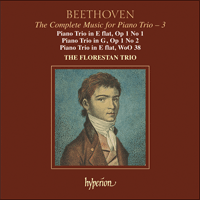

In early November 1792 the twenty-one-year-old Beethoven left his native Bonn for Vienna. His plan was to study composition with Haydn, by now an international celebrity, before conquering the city as a composer-performer. Soon after his arrival he became a house guest of Prince Karl Lichnowsky who held regular private soirées at which Beethoven would astonish the company with his brilliant keyboard improvisations; and it was at one of these soirées that he chose to introduce his first important Viennese compositions, the set of three piano trios which he published by subscription in August 1795. Haydn, recently returned from his second triumphant London visit, was present at the soirée, and warmly praised the E flat and G major trios which are presented on this new disc by the ever-flourishing Florestan Trio.
Beethoven was determined to create a stir in the world with his Opus 1, and seems to have laboured long on the trios, revising them extensively before publication. He had first ventured a piano trio in 1791, and it was no accident that he chose the medium to announce himself to the wider musical world. The combination of violin, cello and piano was a favourite with amateurs, promising healthy sales, and it assured Beethoven a star role on his own instrument.
Op 1 was enthusiastically received, and made the composer a handsome profit. Each of the trios is in four movements rather than the two or three expected in chamber music with piano: these are not elevated divertissements, but symphonies for three instruments.
The third of the Op 1 trios will appear on the fourth, and final, volume of the series, scheduled for release later in 2004.
All of the music on this album is also available as part of the specially priced box set Beethoven: The Complete Music for Piano Trio (download only).

Beethoven was determined to create a stir in the world with his Opus 1, and seems to have laboured long on the trios, revising them extensively before publication. He began work on No 2 in 1793, and on No 3 in 1794, while sketches for No 1 almost certainly date back to the Bonn years. Beethoven had first ventured a piano trio in 1791, and it was no accident that he chose the medium to announce himself to the wider musical world. The combination of violin, cello and piano was a favourite with amateurs, promising healthy sales. It assured Beethoven a star role on his own instrument. And unlike, say, the string quartet and the symphony, it had not been central to the output of Mozart or of Haydn, whose wonderful series of late trios was introduced to Vienna only after his return from London in August 1795.
Despite Haydn’s misgivings about the C minor, Beethoven’s Op 1 was enthusiastically received by both ‘connoisseurs’ and amateur musicians (‘Kenner und Liebhaber’ – a favourite eighteenth-century distinction), and made the composer a handsome profit. Yet with their largely emancipated string parts, their weighty, extended sonata structures and their intensity of musical dialectic, the three works must have seemed like a headlong assault on the traditional notion of the piano trio as a small-scale domestic genre. Each of the trios is in four movements rather than the two or three expected in chamber music with piano: these are not elevated divertissements, but symphonies for three instruments. And if the cello sometimes doubles the keyboard bass, as it rarely does in Beethoven’s later trios, it often asserts its individuality in a way that Mozart only intermittently and Haydn almost never allowed.
The first two movements of the E flat major Trio, No 1, are the most obviously Mozartian in the set, though the opening Allegro’s textural richness, thematic abundance and sheer breadth of scale are hallmarks of the young Beethoven. There is expansion at almost every level: say, in the second group’s leisurely proliferation of themes, beginning with a quiet chorale-like melody spiced with sforzando accents; or in the huge coda, in effect a second development, where first piano and then strings further exploit the movement’s opening ‘rocket’ figure, at one point nonchalantly turning it upside down.
The Adagio cantabile in A flat is just as expansive, a luxuriant rondo with a first episode fashioned as a soulful love duet for violin and cello (in its eloquent middle and upper registers) and an impassioned second episode in the outré key of A flat minor – calculated to appeal to the Kenner among Prince Lichnowsky’s audience. The third movement is the most subversively original in the work, and the first of Beethoven’s true scherzi: with its initial tonal ambiguity (the music feints at C minor, F minor and B flat before finally establishing E flat in bar 15), its comical obsession with the ‘flicking’ opening figure, and its mingled cussedness and mercurial lightness, it leaves its minuet model far in the background.
If the spirit of Mozart lies behind the first two movements, the sonata-form finale suggests Haydn in its verve and brilliance, and in the witty capital Beethoven makes of the initial leaping figure. But the coda is again expanded beyond Haydn’s dimensions into a second development. Its sly opening shift from E flat to E major and subsequent fortissimo wrench back again are an early example of a Beethoven ploy that will find its comic apotheosis in the finale of the Eighth Symphony.
The G major Trio immediately establishes its symphonic scale with an imposing slow introduction – something unheard of in a piano trio, and rare even in a string quartet. But the start of the Allegro lightens the atmosphere with a wispy, capricious theme that hovers on the dominant rather than emphasizing the tonic, G – shades here of Haydn’s ‘Oxford’ Symphony. Haydnesque, too, is the way this theme derives from phrases in the introduction. Beethoven is less lavish with his material than in the E flat Trio, though there is a delightfully jaunty ‘second subject’, proposed by the violin and then elaborated by the piano. But the first theme dominates both the development and the typically ample coda, where Beethoven continues to make witty and whimsical play with the theme’s opening phrase.
Haydn and Mozart wrote many Andantes in gently swaying 6/8 siciliano rhythm. But only rarely did they compose a siciliano in the slower, Adagio tempo. It is characteristic of the young Beethoven’s search for increased profundity of expression that the second movement of the G major Trio combines a siciliano lilt with an unprecedented hymn-like solemnity. The tempo marking, Largo con espressione, is itself novel and significant; and the rapt atmosphere is enhanced by the choice of key, E major, which sounds remote and radiant after G major. Beethoven shows a typical feeling for long-range tonal planning when he later plunges dramatically (with a sudden fortissimo) from B major to the work’s home key of G, initiating a searching modulating development of the opening theme.
Though definitely a scherzo rather than a minuet, the third movement is less wilful than its counterpart in Op 1 No 1, playing insouciantly with rising and falling scales, à la Haydn. The Trio turns to B minor for a laconic waltz of comic banality – the kind of music likely to turn up in Beethoven’s works from the early years right through to the visionary late quartets. After the return of the scherzo Beethoven appends a brief coda that toys with the theme’s opening figure before dying away to pianissimo.
The finale was originally in 4/4 time. But at an early run-through the cellist Anton Kraft (best-known for his association with Haydn) suggested that the music would be better notated in 2/4, and Beethoven duly adopted the idea. Opening with a catchy ‘riding’ theme in rapid repeated notes (perfect for the violin, but artfully refashioned when the piano takes it over), this is another movement that infuses Haydn’s spirit with Beethoven’s own brand of boisterousness. The music is full of aggressive sforzando accents, rough dynamic contrasts (at their most extreme in the coda) and mysterious or dramatic plunges to distant keys. The development alights for a while in E major, the key of the Adagio – another instance of Beethoven’s large-scale tonal strategy. But perhaps the wittiest moment of all comes with the start of the recapitulation. Here a smooth new figure in octaves on the piano seems to be preparing for the return of the ‘riding’ theme, which then enters unobtrusively, before we realize it, while the piano octaves continue as if nothing has happened.
As a bonne bouche The Florestan Trio offers a rarely aired work from Beethoven’s last years in Bonn: the Trio in E flat, WoO38, written in 1790 or 1791 and doubtless played by the composer with members of the Elector’s orchestra. This slender, amiable three-movement work seems almost tentative beside the ambitious Opus 1 trios. But it contains much charming, unassuming music, together with occasional prophetic touches like the subtle elision of development and recapitulation in the first movement. The development introduces a new falling arpeggio figure that Beethoven fleetingly recalls in the coda and was to put to more dramatic use a few years later in the Piano Sonata in F minor, Op 2 No 1.
The middle movement is also in E flat, making this a rare Beethoven work that retains the same key and mode throughout. Though labelled ‘Scherzo’, this is really a minuet, gentler and more decorous than the examples Haydn was producing by this time. The delightful Trio is a bucolic German dance. For the finale Beethoven writes an easy-going rondo whose lilting theme is varied on each of its reappearances. The cello has more independence here than in the earlier movements, especially in the imitative dialogues in the second, ‘developing’ episode. The quiet sideslip to a surprise key in the coda is an early example of a Haydnesque gambit which Beethoven would fruitfully exploit in the years to come.
Richard Wigmore © 2004
Résolu à faire grand bruit avec son op.1, Beethoven semble avoir longuement travaillé ses trios, les révisant largement avant de les publier. Si les numéros 2 et 3 furent commencés l’un en 1793, l’autre en 1794, les esquisses du numéro 1 remontent, elles, très certainement aux années passées à Bonn. Beethoven s’était déjà risqué à un trio avec piano en 1791, et ce ne fut donc pas par hasard qu’il choisit ce genre pour se présenter à un plus grand public musical – la combinaison violon/violoncelle/piano, parmi les préférées des amateurs, promettait de bonnes ventes et assurait à Beethoven la vedette sur son propre instrument. En outre, et contrairement au quatuor à cordes ou à la symphonie, par exemple, le trio avec piano n’avait pas été au cœur de la production d’un Mozart ou d’un Haydn, Haydn dont la merveilleuse série de trios tardifs ne fut présentée à Vienne qu’après son retour de Londres, en août 1795.
Malgré les réserves haydniennes quant au trio en ut mineur, l’op.1 de Beethoven reçut un accueil enthousiaste des connaisseurs et des musiciens amateurs (des «Kenner und Liebhaber», pour reprendre une distinction courante au XVIIIe siècle) et assura au compositeur un joli profit. Pourtant, avec leurs parties de cordes largement émancipées, leurs structures de sonate pesantes, prolongées, et leur dialectique musicale intense, ces trois œuvres ont dû faire figure d’assaut impétueux contre la notion traditionnelle du trio avec piano conçu comme un genre domestique à petite échelle. Chacun de ces trios compte ainsi quatre mouvements, au lieu des deux ou trois habituellement attendus dans la musique de chambre avec piano: ce ne sont pas des divertissements élevés, mais des symphonies pour trois instruments. Et si le violoncelle double parfois la basse du clavier – ce qui se produit rarement dans les trios beethovéniens ultérieures –, il affirme souvent son individualité d’une manière que Mozart ne s’autorisa que par intermittence et Haydn presque jamais.
Les deux premiers mouvements du Trio en mi bémol majeur no1 sont les plus ouvertement mozartiens du corpus, même si la richesse de texture, la luxuriance thématique et l’ampleur d’échelle de l’Allegro sont le sceau du jeune Beethoven. L’accroissement est présent à presque tous les niveaux: dans la tranquille prolifération de thèmes du second groupe, qui s’ouvre sur une paisible mélodie de type choral épicée d’accents sforzando, mais aussi dans l’énorme coda, en réalité un second développement, où le piano, puis les cordes, exploitent plus avant la figure de «fusée» initiale du mouvement, la mettant, à un moment, à l’envers.
L’Adagio cantabile en la bémol, tout aussi expansif, est un luxuriant rondo qui voit un premier épisode façonné en un attendrissant duo d’amour pour violon et violoncelle (dans ses éloquents registres moyen et aigu) précéder un fervent second épisode sis dans la tonalité outrancière de la bémol mineur – destinée à séduire les Kenner de l’auditoire du prince Lichnowsky. Le troisième mouvement, le plus subversivement original de l’œuvre, est le premier vrai scherzo de Beethoven: son ambiguïté tonale initiale (la musique feinte vers ut mineur, fa mineur et si bémol avant de finalement instaurer mi bémol à la mesure 15), son obsession comique quant à la figure d’ouverture «subite» et son entêtement mêlé d’une légèreté pleine d’entrain lui permettent de laisser loin derrière lui son modèle de menuet.
Si l’esprit de Mozart plane sur les deux premiers mouvements, le finale de forme sonate évoque Haydn tant par sa verve et son éclat que par l’intelligente exploitation de sa figure bondissante initiale. Mais, de nouveau, la coda est amplifiée bien au-delà des dimensions haydniennes dans un second développement. Son astucieuse transition d’ouverture, de mi bémol à mi majeur, et la torsion fortissimo subséquente sont la manifestation précoce d’un stratagème beethovénien qui trouvera son apothéose dérisoire dans le finale de la Huitième symphonie.
Le Trio en sol majeur asseoit d’emblée son envergure symphonique par une lente et imposante introduction – fait sans précédent dans un trio avec piano et rare ailleurs, même dans un quatuor à cordes. Mais le début de l’Allegro illumine l’atmosphère grâce à un thème effilé, fantasque, qui rôde autour de la dominante plutôt que d’accentuer la tonique (sol) – ici flottent les ombres de la Symphonie «Oxford» de Haydn. Tout aussi haydnesque est la manière dont ce thème dérive de phrases issues de l’introduction. Beethoven est moins généreux avec son matériau que dans le Trio en mi bémol, malgré la présence d’un «second sujet» délicieusement allègre, proposé par le violon, puis développé par le piano. Mais le premier thème domine à la fois le développement et la coda, d’une ampleur typique, où Beethoven poursuit son jeu fantasque et plein d’esprit avec la phrase d’ouverture du thème.
Auteurs de maints Andante dans un rythme de sicilienne doucement oscillant à 6/8, Haydn et Mozart ne composèrent que rarement une sicilienne dans le tempo de l’Adagio, plus lent. Révélant une quête de profondeur d’expression accrue chez le jeune Beethoven, le second mouvement du Trio en sol majeur marie un rythme du sicilienne à une solennité hymnique sans précédent. L’indication de tempo, Largo con espressione, est en soi novatrice et significative, cependant que l’atmosphère captivante est rehaussée par le choix de la tonalité, mi majeur, qui semble lointaine et rayonnante après sol majeur. Beethoven fait montre d’un sens bien à lui de l’agencement tonal à long terme lorsque, plus tard, il plonge spectaculairement (avec un fortissimo soudain) de si majeur à la tonalité mère de l’œuvre (sol), déclenchant un rigoureux développement modulant du thème d’ouverture.
Pour tenir assurément plus du scherzo que du menuet, le troisième mouvement n’en est pas moins moins obstiné que son pendant de l’op.1 no1 et joue, de manière insouciante, avec des gammes ascendantes et descendantes, à la Haydn. Le Trio passe à si mineur pour une valse laconique, d’une banalité dérisoire – un genre de musique susceptible d’apparaître dans les œuvres du Beethoven des premières années comme des derniers quatuors visionnaires. Passé le retour du scherzo, le compositeur appose une brève coda qui joue avec la figure d’ouverture du thème avant de s’éteindre sur un pianissimo.
Le finale était originellement à 4/4 mais, lors d’une des premières répétitions, le violoncelliste Anton Kraft (mieux connu pour ses liens avec Haydn) suggéra que la musique gagnerait à être notée à 2/4 – ce que Beethoven fit. S’ouvrant sur un thème «chevauchant», facile à retenir, en rapides notes répétées (parfaites pour le violon et astucieusement remodelées lorsque le piano les reprend), il s’agit, là encore, d’un mouvement qui insuffle à l’esprit haydnien le sceau tumultueux beethovénien. La musique est toute accents agressifs sforzando, âpres contrastes dynamiques (à leur extrême dans la coda) et mystérieuses, ou spectaculaires, plongées dans des tonalités lointaines. Le développement fait un instant halte en mi majeur, la tonalité de l’Adagio – nouvel exemple de la stratégie tonale à grande échelle de Beethoven. Mais le moment le plus spirituel survient peut-être avec le début de la reprise: une régulière figure nouvelle, en octaves, au piano, semble préparer le retour du thème «chevauchant», qui fait une entrée discrète, avant même que nous nous en apercevions, tandis que les octaves du piano se poursuivent comme si de rien n’était.
Le Florestan Trio a gardé pour la bonne bouche une œuvre rarement programmée, issue des dernières années que Beethoven passa à Bonn: le Trio en mi bémol, WoO38, écrit en 1790 ou en 1791, et que le compositeur joua sans nul doute avec les membres de l’orchestre de l’électeur. Cette aimable œuvre élancée, en trois mouvements, paraît presque expérimentale à côté des ambitieux Trios, op.1. Elle n’en offre pas moins une musique fort charmante, sans prétention, ainsi que d’occasionnels instants prophétiques, telle la subtile élision du développement et de la reprise dans le premier mouvement. Le développement introduit une nouvelle figure arpégée descendante, que Beethoven reprend rapidement dans la coda – il en fera, quelques années plus tard, un usage davantage dramatique dans la Sonate pour piano en fa mineur, op.2 no1.
Le mouvement médian ne dérogeant pas au mi bémol, cette œuvre est l’une des rares de Beethoven à constamment conserver la même tonalité et le même mode. Quoique étiqueté «Scherzo», il s’agit en réalité d’un menuet, plus doux et bienséant que ceux produits par Haydn à la même époque. Ce ravissant Trio est une bucolique danse allemande. Pour le finale, Beethoven écrit un rondo décontracté, dont le thème harmonieux est varié à chaque apparition. Le violoncelle y apparaît plus indépendant que dans les mouvements antérieurs, notamment dans les dialogues imitatifs du second épisode «en développement». La paisible glissade vers une tonalité surprise, dans la coda, est un exemple précoce d’une astuce haydnesque que Beethoven allait exploiter avec bonheur dans les années à venir.
Richard Wigmore © 2004
Français: Hypérion
Beethoven war entschlossen, mit seinem Opus 1 Aufsehen zu erregen, scheint lange an den Trios gearbeitet zu haben und revidierte sie noch einmal umfassend, ehe er sie veröffentlichte. Er begann 1793 mit der Arbeit an Nr. 2 und 1794 an Nr. 3, wohingegen erste Entwürfe zur Nr. 1 mit ziemlicher Sicherheit auf die Bonner Jahre zurückgehen. Beethoven hatte sich erstmals 1791 an einem Klaviertrio versucht, und es war kein Zufall, dass er diese Gattung wählte, um sich der weiteren Musikwelt vorzustellen. Die Kombination von Violine, Cello und Klavier war bei Amateuren besonders beliebt, was gute Verkaufszahlen versprach. Sie gewährleistete Beethoven eine führende Rolle auf seinem eigenen Instrument. Und anders als beispielsweise das Streichquartett oder die Sinfonie hatte sie weder im Schaffen von Mozart eine zentrale Rolle gespielt noch in dem von Haydn, der seine wunderbare Serie später Trios in Wien erst nach der Rückkehr aus London im August 1795 vorstellte.
Trotz Haydns Bedenken bezüglich des c-Moll-Trios fand Beethovens Opus 1 begeisterte Aufnahme bei Kennern ebenso wie bei Amateurmusikern („Kenner und Liebhaber“ – eine beliebte Unterscheidung im achtzehnten Jahrhundert) und brachte dem Komponisten einen ansehnlichen Profit ein. Doch mit ihren weitgehend unabhängigen Streicherstimmen, den gewichtigen, erweiterten Sonatensatzformen und der Intensität ihrer musikalischen Dialektik müssen die drei Werke wie ein ungestümer Angriff auf die traditionelle Vorstellung vom Klaviertrio als häusliche Kleinform gewirkt haben. Alle drei Trios stehen in vier Sätzen statt der zwei oder drei, die von Kammermusik mit Klavier zu erwarten wäre: Dies sind keine besseren Divertissements, sondern Sinfonien für drei Instrumente. Und wenn das Cello auch manchmal die Basslinie im Klavier verdoppelt, was bei Beethovens späteren Trios selten der Fall ist, pocht das Instrument oft in einer Weise auf seine Individualität, die ihm Mozart nur gelegentlich und Haydn fast nie gestattete.
Die ersten beiden Sätze des Trios in Es-Dur Nr. 1 erinnern von allen aus Opus 1 am ehesten an Mozart, obwohl der strukturelle Reichtum, die Themenfülle und die schiere Breite der Anlage den jungen Beethoven auszeichnen. Es findet sich Erweiterung auf allen Ebenen, so z.B. in der gemächlichen Themenwucherung der zweiten Gruppe, angefangen mit einer leisen choralartigen Melodie, gewürzt mit sforzando-Akzenten; oder in der umfangreichen Coda, die im Grunde eine zweite Durchführung darstellt – hier beuten erst das Klavier und dann die Streicher die einleitende Raketenfigur des Satzes weiter aus und stellen sie einmal sogar nonchalant auf den Kopf.
Das Adagio cantabile in As-Dur ist ebenso expansiv, ein reich ausgeschmücktes Rondo mit einer ersten Episode, die als gefühlvolles Liebesduett für Violine und Cello (in seinem ausdrucksvollen mittleren und oberen Register) gestaltet ist, und einer leidenschaftlichen zweiten Episode in der extravaganten Tonart as-Moll – darauf angelegt, den Kennern unter den Zuhörern im Salon des Fürsten Lichnowsky zu gefallen. Der dritte Satz ist der subversiv originellste des Werks und das erste von Beethovens echten Scherzi: In seiner anfänglichen tonalen Mehrdeutigkeit (die Musik fintiert nach c-Moll, f-Moll und B-Dur, ehe sie sich im 15. Takt schließlich auf Es-Dur festlegt), seiner ulkigen Versessenheit auf die „schnalzende“ Figur der Einleitung und der Mischung aus Sturheit und quecksilbriger Leichtigkeit lässt er das Menuett, das ihm als Vorbild dient, weit hinter sich zurück.
Wenn die ersten beiden Sätze dem Geiste Mozarts verhaftet sind, so gemahnt das schwungvoll-brillante Finale in Sonatensatzform an Haydn, insbesondere in der Art, wie Beethoven aus der einleitenden springenden Figur geistreich besonderes Kapital schlägt. Die Coda ist jedoch wiederum weit über die Dimensionen Haydns hinaus zu einer zweiten Durchführung erweitert. Ihr verschlagener Wechsel von Es-Dur nach E-Dur zu Anfang, gefolgt von der fortissimo gespielten Rückführung, ist ein frühes Beispiel für ein Beethovensches Manöver, das im Finale der Achten Sinfonie seine komische Apotheose findet.
Das Trio in G-Dur etabliert seinen sinfonischen Maßstab sofort mit einer imposanten langsamen Introduktion – unerhört für ein Klaviertrio und sogar im Streichquartett eher rar. Doch der Beginn des Allegros erhellt die Atmosphäre mit einem hauchfeinen, kapriziösen Thema, das auf der Dominante verharrt, statt die Tonika G zu betonen – man fühlt sich an Haydns „Oxford-Sinfonie“ erinnert. Ebenso an Haydn orientiert ist die Art, wie dieses Thema aus Phrasen der Introduktion abgeleitet ist. Beethoven geht hier mit seinem Material weniger verschwenderisch um als im Es-Dur-Trio, auch wenn sich ein wunderbar keckes Seitenthema findet, das von der Violine angespielt und dann vom Klavier weiter ausgeführt wird. Doch das Hauptthema beherrscht sowohl die Durchführung als auch die typisch weitläufige Coda, in der Beethoven weiterhin geistreich und launig mit der Einleitungsphrase des Themas spielt.
Haydn und Mozart komponierten zahlreiche Andantes im sanft wiegenden Siciliano-Rhythmus im 6/8-Takt. Doch nur selten schrieben sie ein Siciliano im langsameren Adagio-Tempo. Es ist für die Suche des jungen Beethoven nach mehr expressivem Tiefgang charakteristisch, dass der zweite Satz des G-Dur-Trios den Schwung eines Siciliano mit unerhörter hymnischer Feierlichkeit zu verbinden weiß. Die Tempoangabe Largo con espressione ist an sich schon neuartig und bedeutungsvoll; und die verzückte Atmosphäre wird noch verstärkt durch die Wahl der Tonart E-Dur, die im Anschluss an G-Dur entlegen und stahlend klingt. Beethoven beweist seinen typischen Sinn für vorausschauende Tonartplanung, wenn er die Musik später dramatisch (mit unvermitteltem fortissimo) von H-Dur in die Grundtonart G-Dur abstürzen lässt und damit eine eingehende, modulierende Durchführung des Anfangsthemas einleitet.
Obwohl es sich beim dritten Satz eindeutig um ein Scherzo handelt, nicht um ein Menuett, ist er weniger mutwillig als sein Gegenstück aus op. 1 Nr. 1 – der Satz spielt unbekümmert à la Haydn mit an- und absteigenden Tonleitern. Nun wendet sich das Trio für einen lakonischen Walzer voll komischer Banalität der Tonart h-Moll zu – diese Art Musik durchzieht Beethovens Schaffen von den frühesten Jahren bis hin zu den visionären späten Quartetten. An die Rückkehr des Scherzos hängt Beethoven eine kurze Coda, die ihr Spiel mit der Eröffnungsfigur des Themas treibt, ehe sie pianissimo erstirbt.
Das Finale stand ursprünglich im 4/4-Takt. Doch bei einer frühen Durchspielprobe meinte der Cellist Anton Kraft (heute vorwiegend für seine Verbindung zu Haydn bekannt), die Musik wäre angemesser in 2/4 notiert, und Beethoven übernahm den Vorschlag auch prompt. Dieser Satz, der mit einem eingängigen „Reiterthema“ in raschen wiederholten Noten einsetzt (sie liegen perfekt für die Violine, werden jedoch kunstvoll umgearbeitet, wenn das Klavier das Thema übernimmt), pflanzt dem Geist Haydns wiederum Beethovens eigene Sorte Ausgelassenheit ein. Die Musik ist voller aggressiver sforzando-Akzente, heftiger dynamischer Kontraste (am extremsten in der Coda) sowie mysteriösen oder dramatischen Sprüngen in entlegene Tonarten. Die Durchführung setzt sich eine Weile in E-Dur fest, der Tonart des Adagio – ein weiteres Beispiel für Beethovens groß angelegte Tonartstrategie. Doch der geistreichste Einfall von allen macht sich am Beginn der Reprise bemerkbar. Hier scheint eine glatte neue Figur in Oktaven auf dem Klavier die Rückkehr des „Reiterthemas“ vorzubereiten, das dann unauffällig einsetzt, ehe wir es so recht bemerken, während sich die Klavieroktaven fortsetzen, als sei nichts geschehen.
Als besonderen Leckerbissen bietet das Florestan-Trio noch ein selten gespieltes Werk aus Beethovens letzten Bonner Jahren dar: Das Trio in Es-Dur, WoO38, entstanden 1790 oder 1791 und vom Komponisten zweifellos mit Mitgliedern des Kurfürstlichen Orchesters aufgeführt. Dieses schlanke, liebenswerte Werk in drei Sätzen wirkt neben den anspruchsvollen Trios op. 1 beinahe zaghaft. Doch es enthält viel charmante, unprätentiöse Musik neben gelegentlichen vorausweisenden Anklängen wie der feinfühlingen Verknappung von Durchführung und Reprise im Kopfsatz. Die Durchführung führt eine neue abfallende Arpeggiofigur ein, an die Beethoven in der Coda kurz erinnert und aus der er Jahre später in der Klaviersonate in f-Moll op. 2 Nr. 1 dramatischeren Nutzen ziehen sollte.
Der Mittelsatz steht ebenfalls in Es-Dur, was dieses Werk zu einem jener seltenen in Beethovens Schaffen macht, die durchweg die gleiche Tonart und den gleichen Modus beibehalten. Obwohl er als Scherzo bezeichnet wird, handelt es sich bei dem Satz in Wahrheit um ein Menuett, sanfter und schicklicher als die von Haydn um diese Zeit geschaffenen. Das wunderbare Trio ist ein bukolischer deutscher Tanz. Als Finale setzt Beethoven ein unbekümmertes Rondo, dessen beschwingtes Thema bei jedem neuerlichen Erklingen abgewandelt wird. Dem Cello wird hier mehr Unabhängigkeit zugestanden als in den vorhergehenden Sätzen, insbesondere in den imitativen Dialogen der zweiten, „durchführenden“ Episode. Das unauffällige Abgleiten in eine unvermutete Tonart in der Coda ist ein frühes Beispiel für einen an Haydn orientierten Kniff, den Beethoven in kommenden Jahren nutzbringend zum Einsatz bringen sollte.
Richard Wigmore © 2004
Deutsch: Anne Steeb/Bernd Müller


