Welcome to Hyperion Records, a British classical label devoted to presenting high-quality recordings of music of all styles and from all periods from the twelfth century to the twenty-first.
Hyperion offers both CDs, and downloads in a number of formats. The site is also available in several languages.
Please use the dropdown buttons to set your preferred options, or use the checkbox to accept the defaults.
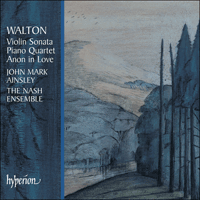

Hyperion continues to salute Walton's centenary year with a selection of his chamber music. This is a collection of intimate works providing many insights into the composer's life. The Piano Quartet, for example, is the first work in which Walton considered he had shown any talent as a composer, and the Valse from Façade illustrates his irreverence towards popular music of the day.
Before Anon in Love, Walton had yet to write for the guitar. The work was commissioned by Peter Pears and Julian Bream who coached him about the instrument’s characteristics. The Passacaglia arose from a friendship with Mstislav Rostropovich, who challenged the composer to write something for him. Loosely based on Bach's works for solo cello, the work comprises a theme and ten variations and was premiered by Rostropovich at Walton's eightieth birthday celebrations.
A chance meeting with Diana Gould, the then-fiancée of Yehudi Menuhin, resulted in the prompt commission of the Violin Sonata. It was to become infused with tragedy following the death of Walton's partner of fourteen years, Alice, Lady Wimbourne, during the work's composition. Walton's overwhelming sense of loss is much in evidence and it now stands as one of his finest achievements.

Walton had become a chorister at Christ Church Cathedral at the age of ten, and with help from his principal mentor, the Dean, Dr Thomas Strong, had remained at the choir school after his voice broke in 1916. In June 1918 he passed the first part of his Bachelor of Music examination and the following November was awarded an Exhibition for two years by Christ Church. In the same year he began composing the Piano Quartet. Despite his precocious musical talents he was obliged to pass the University’s Responsions matriculation examination. After three failed attempts he was finally sent down. By this time, however, he had become the protégé of the Sitwell family, in whose company in the spring of 1920 he visited Italy where he completed the quartet. Unfortunately Walton posted the score back to England and it was lost for a year. Amazingly it resurfaced and Walton made further revisions.
Walton’s decision to write a piano quartet was pragmatic, since he hoped to emulate the success of Herbert Howells’s Piano Quartet of 1916, which had won an award in the first of the Carnegie Trust’s competitions. His ambition succeeded for it too won an award and was published under the Trust’s auspices in 1924 with a dedication to Strong. It was first performed in Liverpool on 19 September 1924 by members of the McCullagh String Quartet with the pianist James Wallace. Walton made further revisions in 1973 after a performance at the Aldeburgh Festival and prior to the publication of a new edition by Oxford University Press.
Given its model, it is not surprising that the shadow of Howells is present in the work, particularly in the first movement. Ravel’s influence is apparent too, as is Stravinsky’s in the rhythmic drive found in both the scherzo and finale, a feature that was to become a hallmark of Walton’s mature style. Another aspect of the quartet that was to be a characteristic of the mature composer is the manner in which Walton develops his thematic ideas by a process of constant evolution, rather than within the confines of a ‘development’ section.
The first movement (Allegramente) is cast in a regular sonata form, opening with the violin, accompanied by a cello drone, playing a gentle modal melody clearly imbued with the spirit of English folk music. Of crucial thematic importance are the notes and rhythmic pattern of the second bar, which act as a germ recurring throughout the work. By contrast the piano has a dramatic, staccato downward phrase which leads to a fortissimo repeat of the violin tune. The piano also announces the flowing second subject in octaves. Fragments from the themes are submitted to Walton’s ongoing transformation process in the short development section. In the coda the music quietens to leave just a ghost of the opening.
The exuberant, playful scherzo is created from four elements: the accentuated rhythmic fragments and the teasing cross-rhythms of the opening; a swaying piano tune; a fugato for the strings alone (the notes of which are derived from the Allegramente’s opening theme); and a proud tune, introduced by the piano, which might be summed up as Elgar crossed with Howells.
In the background of the Andante tranquillo Ravel looms large. Indeed, Walton’s friend, the pianist Angus Morrison, pointed out that the main theme, which is shared between strings and piano, bears an uncanny resemblance to ‘Le martin-pêcheur’ from the former’s Histoires naturelles. The middle section is ushered in by doleful piano chords and harmonics from the violin and leads to an extended viola solo. Briefly the music becomes more agitated, then calms to present a barren landscape in which cello and viola play sombre allusions to the Allegramente’s opening theme, alternating with a dark chorale-like passage for the piano. A pianissimo violin solo brings relief to the oppressive mood as the music strengthens and surges to the movement’s climax and a return of the opening idea.
The last movement is a sonata rondo that abounds with syncopated energy. Incisive off-beat quavers from the strings, and a piano plunge downwards set it in motion followed by the swaggering main tune characterised by repeated notes. Typically, a tiny fragment from it is singled out for use from here on. A flowing cello melody is the basis for the first episode and a fugato forms the second, itself derived from the rondo tune. Later the rondo theme is heard at its most vivacious in a passage that brings Petrushka to mind. Towards the end the music stills; there is a brief recall of the opening of the quartet, before the tempo picks up and the work is whirled to an exhilarating conclusion.
Anon in Love arose from a commission by the tenor Peter Pears and the guitarist Julian Bream who gave the premiere at Shrubland Park Hall, Ipswich, on 21 June 1960 during the Aldeburgh Festival. Pears had suggested to Walton that in concept the work might have the character of a ‘one-man opera’; this appealed to the composer who turned to Christopher Hassall, the librettist of his opera Troilus and Cressida, for advice. Six anonymous sixteenth- and seventeenth-century lyrics on the subject of love emerged as the texts, which Hassall chose from the anthology The English Galaxy of Shorter Poems edited by Gerald Bullett. Walton himself coined the witty title. As writing for the guitar was a new challenge for the composer, Bream demonstrated its characteristics to him and provided a diagram of the fingerboard.
The first three lyrics were also used by English Renaissance lute and madrigal composers, and are found respectively in Hume’s Musicall Humors (1605), John Farmer’s first book of madrigals (1599) and John Wilbye’s first book of madrigals (1598). Throughout the songs Walton reflects the spirit of such composers: rhythmic conceits within the poems are exploited; so too is the expressive potential of word-play, as heard in the first setting with its wide, expressive intervals for the voice and the aching dissonance between voice and guitar at the opening.
The second song with its puckish accompaniment finds the lover in cajoling mood, although the saucy punch line of the object of his desire shows that his earnest endeavours were unnecessary! In the third the lover compares the colour of damask roses to his lover’s lips in an ardent vocal line that reaches a sensuous climax, appropriately, on the word ‘lips’. The fourth song has a vivacious scherzo-like quality with the voice part mainly in quavers until it pointedly changes to staccato crotchets for the final pert line, ‘When all her robes are gone’. In ‘I gave her cakes and I gave her ale’ the music has a rollicking character with virtuoso writing for both voice and guitar featuring glissandi, grace-notes and the body of the guitar tapped in imitation of a drum. The melody of the final song is almost like a folk song which in the first three verses is accompanied by the nonchalant ‘vamping’ of the guitar. In the final verse, however, both voice and guitar increasingly become more animated with syncopated rhythms and misplaced accents that create a mood of heady anticipation at the prospect of the lover winning his lady’s hand.
Walton’s name came to the fore with the first public performance of Façade in 1923. Edith Sitwell and her brothers Osbert and Sacheverell had conceived it as a drawing-room entertainment in which Edith’s seemingly nonsensical poems had exploited pure rhythms and the sounds of words. They decided that music was to be an essential ingredient in the ‘entertainment’ and drafted in Walton. Façade was first performed privately in 1922, with the public premiere taking place seventeen months later at the Aeolian Hall, London, where it was greeted with a mixture of bewilderment and hostility – ‘Drivel they Paid to Hear’ was one headline! Between those two performances considerable changes took place, with some numbers being dropped and new ones added. Valse was one of the latter; it became No 16 of the definitive version published in 1951, and was published in Walton’s arrangement for piano in 1928. With its tongue-in-cheek allusions to the popular music of the day, the ‘Valse’ is typical of the delicious wit that characterises the whole of Façade.
Walton met Mstislav Rostropovich at the 1970 Aldeburgh Festival when the latter had played Prokofiev’s Sinfonia Concertante in the same concert that Walton’s Improvisations on an Impromptu of Benjamin Britten received its British premiere. They became friends after a good-humoured exchange of banter during which Walton asked Rostropovich when he was going to play his cello concerto, and the latter replied by issuing a challenge – if Walton wrote him a new work then he would play both it and the concerto! Almost a decade later, in 1979, Walton started work on a short piece for solo cello intended for Rostropovich, but progress was desperately protracted since he found composing more and more difficult in his old age.
The work, titled Passacaglia, was completed the following year. Walton had in mind Bach’s works for solo cello whilst composing it and considered it more suitable for private rather than public performance. Rostropovich gave the premiere in London on 16 March 1982 as part of the composer’s eightieth birthday celebrations. It comprises a sombre theme followed by ten variations. The first three inhabit the instrument’s lower register, whilst the fourth soars to reach the highest. Variations five and six are faster, and in the seventh pizzicato chords accompany an expressive melodic line. The eighth and ninth combine to make a characteristic fleet and rhythmic Waltonian scherzo, and the work ends in a fast and furious plethora of notes.
The Violin Sonata arose out of a period of turmoil and change in the composer’s life. Its composition was begun in 1947 under tragic circumstances arising from the illness of Alice, Lady Wimborne, with whom he had been having a relationship since 1934. It was not completed until 1949, almost a year after her death, by which time he had met and married a young Argentinian, Susanna Gil.
In 1947 Alice Wimborne was unwell, but her doctor could find nothing wrong. That September she and Walton set out for a holiday in Italy, but they only got as far as Lucerne when her condition worsened. Cancer of the bronchus was diagnosed and she was admitted to hospital. In the immediate post-war years obtaining finances at a distance from home presented considerable difficulties and Walton was desperately worried about how the costs of her treatment would be paid. Recalling the situation in a letter to Angus Morrison in 1969, Walton wrote that by chance he met Diana Gould, who was shortly to become the wife of Yehudi Menuhin, and having explained his plight to her she promptly commissioned on Menuhin’s behalf a sonata for him and her brother-in-law, the pianist Louis Kentner.
Menuhin duly advanced him half of the commission fee and Walton set to work. Composition on the sonata though was interrupted by writing the film score for Olivier’s Hamlet and then by the final harrowing stage of Alice Wimborne’s illness. He resumed work on the sonata after her death on 19 April 1948. Although Walton made no outward reference to his feelings following his loss, it is hard not to hear, in at least the first movement of the sonata, a musical reaction. It was first performed in Zürich by Menuhin and Kentner on 30 September 1949, after which Walton made some revisions, and this definitive version was first heard at the Theatre Royal, Drury Lane, London, on 5 February 1950, played by the same artists.
Despite the sporadic nature of its composition, set against such a varied set of personal circumstances, the work is highly concentrated and stands as one of Walton’s finest achievements. Over a gentle lapping piano accompaniment, the violin plays a lyrical theme that is full of tenderness. A tiny semiquaver gruppetto heard at the beginning of the melody is important in the subsequent thematic development, not only in the first movement, but in the work as a whole, as is a second version of the gruppetto two bars later. The first paragraph ends with an emphatic phrase for piano, then violin, that thrusts upwards, before the pianist introduces the second principal idea. This is not so much of a contrast, however, and it seems to inhabit the same mood established at the outset, particularly as it ends with its own version of the gruppetto that is shot through with a heartrending poignancy. True contrast comes with an agitated appearance of the gruppetto beginning with an upward major seventh (a Walton hallmark) which initiates an assertive and dynamic passage with accents on and off the beat for violin and piano respectively.
In the ebb and flow of the development both instruments share the exploration of the musical material, with the violin making much of the gruppetto as it strives to soar ever higher. Walton caps the movement in inspired fashion, with an extended, contemplative coda in which the violin takes a final look at the main theme against the arpeggiated chords of the piano played with the soft pedal. Its outward tranquillity masks, nevertheless, an undeniable sense of loss lying beneath the surface.
The form of the second movement is a theme and variations. The eight-bar ‘Tema’ is self-contained in character, with none of the expansiveness that marked the first movement’s principal theme. The piano alone then concludes the main material with a chromatic melody that embraces first ten, then all twelve notes of the chromatic scale. Some commentators have alluded to this as a series, but Walton does not exploit them in any Schoenbergian sense.
In the first variation the theme is heard in the context of a different rhythm, 6/8, and is set in spare two-part counterpoint with the piano. The marking for Variation 2, a tempo quasi improvisando, gives the clue to its character, and it culminates in an impassioned outpouring from the violin. Variation 3 is a spiky march featuring double stopping on the violin and ending with a dissonant extension for piano alone. In Variation 4 the instruments tumble helter-skelter in unison and octaves, whilst Variation 5 has the violin playing steady pizzicato quavers against the piano’s florid arabesques. It ends with a short unaccompanied cadenza for the violin. The sixth variation, Scherzando, is appropriately swift and charged with rhythmic energy. Variation 7 is the longest: set to alternating 6/8 and 9/8 rhythms, it has a lilting barcarolle-like quality. The piano begins the coda with what seems like a twelve-note fugal subject; the violin however, does not take up the challenge with an answering subject, merely repeating it cheekily before launching both itself and the piano in a pyrotechnical display of bravura panache.
Andrew Burn © 2002
A dix ans Walton avait été admis au chœur de la Cathédrale Christ Church, à Oxford où grâce à l’aide de son principal mentor, le doyen Thomas Strong, il parvint à demeurer bien après que sa voix eut mué en 1916. En juin 1918, il passait la première partie de son examen pour l’obtention du diplôme de « Bachelor of Music ». En novembre, Christ Church lui octroyait une bourse de deux années. Ce fut au cours de cette année-là qu’il commença la composition de son Quatuor avec piano. Malgré des talents musicaux précoces, il dut s’y reprendre à plusieurs reprises pour tenter de passer l’examen « Responsions » de l’Université. Après trois échecs, il fut finalement renvoyé. Entre-temps, il était devenu le protégé de la famille Sitwell en compagnie de laquelle il visita l’Italie au printemps 1920. Ce fut durant ce séjour qu’il acheva son quatuor. Walton envoya la partition en Angleterre par la poste. Malencontreusement perdue pendant le voyage postal, elle réapparut miraculeusement un an plus tard. Walton conçut alors quelques révisions supplémentaires.
Walton avait choisi d’écrire un quatuor avec piano pour des motifs quelque peu pragmatiques. Peut-être espérait-il émuler le succès que Herbert Howells avait rencontré avec son quatuor avec piano de 1916 grâce auquel il avait remporté le premier des concours de la Fondation Carnegie. Son ambition fut également couronnée de succès puisque sa composition remporta également un prix et fut publiée sous les auspices de la Fondation en 1924 avec une dédicace à Strong. La première audition eut lieu à Liverpool le 19 septembre 1924 sous les doigts des membres du Quatuor McCullagh en compagnie du pianiste James Wallace. Walton remania cette pièce en 1973, après avoir entendu une exécution donnée au Festival d’Aldeburgh, et avant que ne paraisse une nouvelle édition chez Oxford University Press.
Etant donné sa source d’inspiration, il n’est pas étonnant que l’ombre de Howells plane dans l’œuvre, en particulier dans le premier mouvement. L’influence de Ravel y est également perceptible, tout comme celle de Stravinsky dans l’élan rythmique figurant aussi bien dans le scherzo que dans le finale, un trait qui allait également devenir une caractéristique du style de maturité de Walton. Un autre aspect spécifique au quatuor qui allait devenir une caractéristique de la maturité est la manière dont Walton développe ses matériaux thématiques en un procédé d’évolution constante plutôt que de le confiner à une section de « développement ».
Le premier mouvement (« Allegramente ») s’inscrit dans une coupe sonate régulière, s’ouvrant avec le violon, accompagné par un bourdon au violoncelle, jouant une mélodie doucement modale clairement imprégnée de l’esprit de musique folklorique anglaise. Les notes et le motif rythmique de la deuxième mesure jouent un rôle thématique crucial, tout comme cette même mesure qui agit comme un germe récurrent durant toute l’œuvre. Par contraste, le piano cache une phrase dramatique, staccato, qui conduit à une reprise fortissimo de la mélodie dévolue au violon. Le piano annonce également le second thème fluide en octaves. Des fragments de thèmes sont exploités grâce au procédé de transformation continue de Walton en une courte section de développement. Dans la coda, la musique se calme pour ne laisser paraître qu’un fantôme de l’introduction.
Le scherzo exubérant et ludique est créé à partir de quatre éléments : des fragments rythmiques accentués et des contretemps taquins du début, une mélodie oscillante au piano, un fugato pour les cordes seules (dont les notes dérivent du premier thème de l’Allegramente) et une fière mélodie introduite par le piano que l’on pourrait décrire sommairement comme un croisement d’Elgar et de Howells.
En toile de fond de l’Andante tranquillo transparaît Ravel. Un ami de Walton, le pianiste Angus Morrison fit effectivement remarquer que le thème principal, partagé entre les cordes et le piano, ressemble étonnamment au « Martin-pêcheur » des Histoires naturelles de Ravel. La section centrale est annoncée par des accords mornes du piano et les harmoniques du violon. Elle nous mène à un important solo d’alto. La musique s’agite pendant un court instant puis se calme pour offrir un paysage nu où le violoncelle et l’alto se jouent des allusions sombres au thème initial de l’Allegramente qu’ils alternent avec un passage morose aux allures de choral au piano. Un solo pianissimo du violon apporte un répit à l’atmosphère oppressive alors que la musique s’affermit et s’élance en un paroxysme avant de retrouver l’idée initiale.
Le dernier mouvement est un rondo de sonate qui abonde en énergie syncopée. Il débute par des croches incisives à contretemps aux cordes et un piano qui plonge dans le grave avant que n’entre en scène une mélodie principale oscillante caractérisée par ses répétitions de notes. Trait typique, un minuscule fragment y est mis en exergue de temps à autres. Une mélodie fluide au violoncelle forme la base d’un premier épisode tandis qu’un fugato dérivant de la mélodie du rondo, forme le second. Plus tard, le thème du rondo se fait entendre dans sa version la plus animée en un passage qui n’est pas sans rappeler Petrouchka. Vers la fin, la musique se calme,. On y perçoit un souvenir furtif du début du quatuor avant que le tempo ne reprenne de l’allure et que l’œuvre ne se conclue en un tourbillon d’une immense exubérance.
Anon in Love vit le jour à la suite d’une commande du ténor Peter Pears et du guitariste Julian Bream qui en donnèrent la première à Shrubland Park Hall, à Ipswich, le 21 juin 1960 durant le Festival d’Aldeburgh. Pears avait suggéré à Walton d’embrasser au sein de cette œuvre le concept et le caractère d’un « one-man opera ». Cette idée séduisit Walton qui se tourna vers Christopher Hassal, le librettiste de son opéra Troilus and Cressida. Six textes anonymes des seizième et dix-septième siècles sur le sujet de l’amour furent retenus parmi ceux que Hassall sélectionna à partir de l’anthologie The English Galaxy of Shorter Poems, un ouvrage édité par Gerald Bullett. Walton lui-même trouva le titre plein d’esprit. Etant donné qu’il n’avait jamais écrit pour la guitare, Bream lui présenta les caractéristiques de l’instrument et lui fournit un diagramme des positions et des doigtés.
Les trois premiers textes furent aussi utilisés par les compositeurs de luth et de madrigaux de la Renaissance anglaise. On les trouve respectivement dans Musicall Humors (1605) de Hume, le premier livre de madrigaux de John Farmer (1599), et le premier livre de madrigaux de John Wilbye (1598). Tout au cours de ces mélodies, Walton reflète l’esprit de tels compositeurs, les caractéristiques rythmiques au sein des poèmes sont exploitées tout comme le potentiel expressif des jeux de mots comme dans la première réalisation musicale avec ses larges intervalles expressifs pour la voix et la dissonance douloureuse entre la voix et la guitare, au début.
La deuxième mélodie, avec son accompagnement digne de Puck, trouve l’amant d’humeur caressante, même si le mot de la fin, piquant, révélant l’objet de ses désirs, montre que ses entreprises les plus sérieuses n’étaient pas nécessaires ! Dans la troisième, l’amant compare la couleur des roses de Damas aux lèvres de sa bien-aimée dans une ligne vocale ardente qui atteint un apogée sensuel placé sur le mot « lèvres ». La quatrième mélodie possède une vivacité comparable à celle d’un scherzo avec la partie vocale écrite généralement en noires staccato jusqu’à la ligne finale « When all her robes are gone » [quand toutes ses robes sont enlevées]. Pour « I gave her cakes and I gave her ale » [Je lui ai donné des gâteaux et de la bière], la musique s’illustre par un caractère réjoui secondé par une écriture virtuose aussi bien de la voix que de la guitare, avec des glissandi, des notes de grâce et les pulsations martelées sur la caisse de la guitare en guise de tambour. Aux allures de chants folkloriques, la dernière mélodie est accompagnée pour ses trois premières strophes par l’accompagnement nonchalant de la guitare. Dans la dernière strophe, pourtant, la voix et la guitare s’animent progressivement, avec des rythmes syncopés et des déplacements d’accents qui créent une atmosphère d’anticipation fiévreuse à l’idée de l’amoureux gagnant la main de sa bien-aimée.
Le nom de Walton parvint sous les feux de la rampe avec la première exécution publique de Façade en 1923. Edith Sitwell et ses frères Osbert et Sacheverell l’avaient conçu comme un divertissement de salon où les poèmes apparemment incongrus d’Edith exploitaient l’aspect purement rythmique et sonore des mots. Ils décidèrent que la musique devait être un élément essentiel du « divertisssement » et enrôlèrent Walton. Façade reçut sa première audition privée en 1922 tandis que le public pouvait le découvrir pour la première fois dix-sept mois plus tard, à l’Aeolian Hall, à Londres. L’accueil se partagea entre perplexité et hostilité – « Ils ont payé pour entendre des foutaises » titra un des journaux ! Entre ces deux exécutions, la partition fut considérablement remaniée, avec quelques numéros coupés et d’autres ajoutés. Valse appartient à cette deuxième catégorie, et devint le n°16 de la version définitive publiée en 1951. Elle fut également publiée sous la forme d’arrangement pour piano en 1928. Avec ses allusions ironiques à la musique populaire de l’époque, la « Valse » est caractéristique de l’esprit délicieusement humoristique qui caractérise Façade dans son entier.
Walton rencontra Mstislav Rostropovitch durant l’édition 1970 du Festival d’Aldeburgh lorsque celui-ci donna la Sinfonia Concertante de Prokofiev durant le concert où les Improvisations on an Impromptu of Benjamin Britten de Walton recevait sa première britannique. Ils se lièrent d’amitiés après un échange de plaisanteries au cours duquel Walton demanda à Rostropovitch quand il allait enfin jouer son concerto pour violoncelle, et ce dernier de répondre par un défi – si Walton lui écrivait une pièce nouvelle, non seulement il jouerait celle-ci mais aussi le concerto. Quasiment une décennie plus tard, en 1979, Walton s’attela à la composition d’une courte pièce pour violoncelle seule destinée à Rostropovitch, mais les progrès étaient désespérément lents car, avec l’âge, il lui était de plus en plus difficile de composer.
Intitulée Passacaglia, l’œuvre fut achevée l’année suivante. Durant sa composition, Walton avait gardé à l’esprit les œuvres pour violoncelle seul de Bach, si bien qu’il considérait que cette pièce convenait mieux à une exécution privée que publique. Rostropovitch donna la première audition à Londres le 16 mars 1982 au sein des festivités marquant les quatre-vingts ans du compositeur. La Passacaglia comprend un thème sombre suivi de dix variations. Les trois premières sont situées dans le registre grave de l’instrument tandis que la quatrième s’élance pour atteindre les sommets les plus aigus. Les variations cinq et six sont plus rapides, et dans la septième, des accords pizzicato accompagnent la ligne mélodique expressive. Les huitième et neuvième unissent leurs efforts pour réaliser un scherzo waltonien caractéristique par son allure et son rythme. L’œuvre prend fin sur une pléthore de notes, rapide et furieuse.
La Sonate pour violon vit le jour au cours d’une période de tourments et de changements dans la vie du compositeur. Sa composition débuta en 1947 dans les circonstances tragiques nées de la maladie d’Alice, Lady Wimborne, dont il était le compagnon depuis 1934. Elle ne fut achevée qu’en 1949, presque un an après sa mort, alors qu’il avait rencontré et épousé une jeune Argentine, Susanna Gil.
En 1947, Alice Wimborne ne se sentait pas bien, mais son docteur ne parvint à aucun diagnostique. En septembre, elle et Walton partirent en vacance en Italie, mais ne purent aller plus loin que Lucerne car sa condition se détériora. On arriva alors à diagnostiquer un cancer des bronches, et elle fut admise à l’hôpital. Dans les années d’immédiate après-guerre, il était difficile de transférer des fonds de l’étranger, si bien que Walton se demandait désespérément comment payer les honoraires de l’hôpital. Dans une lettre à Angus Morrison datée de 1969, il évoque sa situation et raconte comment il eut la chance de rencontrer Diana Gould qui allait devenir peu de temps après la femme de Yehudi Menuhin. Après l’avoir écouté plaider sa cause, elle lui commandita rapidement, au nom de Menuhin, une sonate pour lui et son beau-frère, le pianiste Louis Kentner.
Menuhin avança la moitié du cachet, et Walton se mit au travail. La composition de la sonate fut pourtant interrompue par l’écriture de la musique pour le film Hamlet d’Olivier, puis par les dernières phases éprouvantes de la maladie d’Alice Wimborne. Walton se remit à la sonate après sa mort, le 19 avril 1948. S’il ne fit aucune référence directe à ses sentiments après la perte de sa compagne, il est difficile de ne pas entendre, au moins dans le premier mouvement de la sonate, une réaction musicale. La première audition eut lieu à Zürich avec Menuhin et Kentner, le 30 septembre 1949, après quoi Walton procéda à quelques révisions. La version définitive fut exécutée pour la première fois au Theatre Royal de Drury Lane de Londres le 5 février 1950 par les mêmes artistes.
Malgré la nature sporadique de sa composition, réalisée dans des circonstances personnelles aussi variées, l’œuvre est éminemment concentrée et constitue un des sommets de la production de Walton. Sur un accompagnement de piano en doux intervalles, le violon énonce un thème lyrique plein de tendresse. Un gruppetto minuscule en doubles croches énoncé au début de la mélodie joue un rôle crucial dans le développement thématique qui s’ensuit, non seulement au sein du premier mouvement, mais dans l’œuvre entière, ainsi qu’une seconde version du gruppetto est énoncée deux mesures plus loin. Le premier paragraphe prend fin par une phrase emphatique au piano reprise au violon qui s’élance en avant, puis le pianiste introduit un second élément thématique principal. Empreint d’une atmosphère similaire à celle du début, celui-ci ne présente guère de contraste, en particulier comme il s’achève par sa propre version du gruppetto énoncée à travers une émotion poignante à briser le cœur. Un véritable contraste apparaît avec l’apparition agitée du gruppetto débutant par une septième majeure ascendante (un trait de Walton) qui engendre un passage affirmatif et dynamique avec des accents sur les temps forts et à contretemps respectivement dans les parties de violon et de piano.
Dans le flot du développement, les deux instruments partagent l’exploration du matériau thématique, le violon se servant au mieux du gruppetto comme il s’élance vers des sommets toujours plus hauts. Walton trouve une conclusion inspirée pour finir ce mouvement, avec une coda imposante et contemplative où le violon retrouve une dernière fois le thème principal sur les accords arpégés du piano joués avec la pédale douce. Son apparente tranquillité masque cependant un sens indéniable de la perte subie, à peine dissimulée sous la surface.
Le deuxième mouvement épouse la forme thème et variations. Du point de vue de son caractère, le « Tema » de huit mesures se suffit à lui-même et ne possède aucun de ces élans expansifs qui marquaient le thème principal du premier mouvement. Le piano seul conclut le matériau principal par une mélodie chromatique qui embrasse d’abord dix puis douze notes de la gamme chromatique. Certains commentateurs y ont fait référence en parlant de série, mais Walton ne les exploite nullement à la manière de Schoenberg.
Dans la première variation, le thème est énoncé dans le contexte de différentes métriques, à 6/8, tout en étant élaboré en contrepoint à deux voix au piano. L’indication de la Variation 2 ‘a tempo quasi improvisando’ donne une idée de son caractère. Elle culmine en un élan passionné du violon. La Variation 3 est une marche piquante avec des jeux en double corde au violon qui s’achève par une extension dissonante pour piano seul. Dans la Variation 4, les instruments tombent pêle-mêle à l’unisson et à l’octave tandis que la Variation 5 voit le violon jouer des croches régulières en pizzicato sur les arabesques fleuries du piano. Celle-ci prend fin par une courte cadence sans accompagnement du violon. La sixième variation, notée « Scherzando » est rapide et chargée d’énergie rythmique comme il sied au genre. La Variation 7 est la plus longue du recueil, alternant mesures à 6/8 et 9/8. Elle possède la qualité lumineuse aux allures de barcarolle. Le piano entonne la coda qui semble être un sujet fugué de douze notes ; mais le violon refuse d’y répondre par une réponse appropriée, préférant la répéter en un clin d’œil taquin avant de se lancer, en compagnie du piano, dans une démonstration virtuose pleine de panache, brillant aussi vivement qu’un feu d’artifice.
Andrew Burn © 2002
Français: Isabelle Battioni
Im Alter von zehn Jahren war Walton Chorknabe an der Christ Church Cathedral geworden und, mit der Unterstützung seines Hauptmentors, dem Dean Dr. Thomas Strong, auch nach seinem Stimmbruch 1916 an dem Sängerknaben-Konvikt geblieben. Im Juni 1918 schloss er den ersten Teil der Bachelor of Music Prüfung ab und im November wurde ihm von Christ Church ein zweijähriges Stipendium verliehen. Im selben Jahr begann er mit der Arbeit am Klavierquartett. Trotz seines frühreifen musikalischen Talents musste er sich den Eingangsprüfungen der Universität unterziehen. Nach drei missglückten Anläufen wurde er schließlich abgewiesen. Zu diesem Zeitpunkt war er jedoch bereits Protegé der Familie Sitwell, in deren Begleitung er 1920 nach Italien reiste, wo er das Quartett fertig stellte. Leider schickte Walton die Partitur mit der Post nach England, woraufhin sie ein Jahr lang verschollen blieb. Erstaunlicherweise tauchte sie wieder auf und Walton konnte weitere Änderungen vornehmen.
Waltons Klavierquartett war aus pragmatischen Beweggründen heraus entstanden: er hoffte, es Herbert Howells gleichzutun, der mit seinem Klavierquartett (1916) einen Preis beim ersten Wettbewerb des Carnegie Trust gewonnen hatte. Sein Ehrgeiz wurde belohnt, da auch sein Quartett einen Preis gewann und unter der Schirmherrschaft des Trusts im Jahre 1924 mit einer Widmung an Strong veröffentlicht wurde. Es wurde in Liverpool am 19. September 1924 von Mitgliedern des McCullagh Streichquartetts sowie dem Pianisten James Wallace uraufgeführt. 1973 überarbeitete Walton es nochmals – nach einer Aufführung beim Aldeburgh Festival und vor der Publikation einer neuen Ausgabe der Oxford University Press.
Aufgrund der Tatsache, dass ihm ein Vorbild vorschwebte, ist es nicht verwunderlich, dass man in dem Werk den Schatten Howells’ spürt, insbesondere im ersten Satz. Außerdem ist der Einfluss Ravels deutlich, ebenso wie der Stravinskys, was sich in dem rhythmischen Schwung des Scherzos und des Finales äußert. Dies ist ein Merkmal, das zum Markenzeichen des ausgereiften Stils von Walton werden sollte. Ein weiteres Charakteristikum des reifen Komponisten, das sich ebenfalls schon in diesem Quartett manifestiert, ist die Art und Weise, mit der Walton seine thematischen Ideen durchführt: sie befinden in einem Prozess konstanter Entwicklung und nicht innerhalb der Grenzen eines „Durchführungsteils“.
Der erste Satz („Allegramente“) ist in eine regelmäßige Sonatenform gegossen. Eröffnet wird er von der Violine (mit Bordunbassbegleitung des Cellos), die eine sanfte modale, von dem Geist der englischen Volksmusik durchdrungene Melodie spielt. Von ungeheurer thematischer Wichtigkeit sind die Töne und das rhythmische Muster des zweiten Taktes, die im ganzen Werk immer wieder auftauchen. Dem gegenübergestellt ist die Klavierstimme mit ihrer dramatischen abwärtssteigenden Staccatophrase, die zu einer Wiederholung der Geigenmelodie im Fortissimo führt. Das Klavier kündigt außerdem das fließende zweite Thema in Oktaven an. Verschiedene Fragmente dieser Themen werden in Waltons fortwährenden Transformationsprozess der kurzen Durchführung eingeflochten. In der Coda beruhigt sich die Musik und hinterlässt nichts weiter als einen Schemen des Anfangs.
Das überschwängliche, spielerische Scherzo besteht aus vier Elementen: den akzentuierten rhythmischen Fragmenten und den spöttischen, sich widersprechenden Rhythmen des Anfangs; einem schaukelnden Klavierthema; einem Fugato der Streicher (das dem Anfangsthema des Allegramente entstammt) und einer stolzen Melodie, die von dem Klavier vorgestellt wird und als eine Mischung aus Elgar und Howells beschrieben werden könnte.
Im Hintergrund des „Andante tranquillo“ zeichnet sich Ravel deutlich ab. Tatsächlich wies Waltons Freund, der Pianist Angus Morrison, darauf hin, dass das Hauptthema, das sich Klavier und Streicher teilen, eine unheimliche Ähnlichkeit mit Ravels „Le martin-pêcheur“ aus den Histoires naturelles habe. Der Mittelteil wird durch klagende Klavierakkorde und Obertöne der Violine eingeleitet, die dann zu einem ausgedehnten Bratschensolo hinführen. Für kurze Zeit erfährt die Musik noch mehr Erregung, beruhigt sich dann und stellt eine karge Landschaft dar, wobei Cello und Bratsche das Eröffnungsthema des ersten Satzes auf melancholische Weise anspielen und dies mit düsteren, choralartigen Passagen des Klaviers alterniert. Ein Violinsolo im Pianissimo bringt Auflockerung in die bedrückende Stimmung, wonach die Musik erstarkt und zu dem Höhepunkt des Satzes und einer Wiederholung des Eröffnungsmotivs hinleitet.
Der letzte Satz steht in Sonatenrondoform und ist voller synkopierter Energie. Prägnante, synkopierte Achtel der Streicher und ein abwärtsgerichteter Sprung des Klaviers setzen ihn in Bewegung, gefolgt von der forschen Hauptmelodie, deren Hauptcharakteristikum Tonrepetitionen sind. Bezeichnenderweise wird ein winziges Fragment hieraus entnommen, um es von dieser Stelle ab weiterzuentwickeln. Eine fließende Cellomelodie liefert das Material für das erste Zwischenspiel und ein Fugato, das aus der Rondomelodie entwickelt ist, liegt dem zweiten zugrunde. Später erklingt das Rondothema in seiner lebhaftesten Form in einer Passage, die an Petruschka erinnert. Gegen Ende kommt die Musik zur Ruhe; der Anfang des Quartetts wird noch einmal kurz wiederholt, bevor das Tempo anzieht und das Werk in einen berauschenden Schluss gewirbelt wird.
Waltons Name kam mit der ersten öffentlichen Aufführung von Façade im Jahre 1923 ins Blickfeld. Edith Sitwell und ihre Brüder Osbert und Sacheverell hatten es sich als Salon-Vergnügung vorgestellt, wobei die scheinbar unsinnigen Gedichte von Edith die puren Rhythmen und Klänge von Wörtern ausnutzten. Sie beschlossen, dass Musik bei dieser „Vergnügung“ eine entscheidende Rolle spielen sollte und planten Walton dafür ein. Façade wurde 1922 zunächst in einem privaten Rahmen und siebzehn Monate später in der Londoner Aeolian Hall erstmals öffentlich aufgeführt, wo es auf eine Mischung von Verwirrung und Ablehnung stieß – eine Überschrift lautete: „Drivel they Paid to Hear“ [Man zahlte, um Kokolores zu hören]! Zwischen diesen beiden Aufführungen wurden erhebliche Änderungen vorgenommen: einige Nummern wurden herausgenommen und neue eingefügt. Valse war eine jener neuen Nummern und wurde die Nr. 16 der endgültigen Fassung, die 1951 publiziert wurde. 1928 war sie zudem bereits als Klavierbearbeitung von Walton herausgegeben worden. Die ironischen Anspielungen an die populäre Musik jener Zeit im „Valse“ sind ein typisches Beispiel für den köstlichen Humor, der für das ganze Werk, Façade, charakteristisch ist.
Anon in Love entstand im Auftrag des Tenors Peter Pears und des Gitarristen Julian Bream, die das Werk in der Shrubland Park Hall in Ipswich am 21. Juni 1960 während des Aldeburgh Festival uraufführten. Pears hatte Walton vorgeschlagen, das Werk wie eine „one-man opera“ zu konzipieren. Dem Komponisten gefiel diese Idee und er bat Christopher Hassall, den Librettisten seiner Oper Troilus and Cressida, um Rat. Sechs anonyme Liebesgedichte aus dem 16. und 17. Jahrhundert, die Hassall aus der Anthologie The English Galaxy of Shorter Poems, herausgegeben von Gerald Bullett, auswählte, wurden als Texte verwendet. Walton selbst hatte den geistreichen Titel geprägt. Da es für den Komponisten eine neue Herausforderung war, für die Gitarre zu schreiben, demonstrierte Bream ihm die Charakteristika des Instruments und fertigte eine Grifftabelle an.
Die ersten drei Gedichte waren bereits von englischen Renaissance-Komponisten zu Lautenliedern und Madrigalen vertont worden und sind jeweils in Humes Musicall Humors (1605), John Farmers erstem Madrigalbuch (1599) und John Wilbyes erstem Madrigalbuch (1598) zu finden. In den Liedern lässt Walton den Geist dieser Komponisten widerspiegeln: die rhythmischen Eigenheiten der Gedichte werden ausgenutzt, ebenso wie das expressive Potential der Wortspiele. Dies kommt in der ersten Vertonung durch die weiten, ausdrucksvollen Intervalle der Singstimme und die peinigende Dissonanz zwischen Singstimme und Gitarre am Anfang des Liedes zum Ausdruck.
Im zweiten Lied, das eine koboldhafte Begleitung hat, wird der Liebhaber als Überredungskünstler dargestellt, obwohl die freche Pointe der Angebeteten seine ernsthaften Bemühungen dann umsonst erscheinen lassen! Im dritten Lied vergleicht der Liebhaber die Lippen seiner Angebeteten mit der Farbe von Damaszenerrosen in einer leidenschaftlichen Vokallinie, die treffenderweise beim Wort „Lippen“ einen sinnlichen Höhepunkt erreicht. Das vierte Lied ist lebhaft und scherzoartig, wobei sich die Singstimme hauptsächlich in Achteln bewegt, bis sie unvermittelt zu Vierteln im Staccato übergeht, um den Schlussvers zu singen: „When all her robes are gone“ [Wenn alle ihre Kleider gefallen sind]. Bei „I gave her cakes and I gave her ale” [Ich gab ihr Kuchen und ich gab ihr Ale] hat die Musik einen ausgelassenen Charakter. Singstimme und Gitarre sind gleichermaßen virtuos gesetzt; es kommen Glissandi und Ornamente vor und der Korpus der Gitarre dient als Trommelersatz. Die Melodie des letzten Liedes ist sehr volksliedhaft und wird während der ersten drei Strophen von dem nonchalanten „Improvisieren“ der Gitarre begleitet. In der letzten Strophe werden Singstimme und Gitarre jedoch immer animierter und die synkopierten Rhythmen und ungewöhnlich verteilten Akzente sorgen für eine berauschende, gespannte Stimmung. Der Liebhaber hat nun endlich gute Aussichten, die Hand seiner Geliebten zu gewinnen.
Walton lernte Mstislav Rostropovich 1970 beim Aldeburgh Festival kennen, als letzterer die Sinfonia Concertante von Prokofiev in demselben Konzert gespielt hatte, in dem auch Waltons Improvisations on an Impromptu of Benjamin Britten seine Premiere in Großbritannien erfuhr. Nach einem heiteren Geplänkel wurden sie Freunde: Walton fragte Rostropovich, wann er denn sein Cellokonzert spielen würde und letzterer antwortete mit einer Herausforderung – wenn Walton ihm ein neues Werk schriebe, würde er sowohl dieses als auch das Cellokonzert aufführen! 1979, also fast zehn Jahre später, begann Walton mit der Arbeit an einem kurzen Stück für Violoncello solo, das für Rostropovich gedacht war. Jedoch kam er nur sehr langsam voran, da ihm das Komponieren durch sein hohes Alter immer schwerer fiel.
Das Werk erhielt den Titel Passacaglia und wurde im darauffolgenden Jahr fertiggestellt. Während der Arbeit daran hatte Walton Bachs Werke für Violoncello solo im Hinterkopf und intendierte es eher für eine private Aufführung und nicht unbedingt für eine öffentliche. Rostropovich brachte es am 16. März 1982 in London im Rahmen der Feierlichkeiten des 80. Geburtstags des Komponisten zur Uraufführung. Das Werk besteht aus einem traurigen Thema, gefolgt von 10 Variationen. Die ersten drei sind im tieferen Klangregister des Instruments angesiedelt, während sich die vierte in die allerhöchsten emporschwingt. Die fünfte und sechste Variation sind schneller und in der siebten begleiten Pizzicato-Akkorde eine expressive melodische Linie. Die achte und neunte verbinden sich zu einem charakteristisch schnellen und rhythmischen Waltonschen Scherzo und das Werk endet in einer rasenden Tonfülle.
Die Violinsonate entstand in einer Zeit, die für den Komponisten von Wandel und Unruhe gezeichnet war. 1947 begann er unter tragischen Umständen, die von der Krankheit von Alice, Lady Wimborne, herrührten, mit der er seit 1934 eine Beziehung gehabt hatte, mit der Komposition. Er beendete die Sonate erst 1949, fast ein Jahr nach ihrem Tod, als er bereits eine junge Argentinierin, Susanna Gil, kennen gelernt und geheiratet hatte.
Im Jahre 1947 war Alice Wimborne erkrankt, jedoch konnte ihr Arzt nichts feststellen. Im September desselben Jahres wollten sie und Walton Urlaub in Italien machen, kamen jedoch nicht weiter als Luzern, wo sich ihr Zustand verschlimmerte. Es wurde Bronchialkrebs diagnostiziert und sie wurde ins Krankenhaus eingewiesen. In den Jahren unmittelbar nach dem Krieg stellte es für Walton ein erhebliches Problem dar, im Ausland an Geld zu kommen und er machte sich über die Finanzierung ihrer Behandlung große Sorgen. In einem Brief an Angus Morrison aus dem Jahre 1969 erinnerte er sich daran und beschrieb, dass er zufällig Diana Gould begegnet war, die kurz darauf Yehudi Menuhin heiratete. Als er ihr von seiner Not berichtet hatte, gab sie sofort an Menuhins Stelle eine Sonate für ihn und ihren Schwager, den Pianisten Louis Kentner, in Auftrag.
Menuhin bezahlte ihm verabredungsgemäß die Hälfte des Honorars im voraus und Walton begann mit der Arbeit. Die Komposition der Sonate wurde jedoch durch die Arbeit an der Filmmusik zu Oliviers Hamlet und dann durch das grauenhafte Endstadium von Alice Wimbornes Krankheit unterbrochen. Er nahm die Arbeit an der Sonate erst nach ihrem Tod am 19. April 1948 wieder auf. Obwohl Walton sich nach außen nicht über seine Gefühle nach dem Verlust äußerte, ist es kaum möglich, eine musikalische Reaktion wenigstens im ersten Satz der Sonate nicht herauszuhören. Das Werk wurde in Zürich von Menuhin und Kentner am 30. September 1949 uraufgeführt, wonach Walton einige Änderungen vornahm. Die endgültige Version wurde dann erstmals im Theatre Royal, Drury Lane, London, am 5. Februar 1950 von denselben Künstlern gespielt.
Obwohl das Werk nur sporadisch entstanden ist und vor dem Hintergrund derart bewegender, persönlicher Erlebnisse, ist es sehr konzentriert und gehört zu den besten Schöpfungen Waltons. Über einer sanft plätschernden Klavierbegleitung spielt die Violine ein sehr zärtliches und lyrisches Thema. Ein winziges gruppetto von Sechzehnteln, das am Anfang der Melodie erklingt, wird in der folgenden thematischen Durchführung wichtig, und das nicht nur im ersten Satz, sondern im ganzen Werk, ebenso wie die zweite Version des gruppetto zwei Takte später. Der erste Teil schließt mit einer emphatischen Phrase des Klaviers, die dann von der Violine übernommen wird. Letztere bewegt sich nach oben, bevor das Klavier das zweite Hauptmotiv vorstellt. Dieses stellt keinen größeren Kontrast dar, sondern sorgt für eine ähnliche Stimmung wie am Anfang, insbesondere deshalb, da es mit seiner eigenen Version des gruppetto endet, das den Hörer mit einer herzzerreißenden Wehmut wie ein Schuss durchfährt. Ein wirklicher Kontrast entsteht durch das agitierte Erscheinen des gruppetto, beginnend mit einer aufsteigenden großen Septime (ein Markenzeichen Waltons), was eine bestimmte und dynamische Passage mit regelmäßigen sowie synkopierten Akzenten für jeweils Violine und Klavier einleitet.
In der Ebbe und Flut der Durchführung wird das Erkunden des musikalischen Materials auf beide Instrumente verteilt, wobei die Violine das gruppetto weiter ausarbeitet und es noch höher treibt. Walton lässt den Satz mit einer ausgedehnten, kontemplativen Coda inspiriert enden, in der die Violine ein letztes Mal zum Hauptthema zurückkehrt, bei dem sie vom Klavier mit gedämpften arpeggierten Akkorden begleitet wird. Die scheinbare äußere Ruhe maskiert den Ausdruck des nicht wegzuleugnenden Verlusts, der unterhalb der Oberfläche liegt.
Der zweite Satz besteht aus einem Thema mit Variationen. Das achttaktige „Tema“ hat einen selbstgenügsamen Charakter und weist – im Unterschied zum Hauptthema des ersten Satzes – keinerlei Ausdehnung auf. Das Klavier beendet es allein, und zwar mit einer chromatischen Melodie, die zunächst zehn und dann alle zwölf Töne der chromatischen Tonleiter umfasst. Einige Kommentatoren haben dies als eine Reihe bezeichnet, jedoch behandelt Walton sie nicht im Schönbergschen Sinne.
In der ersten Variation erklingt das Thema mit einem anderen Rhythmus (6/8) und ist zudem in einen schlanken zweistimmigen Kontrapunkt mit dem Klavier gesetzt. Die Satzbezeichnung für die zweite Variation, „a tempo quasi improvisando“, deutet den Charakter des Stückes an, das mit einem leidenschaftlichen Ausbruch der Violine endet. Die dritte Variation ist ein kantiger Marsch mit Doppelgriffen der Violine und einer dissonanten Erweiterung am Ende für Klavier solo. In der vierten Variation purzeln beide Instrumente unisono und in Oktaven Hals über Kopf umher, während in der fünften Variation die Violine gleichmäßige Pizzicato-Achtel zu den blumigen Arabesken des Klaviers zu spielen hat. Diese Variation endet mit einer kurzen Solokadenz der Violine. Die sechste Variation ist mit „Scherzando“ überschrieben und ist dementsprechend flott und voller rhythmischer Energie. Variation 7 ist die längste: 6/8 und 9/8-Takt alternieren miteinander und das Stück erinnert an eine beschwingte Barcarole. Das Klavier eröffnet die Coda mit einem Motiv, das zunächst ein zwölftöniges Fugenthema zu sein scheint; die Violine nimmt jedoch die Herausforderung nicht an, mit einem passenden Comes zu antworten, sondern wiederholt es lediglich etwas keck, bevor sie sich zusammen mit dem Klavier in eine brillante Vorführung voll bravourösen Elans stürzt.
Andrew Burn © 2002
Deutsch: Viola Scheffel





