
Welcome to Hyperion Records, a British classical label devoted to presenting high-quality recordings of music of all styles and from all periods from the twelfth century to the twenty-first.
Hyperion offers both CDs, and downloads in a number of formats. The site is also available in several languages.
Please use the dropdown buttons to set your preferred options, or use the checkbox to accept the defaults.
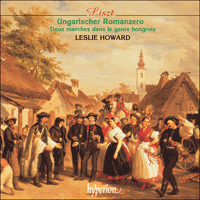


Most Liszt catalogues fail to mention an important unpublished manuscript which is lodged in the Richard Wagner Museum in Bayreuth: a volume of Hungarian dance melodies arranged for the piano with varying degrees of harmonization, extension and elaboration. The pieces are based on music by several known and unknown composers of Hungarian light music—effectively dance-band 'standards' of the day.
Liszt's manuscript consists of eighteen pieces, some of which are quite fully worked out, even though there are almost no markings of tempo, phrasing, fingering, pedalling, dynamics or other indications of touch. The title Ungarischer Romanzero, using a Spanish word to describe Hungarian melodies, signifies merely 'collection of Hungarian songs'. Many of the pieces are complete in the sense that, with a little imagination in terms of tempo and style, they may be played as they stand. Some contain notes written to remind Liszt how to proceed, and many of these continued figurations and varied reprises can be postulated without too much fear of undue liberty.
The Deux marches dans le genre hongrois come from an untitled manuscript from Weimar which was published by the Liszt Society in 1954. They were composed at some point around 1840, and thus are roughly contemporary with the Marche héroïque dans le genre hongrois (Heroischer Marsch im ungarischen Styl), and they bear obvious musical kinship to that imposing work.
All of the music on this album is also available as part of the specially priced box set Liszt: Complete Piano Music: 'Almost any way you choose to look at it, this is a staggering achievement … the grand scope of this project gives us the chance, as listeners, to experience the almost incomprehensible breadth and depth of Liszt's imagination' (International Record Review).

Of course, music of this nature had already supplied Liszt with much material for his recently issued volumes of Rapsodies hongroises Nos 1–15, and it is interesting to see that he was thinking of producing more in the same vein, if on a slighter scale. We have no information relating to the circumstances of the volume’s composition or its intended destination—Liszt seems to have abandoned it completely, apart from using one of the melodies in the Reményi section of the book in his oratorio Die Legende von der heiligen Elisabeth. The present writer was first made aware of the collection’s existence by a splendid article Unbekannte ‘Verbunkos’-Transcriptionen von Ferenc Liszt—‘Ungarischer Romanzero’, by Géza Papp (in Studia Musicologica Academiae Scientiarum Hungaricae 29, 1987), to whom all due and grateful acknowledgement is immediately extended for much of the information reproduced below. Imre Mezð of Editio Musica Budapest kindly supplied a photocopy of the Liszt section of the manuscript, and the whole volume was seen at the Richard Wagner Museum, where thanks are due to Frau Gudrun Föttinger for the subsequent generous provision of a copy of the entire manuscript. And, thanks to the indefatigable Mária Eckhardt (who also assisted Géza Papp in his research), the writer is also in possession of an excellent volume containing quite a number of the original pieces which Liszt used for the Ungarischer Romanzero: Magyar Nóták Veszprém Vármegyébðl (‘Hungarian recruiting dances from Veszprém county’) reprinted in 1994 from early-nineteenth-century editions. It can be seen that Liszt frequently alters details of some of the original melodies, and occasionally does not even follow their original structures.
Liszt’s manuscript consists of eighteen pieces, some of which are quite fully worked out, even though there are almost no markings of tempo, phrasing, fingering, pedalling, dynamics or other indications of touch. The title, at least, was provided by Liszt, although he added ‘(?)’ after it, perhaps not content at using a Spanish word to describe Hungarian melodies. At any event, the title Ungarischer Romanzero signifies merely ‘collection of Hungarian songs’. Many of the pieces are complete in the sense that, with a little imagination in terms of tempo and style, they may be played as they stand. Some contain notes written to remind Liszt how to proceed, and many of these continued figurations and varied reprises can be postulated without too much fear of undue liberty. Several, unfortunately, present very little apart from the basic melody and a hint as to the intended accompaniment pattern, but it was thought best to provide some discreet additions in order to render the whole set performable rather than make a series of decisions over eliminating certain pieces. The following notes make quite clear the extent of any conjectural reconstruction.
No 1 is based on a theme and trio by Antal Csermák known from an 1826 publication. The first section is playable as it stands, and Liszt’s alternative reading in the first bar is played in the da capo reprise. The trio section, which Liszt marks Friska, is not really complete: the second of its two repeated eight-bar sections is followed by ‘etc.’ and the piece is rounded off here by a further reprise of the first eight bars of the trio. No 2 is headed ‘Csermák’, but the origin of the theme has not been traced. Liszt’s noble account is quite complete. No 3, which is also complete, is based on two melodies, the first by Janós Bihari, the second of unknown provenance.
No 4 is based on a Csermák arrangement of a traditional tune. Although at first glance the Liszt version seems unfinished, it is full of instructions to himself about how to vary the reprises of each passage: after the first eight-bar statement he only gives one bar of its reprise with the indication da capo con 8ttavi e ornamenti—easily done. There follows a two-bar sketch of the second section—in F major, marked ‘etc.’—but then the same theme fully worked out in D minor. A note at the end of the page à changer nach E Pedale Dominante refers to a further variation of the opening material sketched on the left facing page, and also marked ‘etc.’—again easily extended to eight bars, which is followed by the trio in D major. Another self-suggestion—all 8ttava (?)—is taken up in the reprise of the trio.
No 5, based on a theme by Gábor Mátray, is a brisk little tune, and, so long as one interprets the shorthand indication in the lower margin on the first page in order to make a repeat, the piece is complete. So is No 6, where Liszt gives the name of the melody: Primatialis nota (‘Melody for the installation of the Prince-Primate’) as well as that of its original composer, Bihari. No 7 begins with the Butsuzó Lassú Magyar (‘Slow Hungarian Farewell-Melody’) of Csermák, but continues with unidentified material. Apart from a shorthand indication of a tranposed reprise of four bars, the piece is fully written out. Serious Liszt-sleuths may recognize in the Bihari melody—Hatvágás-Werbetanz (‘Hatvágás Recruiting Dance’)—of No 8 one of the pair of dances he had previously arranged as a boy (sometimes known as Zum Andenken; see Volume 26 of the present series). Here it is extended in rather a rhapsodic way and, although the manuscript is untidy and one or two left-hand chords are missing, the piece is complete. No 9 is also complete, even though Liszt does not use the trio section of this melody by Csermák.
No 10 is a miniature rhapsody with typical slow and fast sections, the first based on Beni Egressy’s Kornéliához (‘For Kornelia’), the second—marked Allegro guerriero—on an unidentified theme. Although much shorthand is employed, the piece is finished, and it ends with a very jolly coda which (pace Mr Papp, who sees no connection) is derived from the Allegro. No 11 is the largest piece in the set, and is similarly cast as a two-part rhapsody. The first part is based on the Makó Csárdás in a published arrangement by János Travnyik. The fast section is based on several themes, most of whose origins are unknown. The first of these themes will be instantly recognized as the same melody which Brahms employed in his Hungarian Dance No 9; the second is a dance-tune from Kálló.
The Friska which constitutes No 12 is so attractive a medley of dance tunes (of unknown origin) that one must be forgiven the minor surgery necessary to render the piece complete and playable: Liszt’s note—etc. Durchführung—occurs at a point where he is repeating a theme in transposition, so the eight-bar statement can be completed. A little eight-bar theme written separately at the end of the piece is then incorporated, and repeated an octave higher, and the coda has been supplied by a brief repetition of previously heard material with the addition of three closing chords.
The remaining pieces, with the exception of the sixteenth number, are in rather a sketchy state, even though most of them are written out complete as far as the sequence of melodies and variations are concerned. But the accompaniment is most often left blank or only hinted at in shorthand. No 13 is only fully worked in the opening eight bars, marked Bevezetés (‘Introduction’); the succeeding eight bars require elaboration over a sketched series of harmonies. The fast section contains only seven bars where any accompaniment is suggested, but the right-hand is more or less completely indicated. The themes are unidentified.
No 14 is based on Vágy Pannónia felé (‘Longing for Pannonia’) by Janós Lavotta. Only from time to time does Liszt give a fully worked-out accompaniment—none at all in the closing section. No 15 is marked Bihari by Liszt, but Géza Papp has shown that the theme is in fact by Márk Rózsavölgyi. The trio is a melody by Csermák. Liszt only indicates a few bass notes in the first section, but quite a bit of figuration in the second. No 16 is ascribed to József Zomb, although its source has not come to light. Liszt has written a note to himself—(oder 6?)—suggesting a possible change in the opening rhythmic pattern, given as four semiquavers and two quavers in each bar, but suggesting six semiquavers and two quavers. The sextolets are adopted throughout the present performance. Curiously, at the end of this number Liszt writes the opening of number four of this collection again, finishing with ‘etc.’, so perhaps he was thinking of linking these numbers together (a possibility easily explored on a CD player).
No 17 begins with a theme by Bihari and continues with a theme by Jancsi Polturás Lóczi. Liszt supplies a lot of the accompaniment and gives further instructions to add sixths and play with the hands in unison. Otherwise, the accompaniment requires filling out. The tiny romance No 18 has a strangely valedictory quality about it. The melody is ascribed to Bihari, but may be by Ignác Ruzitska, and it might not even be originally Hungarian—its lilting 68 melody against 24 accompaniment is quite uncharacteristic. Some very minor completion of the accompaniment is required.
In 1954, the Liszt Society (in association with Schott and Co.) published Two Pieces in the Hungarian Style from a manuscript in Weimar which bears no title. That edition prints the two unfinished pieces in reverse order to that of the manuscript, and provides the B flat minor piece with a rather rhapsodic ‘concert ending by Louis Kentner’. With best respects to the Liszt Society, and with undiminished admiration for the wonderful artistry of Mr Kentner, it has been decided here to restore the original order of the pieces, affix a title which more nearly corresponds to their character and period (they were composed at some point around 1840, and thus are roughly contemporary with the Marche héroïque dans le genre hongrois (Heroischer Marsch im ungarischen Styl), and they bear obvious musical kinship to that imposing work), and supply conclusions that maintain the style and dignity of the extant music. The first of the Deux marches dans le genre hongrois—a stately slow march in D minor, full of Hungarian ornamentation—breaks off at bar 54, and shows several changes of heart about the composition of the last episode. What seems clear enough is that the original theme must return for its third statement, varied and ornamented at a more florid level than the second appearance. To this end, the present writer has supplied a further twenty-one bars to conclude the work. The manuscript of the B flat minor piece, like that of its companion, contains no tempo direction, dynamics or other performance indications. It seems reasonable to conclude that this is another noble march, full of pictorial Hungarianisms. This march is so close to being complete—the whole structure of varied reprise of march and trio sections, with coda, is plainly all but finished – that only five bars were added to bring the piece to a conclusion.
Leslie Howard © 1998
Bien sûr, Liszt avait déjà puisé force matériau dans ce genre de musique pour ses récents volumes de Rapsodies hongroises nos1–15, et il est intéressant de constater qu’il songeait à produire d’autres œuvres dans le même esprit, mais plus légères. Nous ne disposons d’aucune information quant aux circonstances de composition du volume, ni quant à son dessein—Liszt semble l’avoir totalement abandonné, excepté l’utilisation d’une des mélodies de la portion «Reményi» dans son oratorio Die Legende von der heiligen Elisabeth. Le présent auteur découvrit tout d’abord l’existence de ce recueil grâce à un splendide article de Géza Papp intitulé Unbekannte «Verbunkos»-Transcriptionen von Ferenc Liszt—«Ungarischer Romanzero» (in Studia Musicologica Academiae Scientiarum Hungaricae 29, 1987), qui doit être sincèrement remercié pour avoir fourni l’essentiel des informations reproduites infra. Imre Mezð (Editio Musica Budapest) nous a aimablement procuré une photocopie de la portion «Liszt» du manuscrit; l’ensemble du volume a, en outre, été compulsé au Richard Wagner Museum, où Frau Gudrun Föttinger nous a généreusement permis de disposer d’une copie du manuscrit complet. Enfin, l’infatigable Mária Eckhardt (qui aida aussi Géza Papp dans ses recherches) nous a permis d’avoir en notre possession un excellent volume contenant un grand nombre des pièces originales utilisées par Liszt pour son Ungarischer Romanzero: Magyar Nóták Veszprém Vármegyébðl («Danses de recrutement hongroises du comté de Veszprém»), réédité en 1994 à partir d’éditions du début du XIXe siècle. L’on peut voir que Liszt modifie souvent des détails de certaines mélodies originales, allant parfois jusqu’à ne même pas en suivre les structures.
Le manuscrit de Liszt consiste en dix-huit pièces, quelquefois écrites en toutes notes, bien qu’il n’y ait presque pas d’indications de tempo, de phrasé, de doigté, d’usage de la pédale, de dynamique, ni quelque autre indication de toucher. Liszt précisa au moins le titre, même s’il ajouta «(?)», peut-être insatisfait de recourir à un terme espagnol pour décrire des mélodies hongroises. Quoi qu’il en soit, le titre Ungarischer Romanzero signifie simplement «recueil de mélodies hongroises». Nombre d’entre elles sont complètes, en ce sens qu’un peu d’imagination en termes de tempo et de style suffit pour les jouer telles quelles. Certaines contiennent des notes écrites par Liszt pour se rappeler comment poursuivre, et quantité de ces figurations et reprises variées peuvent être avancées sans grande crainte de licence excessive. Plusieurs, malheureusement, sont fort peu différentes de la mélodie de base et insinuent seulement le schéma d’accompagnement désiré; mais nous avons jugé préférable de réaliser quelques ajouts discrets, afin de rendre l’ensemble interprétable, plutôt que d’éliminer certaines pièces. Les remarques suivantes expliquent l’étendue de ces reconstructions conjecturales.
La no1 repose sur un thème et un trio d’Antal Csermák, connus grâce à une publication de 1826. La première section est interprétable telle quelle, et l’autre lecture lisztienne dans la première mesure est jouée dans la reprise da capo. La section en trio, que Liszt marque Friska, n’est pas complètement achevée: la seconde de ses deux sections de huit mesures répétées est suivie d’un «etc.», et la pièce est alors close par une autre reprise des huit premières mesures du trio. La no2 est intitulée «Csermák», mais l’on n’a pas retrouvé l’origine de son thème. La noble version de Liszt est tout à fait complète. Quant à la no3, elle aussi complète, elle repose sur deux mélodies, l’une de Janós Bihari, l’autre d’origine inconnue.
La no4 est fondée sur un arrangement que Csermák fit d’un air traditionnel. Bien que semblant d’abord inachevée, la version de Liszt regorge d’ instructions à lui-même sur la manière de varier les reprises de chaque passage; passé la première énonciation de huit mesures, le compositeur ne donne qu’une mesure de sa reprise, avec l’indication da capo con 8ttavi e ornamenti—facile à réaliser. S’ensuivent une esquisse de deux mesures de la seconde section—en fa majeur, marquée «etc.»—, puis le même thème écrit en toutes notes, en ré mineur. Une note en fin de page, à changer nach E Pedale Dominante, fait référence à une autre variation du matériau initial esquissé sur la page gauche d’en face, également marquée «etc.»—de nouveau aisément étendue à huit mesures, avant le trio en ré majeur. Une autre suggestion de Liszt—all 8ttava (?)—est adoptée dans la reprise du trio.
La no5, fondée sur un thème de Gábor Mátray, est une petite mélodie alerte, complète pour peu que l’on interprète l’indication sténographiée dans la marge inférieure, sur la première page, qui invite à réaliser une répétition. Il en va de même pour la no6, où Liszt donne le nom de la mélodie, Primatialis nota («Mélodie pour la nomination du prince-primat»), ainsi que celui de son compositeur, Bihari. La no7 s’ouvre sur le Butsuzó Lassú Magyar («Lente mélodie d’adieu hongroise») de Csermák, mais se poursuit avec un matériau non identifié. L’ensemble est écrit en toutes notes, excepté une indication sténographiée relative à une reprise transposée de quatre mesures.
Les fins limiers lisztiens reconnaîtront dans la mélodie de Bihari—Hatvágás-Werbetanz («Danse de recrutement de Hatvágás»)—de la no8 l’une des deux danses arrangées par le compositeur dans son enfance (parfois connues sous le nom de Zum Andenken; cf. volume 26 de la présente série). Elle est ici développée de manière plutôt rhapsodique et est complète—nonobstant un manuscrit désordonné et un ou deux accords de la main gauche manquants—, tout comme la no9, où Liszt n’utilise pas, cependant, la section en trio de la mélodie de Csermák.
La no10 est une rapsodie miniature, dotée de sections lente et rapide typiques: la première repose sur Kornéliához («Pour Kornelia») de Béni Egressy, et la seconde (marquée Allegro guerriero) sur un thème non identifié. Malgré l’usage de force sténographie, cette pièce est achevée, qui se termine par une très joviale coda dérivée (n’en déplaise à M. Papp, qui ne voit pas de lien) de l’Allegro. La no11, la plus volumineuse du corpus, est, elle aussi, une rapsodie à deux parties. La première repose sur la Makó Csárdás figurant dans un arrangement publié par János Travnyik. La section rapide est fondée sur plusieurs thèmes, la plupart d’origine inconnue. Le premier sera d’emblée identifié comme la mélodie utilisée par Brahms dans sa Danse hongroise no9; le deuxième est, quant à lui, un air de danse de Kálló.
La Friska constitutive de la no12 est un pot-pourri de mélodies de danse (d’origine inconnue) si attrayant qu’il faut nous pardonner la chirurgie mineure à laquelle nous avons procédé pour rendre la pièce complète et jouable: la note de Liszt—etc. Durchführung—survient à un moment où il répéte un thème en transposition, de sorte que l’énonciation de huit mesures peut être achevée. Un petit thème de huit mesures écrit séparément à la fin du morceau est ensuite incorporé et repris à l’octave supérieure; quant à la coda, elle consiste en une brève répétition du matériau précédemment entendu, avec l’ajout de trois accords conclusifs.
Les pièces restantes sont, hormis la seizième, sous une forme plutôt esquissée, bien que la majorité présentent la séquence de mélodie et de variations écrite en toutes notes. Mais l’accompagnement est souvent inexistant, ou seulement insinué en sténographie. La no13 n’est travaillée que dans les huit mesures d’ouverture, marquées Bevezetés («Introduction»); les huit mesures suivantes requièrent d’être élaborées sur une série d’harmonies esquissée. La section rapide ne contient que sept mesures, sans la moindre suggestion d’accompagnement, mais la main droite est plus ou moins complètement indiquée. Les thèmes sont non identifiés.
La no14 repose sur Vágy Pannónia felé («Envie de Pannonia») de Janós Lavotta. Liszt ne donne un accompagnement écrit en toutes notes que de temps en temps—et pas du tout dans la section conclusive. Liszt a marqué la no15 Bihari mais Géza Papp a montré que son thème est en réalité de Márk Rózsavölgyi. Le trio est une mélodie de Csermák. Liszt n’indique que quelques notes de basse dans la première section, mais assez de figuration dans la seconde. La no16 est attribuée à József Zomb, mais sa source demeure inconnue. Liszt s’est écrit une note—(oder 6?)—insinuant un possible changement dans le schéma rythmique d’ouverture: six doubles croches et deux croches dans chaque mesure au lieu des quatre doubles croches et deux croches du schéma initial. Les sextolets sont adoptés tout au long de la présente exécution. Curieusement, à la fin de cette pièce, Liszt réécrit l’ouverture de la no4, en terminant par «etc.»—peut-être songeait-il à relier ces deux pièces (une possibilité aisément explorée avec un lecteur de CD).
La no17 débute sur un thème de Bihari et se poursuit sur un thème de Jancsi Polturás Lóczi. Liszt fournit une large part de l’accompagnement et donne d’autres instructions pour ajouter des sixtes et jouer avec les mains à l’unisson. Autrement, l’accompagnement requiert d’être étoffé. La minuscule romance no18 recèle une étrange qualité d’adieu. La mélodie, attribuée à Ignác Ruzitska, pourrait ne même pas être originellement hongroise—sa mélodie chantée à 68, contre un accompagnement à 24, étant tout à fait atypique. L’accompagnement nécessite un très léger achèvement.
En 1954, la Liszt Society publia (en association avec Schott and Co.) Two Pieces in the Hungarian Style (Deux pièces dans le style hongrois), d’après un manuscrit de Weimar, sans titre. Cette édition présente les deux pièces inachevées dans l’ordre inverse du manuscrit et accole à la pièce en si bémol mineur une «fin de concert de Louis Kentner» plutôt rhapsodique. Avec tout le respect dû à la Liszt Society, et avec une admiration intacte pour le merveilleux talent artistique de M. Kentner, nous avons décidé de restaurer ici l’ordre originel des pièces, de leur associer un titre mieux en phase avec leurs caractère et époque (elles furent composées vers 1840 et sont donc grosso modo contemporaines de la Marche héroïque dans le genre hongrois (Heroischer Marsch im ungarischen Styl), œuvre imposante avec laquelle elles présentent une parenté musicale évidente) et de leur fournir des conclusions à même de maintenir le style et la dignité de la musique. La première des Deux marches dans le genre hongrois—une majestueuse marche lente en ré mineur, toute d’ornementations hongroises—s’interrompt à la mesure 54 et comporte plusieurs changements d’avis quant à la composition du dernier épisode. Il semble assez clair que le thème original doive revenir pour une troisième énonciation, variée et ornementée de manière plus fleurie que la deuxième. À cette fin, le présent auteur a achevé l’œuvre en l’assortissant de vingt et une mesures supplémentaires. Le manuscrit de la pièce en si bémol mineur ne contient pas non plus de direction de tempo, de dynamique ou d’autres indications d’exécution. Mais on peut raisonnablement conclure à une autre marche noble, pleine de traits picturaux hongrois. Cette marche est quasi achevée—toute la structure de reprise variée de la marche et de la section en trio, avec la coda, est presque entièrement finie—, et seules cinq mesures furent ajoutées pour la terminer.
Leslie Howard © 1998
Français: Hypérion
Musik dieser Kategorie hatte Liszt bereits als materielle Grundlage für seine zuletzt veröffentlichten Ungarischen Rhapsodien Nrn. 1–15 gedient. Dabei ist besonders der Aspekt, daß er noch mehr in derselben Art schaffen wollte, wenn auch in kleinerem Maßstab, von besonderem Interesse. Leider haben wir keine Informationen über die näheren Umstände bei der Komposition dieses Werkes oder seine beabsichtigte Bestimmung—Liszt scheint sie wohl vollständig aufgegeben zu haben, einmal abgesehen davon, daß er bei seinem Oratorium Die Legende von der heiligen Elisabeth eine der Melodien des Reményi-Abschnittes verwendete. Als Verfasser dieser Zeilen erfuhr ich von der Existenz dieser Sammlung durch einen wunderbaren Beitrag mit dem Titel Unbekannte „Verbunkos“-Transkriptionen von Ferenc Liszt—„Ungarischer Romanzero“ von Géza Papp (in der Studia Musicologica Academiae Scientiarium Hungaricae 29, 1987). Ihm sei unser Dank erwiesen für eine Vielzahl von Informationen, die hier im Anschluß zu finden sind. Imre Mezð von Editio Musica Budapest stellte freundlicherweise eine Photokopie des Liszt-Abschnittes im Manuskript zur Verfügung. Das vollständige Werk konnte man im Richard-Wagner-Museum einsehen, wobei unser Dank an Gudrun Föttinger geht für die darauf folgende großzügige Leihgabe eines Exemplars des gesamten Manuskriptes. Und dank der unermüdlichen Mária Eckhardt (die Géza Papp ebenfalls bei den Nachforschungen unterstützte) konnte ich in Besitz einer hervorragenden Ausgabe mit einer beträchtlichen Anzahl an Originalstücken kommen, die Liszt für das Ungarische Romanzero: Magyar Nóták Veszprém Vármegyébðl („Ungarische Werbetänze der Region Veszprém“) verwendete, das 1994 anhand von Editionen aus dem frühen neunzehnten Jahrhundert neu aufgelegt wurde. Bei einigen seiner Originalmelodien veränderte Liszt häufig irgendwelche Details; und oft folgte er dabei nicht einmal der ursprünglichen Struktur.
Liszts Manuskript umfaßt achtzehn Stücke, wovon einige vollständig ausgearbeitet sind, wenn es auch kaum Angaben zu Tempo, Phrasierung, Fingersatz, Pedalführung, Dynamik und dergleichen gibt. Zumindest der Titel stammt von Liszt selbst, wenn er auch in Klammern ein Fragezeichen daneben setzte, vielleicht weil er nicht ganz mit einem spanischen Titel zur Beschreibung ungarischer Melodien zufrieden war. Der Titel Ungarischer Romanzero steht lediglich für eine „Sammlung ungarischer Lieder“. Viele der Stücke sind insofern vollständig, daß sie—mit etwas Phantasie hinsichtlich Tempo und Stil—frei vom Notenblatt weg gespielt werden können. Einige enthalten Hinweise für Liszt, die ihn an die Verfahrensweise erinnern soll. Viele dieser fortlaufenden Figurierungen und variierten Reprisen können angeführt werden, ohne dabei einen zu großen und unangemessenen Freiraum befürchten zu müssen. Leider bieten einige—abgesehen von der Grundmelodie und einem Hauch des beabsichtigten Begleitrhythmus—sehr wenig, doch deshalb erachtete man es als sinnvoll, das Werk—um es überhaupt erst aufführen zu können—mit einigen diskreten Änderungen zu versehen, anstelle eine Reihe von Entscheidungen über das Streichen gewisser Teile treffen zu müssen. In den folgenden Anmerkungen wird das Ausmaß mutmaßlicher Rekonstruktionen verdeutlicht.
Nr. 1 basiert auf einem 1826 veröffentlichten Thema und Trio von Antal Csermák. Der erste Abschnitt kann in der vorhandenen Form gespielt werden, wobei Liszts Interpretation des ersten Taktes mit da capo-Wiederholungszeichen gespielt wird. Der Trioabschnitt, den Liszt mit Friska kennzeichnete, ist nicht ganz komplett: auf den zweiten der beiden wiederholten Abschnitte mit acht Takten folgt der Vermerk „etc.“; das Stück wird an dieser Stelle mit einer weiteren Reprise der ersten acht Takte des Trios abgerundet. Nr. 2 trägt den Titel „Csermák“; der Ursprung des Themas konnte nicht ermittelt werden. Liszts prächtige Bearbeitung hiervon ist relativ vollständig. Nr. 3, das ebenfalls komplett ist, basiert auf zwei Melodien, wovon die erste von Janós Bihari stammt und die zweite unbekannter Herkunft ist.
Nr. 4 liegt eine Csermák-Bearbeitung einer traditionellen Melodie zugrunde. Die Liszt-Version mag auf den ersten Blick unvollendet erscheinen, doch steckt sie voller Instruktionen, die er zur Variation der Reprisen in den einzelnen Passagen an sich selbst richtete. Nach der ersten Acht-Takt-Exposition gibt er lediglich einem Takt seiner Reprise den Hinweis da capo con 8ttavi e ornamenti. Mit zwei Takten folgt eine kurze Skizzierung des zweiten Abschnittes – in F-Dur, mit dem Vermerk „etc.“—doch daraufhin erscheint das gleiche Thema vollständig ausgearbeitet in d-Moll. Der am Ende der Seite zu findende Hinweis à changer nach E Pedale Dominante bezieht sich auf eine weitere Variation des auf der gegenüberliegenden linken Seite skizzierten Eröffnungsmaterials und ist ebenfalls mit „etc.“ gekennzeichnet. Diese Variation ist auch hier wieder ohne Schwierigkeiten auf acht Takte ausgedehnt, auf die ein Trio in D-Dur folgt. Eine weitere Anmerkung „in eigener Sache“—all 8ttava (?)—finden wir in der Reprise des Trios.
Nr. 5, das auf einer erfrischend-kleinen Melodie von Gábor Mátray basiert, ist, wenn man die Notiz am unteren Rand der ersten Seite in Kurzschrift als Anweisung für eine Wiederholung deutet, ebenso vollständig. Das gleiche gilt auch für die Nr. 6, bei der Liszt der Melodie mit Primatialis nota („Melodie zur Amtseinführung des Prinz-Primas“) sogar einen Titel gibt und den Namen des ursprünglichen Komponisten Bihari erwähnt. Nr. 7 beginnt mit Butsuzó Lassú Magyar („Langsame ungarische Abschiedsmelodie“) von Csermák, setzt allerdings mit unbekanntem Material fort. Das Stück ist, abgesehen von einer Anweisung in Kurzschrift zu einer transponierten Wiederholung von vier Takten, komplett ausgeschrieben.
Wahre Liszt-Kenner können in der Bihari-Melodie Hatvágás-Werbetanz der Nr. 8 einen der beiden bereits im Knabenalter bearbeiteten Tänze erkennen (die gelegentlich auch unter dem Titel Zum Andenken bekannt sind; siehe Vol. 26 dieser Serie). Hier tritt sie eher in der ausgedehnten Form einer Rhapsodie in Erscheinung und, wenn auch das Manuskript etwas ungenau ist und ein oder zwei Akkorde der linken Hand fehlen, so ist das Stück doch insgesamt vollständig. Nr. 9 ist ebenso abgeschlossen, obwohl Liszt nicht den Trioabschnitt dieser Melodie von Csermák verwendet.
Nr. 10 ist eine Rhapsodie in Miniaturformat mit charakteristischen langsamen und schnellen Abschnitten. Der erste hiervon basiert auf Beni Egressys Werk Kornéliához („Für Kornelia“), und der zweite—mit Allegro guerriero gekennzeichnet—auf einer unbekannten Melodie. Es kommt zwar einiges in Kurzschrift zum Einsatz, das Stück aber ist abgeschlossen und endet mit einer äußerst vergnügten Koda, die ihren Ursprung im Allegro hat (Papp sieht dabei aber keinen Zusammenhang). Nr. 11 ist das umfangreichste Stück dieser Zusammenstellung und ist auf ähnliche Weise als zweiteilige Rhapsodie arrangiert. Dem ersten Teil liegt die von János Travnyik veröffentlichte Bearbeitung der Makó Csárdás zugrunde. Der schnelle Abschnitt basiert auf einer Reihe von Themen, deren Ursprung zumeist unbekannt ist. Das erste dieser Themen ist umgehend als die von Brahms bei seinem Ungarischen Tanz No. 9 verwendete Melodie zu erkennen. Beim zweiten handelt es sich um eine Tanzmelodie von Kálló.
Die Friska, aus dem die Nr. 12 besteht, ist ein so attraktives Potpourri aus Tanzmelodien (unbekannten Ursprungs), daß man über die kleinen Ausbesserungen hinwegsehen muß, die notwendig waren, um das Stück zu vollenden und spielbar zu machen. Eine Anmerkung Liszts—etc. Durchführung—erscheint an einer Stelle, an der er ein Thema in Transponierung wiederholt, um die acht Takte umfassende Exposition abschließen zu können. Danach wird ein kurzes, gesondert komponiertes Thema mit acht Takten integriert, das eine Oktave höher wiederholt wird. Die Koda kommt durch eine knappe Wiederholung von bereits gehörtem Material und zusätzlich drei Schlußakkorden zum Einsatz.
Die übrigen Stücke befinden sich, mit Ausnahme der sechzehnten Nummer, eher in einer Rohfassung, wenn auch die meisten hinsichtlich Melodienabfolge und Variationen als vollständig ausgearbeitet betrachtet werden können. Die Begleitung wurde oft vollständig ausgelassen oder es finden sich lediglich Andeutungen darauf in Kurzschrift. Nr. 13 ist nur in den ersten acht Takten vollständig ausgearbeitet und mit Bevezetés („Einführung“) gekennzeichnet; die folgenden acht Takte bedürfen einer näheren Ausführung über eine Reihe ausgedehnter Harmonien. An Stellen, an denen eine Begleitung angegeben ist, umfaßt der schnelle Abschnitt lediglich sieben Takte; die rechte Hand ist aber mehr oder weniger vollständig angegeben. Die Herkunft der Themen selbst ist unbekannt.
Nr. 14 basiert auf Vágy Pannónia felé („Sehnsucht nach Pannonia“) von Janós Lavotta. Lediglich von Zeit zu Zeit präsentiert Liszt eine komplett ausgearbeitete Begleitung—im Schlußabschnitt verwendet er überhaupt keine. Nr. 15 wurde von Liszt mit Bihari angegeben, doch Géza Papp konnte nachweisen, daß dieses Thema eigentlich von Márk Rózsavölgyi stammt. Beim Trio handelt es sich um eine Melodie von Csermák. Im ersten Abschnitt gibt Liszt lediglich ein paar Baßnoten an, im zweiten ziemlich viel Figurierung. Nr. 16 wird József Zomb zugeschrieben, sein Ursprung bleibt uns allerdings verborgen. Liszt fügte eine eigene Notiz hinzu—(oder 6?)—und erwägt einen möglichen Rhythmuswechsel von bisher vier Sechzehntelnoten und zwei Achtelnoten pro Takt auf sechs Sechzehntel—und zwei Achtelnoten. Die Sextolen werden das gesamte Stück hindurch übernommen. Am Ende dieser Nummer wiederholt Liszt merkwürdigerweise die Anfangssequenz der Nummer vier und schließt ab mit „etc.“, womit er womöglich eine Verknüpfung dieser beiden Nummern in Erwägung zog (eine Möglichkeit, die sich mühelos mit einem CD-Spieler erforschen läßt).
Nr. 17 beginnt mit einem Thema aus der Feder Biharis und wird fortgesetzt mit einer Melodie von Jancsi Polturás Lóczi. Liszt liefert eine Menge des Begleitmaterials und gibt weitere Instruktionen zur Integration von Sexten und dem Spiel in beidhändigem Einklang. Ansonsten verlangt die Begleitung nach Ausfüllung. Die kleine Romanze Nr. 18 verstrahlt eine sonderbare Abschiedsstimmung. Die Melodie schreibt man Bihari zu, doch könnte sie auch von Ignác Ruzitska stammen oder eventuell gar nicht ungarischen Ursprungs sein—denn das Nebeneinander ihrer munteren Melodie im 68-Takt und einer Begleitung im 24-Takt ist hierfür ziemlich untypisch. Einige kleinere Vervollständigungen des Begleitarrangements sind notwendig.
Im Jahre 1954 veröffentlichte die Liszt-Gesellschaft (in Verbund mit Schott & Co.) Two Pieces in the Hungarian Style (Zwei Stücke im ungarischen Stil) aus einem unbetitelten Manuskript in Weimar. Bei dieser Edition erscheinen die beiden unvollendeten Stücke in umgedrehter Reihenfolge zum Manuskript. Das Stück in b-Moll erhält dabei einen eher rhapsodischen „Konzertschluß nach Louis Kentner“. Mit allem Respekt an die Liszt-Gesellschaft und mit unverminderter Bewunderung der wunderbaren Kunst Kentners, entschloß man sich, die ursprüngliche Reihenfolge der Stücke an dieser Stelle wiederherzustellen, und einen Titel hinzuzufügen, der ihrem Charakter und ihrer Zeit näherkommt. Beide wurden etwa um 1840 komponiert und stammen daher etwa aus der selben Epoche wie der Marche héroïque dans le genre hongrois (Heroischer Marsch im ungarischen Styl) und weisen eindeutige Parallelen zu diesem imposanten Werk auf. Des weiteren galt es, einen Abschluß zu finden, der den Stil und die Würde der noch vorhandenen Musik beibehält. Der erste der Deux marches dans le genre hongrois—ein würdevoller, langsamer Marsch in d-Moll, voller ungarischer Ausschmückungen—löst sich im 54. Takt und weist in der Komposition der letzten Episode einige Gemütsänderungen auf. Dabei erscheint es ganz selbstverständlich, daß das ursprüngliche Thema zu seiner dritten Exposition zurückkehren muß, und das mit kräftigeren Variationen und Ausschmückungen als bei seinem zweiten Auftreten. Zum Abschluß des Werkes konnte ich am Ende weitere einundzwanzig Takte hinzufügen. Das Manuskript des b-Moll-Stückes enthält, wie auch das seines Begleitwerkes, keine Tempoangaben, dynamische Akzente oder sonstige Angaben zur Ausführung. Die Vermutung liegt nahe, daß es sich auch hier um einen wackeren Marsch handelt, der voller ungarischer Symbolik steckt. Dieser Marsch ist nahezu perfekt—seine gesamte Struktur unterschiedlicher Reprisen der Marsch—und Trioabschnitte, mit Koda, ist fast völlig vollendet—so daß zum Abschluß des Stückes lediglich fünf Takte hinzugefügt werden mußten.
Leslie Howard © 1998
Deutsch: Michael Stoffl