Welcome to Hyperion Records, a British classical label devoted to presenting high-quality recordings of music of all styles and from all periods from the twelfth century to the twenty-first.
Hyperion offers both CDs, and downloads in a number of formats. The site is also available in several languages.
Please use the dropdown buttons to set your preferred options, or use the checkbox to accept the defaults.
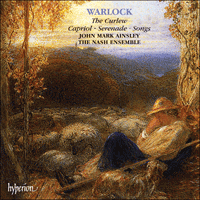


Peter Warlock's posthumous reputation rests largely on his work as a prolific writer of songs. Here we have John Mark Ainsley singing not only nine songs for tenor and string quartet but also The Curlew, Warlock's wonderful cycle setting poems by W B Yeats with accompaniment from a small orchestra. The work opens with a plaintive cry of the curlew from the cor anglais, and birdsong remains a feature throughout.
Two of the composer's three orchestral works are also recorded: the famous Capriol (here in its second version, that for string orchestra) and the less well known Serenade. The former is essentially a collection of sixteenth-century dance tunes but these are often highly embellished and dressed up in twentieth-century orchestration. (The name 'Capriol' comes from a treatise on dance written in 1588 by a canon at the cathedral of Langres.)
The Serenade is a beautiful miniature; it is dedicated to Delius and shows many influences from the older composer while adhering to Warlock's own desire for organization and close-knit cohesion.

This seems a somewhat small output, even allowing for the composer’s early death, but then Warlock was not merely a composer. As Philip Heseltine he was a musicologist of some importance, transcribing and editing much music of the sixteenth and seventeenth centuries, including six volumes of lute songs and many works for viols including Purcell’s Fantasias and works by Matthew Locke. He was also an established music critic: a projected collection of his writings on music will occupy no less than four volumes, without including his valuable short books Delius and The English Ayre. It may be argued that he spread his talents too widely, but hardly that he failed to make good use of his time.
Capriol
In 1588 a book on dance was published under the title Orchésographie et traité en forme de dialogue par lequel toutes personnes peuvent facilement apprendre et pratiquer l’honnête exercice des danses. The name of the author, Thoinot Arbeau, was in fact an anagram of his real name, Jehan Tabourot, but since he was a canon of the cathedral at Langres it was probably politic not to publish a work on such a secular entertainment as dance under his own name. As in many text books of the period the material is presented in the form of a dialogue, in this case between Arbeau and Capriol, a lawyer. This explains Warlock’s choice of name for his Suite ‘based on dance tunes from Arbeau’s Orchésographie’. In 1925 Cyril Beaumont published an English translation of Arbeau’s book, in which the musical illustrations were transcribed by Warlock, who also provided an informative preface on the dance tunes of the period. In October 1927 Warlock produced his Suite based on a selection of these tunes.
Basse Danse This dance had already gone out of fashion in Arbeau’s day, but he includes it in the hope that it may be revived by ‘modest matrons’. It was stately, and the feet were not raised but glided over the floor, hence the name. Warlock follows Arbeau exactly, three melodies, each repeated, followed by a repeat of the first section, though Warlock has a short coda instead of Arbeau’s fourth tune. Each repetition is harmonized and/or orchestrated differently.
Pavane Another stately dance which had taken the place of the basse danse, and was usually followed by the more lively galliard. Arbeau printed this melody in its four-part vocal form, and Warlock, after establishing the dance drum-beat gives this four-part version almost unaltered. He then repeats it with Arbeau’s tenor as a descant; however, the final phrase is given new harmony, as if to show there is a new composer present on the scene.
Tordion This started life as the concluding, slighter faster, figure of the basse danse. Warlock speeds up Arbeau’s tune and lightens each repetition to such an extent that the music almost disappears.
Bransle Originally a country round dance this was taken into aristocratic circles, and it was still danced at the court of Charles II. The longest movement in the suite, Warlock uses no fewer than five of Arbeau’s tunes, gradually gathering pace until the music reaches its brilliant cross-rhythm conclusion.
Pieds-en-l’air Only the first phrase appears in Arbeau, developed by Warlock into a wonderfully flowing four-phrase melody, repeated with new harmonies and given a typical slow Warlock final cadence.
Mattachins The first half of the movement sets out one of Arbeau’s variants of the Air des Bouffons. The second half has no melody, being a series of discordant clashes between concentrated bodies of the strings, sounding more like Bartók than any British composer. (Warlock knew Bartók well, and admired his music.) It clearly derives from the fact that this was a sword dance, and presumably very noisy!
Songs with String Quartet
The songs with string quartet can be divided into three groups. In two cases, Sleep and A Sad Song, the quartet version was composed at the same time as the piano version, and may well have been Warlock’s preferred medium. Two others, The Fairest May and My Lady is a pretty one, have no piano equivalent. The remainder were arranged for quartet some time after the publication of the piano scores.
Sleep is rightly considered one of Warlock’s finest songs, combining an Elizabethan sensitivity to words and rhythms with harmonies influenced by Delius and van Dieren, creating a totally individual sound world. When Warlock made a fair copy of the quartet version in 1927 he made two small changes in the vocal line, which have since been incorporated into the piano score. This is one of the few cases where the composer’s first thoughts may be considered better than his revision.
Both Sleep and A Sad Song come from plays by Beaumont and Fletcher, with considerable disagreement between authorities as to which of the two men wrote which sections of which plays. Sleep comes from The Woman Hater, now thought to be mostly by Beaumont, though Fletcher may have written some scenes, possibly including this lyric. A Sad Song is from The Maid’s Tragedy, generally agreed to be a joint effort, though again this lyric may be by Fletcher. Warlock quoted the following from the play in his manuscript:
Evadne: That’s one of your songs, Madam.
Aspatia: Believe me, ’tis a very pretty one.
Evadne: Fie on it, Madam! The words are so strange, they are able to make one dream of hobgoblins.
The same comment might be made about the music of this very individual song. Warlock uses the words as printed in the old Oxford Book of English Verse, but it is clear that the last line should read: ‘Lay lightly, gently, earth’. It was printed thus in 1622 and 1630, but in 1638 ‘gently’ was misprinted as ‘gentle’, and many later editors changed ‘lay’ to ‘lie’, to make sense, though all until Norman Ault in 1925 retained the erroneous ‘gentle’.
The Fairest May and My Lady is a pretty one are settings of the same poem from an Elizabethan manuscript (BM Harleian MS7578) printed in Chambers and Sidgwick’s anthology Early English Lyrics, a favourite source of verse for the composer. This poem was first set by Warlock as As ever I saw in 1918. My Lady is a pretty one was composed in 1919 but, astonishingly, not published until 1956. It is an absolute charmer, with dancing accompaniment throughout, much of it pizzicato, and conveys an irresistible sense of delight. In 1930 John Goss told Warlock he intended to include As ever I saw in a future concert. Warlock was less than happy about this early song and decided to rewrite it. He changed the time signature to 6/8 rather than 3/4, gave it a more elaborate, Elizabethan-influenced accompaniment, and made considerable changes to the vocal line. The final violin flourish could have come out of one of Dowland’s lute pieces. Note: verse 3, conceit = opinion; verse 4, wonderly wrought = worked wonders; Christ … bought = Christ by his death on the cross ‘bought’ forgiveness for the sins of all mankind; verse 6, may = maiden.
The remaining five songs are straightforward arrangements of the original piano accompaniments for string quartet, though Warlock could not resist making minor improvements as he went along. My little sweet darling is given an additional two-bar introduction. The words of this attractive lullaby are taken from an Elizabethan song for voice and viols, possibly by William Byrd. Mourn no moe is from another play by John Fletcher, The Queen of Corinth. Warlock again added two bars introduction, and altered the vocal line in three places. The mood is similar to that of A Sad Song.
Warlock set the famous lines Take, O take those lips away from Measure for Measure twice. This 1918 setting is immeasurably superior to his first attempt in 1916. It seems likely that Warlock had strings in mind when he first composed this, since some chords are unreachable with two hands, and the pedalling required blurs the subtle counterpoint. This is a quite unforgettable expression of regret for the loss of love.
My gostly fader has numerous small changes of rhythm in the voice part for the sake of more accurate word inflexions. The poem was probably written by Charles d’Orleans while in exile in England, and is set in a free recitation style almost unique in Warlock’s work. Both words and music may need a little study, but once understood will be found quite haunting in their effect. A paraphrase of the poem is printed alongside. The last line could also be read read as, ‘I ask forgiveness for anything else’, which is even more pointed. Note that lack of premeditation lessens sin, and promise of restoration is necessary for forgiveness for theft.
Chopcherry is again Warlock’s second setting of this cheerful poem. The first was composed in 1918 with the title ‘Whenas the rye’. In 1922 the composer wrote to his mentor Colin Taylor, ‘Don’t let that song get too popular, for I have done a much better setting of the same delightful poem – this is altogether fresher and nearer the spirit of the words’. Chopcherry was a game in which one tried to catch a suspended cherry in one’s teeth. Pinning down this delightful music would be just as hard.
The Serenade is dedicated ‘to Frederick Delius on his sixtieth birthday’. Delius gave Warlock much encouragement when he was making his first attempts at composition, and in return Warlock made many arrangements of Delius’s music and helped to organize concerts of his work. It is natural that a work with such a dedication should show many influences from the older composer. However, there are many passages that are pure Warlock, particularly a rocking figure on lower strings very similar to the opening string passage in The Curlew. Both works were composed between 1920 and 1922 at Cefn Bryntalch, the family home in Wales. Though on first hearing the Serenade may seem as vague as one of Delius’s rhapsodies, further hearings show it to be clearly organized. There are some four sections of related but distinct melodic material, the fourth being the rocking figure mentioned above. After a brief climax combining some of this material there is a varied recapitulation, ending with a brief coda.
The first version of The Curlew was performed in 1920 and consisted of five settings of poems by W B Yeats. In 1922, in Wales, Warlock reconsidered the work. He dropped the original third and fourth songs, substituting the present long and complex third song. It was published in this revised form in 1922, receiving an award from the Carnegie Trust.
The substantial introduction opens with the cor anglais giving out the cry of the curlew, taken over by the viola. This is followed by the rocking theme on the strings also used in the Serenade. The flute then has the peewit’s call, with its many repeated notes. After a brief climax the rocking theme returns, then a cello solo leads into the first song. This passionate outburst is succeeded by a short interlude based on the introductory material. The second song is self-contained; it appeared in both versions of The Curlew, and was probably written about 1916. After the next interlude, a recitative for cor anglais and some development of the rocking theme, comes the new song, a setting of Yeats’s The withering of the boughs, with three strongly contrasted verses, each ending with the words which could be considered the core of the cycle: ‘The boughs have withered because I have told them my dreams’.
The final interlude is dominated by chords built up from piles of fourths, and more flute calls. This leads into the last song, virtually unaccompanied, until the viola ends the work with a modified inversion of the cor anglais opening phrase, subsiding onto an empty, hopeless, bare fifth with the cello.
Michael Pilkington © 1997


