Welcome to Hyperion Records, a British classical label devoted to presenting high-quality recordings of music of all styles and from all periods from the twelfth century to the twenty-first.
Hyperion offers both CDs, and downloads in a number of formats. The site is also available in several languages.
Please use the dropdown buttons to set your preferred options, or use the checkbox to accept the defaults.
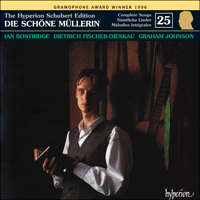


All of the music on this album is also available as part of the specially priced box set The Complete Songs of Franz Schubert: ‘This is an archive of glorious Lieder singing as much as it is a definitive treasury of the greatest Lieder ever composed’ (The Guardian).

O wenn ich doch das Rädlein wär
So wollt ich Lieb’ ihr sausen;
Und wär ich der Mühlbach unterher,
So wollt ich Lieb’ ihr brausen.
If I were the wheel
I would boom to my love;
And if I were the millstream below
I would roar my love to her.
Rückert’s poem ends with the following lines which encapsulate the miller’s fate in Schubert's cycle:
Und wenn ich nicht ruh’ in der Müllerin Arm,
So ruh’ ich in ihren Wassern.
And if I can’t rest in the miller-maid’s arms
I shall rest in her waters.
Paisiello’s opera was a great success in Berlin and it is to the lively cultural life in that city of salons immediately after the Napoleonic wars that we owe the birth of the cycle, if not as we know it then in its first incarnation as an amateur Liederspiel—a type of party-game with music. A number of young artists gathered under the roof of Friedrich August von Stägemann, an important civil servant and supporter of the arts. Among his protégés were Achim von Arnim (co-collector of Des Knaben Wunderhorn) and Wilhelm Hensel who was later to be an important painter and the husband of Felix Mendelssohn’s sister Fanny. At that time Hensel was still unmarried and was the close friend of a young poet named Wilhelm Müller who had been a fellow private volunteer in the war to free the Germans of French domination. Also part of Stägemann’s gatherings was the somewhat older Ludwig Rellstab (an artillery officer in the war) who was to be one of the last poets to be set by Schubert. The circle was enlivened by a number of pretty girls—Luise, Hensel’s eighteen-year-old sister, and the sixteen-year-old daughter of the house, Hedwig von Stägemann who was the original ‘schöne Müllerin’. Someone hit on the idea of making a collaborative play in the form of a poetry contest where each character had to write his or her own words. The story was to be about Rose, the miller’s daughter, and her rival suitors—the miller, the hunter, the gardener and the country squire. At the end Rose was to be so shocked by the miller’s suicide that she too was to throw herself into the brook, after which the hunter would sing a lament at the lovers’ graves. In this concept, uncomfortably reminiscent of Pyramus and Thisbe, Hedwig played the Müllerin, Hensel the hunter, his sister the gardener and Förster, a publisher and another member of the circle, the squire. Wilhelm Müller was somewhat predictably assigned the role of the miller himself.
Someone had to write the music for this Liederspiel, and the composer Ludwig Berger (1777–1839) was persuaded to provide it. Much older than the rest of the circle, he probably had not much patience with the amateur nature of the enterprise and the inevitably uneven accomplishment of the literary contributions. We know little of the performance of the work as the young people first envisaged it, but Berger must quickly have seen that young Müller’s poems were better than the others—and of course Müller had written his part of the story in the first person and from the miller’s point of view. Thanks to Berger, who (according to Rellstab) took Müller in hand and mercilessly nagged him until he felt the poems were right, a metamorphosis took place and a poetic cycle gradually emerged—one, moreover, which was specially crafted for music. The Berger cycle consists of ten songs. Five of these use Müller’s texts, beginning with Wanderlied (which we now know as Wohin?) and ending with Des Baches Lied (Schubert’s Des Baches Wiegenlied). Although it is of course not comparable to Schubert’s cycle, Berger’s work deserves a hearing; it is considerably more interesting than later songs to these texts by Spohr, Klein, Reissiger and Curschmann.
After this confrontation with Berger the poet gradually expanded the concept, filling in narrative gaps, and Die schöne Müllerin came into being more or less as we know it. There are moments in Müller’s work where some of the ideas of his collaborators have been taken on board, particularly those of Luise Hensel whose poems were published alongside Müller’s in an almanac soon after their composition. In 1817 Müller left Berlin for Rome and the party days among the young people were over. The poems were published in small groups in various newspapers before the final version of the complete cycle (with the words ‘to be read in winter’ printed under the title) emerged in 1821 as part of a much bigger collection of Müller poems entitled Sieben und siebzig Gedichte aus den hinterlassenen Papieren eines reisenden Waldhornisten (‘Seventy-seven poems from the posthumous papers of a travelling horn-player’).
Schubert’s first biographer, Kreissle von Hellborn, recounts a story which, because of several inconsistencies, is probably apocryphal: Schubert is said to have come across the Müller book in the library of Benedikt Randhartinger and was so taken with the poetry that he simply pocketed it and went home. Randhartinger called on him the next day to retrieve his property and was astonished to receive from the composer not only apologies for his strange behaviour but the first songs in the cycle. There are other theories about the work’s genesis. Susan Youens points out that there is a possibility that Schubert might have been introduced to Müller’s poetry by no less a celebrity than Carl Maria von Weber (the dedicatee of Müller’s second Waldhornisten anthology) who visited Vienna in 1822. Youens’s new book, Life and Legend in Schubert’s Die schöne Müllerin is the definitive work on the cycle's background.
The readings
Müller’s cycle contains five more items than Schubert chose to set, and there is a sixth poem, Ein ungereimtes Lied, which Müller originally planned as part of the work and which we have restored to the sequence. In Der Dichter, als Prolog and Der Dichter, als Epilog the poet offers an apologia before and after the main body of the work in the form of speeches in front of the curtain. As well as these gently ironic and somewhat humorous pieces there are three sizeable poems, the first of which adds a great deal to our understanding of the miller-girl’s daily life (Das Mühlenleben), while the other two illuminate the despair of the boy towards the end of the work (Erster Schmerz, letzter Scherz and Blümlein Vergissmein). In this performance the poems are interpolated in Müller’s order. It is clear that Schubert’s music needs no prologue and epilogue to achieve its full effect, although the poems’ domestic origins as explained above are very much clearer when the cycle is heard framed by these readings. The composer missed out Das Mühlenleben to make the girl deliberately less characterized, thus more mysterious, and the two other poems, fascinating commentaries on the boy’s disturbed mental condition, were sacrificed to aid the dramatic tension of the whole and to conserve a tight structure as the cycle moves inexorably (at least it does with Schubert) to its conclusion. In live performance, reinstating the poems as readings would thus perhaps be questionable although preferable to performing the songs in the settings of the Stuttgart composer Ludwig Stark who quite happily placed his work alongside Schubert’s. On disc, however, the listener will be able to hear a much-recorded cycle from a new perspective. In any case the cycle can be heard uninterrupted by words by programming the player to skip the appropriate tracks.
The reader
Early plans for Dietrich Fischer-Dieskau to make a disc of songs for this series fell victim to a flood in the Siemens-Villa in Berlin where the recording was to have taken place. After that, logistics and the singer’s impending retirement prevented re-scheduling. Even without his participation as a singer it is unarguable that Fischer-Dieskau is one of the fathers of The Hyperion Schubert Edition: his ground-breaking Schubert recordings with Gerald Moore in the seventies gave us the courage to embark on an enterprise such as ours. Where he leads others have followed, and this has been a pattern throughout his life; for over forty years Fischer-Dieskau has dominated the world of Lieder. Apart from his example as a performing artist, countless programme planners owe to his song archive their knowledge of the repertoire available to them. Over the years he has built up a list of recordings which now makes an endlessly consulted encyclopaedia of the Lied. In his seventieth-birthday year, and in a new capacity as a reader, Dietrich Fischer-Dieskau adds the name of Hyperion to the recording companies with which he has been associated, a happy and fitting event for the Schubert Edition.
Afterword
It is perhaps after hearing Die schöne Müllerin that the listener is best able to take into account the sad circumstances of its composition. Early in 1823 (or towards the end of 1822) Schubert contracted syphilis. Legend has it that one of his closest friends, Franz von Schober, had encouraged him to visit a prostitute, but no one can say whether this visit was an isolated incident; it is possible that, as in the case of Brahms, the professional ladies of Vienna were patronised by the composer when he could afford them. Several of Schubert’s contemporaries refer to his ‘burning sensuality’ and his schoolfriend Josef Kenner wrote that the composer’s ‘craving for pleasure dragged his soul down to the slough of moral degredation’. These remarks seem excessively censorious at a time when it was quite common for young men, frustrated by the purity of their chaperoned wives-to-be, to make alternative arrangements. Perhaps Kenner was referring to something more forbidden. Many years ago Walter Legge told me that in the Vienna of the 1930s he had been told ‘on the best authority’ that the composer’s illness was a result of a homosexual encounter. Whatever the truth of this and other theories we know that Schubert had a spell in hospital, and that he lost his hair due to the mercury treatment that was then the only palliative for the disease. He thus had to suffer not only the symptoms of syphilis (particularly unpleasant, though not yet fatal, in the secondary stage) but all the significant changes it brought into his life: the fear and moral condemnation of those he had thought to be friends; the belief that he did not have the right to have a relationship for fear of passing on the infection; above all the knowledge that the time remaining to him as a composer was limited, and that his life was one day to end in the most harrowing circumstances. Parallels with HIV and AIDS have given Schubert’s tragic plight many modern resonances. ‘I have brought it on myself’, he probably thought, and many people, then as now, would agree with him. It was during his hospital stay in 1823 that he composed parts of Die schöne Müllerin.
Schubert went through terrible patches of despair—and for quite some time after the initial diagnosis. We know this from a letter he wrote to his friend Leopold Kupelwieser in Rome as late as March 1824:
I feel myself to be the most unhappy and wretched creature in the world. Imagine a man whose health will never be right again, and who in sheer despair over this ever makes things worse and worse, instead of better; imagine a man, I say, whose most brilliant hopes have perished, to whom the happiness of love and friendship have nothing to offer but pain […] ‘My peace is gone, my heart is sore, I shall find it never and nevermore’ I may well sing now, for each night, on retiring to bed, I hope I may not wake again …
In May 1823 Schubert also wrote an astonishing poem entitled Mein Gebet (‘My Prayer'); he seems to have needed to express himself in words only at moments of the greatest stress when the music has dried up. His familiarity with Greek mythology is used to express what seems to be a suicidal depression. The last two strophes run thus:
Sieh, vernichtet liegt im Staube,
Unerhörtem Gram zum Raube,
Meines Lebens Martergang
Nahend ew’gem Untergang.
Todt’ es und mich selber tödte,
Stürz’ nun Alles in die Lethe,
Und ein reines kräft’ges Sein
Lass’, o Grosser, dann gedeih’n.
See the martyrdom, which is my life,
lies stricken in the dust,
afflicted by unbearable anguish
and nearing eternal extinction.
Slay it, and slay me:
now plunge all into Lethe,
and thence, O God,
let a pure strong being arise.
It is at this moment, when we imagine the composer plunged into the Lethean waters that the connection with Die schöne Müllerin and the boy who ends his life in the mill-stream seems most intense. As a result of the 1823 crisis Schubert felt himself an utter failure as a man. Apart from his illness, his operatic hopes were dashed and he had failed to make a career of any import. He was very small in stature (about 5'), overweight and never a sensation with the ladies in physical terms. He must have sometimes longed to have an appearance and personality which matched his inner fires. Schubert was (and is) loved by many people, but as Music incarnate rather than as a sexual being; to this day many of his fans recoil from accepting that he was as much possessed by rampant Dionysos as by balanced Apollo—despite the fact that his music bears witness to these twin influences. In the romantic sphere he was almost certainly afraid of rejection and probably half expected it. His lack of self-esteem in non-musical matters (there is much evidence for this in countless expressions of shyness and an unwillingness and lack of pretension) fits with the conventional psychological portrait of those who pay for sex. He was almost certainly prey to secret crushes and passionate fantasies. Even before his illness he seems to have been a terrible disappointment to his father on personal, if not musical, grounds. In July 1822 he wrote down a dream (Mein Traum—Documentary Biography, p226) in which he refuses to eat a banquet provided for him by his father and is banished into the wilderness; on his return he is shown his father’s favourite garden and he also rejects this, saying that it is repulsive. This surely shows the composer’s inability to live life in the conventional manner expected of him by Schubert senior. Despite a loyal circle of friends Schubert was in some ways a loner and a misfit, and this is surely why, in the depths of his crisis, he felt so much in common with the miller-boy whom he makes a much more complex creation than Müller perhaps intended. (The poet’s Prologue and Epilogue barely conceal a chuckle; the composer’s music allows many a tear.) The difficulty in reconciling love with sex, an inability to differentiate between fantasy and reality, and a lack of decisive masculine confidence seem to be common ground for the composer and the hero of his cycle. In some of the songs (Ungeduld, Mein!) the exaggerated rhapsodic intensity of Paul Verlaine’s La Bonne Chanson comes to mind, love poems written by the bisexual poet to his fiancée in an effort to convince himself (unsuccessfully in the long run) that their life together would be idyllic. Does the miller really long for the girl, or, like Verlaine’s Mathilde, is it the idea of her, the concept of fitting into an everyday normality, which is so appealing?
Of course Müller does not see his own poems in anything like so complicated a light, but Schubert’s music adds to this story many dimensions undreamed of by its creator. He has fashioned out of this cycle something utterly his own in which the eponymous heroine, who represents the normality so elusive to the miller, scarcely makes an appearance. The composer chooses not to set the poem Das Mühlenleben which rounds the Müllerin’s character; he wanted her to be more enigmatic, less of a real character. In this way the miller’s passion becomes mysterious and self-deluding, less reasonable, more obsessive. For all the boy’s passionate projections, the girl herself is but a shadowy presence and it is the brook, a friend and confidant, who wins the boy in the end. It is as if the hero were being pulled in two directions at once. Those who argue that Schubert was homosexual or bisexual (the latter more likely in my own opinion) might cite the composer’s sympathy with, and understanding of, the ambivalence and sexual diffidence which run beneath the surface of this cycle where the boy seems to be attracted by rival forces—the female Müllerin and the masculine brook which eventually claims him. It is notable that the disguised misogyny and anger against women that we find for example in the Italienisches Liederbuch of Wolf (another syphilitic) is not to be found here, although it is generally accepted that Schubert caught his illness from a woman.
If we were to believe that this young man has committed suicide only because a girl he fancies has gone off with someone else, we should be diminishing the importance of this cycle. The composer’s agenda here is surely infinitely deeper. The work is a lament both for what Schubert has lost and what he will never attain; it is a salute to all those who fail to live up to what is expected of them, particularly in terms of the stereotypes of manliness and heroism. In this respect the young miller is an anti-hero; it is a compassionate portrait of a ‘loser’ and a reminder that those who make nothing of their lives are often those who are are simultaneously enriched and damned by a poetic nature which cannot face the everyday world; it is a farewell to the composer’s youthful belief that he could trust to chance to look after him, that something good was bound to happen around the corner. Alone and terminally ill, Schubert had to face the stark realities of the future as he worked on this cycle. From the tone of Mein Gebet there must have been a great danger that feelings of bitterness would poison the sweet well-spring of his creative inspiration. He had no psychiatrist to whom he could pour out his problems, but he had the self-preserving instincts given to the greatest of artists. We know that Schubert did not drown himself and that he kept his talents not only intact but more finely honed than ever before. From 1823 he wrote less music, perhaps, but there is scarcely a note that is not meant and of significance. In writing Die schöne Müllerin the composer was in effect his own psychiatrist: he worked through his own problems by transferring his disappointments and grief on to the shoulders of the young miller. As a part of this process of self-forgiveness and reconciliation it is the miller who dies in Schubert’s stead, leaving the composer free to continue with his life’s work. That the composer is somehow transfigured by this death-at-one-remove is something we hear in the new music, never a note wasted, which flows from his pen in the last five years of his life. If listening to music can change a life, how much more true must that be for the person writing it. This work is testimony to the powers of spiritual healing at this composer’s finger-tips; many Schubertians would claim to have benefited from them, and so—thank heavens—did the composer himself when he was most in need.
Graham Johnson © 1996