
Welcome to Hyperion Records, a British classical label devoted to presenting high-quality recordings of music of all styles and from all periods from the twelfth century to the twenty-first.
Hyperion offers both CDs, and downloads in a number of formats. The site is also available in several languages.
Please use the dropdown buttons to set your preferred options, or use the checkbox to accept the defaults.
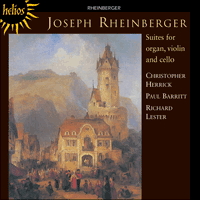



Joseph Rheinberger, organist of his local church by the age of seven, wrote just before his death (and somewhat autobiographically): 'People die so quickly nowadays; some are even dead long before they notice it'. He is largely remembered today as the composer of twenty seminal organ sonatas, but Rheinberger also produced symphonies, operas, mass settings, and much chamber music, all highly proficient, if sometimes conservative.
The Suite for organ, violin and cello is a genuinely original work: a real piece of chamber music for a rarely exploited combination of instruments, and one with tremendous sweep and vigour. The Six Pieces for violin and organ are equally interesting, the instruments uncharacteristically being treated as equals for much of the work.

As important as the organ sonatas certainly are, there is also a substantial body of chamber works in which his considerable gift for melody and his command of form combine in music of great passion, far away from the imagined dustiness of the organ loft. The fiery first and last movements of the String Quintet in A minor, Op 82, as well as the works recorded here, demonstrate most convincingly the successful blend of classical formal balance and contrapuntal skill with the expressive world of the early Romantics, which is the hallmark of Rheinberger’s style. Perhaps this synthesis is seen at its most potent in the extraordinarily beautiful Theme and Variations for string quartet, Op 93. (The passacaglia theme, by the way, bears more than a passing resemblance to the Beatles’ song All my loving.)
Joseph Rheinberger was born on 17 March 1839 at the court of the Prince of Liechtenstein, where his father was treasurer. There was little artistic activity at home, but his talent was recognized and nurtured by a local teacher, Sebastian Pöhli, and at the age of seven he was able to assume the post of organist at the church of St Florian in his home town of Vaduz. He was clearly regarded as a local prodigy, but it was not until 1851 that his father was persuaded to send him to study in Munich, where he lived for the rest of his life. Until he was fifteen he studied piano, organ and theory at the conservatory with some of the finest teachers of the day and made a strong impression with his command of counterpoint and organ-playing skills. He earned a living by teaching the piano and playing the organ at various Munich churches, meanwhile continuing his studies privately with Franz Lachner, an influential Munich musician who had known Beethoven in Vienna. Rheinberger began composing at a very early age: a Mass for three voices and organ was performed in Vaduz at around the time of his eighth birthday and during his early years in Munich he wrote a prodigious amount of music, including three symphonies and three operas. However, he was highly critical of this juvenilia and his earliest acknowledged work is a set of four piano pieces which appeared in 1859.
In that same year he was appointed to the staff of the conservatory, at first as a piano teacher, later taking charge of the theory class. His most influential post, that of professor of composition, came in 1867 at the instigation of Hans von Bülow. Rheinberger was a remarkably versatile musician, holding at various times posts as organist of St Michael’s Church, conductor of the Munich Choral Society (where he was particularly noted for his performances of Handel oratorios), and répétiteur at the court opera. Here he witnessed the premiere of Wagner’s Tristan und Isolde. Clearly he was not temperamentally suited to the theatre, but he did have an early success with his incidental music to Calderón’s El magico prodigoso, and wrote two mature operas, Die sieben Raben and Türmers Töchterlein. His formidable list of compositions also includes thirteen masses, numerous smaller pieces of church music, songs, four piano sonatas and chamber works, as well as the twenty sonatas and many shorter pieces for the organ for which he is principally remembered today.
It was undoubtedly as a teacher that Rheinberger achieved his greatest influence. The high modernism of Liszt and Wagner was not to his taste and did not impinge on his style at all; but while instilling in his pupils (who included Humperdinck, Wolf-Ferrari and Wilhelm Furtwängler) a concern for balance and clarity he did not allow his own prejudices to stand in the way of their exploration of the new paths opening in front of them. Rheinberger’s artistic philosophy was summed up by Furtwängler thus: ‘Naturalness in music was for him the overriding law: naturalness in the voice leading, in the form, in the expression.’ In spite of receiving many awards and honours towards the end of his life, he became increasingly depressed, both by his failing health and by the feeling that his music was becoming unfashionable. Shortly before his death in November 1901 he wrote: ‘People die so quickly nowadays; some are even dead long before they notice it.’
Suite for organ, violin and cello Op 149
The development of the symphony during the latter part of the eighteenth century meant the demise of the baroque suite, but the form began to reassert itself in the middle of the nineteenth century as a way of drawing together sets of character pieces. Rheinberger’s teacher, Franz Lachner, wrote eight suites for orchestra and several of his own organ sonatas are in fact closer in spirit to this form than to the late nineteenth-century concept of the sonata.
The Op 149 Suite begins with an extended movement in sonata form, launched in vigorous mood by the violin’s octave leap which is immediately imitated by the cello. The material of the exposition consists of several short motifs, each with a distinctive profile, presented in dialogue by the violin and cello, the organ taking a more modest, though not merely accompanimental, role. The music moves effortlessly from one idea to the next and the section ends with a three-note cadential figure played by the strings in unison. The music, having remained firmly rooted in the home keys of C minor and E flat major during the exposition, now plunges into the remote region of G flat major and develops one of the more lyrical ideas. The working out of the ideas in the development section is remarkably lucid and thoroughgoing, but without any hint of the dryness of which Rheinberger is sometimes accused; the music has a tremendous sweep and vigour. A move towards G minor, during which the violin and the right hand of the organ play a duet in thirds and sixths, marks the beginning of the long preparation for the return to the opening ideas. Again this is no mere mechanical reprise, but themes are presented in new juxtapositions and now in C major. After an impassioned climax and a gentle reminder of the initial motif the music winds down to a quiet close.
The second movement, a theme and seven variations, again shows Rheinberger’s mastery of form. The soulful, yearning theme is first presented by the organ and then repeated by the strings a major third lower, a beautiful Schubertian touch. The organ then plays a four-bar coda, which appears virtually unchanged in each of the opening four variations. The first variation follows the outline of the theme fairly closely, but already in the second Rheinberger is beginning to use it as a pool of ideas for development. As the variations progress they become much more wide-ranging harmonically – a collection of short character pieces. The fifth and sixth variations, which run into one another, can be seen as a miniature development section with the violin spinning a long impassioned melody over a pizzicato cello part. After a powerful climax the music relaxes through E flat major but immediately builds the tension again for the return to the home key of G major and the seventh variation, the longest. Brief cadenza-like figures herald the quiet end of this remarkable movement.
The Sarabande is in an uncomplicated A–B–A form, in C minor, with a contrasting trio section in A flat. The organ comes into its own in the Finale where the writing is extrovert and virtuosic with much rapid passagework. The movement makes a triumphant ending to a genuinely original work: a real piece of chamber music for a rarely explored combination of instruments.
Six Pieces for Violin and Organ Op 150
The variations which make up the first of the Six Pieces, Op 150, are possibly even more wide-ranging and improvisatory than those in the Suite, Op 149. The theme is in the manner of a sarabande, with a dramatic interrupted cadence in the twelfth bar, which is reinterpreted in many different ways in the course of the piece. The first variation begins by sticking to the harmonic outline of the theme, but soon the violin’s cantilena is winging its own independent way. There is an interesting change in texture for the second variation, with the violin playing on its lowest string and the organ above it. The third is in the style of a caprice, with continuous semiquavers for the violin and chordal accompaniment from the organ. The fourth and final variation is like a miniature violin concerto, complete with cadenza, ending quietly in the major.
The other pieces in the set are all in fairly traditional forms, in an idiom familiar from his Monologues and Character Pieces for solo organ. Abendlied, Pastorale and Elegie all demonstrate Rheinberger’s ability to spin long and expressive melodic lines, and he thought highly enough of them to arrange them for cello. Even in the simple song form of a piece like Abendlied, he confounds our expectations by interrupting the reprise with new material. The third movement is a Gigue, with a certain earthy, peasant-like quality to it. The adagio of the sixth movement combines the sharply dotted rhythms of the French overture with the rhetorical flourishes of the nineteenth-century virtuoso. The energetic fugato which follows moves effortlessly in and out of passages of contrasting lyricism. The opening dotted style returns at the end to round the piece off in a grand and dramatic manner.
Stephen Westrop © 1996
Quelque importantes que soient certainement ses sonates pour orgue, Rheinberger composa aussi un important corpus d’œuvres de chambre, qui combinèrent son don considérable pour la mélodie et sa maîtrise de la forme en une musique des plus passionnées, bien éloignée de l’image poussiéreuse de la tribune d’orgue. À l’instar des œuvres du présent enregistrement, les fougueux premier et dernier mouvements du quintette à cordes en la mineur, op. 82, démontrent de la manière la plus convaincante l’alliance heureuse de l’équilibre formel classique, du talent contrapuntique et de l’univers expressif des premiers romantiques, véritable sceau stylistique de Rheinberger. Peut-être la puissance suprême de cette synthèse se retrouve-t-elle dans l’extraordinairement magnifique Thème et Variations pour quatuor à cordes, op. 93. (À ce propos, le thème de la passacaille a plus qu’une ressemblance éphémère avec la chanson All my loving des Beatles.)
Joseph Rheinberger naquit le 17 mars 1839 à la cour du prince de Liechtenstein, où son père était trésorier. Les activités musicales n’avaient que peu de place chez les Rheinberger, mais un professeur local, Sebastian Pöhli, reconnut et nourrit le talent de Joseph, qui put assumer, dès l’âge de sept ans, le poste d’organiste à l’église de Saint-Florian, dans sa ville natale de Vaduz. Bien que clairement considéré comme un prodige local, il ne fut envoyé étudier à Munich qu’en 1851, une fois les réticences de son pere vaincues; il y demeura toute sa vie. Jusqu’à quinze ans, il étudia le piano, l’orgue et la théorie au conservatoire avec certains des meilleurs professeurs de l’époque et impressionna fortement par sa maîtrise du contrepoint, par ses talents d’organiste. Pour gagner sa vie, il enseigna le piano et joua de l’orgue dans plusieurs églises de Munich, tout en poursuivant des études privées avec Franz Lachner, musicien munichois influent qui avait connu Beethoven à Vienne. Rheinberger commença à composer à un âge très précoce: une messe pour trois voix et orgue fut ainsi interprétée à Vaduz aux alentours de son huitième anniversaire et une quantité prodigieuse de musique – dont trois symphonies et autant d’opéras – date de ses premières années à Munich. Mais il se montra extrêmement critique envers ces œuvres de jeunesse et sa toute première œuvre reconnue est un ensemble de quatre pièces pour piano, paru en 1859.
Cette même année fut celle de sa nomination au conservatoire, d’abord comme professeur de piano, puis comme chargé de la classe de théorie. Son poste le plus influent, celui de professeur de composition, lui fut attribué en 1867, à l’instigation de Hans von Bülow. Musicien aux talents remarquablement divers, Rheinberger occupa, à différents moments, des postes d’organiste à l’église Saint-Michel, de chef d’orchestre à la Société chorale de Munich (où ses interprétations des oratorios de Haendel furent particulièrement remarquées) et de répétiteur à l’opéra de la cour. Là, il assista à la première de Tristan und Isolde, de Wagner. Son caractère ne convenait manifestement pas au théâtre, mais il eut un premier succès avec sa musique de scène pour El magico prodigoso de Calderón et écrivit deux opéras aboutis, Die sieben Raben et Türmers Töchterlein. La formidable liste de ses compositions comprend également treize messes, de nombreuses pièces moindres de musique d’église, des chants, quatre sonates pour piano et des œuvres de chambre, auxquels s’ajoutent les vingt sonates et quantité de morceaux plus brefs pour orgue, qui lui valent surtout sa réputation actuelle.
Mais ce fut sans conteste comme professeur que Rheinberger atteignit à sa plus grande influence. Son style ne fut aucunement affecté par le fort modernisme de Liszt et de Wagner, qu’il ne goûtait pas; mais, tout en inculquant un souci d’équilibre et de clarté à ses élèves (dont Humperdinck, Wolf-Ferrari et Wilhelm Furtwängler), il ne laissa jamais ses préjugés se dresser en travers de leur exploration des voies nouvelles qui s’ouvraient à eux. Furtwängler résuma ainsi la philosophie artistique de son maître: «Le naturel dans la musique était pour lui le précepte primordial: naturel de la conduite des voix, de la forme, de l’expression.» En dépit des nombreuses récompenses et honneurs qui marquèrent la fin de sa vie, Rheinberger devint de plus en plus déprimé, tant par une santé défaillante que par le sentiment que sa musique devenait démodée. Peu avant sa mort, en novembre 1901, il écrivit: «L’on est somme toute vite mort de nos jours; plus d’un l’est déjà depuis longtemps et ne s’en aperçoit même pas.»
Suite pour orgue, violon et violoncelle op. 149
Le développement de la symphonie dans la seconde moitié du XVIIIe siècle signifia la disparition de la suite baroque. Mais la forme commença à se réaffirmer au milieu du XIXe siècle comme moyen de rassembler des pièces de caractère. Franz Lachner, le maître de Rheinberger, écrivit huit suites pour orchestre et plusieurs des sonates pour orgue de son disciple sont en fait d’un esprit plus proche de ce style que de la sonate de la fin du XIXe siècle.
La Suite, op. 149 s’ouvre sur un mouvement prolongé de forme sonate, vigoureusement déclenché par le saut d’octave du violon, tout de suite imité par le violoncelle. Le matériau de l’exposition consiste en plusieurs courts motifs distincts, présentés en dialogue par le violon et le violoncelle, l’orgue jouant un rôle plus modeste, au-delà, cependant, du simple accompagnement. La musique se meut aisément d’une idée à l’autre et la section s’achève sur une figure cadentielle de trois notes, jouées par les cordes à l’unisson. La musique, demeurée fermement enracinée dans les tonalités d’ut mineur et de mi bémol majeur tout au long de l’exposition, plonge désormais dans la zone reculée du sol bémol majeur pour développer un des thèmes plus lyriques. L’élaboration des idées est remarquablement limpide et approfondie dans la section de développement, sans une once de cette sécheresse dont Rheinberger est parfois accusé; cette musique possède une amplitude et une vigueur immenses. Un déplacement vers le sol mineur, durant lequel le violon et la main droite de l’orgue jouent un duo en tierces et en sixtes, marque le début de la longue préparation de la reprise des idées initiales. Là encore, il ne s’agit pas d’une simple reprise mécanique car les thèmes sont présentés dans de nouvelles juxtapositions, dorénavant en ut majeur. Après un apogée passionné et un doux rappel du motif initial, la musique s’abaisse délicatement vers une conclusion paisible.
Le deuxième mouvement, un thème et sept variations, montre à nouveau la maîtrise rheinbergerienne de la forme. Le thème émouvant, languissant, est d’abord exposé par l’orgue puis répété par les cordes une tierce majeure plus bas – une magnifique touche schubertienne. L’orgue joue ensuite une coda de quatre mesures, qui apparaît pratiquement inchangée dans chacune des quatre premières variations. La première de ces variations suit assez étroitement le canevas du thème mais, déjà, la deuxième commence à l’utiliser comme une réserve d’idées pour le développement. Toutes ces variations deviennent beaucoup plus harmoniquement amples à mesure qu’elles progressent – un ensemble de brèves pièces de caractère. Les cinquième et sixième variations, qui se fondent l’une dans l’autre, peuvent être considérées comme une section de développement miniature, qui voit le violon tisser une longue mélodie passionnée sur une partie pour violoncelle en pizzicato. Passé un apogée puissant, la musique se relâche via le mi bémol majeur avant de reconstruire aussitôt la tension pour le retour à la tonalité de sol majeur et pour la septième variation, la plus longue. De courtes figures cadentielles annoncent la fin paisible de cet admirable mouvement. La Sarabande est dans une forme simple A–B–A, en ut mineur, avec une section en trio contrastante, en la bémol. L’orgue montre ses capacités dans le Finale, où l’écriture, extravertie et virtuose, offre de nombreux passages rapides. Ce mouvement achève triomphalement une œuvre authentiquement originale, une véritable pièce de musique de chambre pour une combinaison instrumentale rarement explorée.
Six Pièces pour violon et orgue op. 150
Les variations constitutives de la première des Six Pièces sont probablement encore plus amples et improvisées que celles de la Suite, op. 149. Le thème est à la manière d’une sarabande, avec une remarquable cadence interrompue dans la douzième mesure, réinterprétée de différentes manières au cours du morceau. La première variation commence en suivant le canevas harmonique du thème mais la cantilène du violon s’envole bientôt, indépendante. La deuxième variation recèle un intéressant changement de texture, qui voit le violon jouer sur sa corde la plus grave, avec l’orgue par-dessus lui. La troisième variation est conçue dans le style d’un caprice, avec des doubles croches continues pour le violon et un accompagnement en accords à l’orgue. La quatrième et dernière variation ressemble, enfin, à un concerto pour violon miniature, doté d’une cadence et tanquillement achevé en majeur.
Toutes les autres pièces de cet ensemble présentent des formes plutôt traditionnelles, dans le style familier des Monologues et Pièces de caractères pour orgue solo de Rheinberger. Abendlied, Pastorale et Elegie démontrent la capacité du compositeur à tisser de longues et expressives lignes mélodiques; lui-même en pensa suffisamment de bien pour les arranger pour violoncelle. Même dans la simple forme «Lied» d’une pièce comme Abendlied, il confond nos attentes en interrompant la reprise avec un nouveau matériau. Le troisième mouvement est, pour sa part, une Gigue exhalant une certaine qualité truculente, agreste. L’adagio du sixième mouvement combine, quant à lui, les rythmes vivement pointés de l’ouverture française aux fioritures rhétoriques des virtuoses du XIXe siècle. Arrive ensuite le fugato énergique qui va et vient aisément dans des passages d’un lyrisme contrastant. Le style pointé initial revient à la fin pour clore la pièce d’une manière insigne, majestueuse.
Stephen Westrop © 1996
Français: Hypérion
So wichtig seine Orgelsonaten gewiß auch sind, gibt es dennoch auch eine umfassende Sammlung von Kammerwerken, in denen sich seine bemerkenswerte melodische Begabung und seine Beherrschung der Formgebung zu Musik von großer Leidenschaft vereinigen, Musik die weit entfernt von der imaginären Verstaubtheit der Orgel in der Dachkammer ist. Der temperamentvolle erste und letzte Satz des Streichquintetts in a-Moll, Op. 82, ebenso wie alle Einspielungen auf dieser CD, veranschaulichen äußerst überzeugend die gelungene Mischung von klassischem Formgleichgewicht, seinem kontrapunktischen Können und der ausdrucksvollen Welt der frühen Romantiker, dem Kennzeichen von Rheinbergers Stil. Diese Synthese tritt wohl am deutlichsten in jenem außerordentlich schönen Thema mit Variationen für Streichquartett, Op. 93 hervor. (Das Passsacaglia-Thema hat übrigens mehr als nur eine flüchtige Ähnlichkeit mit dem Beatles-Song All my loving.)
Joseph Rheinberger wurde am 17. März 1839 am Hofe des Fürsten von Liechtenstein geboren, wo sein Vater Schatzmeister war. Zu Hause gab es sehr wenig künstlerische Aktivitäten, doch ein Lehrer am Ort, Sebastian Pöhli, erkannte und förderte sein Talent. So konnte er bereits im Alter von sieben Jahren die Stelle des Organisten an der Florianskirche in seiner Heimatstadt Vaduz übernehmen. Er wurde ganz eindeutig als das Wunderkind der Stadt betrachtet, doch erst im Jahr 1851 konnte sein Vater überredet werden, ihn zum Studium nach München zu schicken, wo er den Rest seines Lebens verbringen sollte. Bis zu seinem 15. Lebensjahr studierte er am Konservatorium bei einigen der besten Lehrer seiner Zeit Klavier, Orgel und Musiktheorie, und hinterließ mit seiner Beherrschung des Kontrapunktes und des Orgelspiels einen starken Eindruck. Seinen Lebensunterhalt verdiente er sich mit Klavierunterricht und Orgelspielen an verschiedenen Münchener Kirchen, während er sein Studium privat bei Franz Lachner fortsetzte, einem einflußreichen Münchener Musiker, der Beethoven in Wien gekannt hatte. Rheinberger begann schon sehr früh mit dem Komponieren: etwa um seinen achten Geburtstag wurde eine Messe für drei Stimmen und Orgel in Vaduz aufgeführt, und während seiner frühen Jahre in München komponierte er erstaunlich viele Werke, darunter auch drei Symphonien und drei Opern. Was seine Jugendwerke anging war er jedoch äußerst kritisch, und sein erstes anerkanntes Werk ist ein Satz von vier Klavierstücken, der 1859 erschien.
Im gleichen Jahr wurde er ins Lehrerkollegium am Konservatorium aufgenommen – zuerst als Klavierlehrer, und später übernahm er den theoretischen Unterricht. Seine einflußreichste Stelle als Professor der Kompositionslehre erhielt er 1867 auf Veranlassung von Hans von Bülow. Rheinberger war ein bemerkenswert vielseitiger Musiker und er arbeitete unter anderem zu verschiedenen Zeiten als Organist an der Michaelskirche, als Dirigent der Münchner Chorgesellschaft (wo er sich besonders mit seinen Aufführungen von Händels Oratorien hervortat) sowie als Korrepetitor an der Hofoper. Hier wurde er Zeuge der Uraufführung von Wagners Tristan und Isolde. Ganz deutlich lag das Theater seinem Temperament nicht, doch konnte er einen frühen Erfolg mit seiner Bühnenmusik für Calderóns El magico prodigoso verzeichnen, und er schrieb auch zwei reife Opern, Die sieben Raben und Türmers Töchterlein. Die beachtliche Liste seiner Werke umfaßt außerdem dreizehn Messen, zahlreiche kleinere kirchenmusikalische Stücke, Lieder, vier Klaviersonaten und Kammerwerke ebenso wie die zwanzig Sonaten und viele kürzere Orgelstücke, für die er heute hauptsächlich bekannt ist.
Zweifelsohne erreichte Rheinberger seinen größten Einfluß als Lehrer. Der hochgradige Modernismus von Liszt und Wagner entsprachen nicht seinem Geschmack und hatten auch keinerlei Einfluß auf seinen Stil; doch während er seinen Schülern (zu denen Humperdinck, Wolf-Ferrari und Wilhelm Furtwängler zählten) ein Gefühl für Gleichgewicht und Klarheit vermittelte, ließ er nicht zu, daß seine eigenen Vorurteile sie bei der Erforschung neuer Wege, die sich vor ihnen auftaten, behindern sollten. Furtwängler faßte Rheinbergers künstlerische Philosophie wie folgt zusammen: „Ihm war die Natürlichkeit beim Musizieren oberstes Gesetz: Natürlichkeit der Stimmführung, der Formgebung, des Ausdrucks.“ Obgleich ihm gegen Ende seines Lebens zahlreiche Auszeichnungen und Ehren verliehen wurden, litt er zunehmend unter Depressionen, zum einen aufgrund der Verschlechterung seines Gesundheitszustandes und zum anderen aufgrund des Gefühls, daß seine Musik aus der Mode geriet. Kurz vor seinem Tod im November 1901 schrieb er: „Man ist jetzt überhaupt schnell Todt; Mancher ist es schon längst und merkt es nur nicht.“
Suite für Orgel, Violine und Cello Op. 149
Die Entwicklung der Symphonie in der zweiten Hälfte des achtzehnten Jahrhunderts bedeutete das Ende der barocken Suite, doch diese Musikform trat wieder in der Mitte des neunzehnten Jahrhunderts hervor – dieses Mal als Methode, um verschiedene Charakterstücke zusammenzuziehen. Rheinbergers Lehrer, Franz Lachner, komponierte acht Suiten für Orchester, und mehrere seiner eigenen Orgelsonaten sind dieser Musikform eigentlich näher als dem Konzept der Sonate des späten neunzehnten Jahrhunderts.
Die Suite, Op. 149, beginnt mit einem ausgedehnten Satz in Sonatenform, der mit dem Oktavsprung der Violine, der sogleich vom Cello imitiert wird, in schwungvoller Laune lanciert wird. Das Material für die Themenaufstellung besteht aus mehreren kurzen Motiven, von denen jedes ein unverkennbares Profil besitzt, welche in einem Dialog von Violine und Cello präsentiert werden, wobei die Orgel eine bescheidenere, jedoch nicht nur begleitende Rolle übernimmt. Die Musik geht mühelos von einer Idee zur nächsten, und der Abschnitt endet mit einer dreinotigen Kadenzfigur, die von den Streichern unisono gespielt wird. Die Musik, die während der Themenaufstellung fest in den Grundtonarten c-Moll und Es-Dur verwurzelt blieb, stürzt sich nun in die weit entfernte Region des Ges-Dur und spinnt jetzt eine der eher lyrischen Ideen fort. Die Ausarbeitung der Ideen im Durchführungsteil ist bemerkenswert klar und tiefgreifend, doch ohne jede Spur der Trockenheit, deren Rheinberger manchmal bezichtigt wird; die Musik besitzt einen ungeheuren Schwung und Elan. Ein Wechsel zu g-Moll, während dessen die Violine und die rechte Hand der Orgel ein Duett in Terzen und Sexten spielen, markiert den Anfang einer langen Vorbereitung auf die Rückkehr zu den Anfangsideen. Abermals ist dies nicht lediglich eine mechanische Reprise, sondern die Themen werden in neuen Reihungen und nun in der Tonart C-Dur präsentiert. Nach einem leidenschaftlichen Höhepunkt und einer sanften Erinnerung an das Anfangsmotiv verlangsamt sich die Musik bis zu einem stillen Abschluß.
Der zweite Satz, ein Thema und sieben Variation, zeigt abermals Rheinbergers meisterhafte Beherrschung der Formgebung. Ein gefühl- und sehnsuchtsvolles Thema, das zuerst von der Orgel präsentiert und dann von den Streichern um eine Ganztonterz tiefer wiederholt wird, hat einen wunderschönen Schubert’schen Anstrich. Die Orgel spielt dann eine viertaktige Koda, die in jeder der ersten vier Variationen nahezu unverändert erscheint. Die erste Variation hält sich stark an den Themenabriß, doch bereits bei der zweiten Variation beginnt Rheinberger, ihn als eine große Quelle von Ideen zum Weiterspinnen zu benutzen. Mit ihrer weiteren Entwicklung werden die Variationen harmonisch weitreichender – eine Sammlung kurzer Charakterstücke. Die fünfte und sechste Variation, die aufeinandertreffen, können als Durchführungsteil in Miniaturform betrachtet werden, wobei die Violine eine leidenschaftliche Melodie über eine Pizzicato-Cellostimme spinnt. Nach einem kraftvollen Höhepunkt entspannt sich die Musik durch die Tonart Es-Dur und baut sofort wieder die Spannung für die Rückkehr zur Grundtonart G-Dur und der siebten Variation, der längsten, auf. Kurze kadenzenhafte Figuren sind der Vorbote des ruhigen Endes dieses bemerkenswerten Satzes.
Die Sarabande besitzt ein unkomplizierte A–B–A-Form in c-Moll mit einem kontrastierenden Trioabschnitt in As. Im Finale wird das volle Potential der Orgel gezeigt. Dort wird die Komposition extrovertiert und virtuos mit vielen Läufen. Der Satz stellt ein triumphales Ende eines wahrhaft genialen Originalwerks dar: ein echtes Kammerwerk für eine nur selten erkundete Instrumentalkombination.
Sechs Stücke für Violine und Orgel Op. 150
Die Variationen, aus denen sich die ersten der Sechs Stücke zusammensetzen sind möglicherweise sogar noch weiterreichend und improvisatorischer als jene in der Suite, Op. 149. Das Thema ist nach Sarabandenart mit einer dramatisch unterbrochenen Kadenz im zwölften Takt, die im Laufe des Stückes auf vielerlei verschiedene Weisen interpretiert wird. Die erste Variation hält sich zu Beginn an den harmonischen Abriß des Themas, doch schon bald schlägt die Kantilene der Violine ihren eigenen eigenwilligen Weg ein. In der zweiten Variation ist ein interessanter Strukturwechsel zu beobachten: die Violine spielt auf ihrer niedrigsten Saite und die Orgel darüber. Die dritte Variation ist im Stil eines Capriccio gehalten mit fortlaufenden Sechzehntel für die Violine und Akkordbegleitung der Orgel. Bei der vierten und letzten Variation handelt es sich um ein Violinkonzert in Miniaturform, das, komplett mit Kadenz, ruhig in der Durtonart endet.
Die anderen Stücke sind in ihrer Form alle recht traditionell angelegt, in einer Tonsprache, die aus seinen Monologen und Charakterstücken für Soloorgel vertraut ist. Rheinbergers Abendlied, Pastorale und Elegie zeigen alle seine Fähigkeit, lange und ausdrucksvolle Melodielinien zu spinnen, und er hielt so viel von ihnen, daß er sie für Cello arrangierte. Selbst in der einfachen Liedform eines Stückes wie dem Abendlied wirft er unsere Erwartungen durcheinander, indem er die Reprise mit neuem Material unterbricht. Beim dritten Satz handelt es sich um einen Gigue, der eine gewisse Derbheit und Rustikalität besitzt. Das Adagio des sechsten Satzes vereint die scharf punktierten Rhythmen der französischen Ouvertüre mit den rhetorischen Schnörkel eines Virtuosen des 19. Jahrhunderts. Das nachfolgende energische Fugato wechselt mühelos zwischen Passagen kontrastierender Lyrik. Der punktierte Stil der Eröffnung kehrt am Ende wieder zurück, um das Stück prachtvoll und dramatisch abzurunden.
Stephen Westrop © 1996
Deutsch: Anke Vogelhuber