Welcome to Hyperion Records, a British classical label devoted to presenting high-quality recordings of music of all styles and from all periods from the twelfth century to the twenty-first.
Hyperion offers both CDs, and downloads in a number of formats. The site is also available in several languages.
Please use the dropdown buttons to set your preferred options, or use the checkbox to accept the defaults.
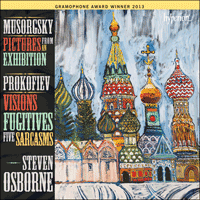


Steven Osborne has become one of the most valuable pianists recording today. His recent complete Rachmaninov Preludes release was critically acclaimed as the greatest modern version since Ashkenazy. Now he turns to further cornerstones of the Russian repertoire in this recording of Musorgsky’s Pictures from an Exhibition (a work which has been in Osborne’s concert repertoire for many years), and two sets of Prokofiev’s miniatures.
Musorgsky’s masterpiece is one of the most popular programmatic works of the 19th century. Yet it is also a great pianistic challenge, with the spectacular textures of the climactic movement ‘The Great Gate of Kiev’ requiring the highest technical accomplishments.
David Fanning writes of Prokofiev’s Visions fugitives: ‘Prokofiev supplies snapshots of his most characteristic moods—sometimes grotesque, sometimes incantatory and mystical, sometimes simply poetic, sometimes aggressively assertive, sometimes so delicately poised as to allow the performer and the listener to make up their own minds.’ Osborne’s subtle, yet brilliant use of colour and characterization makes him the ideal performer of this set. Sarcasms—as befits the title—is an experimental, provocative work, performed by Osborne with biting humour.

Pictures from an Exhibition (for some reason the common mistranslation of Musorgsky’s ‘from’ as ‘at’ has proved hard to dislodge) was composed rapidly in the first three weeks of June 1874. It consists of musical representations of eleven of Hartmann’s works, six of which have been preserved in various archives and can be seen in a number of modern re-publications of the work (the ‘Two Jews’ were originally two separate paintings). In a Preface to the first publication of Pictures, Stasov left helpful descriptions of each object, which are all we have to go on for those since lost. That edition, which appeared in 1886, five years after the composer’s death, came with emendations by Rimsky-Korsakov; and it was from this well-meaning but somewhat bowdlerised version that Ravel made his famous orchestration in 1922. Publication in Musorgsky’s original form had to wait until 1931.
To help assemble his ten ‘pictures’ into a coherent musical ‘exhibition’, Musorgsky decided to depict himself, too, as if walking from one display to another in various moods, in a series of what he called Promenades. The first of these is styled additionally ‘in modo russico’, presumably because of its changing time signatures and folksong motifs. After this sturdy introduction the composer as it were rounds a corner and finds himself confronted by the first object on display, ‘Gnomus’. According to Stasov, this was a design for a grotesque nutcracker, in the form of a dwarf on deformed legs and with huge jaws. A chastened form of the Promenade then ushers in ‘Il vecchio castello’, depicting a troubadour singing over a drone bass in front of a medieval castle.
A renewed confident stride brings us quickly to ‘Tuileries’, which represents children squabbling and playing in the avenues of the famous Parisian gardens. With no intervening Promenade, ‘Bydło’ depicts a Polish ox-cart on huge wheels, to which Rimsky-Korsakov made one of his most cavalier amendments, changing Musorgsky’s initial fortissimo to pianissimo, perhaps with the idea of the cart slowly approaching and receding, rather as in the Funeral March of Chopin’s B flat minor Sonata with its similar implacable harmonic foundation. Then a Promenade in the piano’s higher register anticipates the quicksilver humour of the ‘Ballet of the unhatched chicks’, a response to one of seventeen Hartmann illustrations for the ballet Trilby, with choreography by Petipa and music by Julius Gerber (the scene was apparently danced by children of the Imperial Ballet School, their arms and legs protruding from egg-shell costumes). Again without a break we move into ‘Samuel Goldenberg and Schmuyle’, a conflation of two portraits made during Hartmann’s visits to Sandomir, Poland, depicting a rich and a poor Jew. Musorgksy’s original title was for long suppressed, presumably because it provided an uncomfortable reminder of the casual anti-semitic attitudes he shared with large numbers of the Russian aristocratic intelligentsia of the time.
At this point the pianist has to take a deep breath, because the rest of the work plays without a break, and its technical demands steadily increase. A texturally enriched version of the opening Promenade introduces ‘Limoges, the market place’, subtitled ironically ‘The Big News’ (Musorgsky’s crossed-out annotations concern chit-chat over a runaway cow). After this fuss and bother, we are plummeted into the ‘Catacombae’ beneath Paris, coming face to face with an ancient Roman burial-ground (the second part of this memento mori, in which the Promenade theme appears beneath chilling tremolandos, had no title in the original). The ghoulish vein is developed with a musical depiction of Hartmann’s design for a clock in the form of a ‘hut on fowl’s legs’, titled ‘Baba Yaga’ after the evil witch of Russian folklore. The cycle is crowned by a grandiose aural realization of Hartmann’s design for ‘The Bogatyr Gate in Kiev’ (better known as ‘The Great Gate of Kiev’). The Bogatyrs were medieval warrior-nobles, and Hartmann’s gate, which was never actually built, was to have featured a bell-tower in the shape of a gigantic helmet—clearly the inspiration for Musorgsky’s spectacular, tintinnabulating textures.
For composers from Schubert to the present day the attractions of the piano miniature have been broadly similar. It has a better-than-average chance of being taken up by young or amateur players; it therefore stands a better-than-average chance of being published; for the composer-performer it fits snugly into recital programmes, where it may serve as an advertisement for and introduction to other compositions; and it may provide a useful testing-ground for compositional ideas, prior to their potential deployment in more demanding large-scale forms.
In their various contrasting ways, the twenty miniatures that make up Prokofiev’s Visions fugitives display all those qualities, and they have always been among the most popular of his piano pieces. The title of the collection is a poetic rendering of the Russian Mimolyotnosti (literally ‘things flying past’, or more pretentiously ‘transiences’) from the poem ‘I do not know wisdom’ by the symbolist Konstantin Balmont. Taking his cue from the lines ‘In every fugitive vision / I see whole worlds: / They change endlessly, / Flashing in playful rainbow colours’, Prokofiev supplies snapshots of his most characteristic moods—sometimes grotesque, sometimes incantatory and mystical, sometimes simply poetic, sometimes aggressively assertive, sometimes so delicately poised as to allow the performer and the listener to make up their own minds.
The Visions were assembled between 1915 and 1917. In his 1941 autobiography Prokofiev claimed that No 19 reflected the excitement of the crowds at the time of the February 1917 Revolution (which deposed the tsar—the more famous ‘October’ Revolution, establishing Bolshevik rule, followed later the same year). But that claim may be a case of self-reinvention aimed at a Soviet readership. Without that information, the same could as easily be said of Nos 4, 14 and 15. In 1935 Prokofiev made recordings of ten pieces from the set, and his playing is notable for its wistfulness, subtle shadings and—in places—rhythmic freedom. Even the clowning of the Ridicolosamente No 10 is rather shy in Prokofiev’s hands, and the delicacy he brings to the following piece brings out its affinities with Debussy’s Minstrels.
Standing rather apart from the salon pieces, Impressionist evocations and fairy tales that make up the bulk of early twentieth-century piano miniatures, there are also some that have their sights set more on innovation and experiment. Prokofiev himself gave one of the earliest performances of Schoenberg’s Three Piano Pieces, Op 11 (1909), and Bartók’s uncompromising Burlesques (1908–11) and Allegro barbaro (1911) enjoyed considerable notoriety at the time. Prokofiev’s own Sarcasms, composed between 1912 and 1914, are more or less in this mould, and they are certainly among his most experimental works before his period of self-imposed exile from 1918.
No doubt there was an element of image-consciousness here, too, right from the beginning. Prokofiev revelled in the controversy provoked by his more extravagant compositions and performances. In 1941 he reflected on the fifth Sarcasm, perhaps again with a degree of hindsight: ‘Sometimes we laugh maliciously at someone or something, but when we look closer, we see how pathetic and unfortunate is the object of our laughter. Then we become uncomfortable and the laughter rings in our ears, laughing now at us.’ But there is no need to take these compositions too seriously. Equally plausible is the response of the noted Russian virtuoso Konstantin Igumnov to the same piece: ‘This is the image of a reveller. He has been up to mischief, has broken plates and dishes, and has been kicked downstairs; he lies there and finally begins to come to his senses; but he is still unable to tell his right foot from his left.’
David Fanning © 2013
Rédigés rapidement dans les trois premières semaines de juin 1874, les Tableaux d’une exposition représentent en musique onze créations de Hartmann, dont six nous ont été conservées dans diverses archives et figurent dans plusieurs rééditions modernes de l’œuvre (les «Deux Juifs» étaient, au départ, des tableaux distincts). Dans une préface à la première édition des Tableaux, Stasov fournit d’utiles descriptions de chaque objet, qui sont tout ce qui nous reste de ceux perdus depuis. Cette édition, parue en 1886, cinq ans après la mort de Moussorgski, fut assortie de corrections de Rimski-Korsakov; et ce fut à partir de cette version bien intentionnée mais un rien expurgée que Ravel réalisa sa fameuse orchestration, en 1922. L’original de Moussorgski ne parut pas avant 1931.
Pour mieux agencer ses dix «tableaux» en une «exposition» musicale cohérente, Moussorgski décida de se dépeindre aussi, comme s’il allait d’un objet à l’autre, dans des atmosphères variées, en une série de ce qu’il appela des Promenades. La première d’entre elles est, en outre, dite «in modo russico», probablement à cause de ses signes de la mesure changeants et de ses motifs de chants traditionnels. Passé cette robuste introduction, le compositeur tourne, si l’on peut dire, et se retrouve confronté au premier objet exposé, «Gnomus»—à savoir, selon Stasov, un projet de casse-noisettes grotesque, en forme de nain aux jambes difformes, aux mâchoires énormes. Une version corrigée de la Promenade débouche ensuite sur «Il vecchio castello», où un troubadour est en train de chanter par-dessus une basse en bourdon, devant un château médiéval.
Un pas d’une confiance renouvelée et nous voilà aux «Tuileries», célèbres jardins parisiens dans les avenues desquels des enfants se chamaillent et jouent. Sans Promenade transitoire, «Bydło» décrit un chariot à bœufs polonais aux roues immenses; Rimski-Korsakov apporta ici une de ses corrections les plus cavalières, transformant en pianissimo le fortissimo initial de Moussorgski, peut-être avec l’idée du chariot approchant et reculant lentement, un peu comme dans la Marche funèbre de la Sonate en si bémol mineur de Chopin, aux fondations harmoniques tout aussi implacables. Une Promenade dans le registre supérieur du piano anticipe ensuite l’humour très vif du «Ballet des poussins dans leurs coques», écrit en réaction à l’une des dix-sept illustrations réalisées par Hartmann pour le ballet Trilby, avec une chorégraphie de Petipa et une musique de Julius Gerber (cette scène était apparemment dansée par les enfants de l’école du Ballet impérial, les bras et les jambes sortant de costumes en forme de coquilles d’œuf). De nouveau sans transition aucune, on passe à «Samuel Goldenberg et Schmuyle»; ces deux portraits exécutés pendant les séjours de Hartmann à Sandomir, en Pologne, montrent deux Juifs, l’un riche, l’autre pauvre. Le titre original fut longtemps omis, probablement parce qu’il rappelait désagréablement l’antisémitisme désinvolte de Moussorgski et d’une partie de l’intelligentsia aristocratique russe de l’époque.
C’est alors que le pianiste doit respirer un grand coup, car le reste de l’œuvre se joue sans dételer, avec des exigences techniques toujours plus poussées. Une version, à la texture enrichie, de la Promenade inaugurale introduit «Limoges—le marché», sous-titré avec ironie «Les grandes nouvelles» (les annotations biffées de Moussorgski concernent des papotages sur une vache en fuite). Après toute cette agitation et ces tracas, nous voilà plongés dans les «Catacombes», sous Paris, nez à nez avec un cimetière romain (la seconde partie de ce memento mori, où le thème de la Promenade se dessine sous des tremolandos glaçants, était sans titre dans l’original). La veine macabre est développée dans une représentation musicale du plan établi par Hartmann pour une horloge en forme de «cabane sur des pattes de poule» baptisée «Baba Yaga», du nom de la sorcière maléfique du folklore russe. Le cycle est couronné d’une grandiose incarnation sonore du dessin de Hartmann pour «La porte des Bogatyrs de Kiev» (mieux connue sous le nom «La grande porte de Kiev»). Les Bogatyrs étaient des nobles-guerriers médiévaux, et cette porte, demeurée à l’état de projet, devait avoir un clocher en forme de gigantesque heaume—source évidente des spectaculaires textures tintinnabulantes imaginées par Moussorgski.
Depuis Schubert, la miniature pour piano n’a cessé d’attirer les compositeurs, grosso modo pour les mêmes raisons. Davantage susceptible d’être reprise par des pianistes jeunes ou amateurs, elle a plus de chances d’être publiée; pour le compositeur-interprète, elle s’intègre parfaitement dans les programmes de récital, où elle peut annoncer et présenter d’autres œuvres; elle peut aussi servir à tester des idées compositionnelles, avant leur éventuelle inclusion dans des formes d’envergure, plus exigeantes.
Riches en contrastes, les vingt miniatures des Visions fugitives de Prokofiev ont toutes ces qualités et comptent depuis toujours parmi les morceaux de piano les plus populaires. Le titre du recueil est une traduction poétique du terme russe Mimolyotnosti (littéralement «choses qui passent» ou, plus prétentieusement, «caractères éphémères»), tiré du poème «Je ne connais pas la sagesse» du symboliste Konstantin Balmont. S’inspirant des vers «En chaque vision fugitive / Je vois des mondes entiers: / Ils changent sans cesse, / Étincelant dans les gaies couleurs de l’iris», Prokofiev nous offre des instantanés de ses climats les plus typiques—tantôt grotesques, tantôt incantatoires et mystiques, tantôt simplement poétiques, tantôt violemment affirmatifs, tantôt si subtilement posés qu’ils laissent interprète et auditeur libres de choisir.
Les Visions furent assemblées entre 1915 et 1917. Dans son autobiographie de 1941, Prokofiev affirma que la no 19 reflétait l’excitation des foules lors de la révolution de février 1917 (celle qui déposa le tsar; celle, plus célèbre, d’«Octobre» de la même année, instaura le régime bolchevique). Mais il se peut qu’il ait réinventé tout cela pour séduire le lectorat soviétique. Sans cette information, on pourrait en dire autant des nos 4, 14 et 15. En 1935, Prokofiev enregistra dix pièces de ce corpus et son jeu vaut par ses nuances mélancoliques, subtiles et, quelques fois, par sa liberté rythmique. Même la pitrerie de la nº 10 Ridicolosamente est plutôt timide entre ses mains, tandis que la délicatesse apportée à la pièce suivante trahit des affinités avec les Ménestrels de Debussy.
Tranchant avec les morceaux de salon (des évocations impressionnistes et des contes de fées qui, au début du XXe siècle, constituent le gros des miniatures pianistiques), certaines pièces aspirent à plus d’innovation et d’expérimentation. Prokofiev lui-même assura l’une des toute premières exécutions des Trois Pièces pour piano, op. 11 (1909) de Schoenberg et, à l’époque, Burlesques (1908–11) et Allegro barbaro (1911), œuvres intransigeantes de Bartók, jouissaient d’une considérable notoriété. Les Sarcasmes, écrits entre 1912 et 1914, sont plus ou moins dans la même veine et comptent parmi les œuvres les plus expérimentales rédigées par Prokofiev avant la période d’exil qu’il s’imposa à partir de 1918.
Nul doute qu’il y eut d’emblée comme une conscience de l’image. Prokofiev se délecta à la controverse suscitée par ses compositions et ses interprétations extravagantes. En 1941, il réfléchit à son cinquième Sarcasme avec peut-être, là encore, un certain recul: «Parfois, nous rions méchamment de quelqu’un ou de quelque chose mais, quand on y regarde de plus près, on voit combien l’objet de notre moquerie est pitoyable, malheureux. On se sent alors mal à l’aise et le rire retentit à nos oreilles, mais c’est de nous qu’il se moque.» Il ne faut cependant pas prendre ces œuvres trop au sérieux. Tout aussi plausible est en effet la réaction du célèbre virtuose russe Konstantin Igumnov, à propos de la même pièce: «C’est l’image d’un noceur. Il a fait des bêtises, a cassé de la vaisselle, a été poussé au bas des escaliers; il gît là et commence enfin à reprendre ses esprits; mais il est toujours incapable de distinguer son pied droit de son pied gauche.»
David Fanning © 2013
Français: Hypérion
Die Bilder einer Ausstellung entstanden innerhalb der ersten drei Juniwochen des Jahres 1874. Es handelt sich dabei um musikalische Darstellungen von 11 Werken Hartmanns, von denen sechs in diversen Archiven aufbewahrt werden und in zahlreichen modernen Wiederveröffentlichungen des Werks gesehen werden können (die „Zwei Juden“ waren ursprünglich zwei unterschiedliche Gemälde). In einem Vorwort zur Erstveröffentlichung der Bilder hatte Stassow alle Objekte kurz beschrieben, was besonders hilfreich im Falle der heute verschollenen Kunstwerke ist, da sonst keine weiteren Hinweise überliefert sind. Diese Ausgabe, die 1886, fünf Jahre nach dem Tod des Komponisten, erschien, war mit Korrekturen Rimskij-Korsakows versehen, und es war diese gut gemeinte, jedoch in gewisser Weise zensierte Version, die der berühmten Orchestrierung Ravels von 1922 zugrunde lag. Die Veröffentlichung der Originalversion Mussorgskys musste bis 1931 warten.
Um seine zehn „Bilder“ in eine zusammenhängende musikalische „Ausstellung“ einzupassen, entschied sich Mussorgsky dafür, auch sich selbst darzustellen, und zwar als Betrachter, der, jeweils unterschiedlich gestimmt, von einem Ausstellungsstück zum nächsten wandelt—diese Passagen bezeichnete er als Promenaden. Die erste ist zudem „in modo russico“ gehalten, vermutlich aufgrund der wechselnden Tempovorzeichnungen und volksliedhaften Motive. Nach dieser robusten Einleitung wechselt der Komponist sozusagen die Richtung und findet sich vor dem ersten Ausstellungsstück, dem „Gnom“, wieder. Stassow zufolge war dies ein Entwurf für einen grotesken Nussknacker in der Form eines Zwergs mit missgestalteten Beinen und riesigen Kieferknochen. Eine gedämpfte Version der Promenade leitet dann „Das alte Schloss“ ein, das einen Troubadour darstellt, der vor einem mittelalterlichen Schloss steht und zu einer Bordunbass-Begleitung singt.
Ein frischer, zuversichtlicher Schritt bringt uns zügig zu den „Tuilerien“, wo spielende und sich streitende Kinder in den Alleen der berühmten Pariser Gärten dargestellt werden. Ohne überleitende Promenade folgt danach der polnische „Ochsenkarren“ auf riesigen Rädern, bei dem Rimskij-Korsakow eine sehr ungenierte Änderung vornahm und Mussorgskys ursprüngliches Fortissimo in ein Pianissimo umwandelte, möglicherweise um den Karren langsam sich annähern und dann wieder zurückgehen zu lassen, in ähnlicher Weise wie in dem Trauermarsch der Sonate b-Moll von Chopin, der eine gleichartige, unerbittliche harmonische Grundlage hat. Danach wird in einer Promenade im höheren Register des Klaviers der quecksilbrige Humor des „Balletts der unausgeschlüpften Küken“ antizipiert—eine musikalische Reaktion auf eine von insgesamt 17 Illustrationen Hartmanns für das Ballett Trilby von Yuli Gerber und dem Choreographen Petipa (diese Szene wurde offenbar von Kindern der Kaiserlichen Ballettschule getanzt, deren Arme und Beine aus Eierschalen-Kostümen hervorragten). Wiederum ohne Pause geht es mit „Samuel Goldenberg und Schmuyle“ weiter, eine Verschmelzung zweier Porträts, die während Hartmanns Aufenthalten im polnischen Sandomir entstand, wo er einen reichen und einen armen Juden darstellte. Mussorgskys Originaltitel wurde lange Zeit unterdrückt, da er wohl einen unangenehmen Nachgeschmack an seine leichtfertigen antisemitischen Ansichten hinterließ, die er mit zahlreichen Mitgliedern der russischen aristokratischen Intellektuellenschicht der Zeit teilte.
An dieser Stelle muss der Pianist tief durchatmen, da von hier bis zum Ende des Werks keine Pause mehr kommt, die technischen Anforderungen jedoch stetig größer werden. Eine in der Textur angereicherte Version der ersten Promenade leitet „Limoges. Der Marktplatz“ ein, das den ironischen Untertitel „Die große Neuigkeit“ trägt (Mussorgskys durchgestrichene Anmerkungen beziehen sich auf Geplauder über eine ausgerissene Kuh). Nach diesen Aufregungen sinken wir in die „Katakomben“ unterhalb von Paris hinab und stehen einer alten römischen Gruft gegenüber (der zweite Teil dieses Memento mori, in dem das Promenadenthema unter schaurigen Tremolandi erklingt, trägt im Original keinen Titel). Das morbide Element wird mit einer musikalischen Darstellung von Hartmanns Entwurf einer Uhr in Form einer „Hütte auf Hühnerfüßen“ noch weiter ausgearbeitet und ist nach der bösen Hexe der russischen Folklore, „Baba Yaga“, benannt. Der krönende Abschluss des Zyklus’ ist eine grandiose klangliche Umsetzung von Hartmanns Entwurf des „Bogatyri-Tors in Kiew“ (bzw. „Das große Tor von Kiew“). Die Bogatyri waren mittelalterliche adelige Krieger und Hartmanns Tor, das allerdings nie gebaut wurde, sollte einen Glockenturm in der Form eines gigantischen Helms bekommen—offenbar die Inspirationsquelle für Mussorgskys spektakuläre, klingelnde Texturen.
Für Komponisten von Schubert bis zur heutigen Zeit sind die Vorzüge der Klavierminiatur im Großen und Ganzen gleich geblieben. Der Wahrscheinlichkeitsgrad, dass derartige Stücke von jungen oder Amateur-Pianisten gespielt werden, ist relativ hoch und daher sind auch die Aussichten auf Veröffentlichung überdurchschnittlich gut; Komponisten-Interpreten können solche Stücke gut in Klavierabenden darbieten, wo sie als Ankündigung anderer Kompositionen fungieren können, und schließlich können sie als nützliches Prüfgelände für kompositorische Ideen dienen, bevor diese in anspruchsvolleren, größeren Formen ausgearbeitet werden.
In verschiedenerlei Art weisen die 20 Miniaturen Prokofjews mit dem Titel Visions fugitives alle diese Charakteristika auf und haben stets zu seinen beliebtesten Klavierwerken gezählt. Der Titel der Sammlung ist eine poetische Wiedergabe des russischen Wortes Mimolyotnosti (wörtlich: „vorbeifliegende Dinge“, oder, etwas prätentiöser: „Vergänglichkeiten“) aus dem Gedicht „Ich kenne die Weisheit nicht“ des Symbolikers Konstantin Balmont. Prokofjew ließ sich von der Zeile „In jeder flüchtigen Erscheinung sehe ich Welten, im vollen Wechselspiel der Regenbogenfarben“ inspirieren und fertigte Schnappschüsse seiner charakteristischsten Stimmungen an—manchmal grotesk, manchmal beschwörend und mystisch, manchmal schlicht-poetisch, manchmal aggressiv-bestimmt und manchmal so behutsam ausbalanciert, als könnten Ausführender und Zuhörer die Atmosphäre selbst bestimmen.
Die Visions fugitives wurden zwischen 1915 und 1917 zusammengestellt. In seiner Autobiographie von 1941 behauptete Prokofjew, dass Nr. 19 die Aufregung der Massen zur Zeit der Februarrevolution 1917 wiedergäbe (in der der Zar abgesetzt wurde—die berühmtere „Oktoberrevolution“, in der die Bolschewisten die Macht übernahmen, folgte später im selben Jahr). Diese Behauptung könnte jedoch ein Versuch Prokofjews sein, sich selbst, gegenüber sowjetischen Lesern, ein neues Image zu verleihen. Ohne diesen Hinweis könnte durchaus dasselbe über Nr. 4, 14 und 15 gesagt werden. 1935 spielte Prokofjew zehn Stücke des Zyklus’ ein und sein Spiel ist besonders bemerkenswert aufgrund seiner Schwermut, der subtilen Schattierungen und seiner—stellenweise—rhythmischen Freiheit. Selbst das Herumalbern in Nr. 10, Ridicolosamente, klingt in Prokofjews Händen recht scheu, und die Zartheit, mit der er das folgende Stück spielt, unterstreicht die Ähnlichkeit mit Debussys Minstrels.
Der Großteil der Klavierminiaturen des 20. Jahrhunderts besteht aus Salonstücken, impressionistischen Darstellungen und Märchen, doch gibt es auch eine Reihe von Werken, die sich davon absetzen und innovativer und experimenteller ausgerichtet sind. Prokofjew selbst gab eine der ersten Darbietungen der Drei Klavierstücke, op. 11 (1909) von Schönberg; Bartóks unnachgiebige Burlesques (1908–11) sowie das Allegro barbaro (1911) waren berühmt-berüchtigt. Prokofjews Sarkasmen, die zwischen 1912 und 1914 entstanden, sind aus ähnlichem Holz geschnitzt und gehören sicherlich zu seinen experimentellsten Werken vor seinem selbstauferlegten Exil ab 1918.
Zweifellos ist hier auch von Anfang an ein gewisses Imagebewusstsein zu beobachten. Prokofjew schwelgte in den Kontroversen, die seine extravaganteren Kompositionen und Aufführungen entfachten. 1941 äußerte er sich über den fünften Sarkasmus, möglicherweise wiederum in gewisser Weise rückblickend: „Zuweilen lachen wir maliziös über etwas oder jemanden, doch wenn wir genauer hinschauen, sehen wir, wie erbärmlich und bedauernswert der Gegenstand unseres Lachens ist. Dann wird es uns unbehaglich zumute und das Gelächter klingt in den Ohren nach und lacht nun über uns.“ Doch müssen diese Kompositionen nicht allzu ernst genommen werden. Ebenso plausibel ist die Reaktion des berühmten russischen Klaviervirtuosen Konstantin Igumnow auf dasselbe Stück: „Dies ist das Bild eines Schwärmers. Er hat Unfug angerichtet, Teller und Schüsseln zerbrochen und ist die Treppe hinab gestoßen worden; dort liegt er und kommt langsam wieder zu Sinnen, kann aber immer noch nicht den rechten Fuß von seinem linken unterscheiden.“
David Fanning © 2013
Deutsch: Viola Scheffel