Welcome to Hyperion Records, a British classical label devoted to presenting high-quality recordings of music of all styles and from all periods from the twelfth century to the twenty-first.
Hyperion offers both CDs, and downloads in a number of formats. The site is also available in several languages.
Please use the dropdown buttons to set your preferred options, or use the checkbox to accept the defaults.
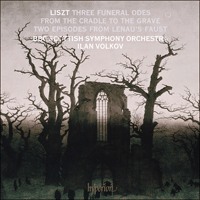

As part of Liszt’s anniversary year Hyperion turns to some of the composer’s most underrecorded and underperformed works. Liszt’s piano music is so much in the foreground that his works for orchestra have been almost forgotten. Here the BBC Scottish Symphony Orchestra and Ilan Volkov present a fascinating selection.
Liszt’s Trois Odes funèbres were composed between 1860 and 1866, and exist in a variety of versions: for orchestra, for piano solo and for piano duet. There is also a chorus in the first Ode and the possibility of a narrator in the first and second. The first is also an organ piece, with the title Trauerode, and La notte also exists for violin and piano. The third of the Odes is also entitled ‘Epilogue to the Symphonic Poem: Tasso, Lamento e Trionfo’, and in its orchestral version it enjoyed a certain vogue towards the end of the nineteenth century. Although it is quite clear from the original manuscripts that Liszt intended these works to be performed as a cycle, they have never been published together and have rarely been performed as he wished.
‘From the cradle to the grave’ was written after a drawing by the Hungarian artist Mihály Zichy (1827–1906) depicting three stages of existence: birth; the struggle for being; and death, the cradle of the life to come.
The Faust legend preoccupied Liszt for much of his life, and inspired the composer’s most famous orchestral work, the Faust Symphony. However Zwei Episoden aus Lenaus Faust also contains some of the composer’s most thrillingly atmospheric music.

Your correction of the title of my most recent symphonic poem is most judicious—‘du berceau jusqu’à la tombe’, not ‘jusqu’au cercueil’, as Zichy put it. I adopt it with gratitude—actually, the coffin remains just a piece of furniture, while the tomb becomes metaphorical.
The outer sections have much in common with Liszt’s late introspective keyboard works, whilst the strivings of the middle section hark back to the earlier symphonic poems. The first part is very similar to the separately published Wiegenlied for piano solo, and the final part combines themes from the previous two before disappearing in etherium. Unusually, Liszt drafted the whole work for piano, then arranged and amplified it for duet and for orchestra, and transferred later alterations back into the solo version. Liszt dedicated the piece in all its guises to Mihály Zichy.
Liszt’s Trois Odes funèbres were composed between 1860 and 1866, and exist in a variety of versions: for orchestra, for piano solo and for piano duet. There is also a chorus in the first Ode and the possibility of a narrator in the first and second. The first is also an organ piece, with the title Trauerode, and La notte also exists for violin and piano. The third of the Odes is also entitled ‘Epilogue to the Symphonic Poem: Tasso, Lamento e Trionfo’, and in its orchestral version it enjoyed a certain vogue towards the end of the nineteenth century, especially when conducted by its dedicatee Leopold Damrosch. Although it is quite clear from the original manuscripts that Liszt intended these works to be performed as a cycle, they have never been published together and have rarely been performed as he wished.
Les morts was prompted by the death of Liszt’s only son Daniel at the age of twenty, and is constructed about an orison by the Abbé Felicité de Lamennais (1782–1854): the end of each stanza of both poem and music has the refrain ‘Blessed are the dead who die in the grace of Lord’, and towards the end the psalm ‘De Profundis’, the ‘Te Deum’ and the ‘Sanctus’ are quoted. By following the structure of the poem, Liszt evolves a highly original musical form. The sung text presents the Latin version of these famous lines; Lammenais’ poem is written out throughout the score above the first violin line, possibly with view to recitation, but more likely with a view to assisting the conductor to achieve the appropriate expression. The rhythm of the words is clearly reflected by that of the music.
The dead
They have also passed over this earth; they have gone down the river of Time; their voices were heard on its banks, and then nothing more was heard. Where are they? Who will tell us? Happy the dead that die in the Lord!
Whilst they were passing, a thousand vain shadows presented themselves to their sight; the world that Christ has cursed showed to them its grandeur, riches, voluptuousness; they saw it, and suddenly they only saw Eternity. Where are they? Who will tell us? Happy the dead that die in the Lord!
Like a light from ahigh a cross in the distance appeared to guide their course; but all did not behold it. Where are they? Who will tell us? Happy the dead that die in the Lord!
There were those that said: What is that stream that carries us away? Is there anything after this rapid voyage? We do not know, nobody knows. And as they said that, the laughing vanished. Where are they? Who will tell us? Happy the dead that die in the Lord!
There were also those who seemed to hearken, in a profound meditation, to an inward word; and then, with eye fixed on the setting sun, they sang all at once of an invisible dawn and of a day that never ends. Where are they? Who will tell us? Happy the dead that die in the Lord!
Swept away pell-mell, young and old, all disappeared like to the vessel chased by the storm.
One could sooner count the sands of the sea than the number of those that hastened to pass. Where are they? Who will tell us? Happy the dead that die in the Lord!
Those that saw them have said that there was a great sadness in their hearts: anguish upheaved their chest, as if tired of the work of living, lifting their eyes to Heaven, they wept. Where are they? Who will tell us? Happy the dead that die in the Lord!
From the unknown places where the river loses itself two voices arise unceasingly: The one says: From the bottom of the abyss I have cried to Thee, Lord; Lord, listen to my wailing, lend ear to my prayer. If Thou searchest our iniquity, who will look well in Thy sight? But near Thee is mercy and unbounded redemption.
And the other: We praise Thee, O God! we bless Thee: holy, holy, holy is the Lord God of Armies! The earth and the heavens are filled with Thy glory.
And we also, we shall go whence those wailings or those songs of triumph come. Where shall we be? Who will tell us? Happy the dead that die in the Lord!
Felicité de Lamennais (1782–1854) (English translation by J Köttgen)
La notte was composed upon the death after childbirth of Liszt’s elder daughter Blandine, but its roots lie much earlier: in the second book of the Années de pèlerinage there is a piece, Il penseroso, inspired by a statue of Michelangelo’s of the same name, sculpted for the tomb of Lorenzo de Medici in the church of San Lorenzo in Florence. La notte develops this earlier work by composing a variation on it and inserting a very beautiful central episode whose opening phrase is overlaid with the words from Virgil’s Aeneid: ‘And dying he remembers fair Argos’—clearly motivated by Liszt’s own feeling that he would die far from his native Hungary, and the musical point is made by the wistful reminiscence of the Hungarian cadence so familiar to us from his Rhapsodies. The title was inspired by the poetic quatrain by Michelangelo which appears on his statue, and at the head of both Liszt works:
Grato m’è il sonno, e più l’esser di sasso.
Mentre che il danno e la vergogna dura.
Non veder, non sentir m’è gran ventura
Però non mi destar, deh’—parla basso!
Le triomphe funèbre du Tasse is prefaced by a long quotation from Pierantonio Serassi’s account of Tasso’s funeral, at which all of those who had sought to vilify and persecute the poet during his lifetime turned up in their finery to lament his passing. Liszt certainly believed that his time too would not come until after his own death, and this piece can be seen as a self-portrait as much as it can a work honouring Tasso—the subject of an earlier symphonic poem first written as an overture to Goethe’s play Torquato Tasso. Although the Ode uses two themes from the symphonic poem it stands as a completely independent work, and like the other Odes is characterized by dignity and restraint, as well as extremely forward-looking chromaticism.
The Faust legend preoccupied Liszt for much of his life. Berlioz had introduced Liszt to Gérard de Nerval’s French translation of Goethe’s Faust when the two composers first met in December 1830. Liszt became immediately obsessed by it, and became the dedicatee and champion of Berlioz’s dramatic legend on the subject: La damnation de Faust. Goethe’s play inspired Liszt’s orchestral masterpiece, Eine Faust-Symphonie, which was dedicated in turn to Berlioz. Liszt’s other Faust-related works include the present Zwei Episoden—a response to Nikolaus Lenau’s long poem in twenty-four episodes on the subject (Liszt’s pieces are based on episodes 11 and 6); the late Zweiter, Dritter and Vierter Mephisto-Walzer, the Bagatelle sans tonalité (also, confusingly, called Vierter Mephisto-Walzer in the manuscript) and the Mephisto-Polka do not specify their particular literary sources of inspiration. Liszt also made piano transcriptions of music from Berlioz’s La damnation, from Gounod’s opera Faust and from Lassen’s incidental music to Goethe’s Faust.
The Zwei Episoden aus Lenaus Faust were completed in their orchestral guise by 1861, but Liszt’s piano version of the Der Tanz in der Dorfschenke—Erster Mephisto-Walzer, which preceded the orchestral version, had already appeared. Liszt may have begun the composition as early as 1857. (The MS lacks ‘Erster’, but editions that have appeared since the composition of the other Mephisto waltzes have rightly seen fit to number the first of them.)
Der nächtliche Zug is a work of frightening solemnity—Faust confronted with the dark mysteries of life and death—and the outer sections are bleak and almost atonal. The two central sections are in gentle contrast, the first purgatorial in its yearning and tonal flux, the second quietly and eventually grandly confident in its singing of the plainsong—usually associated with Corpus Christi or Maundy Thursday—‘Pange lingua gloriosi corporis mysterium’ (the hymn by St Thomas Aquinas, rendered in The New English Hymnal as ‘Of the glorious body telling, / O my tongue, its mysteries sing’). As many a commentator has observed, this is unquestionably one of Liszt’s finest works, and its neglect in performance of any of its versions is inexplicable, particularly in the light of the phenomenal success of its companion piece. It is especially rare to hear the fulfilment of Liszt’s conception: to have the pieces played as a pair—Mephisto’s mad whirl of earthly pleasures mocked being a perfect foil for the awesome fatalism of Faust’s vision on his night ride. The piano solo version contains only the Presto coda: Mephisto laughs, dances away, and the vision is abandoned. The orchestral score presents two endings: the familiar Presto and an alternative Allegro molto ending which roars into life and dies away (this is the only ending provided in the version for piano duet, and is the version recorded here), depicting the pleasure-seekers sinking ‘in the ocean of their own lust’, as it is often given in translation. Humphrey Searle (in The Music of Liszt) cannot be bettered in his paraphrase of the episodes from Lenau’s poem:
1. It is a warm spring night, dark and gloomy, but the nightingales are singing. Faust enters on horseback, letting his horse quietly saunter on. Soon lights are seen through the trees, and a religious procession approaches, singing … the procession passes on, and Faust, left alone, weeps bitterly into his horse’s mane.
2. Faust and Mephistopheles enter the inn in search of pleasure; the peasants are dancing, and Mephisto seizes the violin and intoxicates the audience with his playing. They abandon themselves to love-making, and two by two slip out into the starlit night, Faust with one of the girls; then the singing of the nightingale is heard through the open doors.
Liszt dedicated the Episodes—in all their versions—to his sadly short-lived but phenomenal student Carl Tausig (1841–1871).
Leslie Howard © 2011
Votre correction du titre de mon récent poème symphonique est fort judicieuse—du berceau jusqu’à la tombe, non jusqu’au cercueil, selon l’inscription de Zichy. Je l’adopte avec remerciement—en effet le cercueil ne reste qu’un meuble, tandis que la tombe devient métaphore.
Les sections externes ont beaucoup de points communs avec les dernières œuvres pour clavier introspectives de Liszt, alors que les affrontements de la section médiane rappellent les poèmes symphoniques antérieurs. La première partie ressemble beaucoup au Wiegenlied pour piano seul publié séparément, et la dernière partie associe des thèmes des deux précédentes avant de disparaître dans l’atmosphère. Chose rare, Liszt a esquissé toute cette œuvre pour piano, puis l’a arrangée et amplifiée pour piano à quatre mains et pour orchestre, avant de reporter les modifications dans la version pour piano seul. Liszt a dédié cette pièce sous toutes ses formes à Mihály Zichy.
Les Trois Odes funèbres de Liszt ont été composées entre 1860 et 1866 et existent dans de multiples versions: pour orchestre, pour piano seul et pour piano à quatre mains. Il y a aussi un chœur dans la première ode et la possibilité d’un récitant dans la première et la deuxième. La première existe également comme pièce pour orgue, sous le titre Trauerode, et il y a une version pour violon et piano de La notte. La troisième ode s’intitule aussi «Épilogue au poème symphonique: Tasso, Lamento e Trionfo» et, dans sa version pour orchestre, elle a connu une certaine vogue vers la fin du XIXe siècle, surtout sous la direction de son dédicataire Leopold Damrosch. Même s’il ressort clairement des manuscrits originaux que Liszt voulait que ces œuvres soient jouées comme un cycle, elles n’ont jamais été publiées ensemble et ont rarement été exécutées comme il le désirait.
Liszt a composé Les morts à la suite de la mort de son fils unique, Daniel, à l’âge de vingt ans; cette œuvre est construite sur une oraison de l’abbé Félicité de Lamennais (1782–1854): la fin de chaque strophe du poème comme de la musique comporte le refrain «Heureux les morts qui meurent dans le Seigneur» et, vers la fin, il cite le psaume «De Profundis», le «Te Deum» et le «Sanctus». En suivant la structure du poème, Liszt élabore une forme musicale très originale. Le texte chanté reprend la version latine de ces vers célèbres; le poème de Lamennais est écrit d’un bout à l’autre de la partition au-dessus de la ligne de premier violon, peut-être en vue de la récitation, mais plus probablement dans le but d’aider le chef d’orchestre à obtenir l’expression appropriée. Le rythme des mots se reflète clairement dans celui de la musique.
Les morts
Ils ont aussi passé sur cette terre; ils ont descendu le fleuve du temps; on entendit leur voix sur ses bords, et puis l’on n’entendit plus rien. Où sont-ils? Qui nous le dira? Heureux les morts qui meurent dans le Seigneur!
Pendant qu’ils passaient, mille ombres vaines se présentèrent à leurs regards; le monde que le Christ a maudit leur montra ses grandeurs, ses richesses, ses voluptés; ils le virent, et soudain ils ne virent plus que l’éternité. Où sont-ils? Qui nous le dira? Heureux les morts qui meurent dans le Seigneur!
Semblable à un rayon d’en haut, une croix, dans le lointain, apparaissait pour guider leur course: mais tous ne la regardaient pas. Où sont-ils? Qui nous le dira? Heureux les morts qui meurent dans le Seigneur!
Il y en avait qui disaient: Qu’est-ce que ces flots qui nous emportent? Y a-t-il quelque chose après ce voyage rapide? Nous ne le savons pas, nul ne le sait. Et comme ils disaient cela, les rires s’évanouissaient. Où sont-ils? Qui nous le dira? Heureux les morts qui meurent dans le Seigneur!
Il y en avait aussi qui semblaient, dans un recueillement profond, écouter une parole secrète; et puis, l’œil fixé sur le couchant, tout à coup ils chantaient une aurore invisible et un jour qui ne finit jamais. Où sont-ils? Qui nous le dira? Heureux les morts qui meurent dans le Seigneur!
Entraînés pêle-mêle, jeunes et vieux, tous disparaissaient tels que le vaisseau que chasse la tempête.
On compterait plutôt les sables de la mer que le nombre de ceux qui se hâtaient de passer. Où sont-ils? Qui nous le dira? Heureux les morts qui meurent dans le Seigneur!
Ceux qui les virent ont raconté qu’une grande tristesse était dans leur cœur: l’angoisse soulevait leur poitrine, et, comme fatigués du travail de vivre, levant les yeux au ciel, ils pleuraient. Où sont-ils? Qui nous le dira? Heureux les morts qui meurent dans le Seigneur!
Des lieux inconnus où le fleuve se perd, deux voix s’élèvent incessamment: L’une dit: Du fond de l’abîme, j’ai crié vers vous, Seigneur: Seigneur écoutez mes gémissements, prêtez l’oreille à ma prière. Si vous scrutez nos iniquités, qui soutiendra votre regard? Mais près de vous est la miséricorde et une rédemption immense.
Et l’autre: Nous vous louons, ô Dieu! Nous vous bénissons: saint, saint, saint est le Seigneur Dieu des armées! La terre et les cieux sont remplis de votre gloire.
Et nous aussi nous irons là d’où partent ces plaintes ou ces chants de triomphe. Où serons-nous? Qui nous le dira? Heureux les morts qui meurent dans le Seigneur!
Felicité de Lamennais (1782–1854)
La notte a été composée après la mort en couches de la fille aînée de Liszt, Blandine, mais ses racines remontent beaucoup plus loin: le deuxième livre des Années de pèlerinage comporte un morceau, Il penseroso, inspiré par la statue homonyme de Michel-Ange, sculptée pour la tombe de Laurent de Médicis dans l’église San Lorenzo à Florence. La notte développe cette œuvre antérieure en composant une variation sur celle-ci et en insérant un très bel épisode central dont la première phrase est soulignée par les mots de L’Énéide de Virgile: «Et en mourant il se souvient de la belle Argos»—référence évidente aux pensées de Liszt, persuadé qu’il allait mourir loin de sa Hongrie natale, ce que traduit en musique la réminiscence nostalgique de la cadence hongroise que ses rhapsodies nous ont appris à bien connaître. Le titre s’inspire du quatrain poétique de Michel-Ange qui figure sur sa statue et en tête des deux œuvres de Liszt:
Grato m’è il sonno, e più l’esser di sasso.
Mentre che il danno e la vergogna dura.
Non veder, non sentir m’è gran ventura
Però non mi destar, deh’—parla basso!
Il m’est doux de dormir et d’être de marbre.
Aussi longtemps que l’injure et la honte durent,
Ne pas voir, ne pas entendre m’est un grand bonheur;
Aussi ne m’éveille pas, mais parle à voix basse.
Le triomphe funèbre du Tasse est préfacé par une longue citation de Pierantonio Serassi décrivant les funérailles du Tasse, où tous ceux qui avaient cherché à diffamer et persécuter le poète de son vivant se présentèrent parés de leurs plus beaux atours pour pleurer sa disparition. Liszt croyait certainement que son heure ne viendrait pas avant sa propre mort et cette œuvre peut être considérée comme un autoportrait tout autant qu’un hommage au Tasse—sujet d’un poème symphonique antérieur écrit tout d’abord comme une ouverture pour la pièce de Goethe Torquato Tasso. Si cette ode utilise deux thèmes du poème symphonique, elle se présente comme une œuvre totalement indépendante et, comme les autres odes, elle se caractérise par la dignité et la modération, ainsi que par un chromatisme tourné vers l’avenir.
Liszt s’est intéressé à la légende de Faust pendant une grande partie de sa vie. Lorsque les deux compositeurs avaient fait connaissance en décembre 1830, Berlioz lui avait fait connaître la traduction française du Faust de Goethe par Gérard de Nerval. Immédiatement obsédé par cette œuvre, Liszt était devenu le dédicataire et le champion de la légende dramatique que Berlioz en avait tiré: La damnation de Faust. La pièce de Goethe a inspiré à Liszt un chef-d’œuvre orchestral, Eine Faust-Symphonie, dédiée à son tour à Berlioz. Ses autres œuvres sur le thème de Faust comprennent les présents Zwei Episoden—réponse au long poème de Nikolaus Lenau sur ce sujet (les pièces de Liszt reposent sur les épisodes 11 et 6); les tardifs Zweiter, Dritter et Vierter Mephisto-Walzer («Méphisto-Valses nos 2, 3 et 4»), la Bagatelle sans tonalité (également intitulée Vierter Mephisto-Walzer [«Méphisto-Valse no 4»] d’une manière qui prête à confusion sur le manuscrit) et la Mephisto-Polka ne contiennent aucune indication sur leurs propres sources littéraires d’inspiration. Liszt a également fait des transcriptions pour piano de certains extraits de la Damnation de Berlioz, de l’opéra Faust de Gounod et de la musique de scène de Lassen pour le Faust de Goethe.
Avant d’écrire la version pour orchestre des Zwei Episoden aus Lenaus Faust («Deux Épisodes du Faust de Lenau») achevée en 1861, Liszt avait publié la version pour piano de Der Tanz in der Dorfschenke—Erster Mephisto-Walzer («La Danse à l’auberge du village—Méphisto-Valse no 1»). Il a peut-être commencé cette œuvre dès 1857. (Le manuscrit ne présente pas le mot «Erster», mais des éditions postérieures à la composition des autres Méphisto-Valses ont jugé bon, à juste titre, de numéroter la première d’entre elles.)
Der nächtliche Zug («La procession nocturne») est une œuvre d’une solennité effrayante—Faust confronté aux sombres mystères de la vie et de la mort—et les sections externes sont austères et presque atonales. Les deux sections centrales présentent un doux contraste, la première infernale dans son désir ardent et son perpétuel changement tonal, la seconde calme et d’une confiance magnifique que traduit le «Pange lingua gloriosi corporis mysterium» en plain-chant, l’hymne de saint Thomas d’Aquin généralement associé à la Fête-Dieu et au jeudi saint (que le New English Hymnal reprend comme «Of the glorious body telling, / O my tongue, its mysteries sing» [«Chante, ma langue, le mystère du Corps de gloire»]). Comme l’ont écrit de nombreux commentateurs, c’est sans conteste l’une des plus belles œuvres de Liszt et il est inexplicable qu’elle soit si rarement jouée dans l’une ou l’autre de ses versions, surtout si l’on tient compte du succès phénoménal de l’autre pièce de ce diptyque. Il est très rare de pouvoir apprécier la réalisation de la conception de Liszt avec une exécution conjointe deux pièces—le tourbillon fou de plaisirs terrestres simulés de Méphisto faisant parfaitement ressortir le redoutable fatalisme de la vision de Faust dans son parcours nocturne. Dans la version pour piano seul, il n’y a qu’une coda, Presto: Méphisto rit, part en dansant et la vision disparaît. La partition d’orchestre présente deux fins: le Presto familier et une fin alternative Allegro molto qui démarre en hurlant et disparaît (la version pour piano à quatre mains ne comporte que cette conclusion qui est enregistrée ici), une peinture des jouisseurs sombrant «dans l’océan de leur propre luxure», comme on le traduit souvent. On ne saurait mieux faire que citer Humphrey Searle (dans The Music of Liszt) dans sa paraphrase des épisodes du poème de Lenau:
1. C’est une chaude nuit de printemps, sombre et morose, mais les rossignols chantent. Faust entre à cheval, laissant son cheval avancer d’un pas nonchalant. On aperçoit bientôt des lumières à travers les arbres et une procession religieuse approche, en chantant … la procession passe, et Faust, laissé seul, pleure amèrement dans la crinière de son cheval.
2. Faust et Méphistophélès entrent à l’auberge en quête de plaisirs; les paysans dansent et Méphisto s’empare du violon et grise l’auditoire de son jeu. Ils s’abandonnent à faire l’amour et, deux par deux, sortent discrètement dans la nuit étoilée, Faust avec l’une des jeunes filles; puis on entend le chant du rossignol à travers les portes ouvertes.
Liszt a dédié les Épisodes—dans toutes leurs versions—à son remarquable élève Carl Tausig (1841–1871), malheureusement trop tôt disparu.
Leslie Howard © 2011
Français: Marie-Stella Pâris
Ihre Korrektur des Titels meines jüngsten sinfonischen Gedichts mit „du berceau jusqu’à la tombe“ anstelle von Zichys Titel „jusqu’au cercueil“ ist höchst gerechtfertigt. Ich übernehme dies mit Dankbarkeit, denn der Sarg ist und bleibt ein Möbelstück, während das Grab zur Metapher wird.
Die Eckteile haben viel mit Liszts späten Werken für Tasteninstrumente gemeinsam, während der Mittelteil zurück zu den früheren sinfonischen Gedichten strebt. Der erste Teil ähnelt sehr dem getrennnt veröffentlichten Wiegenlied für Klaviersolo, und der letzte kombiniert Themen aus den beiden vorherigen Teilen, bevor er in den Äther entschwindet. Ungewöhnlich für Liszt ist, dass er das gesamte Werk zunächst für Klavier konzipierte, dann für Duett und Orchester arrangierte und verstärkte und schließlich frühere Änderungen zurück in die Solofassung brachte. Liszt widmete das Werk in allen Ausformungen Mihály Zichy.
Die Trois Odes funèbres wurden zwischen 1860 und 1866 komponiert und sind in mehreren Versionen für Orchester, Klaviersolo und Klavierduett überliefert. Außerdem hat die erste Ode einen Chor, und in der ersten und zweiten können Erzähler eingefügt werden. Die erste Ode existiert auch als Orgelstück mit dem Titel Trauerode und La notte als Stück für Geige und Klavier. Die dritte Ode trägt auch den Titel „Epilog zum Sinfonischen Gedicht Tasso, Lamento e Trionfo“ und entsprach gegen Ende des 19. Jahrhunderts einem bestimmten Publikumsgeschmack vor allem dann, wenn sie von ihrem Widmungsträger Leopold Damrosch dirigiert wurde. Obgleich aus den Handschriften deutlich wird, dass Liszt diese Kompositionen als Zyklus angelegt hatte, werden sie sehr selten seinen Wünschen gemäß aufgeführt und sind nie zusammen veröffentlicht worden.
Nach dem Tod seines einzigen Sohnes Daniel im Alter von zwanzig Jahren komponierte Liszt Les morts entlang den Strukturen einer Aufforderung zum Gebet des Abbé Felicité de Lamennais (1782–1854): Die einzelnen Strophen sowohl des Gedichts als auch der Musik enden mit dem Refrain „Selig sind die Toten, die im Herrn sterben“, und zum Schluss werden der Psalm „De Profundis“ sowie das „Te Deum“ und das „Sanctus“ zitiert. Mit der Anlehnung an die Struktur des Gedichts entwickelt Liszt eine ungemein originelle musikalische Form. Der Gesangstext präsentiert die lateinische Fassung dieser berühmten Zeilen, und in der Partitur ist das Gedicht von Lammenais oberhalb der gesamten Stimme der ersten Geige eingetragen, und zwar entweder für mündlichen Vortrag oder, wahrscheinlicher, als Anleitung des Dirigenten zur Erzielung des angestrebten Ausdrucks, und die Musik unterstreicht deutlich den Textrhythmus.
Die Toten
Gleich uns wandelten sie einst auf Erden und glitten hinab im Strome der Zeit. An seinen Ufern erklang ihre Stimme, doch keiner, keiner vernimmt sie mehr. Wo sind sie? Wer sagt es? Selig sind die Toten, die im Herrn sterben!
Da sie lebten, umgaben sie eitle Schatten; die Welt, die Christus verdammte, zeigte ihnen ihre Lust und Herrlichkeit. Sie freuten sich ihrer, nun aber schauen sie nur die Ewigkeit. Wo sind sie? Wer sagt es? Selig sind die Toten, die im Herrn sterben!
Als Leitstern auf ihrem Lebenspfade leuchtete ihnen von fern das Himmelslicht eines Kreuzes; alle aber gewahrten es nicht. Wo sind sie? Wer sagt es? Selig sind die Toten, die im Herrn sterben!
Ihrer manche fragten: „Wohin tragen uns die Fluten? Erwartet uns ein Ziel nach ruhloser Fahrt? Wir wissen’s nicht, und keiner weiß es.“ Und da sie so sprachen, erstarb alles Lachen. Wo sind sie? Wer sagt es? Selig sind die Toten, die im Herrn sterben!
Und andere schienen, tiefer Andacht voll, einer geheimen Botschaft zu lauschen; den Blick gen Abend gerichtet, sangen sie von einer unsichtbaren Morgenröte und einem nie endenden Tag. Wo sind sie? Wer sagt es? Selig sind die Toten, die im Herrn sterben!
Im Wirbel fortgerissen, jung und alt, verschwanden sie alle, wie das Schiff, das der Sturm entführt.
Eher könnte man die Sandkörner des Meeres zählen, als die Schar derer, die eilends dahinglitten. Wo sind sie? Wer sagt es? Selig sind die Toten, die im Herrn sterben!
Die sie vorübertreiben sahen, bezeugten, daß ihr Herz von tiefer Traurigkeit erfüllt war, daß Angst ihre Brust durchwühlte und daß sie, wie müde der Last des Lebens, die Augen zum Himmel wandten und weinten. Wo sind sie? Wer sagt es? Selig sind die Toten, die im Herrn sterben!
Zwei Stimmen wedern laut, wo der Strom an unbekannten Ufern mündet. Die eine spricht: „Aus des Abgrundes Tiefen habe ich dich gerufen, Herr. Herr, höre mein Seufzen, neige meinem Bitten dein Ohr! Wenn du unsre Sünden wägst, wer soll vor deinem Blick bestehen? Aber bei dir ist Barmherzigkeit, ist Erlösung.“
Und die andere Stimme: „Herr Gott, wir loben dich und preisen dich: Heilig, heilig, heilig ist Gott der Herr. Himmel und Erde sind deiner Ehre voll!“
Auch wir, wir alle gehen dahin, von wo diese Klagen oder Lobgesänge ertönen. Wo wedern wir dann sein? Wer sagt es? Selig sind die Toten, die im Herrn sterben!
(Felicité de Lamennais (1782–1854). Deutsch von La Mara [Marie Lipsius, 1837–1927])
Liszt komponierte La notte, nachdem seine ältere Tochter Blandine im Kindbett gestorben war, doch die Ursprünge des Werks reichen sehr viel weiter zurück: Das zweite Buch der Années de pèlerinage enthält ein Stück namens Il penseroso, das von der Inschrift auf Michelangelos gleichnamiger Statue für das Grabmahl von Lorenzo de Medici in der Kirche San Lorenzo in Florenz inspiriert war. Mit La notte entwickelt Liszt dieses frühere Werk weiter mit einer Variation und der Einfügung einer sehr schönen zentralen Episode, deren Einleitung er aus dem deutlichen Gefühl heraus, einst fern von seiner ungarischen Heimat sterben zu müssen, mit den Worten aus Virgils Aeneis überlagert: „Und sterbend gedenkt er des schönen Argos.“ Musikalisch erreicht er dies mit der beschwörenden Erinnerung an die aus seinen Rhapsodien so vertrauten ungarischen Kadenzen. Der Titel geht auf den Vierzeiler auf Michelangelos Statue zurück, der auch im Kopf beider Werke von Liszt erscheint:
Grato m’è il sonno, e più l’esser di sasso.
Mentre che il danno e la vergogna dura.
Non veder, non sentir m’è gran ventura
Però non mi destar, deh’—parla basso!
Ich bin glücklich zu schlafen und mehr noch, von Stein zu sein.
Solange Verletzung und Schande andauern,
nicht zu sehen, zu hören ist ein großes Glück für mich,
Doch stört mich nicht, eh! Sprecht leise.
Der Ode Le triomphe funèbre du Tasse geht ein langes Zitat aus Pierantonio Serassis Bericht über Torquato Tassos Beerdigung voraus, an der sich all diejenigen in bester Aufmachung beteiligten, die den Dichter zu Lebzeiten mit Verleumdungen verfolgt hatten, um nun sein Ableben zu beklagen. Liszt glaubte sicherlich, dass auch seine Zeit erst nach seinem Tod kommen werde, und man kann dieses Werk ebenso als Selbstporträt wie als Ehrung dieses Dichters verstehen, der bereits Gegenstand einer früheren sinfonischen Dichtung als Ouvertüre zu Goethes Theaterstück Torquato Tasso gewesen war. Obgleich die Ode zwei Themen aus dem sinfonischen Gedicht verarbeitet, ist sie ein durch und durch eigenständiges Werk und wie die anderen Oden durch Würde und Zurückhaltung, aber auch von außerordentlich voraus schauender Chromatik geprägt.
Liszt war viele Jahre seines Lebens von der Faustlegende fasziniert. Berlioz hatte ihn mit Gérard de Nervals französischer Übersetzung von Goethes Faust bekannt gemacht, als die beiden Komponisten sich erstmals im Dezember 1830 trafen. Liszt war sofort vereinnahmt davon und wurde Widmungsträger und Förderer von Berlioz’ dramatischer Legende über das Thema La damnation de Faust. Goethes Theaterstück inspirierte Liszt zu seinem meisterlichen Orchesterwerk Eine Faust-Sinfonie, die er wiederum Berlioz widmete. Andere Werke über Faust ohne besondere Angabe ihrer Inspirationsquelle sind die hier eingespielten Zwei Episoden als Erwiderung auf Nikolaus Lenaus langes, aus vierundzwanzig Episoden bestehendes Gedicht über das Thema (Liszts Beitrag ist auf die elfte und sechste Episode beschränkt); die späten Mephisto-Walzer Nr. 2, 3 und 4; die Bagatelle sans tonalité (in der Handschrift verwirrenderweise ebenfalls als Vierter Mephisto-Walzer bezeichnet); und die Mephisto-Polka. Liszt verfertigte auch Klavierauszüge aus Berlioz’ La damnation de Faust, aus Gounods Oper Faust und aus Lassens Zwischenmusik zu Goethes Faust.
Liszts Orchesterfassungen der Zwei Episoden aus Lenaus Faust waren 1861 fertiggestellt, doch die vorher entstandene Klavierfassung des ersten Mephisto-Walzers Der Tanz in der Dorfschenke war bereits veröffentlicht und möglicherweise schon 1857 begonnen worden. (In der Handschrift fehlt „Erster“, doch in den seitdem veröffentlichten Mephisto-Walzern ist der jeweils erste erwartungsgemäß nummeriert worden.)
Der nächtliche Zug ist ein Werk von schrecklich würdiger Feierlichkeit: Faust wird konfrontiert mit den düsteren Mysterien von Leben und Tod, und die Eckteile sind freudlos bis fast zur Atonalität. Die beiden Mittelteile stehen in zartem Kontrast dazu: Der erste mit seiner Sehnsucht und seinem tonalen Dahinfließen wirkt reinigend; der zweite ist ruhig und wird dann großartig zuversichtlich mit seinem Abendmahlsgesang von Thomas von Aquin zum Gründonnerstag und Fronleichnam: „Pange lingua gloriosi corporis mysterium“ (Preise, Zunge, das Geheimnis dieses Leibs voll Herrlichkeit). Nicht wenige Kommentatoren haben ihr Unverständnis darüber ausgedrückt, dass dieses Stück, obwohl es fraglos zu Liszts besten Werken gehört, in allen Fassungen, vor allem angesichts des phänomenalen Erfolgs seines Begleitstücks, vom Konzertsaal so unerklärlich stark vernachlässigt worden ist. Besonders selten ist auch die Erfüllung von Liszts Vorstellung, die beiden Stücke als Paar aufzuführen und Mephistos karikierenden Wirbel irdischer Freuden als vollkommenen Kontrast zum Ehrfurcht heischenden Fatalismus von Fausts Vision seines nächtlichen Ritts darzustellen. Nur die Fassung für Klaviersolo enthält die Presto-Coda: Mephisto lacht und tanzt hinweg, und die Vision schwindet dahin. Die Orchesterpartitur bietet zwei Schlüsse, und zwar das bekannte Presto und ein alternatives Allegro molto, das mit Ausbrüchen zum Leben endet und dann abstirbt (der einzige und hier eingespielte Schluss in der Fassung für Klavierduett), um das Versinken der Vergnügungssüchtigen „im Meer ihrer Begierde“ zu beschreiben, wie es so häufig in Übersetzungen heißt. Besser als Humphrey Searle (in The Music of Liszt) könnte man diese Episoden aus Lenaus Gedicht nicht zusammenfassen:
1. In einer warmen, dunkel-schwermütigen Frühlingsnacht singen die Nachtigallen; Faust trabt gemächlich auf einem Pferd herein. Bald werden die Lichter einer religiösen Prozession mit Gesang zwischen den Bäumen sichtbar … die Prozession geht vorüber und lässt Faust zurück, der bitterlich in die Mähne seines Pferdes weint.
2. Faust und Mephisto betreten die Dorfschenke auf der Suche nach Unterhaltung; die Bauern tanzen, Mephisto greift eine Geige und verzaubert mit seinem Spiel das Publikum, das sich dann dem Liebeswerben hingibt und paarweise in die sternklare Nacht entschwindet, darunter auch Faust mit einem Mädchen. Der Gesang der Nachtigall klingt weiter durch die offenen Türen herein.
Liszt widmete die Episoden in allen Fassungen seinem phänomenalen, aber leider sehr kurzlebigen Schüler Carl Tausig (1841–1871).
Leslie Howard © 2011
Deutsch: Henning Weber