Welcome to Hyperion Records, a British classical label devoted to presenting high-quality recordings of music of all styles and from all periods from the twelfth century to the twenty-first.
Hyperion offers both CDs, and downloads in a number of formats. The site is also available in several languages.
Please use the dropdown buttons to set your preferred options, or use the checkbox to accept the defaults.
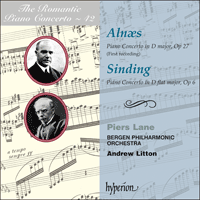



Hyperion’s record of the month of April is the forty-second release in our prestigious Romantic Piano Concerto series.
We went to Norway for this one—and rightly so as the recording reveals that there’s more to Norwegian Romantic Piano Concertos than Grieg in A minor. While Sinding is at least a name to most people (if only for The Rustle of Spring) Alnæs is almost completely unknown outside his native land, yet it is perhaps this latter’s concerto which makes the bigger impression. This is a glorious late romantic work in an idiom akin to Rachmaninov; indeed there are passages which seem to quote the Russian’s fourth concerto—except that the Alnæs was written first. Did Rachmaninov perhaps hear an early performance?
The Sinding is a monolithic three-movement work where all the material is based on one theme which undergoes many Lisztian transformations. The piece is hugely virtuosic, some may say bombastic—but some may also say that’s what this series is about—and it’s all good fun!
We’re delighted to continue our relationship with Andrew Litton as the new principal conductor of the Bergen Philharmonic and here he is joined by RPC stalwart Piers Lane in his sixth contribution to the series.

Alnæs received his musical education at the private music conservatory in Oslo. He continued his studies in Leipzig, where he was taught composition by Carl Reinecke. After the premiere of his first symphony in 1896 he received a scholarship giving him the opportunity to study composition with Julius Ruthardt in Berlin. The first results of his time in Berlin were the Variations symphoniques for orchestra (1898) and several smaller piano pieces. A concert presenting his orchestral music in Leipzig in 1900 revealed his ambitions as a composer, but like Edvard Grieg he was forced to undertake a range of musical tasks which took up much of the time he could devote to composing. Twenty-four of his forty-five opuses are collections of songs, and Alnæs became one of Scandinavia’s most performed song composers. His piano music, which mostly consists of poetic miniatures, also has a dominant place in his output, demonstrating that Alnæs aimed to compose music that his publishers would find marketable. Alnæs also composed chamber and choral music, but after 1900 the piano concerto and the second symphony are the only works on a larger scale.
The Piano Concerto in D major, Op 27, and the two symphonies are composed in Classical forms with a late-Romantic harmonic style, placing Alnæs in the same tradition as Rubinstein and Rachmaninov. His colleague Gerhard Schjelderup characterized Alnæs in 1921 as a typical lyricist who did not develop new and individual methods. In Schjelderup’s opinion Alnæs was ‘a healthy and true musician, keeping both feet on the ground and remaining firmly within an expressive sphere accessible to his listeners’. Schjelderup described the piano music as empty and vacuous, but it is doubtful that he ever heard the piano concerto, which is a firework of life and energy, far removed from the cathedral organist’s weekly chorale improvisations on the organ.
The first movement, in a brilliant and shining D major, has a large-scale and impressive character reminiscent of Rachmaninov. Glittering virtuoso piano passages alternate with orchestral writing that—with its eight horns, six trombones, four trumpets and two bass tubas—has a Wagnerian force. In complete contrast, the second movement has a tragic character in the mood of a funeral march. A timpani roll à la Grieg then launches the listener into a delicious waltz, which in grace and vigour stands alongside Weber’s Aufforderung zum Tanz. The last movement is a tribute to the Viennese waltz and a splendid mixture of popular melody and virtuoso piano-writing that demands spontaneous applause.
Christian Sinding (1856–1941) descends from a family with several talented artists: Sinding’s brother Otto was a famous painter and his brother Stephan a well-known sculptor. Christian Sinding himself started his musical career as a violinist and played for a while in the Philharmonic Society in Oslo under the baton of the composer Johan Svendsen. While he continued his music studies in Leipzig some of Sinding’s compositions were performed, but they did not elicit a positive response from his friends at the conservatory. Not only this, but Sinding’s severe self-criticism led him to destroy many of his works. Between 1882 and 1884 Sinding studied in Munich, and following the more positive recognition he received there he concentrated fully on composing. This was only possible thanks to scholarships from the Norwegian government and private foundations, and a contract with the publisher Peters in Leipzig in 1892 was an important step in his struggle to earn a living from composing.
Sinding lived in Germany for almost forty years and forged strong links with German cultural life. In 1910 the Norwegian government offered him a state salary, and from 1924 he lived in the honorary residence Wergelandsgrotten near the King’s palace—a sign that he, alongside Grieg and Svendsen, was considered one of Norway’s foremost composers.
More than two-thirds of Sinding’s compositions are songs or piano music, works that were easy for his publishers to sell. Sinding made his international breakthrough with his Piano Quintet, which Ferruccio Busoni and the Brodsky Quartet premiered in 1885. The next works to arouse attention were the Variations in E flat minor for two pianos, Op 2, and the Piano Concerto in D flat major, Op 6 (1889, revised 1901). Nevertheless, it was not until he composed the piano piece Frühlingsrauschen (‘Rustle of Spring’, 1899) that he really became a world-famous composer. Frühlingsrauschen was reprinted in many editions and in the first half of the twentieth century was an international hit. It has been claimed that most of Sinding’s outstanding music was composed before 1900, but he also produced important works in later years—four symphonies, three violin concertos, chamber music and the Wagner-inspired opera Der heilige Berg (1914).
Sinding did not compose national Norwegian music in the same way as Grieg; there are very few examples in his music of the influence of Norwegian folk music. Sinding was more cosmopolitan and was influenced by composers including Liszt and Wagner. In the piano concerto he uses Classical forms, but the movements are bound together into a cyclic unity through their thematic interrelationships. Thus the main themes in the second and third movements are transformations of the opening theme of the first movement.
The first movement has three contrasting themes which are elaborated and combined in the development section. Formations of sequences create long arching lines, giving the music a monumental and heroic effect. The relationship of the main theme to the Gibichung-theme in the first scene of the first act in Wagner’s Götterdämmerung has not escaped some observant listeners. There are also associations with works by Tchaikovsky and Rubinstein, although these are likely to be the sharing of a common musical inheritance rather than deliberate reminiscences. Even the ‘Grieg leitmotif’ plays a role in the concerto. Ultimately, however, it is the impression of a well-integrated structure combining power and freshness that fully engages the listener.
In the second movement Andante, in E minor, a solo horn presents a minor-key version of the opening theme from the first movement and gives the whole movement a dreamy and meditative character. The sound of the horn, the minor tonality and the ‘Grieg leitmotif’ are among the reasons why contemporary German critics perceived in this movement the light and ‘Nordic’ sound characteristic of some of Sinding’s music. Gradually the music in the second movement is developed and reaches a new heroic stature. It is interesting to note at certain points how close Sinding’s music comes to Debussy, with his use of parallel triads, and to Sibelius, through a dark and densely coloured harmony and instrumentation. The two first movements of the concerto were premiered by Erika Nissen in 1889 in Oslo, as a contribution to Sinding’s application for a state grant.
Sinding struggled to finish the last movement, and before publishing the Concerto in 1890 he made extensive reworkings. In 1901 Sinding issued another version of the Concerto, with significant alterations to the last movement, affecting the harmony and structure. Elsewhere he also revised much of the piano-writing, without changing the orchestral parts or the underlying harmony and structure, in an attempt to clarify some of the more complex piano figurations and simplify the most intractable passagework. This recording follows the revised edition of 1901, but where it could be argued that Sinding’s desire to streamline the solo part resulted in the loss of worthwhile pianistic intricacies, Piers Lane has retained some elements of the piano-writing from the original 1890 version.
Harald Herresthal © 2007
D’abord élève au conservatoire privé d’Oslo, Alnæs poursuivit ses études à Leipzig, où Carl Reinecke lui enseigna la composition. Après la création de sa première symphonie (1896), une bourse lui permit d’aller étudier la composition avec Julius Ruthardt, à Berlin. Les premiers résultats de ce séjour furent les Variations symphoniques pour orchestre (1898) et plusieurs pièces pour piano, plus modestes. En 1900, à Leipzig, un concert consacré à sa musique orchestrale dévoila ses ambitions de compositeur mais, comme Edvard Grieg, il dut assumer toute une série de tâches musicales qui absorbèrent l’essentiel de son temps de composition. Vingt-quatre de ses quarante-cinq opus sont des recueils de chants et il devint l’un des mélodistes les plus joués de Scandinavie. Sa musique de piano, constituée surtout de miniatures poétiques, occupe aussi une place essentielle dans sa production, prouvant combien il souhaitait écrire des pièces vendables aux yeux de ses éditeurs. Il composa également de la musique de chambre et des pièces chorales mais le concerto pour piano et la Symphonie no 2 seront ses seules œuvres à plus grande échelle postérieures à 1900.
Le Concerto pour piano en ré majeur, op. 27 et les deux symphonies adoptent des formes classiques et un style harmonique empreint d’un romantisme tardif, inscrivant Alnæs dans la tradition des Rubinstein et autres Rachmaninov. À en croire son collègue Gerhard Schjelderup, en 1921, Alnæs était le type même du mélodiste, qui ne développa aucune méthode nouvelle ni personnelle, un «musicien robuste et authentique, gardant les deux pieds sur terre et restant fermement ancré dans une sphère expressive accessible à tous ses auditeurs». Schjelderup jugeait la musique pianistique d’Alnæs vide et sans intérêt, mais probablement n’avait-il jamais entendu le concerto pour piano, ce feu d’artifice, plein de vie et d’énergie, très éloigné des improvisations sur choral auxquelles le compositeur se livrait, chaque semaine, à l’orgue de la cathédrale.
Par son envergure, par son caractère impressionnant, le premier mouvement, sis dans un brillant et étincelant ré majeur, rappelle Rachmaninov. De scintillants passages pianistiques virtuoses alternent avec une écriture orchestrale qui—avec ses huit cors, ses six trombones, ses quatre trompettes et ses deux tubas basses—dégage une force wagnérienne. En total contraste, le deuxième mouvement possède une caractère tragique, dans le mode d’une marche funèbre. Un roulement de timbales à la Grieg entraîne alors l’auditeur dans une valse délicieuse, qui rivalise de grâce et de vigueur avec l’Aufforderung zum Tanz de Weber. Quant au dernier mouvement, qui rend hommage à la valse viennoise, son splendide mélange de mélodies populaires et d’écriture pianistique virtuose appelle des applaudissements spontanés.
Christian Sinding (1856–1941) appartient à une famille d’artistes talentueux—ses frères Otto et Stephan furent l’un un peintre célèbre, l’autre un sculpteur fameux. Lui-même commença sa carrière musicale comme violoniste et joua pendant quelques temps dans la Société philharmonique d’Oslo, sous la baguette du compositeur Johan Svendsen. Alors qu’il étudiait encore à Leipzig, certaines de ses compositions furent jouées, mais sans rencontrer d’échos positifs auprès de ses amis du conservatoire. Ce qui, ajouté à une sévère autocritique, le poussa à détruire nombre de ses œuvres. De 1882 à 1884, il étudia à Munich où, reconnu de manière plus positive, il décida de se concentrer sur la seule composition, un choix rendu possible par des bourses du gouvernement norvégien et de fondations privées; en 1892, un contrat avec les éditions leipzigoises Peters marqua une étape importante dans son combat pour vivre de sa musique.
Sinding, qui demeura presque quarante ans en Allemagne, forgea de forts liens avec la vie culturelle de ce pays. En 1910, le parlement norvégien lui offrit un salaire et, à partir de 1924, il vécut, à titre gracieux, dans la résidence de Wergelandsgrotten, non loin du palais royal—signe que, comme Grieg et Svendsen, il était tenu pour l’un des grands compositeurs de Norvège.
Plus des deux-tiers des compositions de Sinding sont des mélodies ou des pièces pour piano, des œuvres que les éditeurs vendaient sans peine. Au niveau international, il perça grâce à son Quintette avec piano, créé par Ferruccio Busoni et le Brodsky Quartet en 1885. Les Variations en mi bémol mineur, op. 2 et le Concerto pour piano en ré bémol majeur, op. 6 (1889, révisé en 1901) retinrent ensuite l’attention, mais il lui fallut attendre Frühlingsrauschen («Murmures de printemps», 1899) pour vraiment connaître la célébrité. Cette pièce pour piano, réimprimée dans de nombreuses éditions, fut un succès international dans la première moitié du XXe siècle. Selon certains, Sinding composa l’essentiel de ses œuvres remarquables avant 1900, mais d’importantes pièces sont plus tardives—quatre symphonies, trois concertos pour violon, de la musique de chambre et l’opéra d’inspiration wagnérienne Der heilige Berg (1914).
Sinding ne composa pas de musique norvégienne au sens griegien du terme et la musique populaire de son pays a laissé bien peu de traces dans son œuvre: davantage cosmopolite, il subit l’ascendant de compositeurs comme Liszt et Wagner. Dans le concerto pour piano, les formes sont classiques, mais les mouvements, liés par des corrélations thématiques, présentent une unité cyclique: les thèmes principaux des deuxième et troisième mouvements sont ainsi des métamorphoses du thème d’ouverture du premier mouvement.
Ce premier mouvement recèle trois thèmes contrastés qui sont élaborés et combinés dans la section de développement. Les formations de séquences créent de longues lignes en arche, conférant à la musique un effet monumental et héroïque. La parenté du thème principal avec le motif des Gibichs du Götterdämmerung wagnérien (acte I, scène 1) n’aura pas échappé à la perspicacité de certains auditeurs. À noter aussi des connexions avec des œuvres de Tchaïkovsky et de Rubinstein, quoiqu’il faille probablement y voir le partage d’un héritage musical commun, et non des réminiscences délibérées. Même le «leitmotiv de Grieg» joue un rôle dans ce concerto. Mais ce qui prime ici, c’est l’impression de structure bien combinée, mêlant puissance et fraîcheur, qui attire pleinement l’auditeur.
Dans le deuxième mouvement Andante, en mi mineur, un cor solo propose une version en mineur du thème d’ouverture du premier mouvement, conférant au mouvement tout entier langueur et méditation. La sonorité du cor, la tonalité mineure et le «leitmotiv de Grieg» expliquent pourquoi la critique allemande de l’époque perçut dans ce mouvement le son léger et «nordique» propre à certaines pièces de Sinding. La musique de ce deuxième mouvement est développée jusqu’à atteindre une nouvelle stature héroïque. Il vaut de souligner combien la musique de Sinding est, par endroits, proche de celle de Debussy (usage d’accords parfaits parallèles) et de Sibelius (harmonie sombre et densément colorée, mais aussi instrumentation). Les deux premiers mouvements du concerto furent créés par Erika Nissen en 1889 à Oslo, pour appuyer la demande de subvention faite par Sinding.
Sinding peina à achever le dernier mouvement et la publication du concerto, en 1890, fut précédée de vastes refontes. En 1901, une nouvelle version parut, modifiant beaucoup l’harmonie et la structure du dernier mouvement. Ailleurs, Sinding révisa aussi l’essentiel de l’écriture pianistique, en conservant intactes les parties orchestrales, l’harmonie et la structure sous-jacentes, pour tenter et de clarifier certaines figurations pianistiques complexes, et de simplifier les passages les plus inextricables. Cet enregistrement suit l’édition révisée de 1901, mais Piers Lane a gardé certains éléments de l’écriture pianistique originale (version de 1890), là où le désir de «dégraisser» la partie solo semble avoir entraîné la perte de complexités intéressantes.
Harald Herresthal © 2007
Français: Hyperion Records Ltd
Alnæs erhielt seine musikalische Ausbildung am privaten Musikkonservatorium in Oslo. Er setzte seine Studien in Leipzig fort, wo er bei Carl Reinecke Kompositionsunterricht erhielt. Nach der Uraufführung seiner Ersten Symphonie 1896 erhielt er ein Stipendium, um bei Julius Ruthard in Berlin Komposition zu studieren. Die ersten Resultate seiner Zeit in Berlin waren die Variations symphoniques für Orchester (1898) und mehrere kleinere Klavierstücke. Ein Konzert, das 1900 seine Orchestermusik in Leipzig vorstellte, bezeugt seine Ambitionen als Komponist, aber wie Grieg war auch er gezwungen, eine Anzahl musikalischer Aufgaben zu übernehmen, die ihn viel Zeit kosteten, die er sonst dem Komponieren hätte widmen können. Vierundzwanzig seiner fünfundvierzig Werke sind Liedersammlungen, die Alnæs zu einer der am häufigsten aufgeführten Liedkomponisten in Skandinavien machte Seine Klaviermusik, zum Großteil poetische Miniaturen, nimmt ebenfalls eine vorherrschende Stellung in seinem Œuvre ein, und zeigt, dass Alnæs Musik komponieren wollte, die seine Verleger leicht vermarkten konnten. Er komponierte auch Kammer- und Chormusik, aber das Klavierkonzert und die Zweite Symphonie sind seine einzigen größeren Werke nach 1900.
Das Klavierkonzert in D-Dur, op. 27, und die beiden Symphonien sind in klassischen Formen und im harmonischen Stil der Spätromantik angelegt, was Alnæs in die gleiche Tradition wie Rubinstein und Rachmaninow setzt. Sein Kollege Gerhard Schjelderup charakterisierte Alnæs 1921 als typischen Lyriker, der keine neuen und individuellen Methoden entwickelte. Nach Schjelderups Ansicht war er „ein gesunder, echter Musiker, der beide Füße auf dem Boden hatte und fest innerhalb eines Ausdrucksbereichs blieb, den seine Hörer zugänglich fanden“. Schjelderup beschrieb die Klaviermusik als leer und nichtssagend, aber es ist zweifelhaft, ob er je das Klavierkonzert hörte, das ein Feuerwerk von lebendiger Energie ist; weit entfernt von den wöchentlichen Choralimprovisationen des Domorganisten.
Der erste Satz, in brillant leuchtendem D-Dur, ist breit angelegt und eindrucksvoll, und erinnert im Charakter an Rachmaninow. Glänzende virtuose Klavierpassagen alternieren mit einem Orchestersatz, der—mit seinen acht Hörnern, sechs Posaunen, vier Trompeten und zwei Basstuben—wagnerisches Gewicht besitzt. In völligem Kontrast steht der zweite Satz mit seinem tragischen Charakter in der Stimmung eines Trauermarsches. Ein Paukenwirbel à la Grieg transportiert den Hörer dann in einen anmutigen Walzer mit einer herrlichen Mischung von populärer Melodie und virtuoser Klavierschreibweise, die spontanen Applaus fordert.
Christian Sinding (1856–1941) stammt aus einer Familie mit mehreren talentierten Künstlern: Sindings Bruder Otto war ein berühmter Maler und sein Bruder Stephan ein bekannter Bildhauer. Christian selbst begann seine musikalische Karriere als Geiger und spielte eine Zeit lang im Philharmonischen Verein in Oslo unter der Leitung des Komponisten Johan Svendsen. Während seines weiteren Musikstudiums in Leipzig wurden einige seiner Kompositionen aufgeführt, fanden aber keine gute Aufnahme bei seinen Freunden am Konservatorium. Dies und Sindings eigene harte Selbstkritik führten dazu, dass er viele seiner Werke vernichtete. Zwischen 1882 und 1884 studierte Sinding in München und nach der positiveren Aufnahme, die er dort fand, konzentrierte er sich voll aufs Komponieren. Dies war nur durch Stipendien von der norwegischen Regierung und privaten Stiftungen möglich, und ein Vertrag mit dem Verlag Peters in Leipzig 1892 war ein wesentlicher Schritt in seinen Bemühungen, sich einen Lebensunterhalt als Komponist zu verdienen.
Sinding lebte fast vierzig Jahre lang in Deutschland und schmiedete starke Verbindungen mit dem deutschen Kulturleben. 1910 bot ihm das norwegische Parlament ein jährlicher Ehrensold, und ab 1924 lebte er in der staatlichen Ehrenwohnung „Wergelandsgrotten“ in der Nähe des königlichen Palastes—ein Zeichen, dass er neben Grieg und Svendsen als einer der bedeutendsten Komponisten Norwegens angesehen wurde.
Über zwei Drittel von Sindings Kompositionen sind Lieder oder Klaviermusik, Werke, die sein Verleger leicht verkaufen konnte. Sinding machte seinen internationalen Durchbruch mit seinen Klavierquintett, das Ferruccio Busoni und das Brodsky-Quartett 1885 uraufführten. Die nächsten Werke, mit denen er Aufsehen erregte, waren die Variationen in es-Moll für zwei Klaviere, op. 2 und das Klavierkonzert in Des-Dur, op. 6 (1889, 1901 revidiert). Aber erst mit dem Klavierstück Frühlingsrauschen (1899) wurde er wahrhaft weltberühmt als Komponist. Frühlingsrauschen wurde in vielen Ausgaben nachgedruckt und war in der ersten Hälfte des 20. Jahrhunderts ein internationaler Hit. Es wurde behauptet, dass Sinding seine wichtigsten Werke vor 1900 komponierte, aber er produzierte auch in späteren Jahren bedeutende Kompositionen—vier Symphonien, drei Violinkonzerte, Kammermusik und die von Wagner inspirierte Oper Der heilige Berg (1914).
Sinding komponierte keine nationale norwegische Musik wie Grieg; in seiner Musik finden sich nur wenige Beispiele für den Einfluss norwegischer Volksmusik. Sinding war weltoffener und eher durch Komponisten wie Liszt und Wagner beeinflusst. In seinem Klavierkonzert verwendet er klassische Formen, aber die Sätze werden durch ihre thematischen Wechselbeziehungen in eine zyklische Einheit gebunden. Die Hauptthemen des zweiten und dritten Satzes sind daher Transformationen des Anfangsthemas des ersten Satzes.
Der erste Satz besitzt drei kontrastierende Themen, die in der Durchführung erweitert und kombiniert werden. Sequenzbildungen kreieren lange Melodiebögen, die die Musik monumental und heroisch wirken lassen. Die Verwandtschaft des Hauptthemas mit dem Gibichungenthema in der ersten Szene des ersten Aktes in Wagners Götterdämmerung entgeht manchem aufmerksamem Hörer nicht. Weitere Assoziationen finden sich mit Tschaikowsky und Rubinstein, obwohl diese wohl eher auf ein gemeinsames musikalisches Erbe zurückzuführen sind als auf absichtliche Anspielungen. Selbst das „Grieg-Leitmotiv“ spielt eine Rolle im Konzert. Am bedeutendsten ist jedoch der Eindruck einer gut integrierten Struktur, die Kraft und Frische auf solche Weise verbindet, dass sie den Hörer voll engagiert.
Im zweiten Satz, Andante, in e-Moll stellt ein Solohorn eine Mollvariante des Anfangsthemas aus dem ersten Satz vor und gibt dem gesamten Satz einen träumerisch-meditativen Charakter. Der Hornklang, die Molltonalität und das „Grieg-Leitmotiv“ sind die Gründe, warum die zeitgenössischen deutschen Kritiker in diesem Satz das Licht und den „nordischen“ Klang vernahmen, der für einen Teil von Sindings Musik typisch ist. Die Musik des zweiten Satzes entwickelt sich langsam und nimmt schließlich eine neue heroische Statur an. Es ist interessant, wie nahe Sindings Musik an manchen Stellen mit seinem Gebrauch von Dreiklangsparallelen der von Debussy, und durch dichte, dunkel gefärbte Harmonik und Orchestrierung der von Sibelius vorgreift. Die beiden ersten Sätze des Konzert wurden 1889 als Beitrag zu Sindings Bewerbung für ein Staatsstipendium von Erika Nissen in Oslo uraufgeführt.
Sinding plagte sich mit der Fertigstellung des letzten Satzes, und vor der Veröffentlichung 1890 überarbeitete er das Konzert ausführlich. 1901 veröffentlichte er eine weitere Version des Konzerts mit bedeutenden Änderungen im letzten Satz, was die Harmonik und Struktur betrafen. An anderen Stellen revidierte er den Klaviersatz, ohne die Orchesterstimmen oder die fundamentale Harmonik und Anlage zu ändern, um einige der komplizierteren Klavierfigurationen und das sperrigste Passagenwerk klarer zu definieren. Die vorliegende Aufnahme folgt der revidierten Ausgabe von 1901, aber Piers Lane hat an einigen Stellen, wo argumentiert werden kann, dass Sindings Bestreben, die Solopartie zu rationalisieren, im Verlust interessanter pianistischer Raffinesse resultierte, einige Elemente des Klaviersatzes aus der Originalversion von 1890 beibehalten.
Harald Herresthal © 2007
Deutsch: Renate Wendel