Welcome to Hyperion Records, a British classical label devoted to presenting high-quality recordings of music of all styles and from all periods from the twelfth century to the twenty-first.
Hyperion offers both CDs, and downloads in a number of formats. The site is also available in several languages.
Please use the dropdown buttons to set your preferred options, or use the checkbox to accept the defaults.
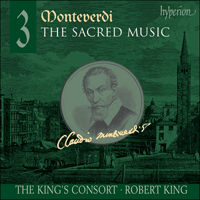

Hot on the heels of their glorious recording of Handel’s Ode for St Cecilia, Robert King, Carolyn Sampson and James Gilchrist are here joined by a host of further soloists for this third volume of Monteverdi’s sacred music.
The programme opens with the ebullient second setting of the Dixit Dominus and ends with the seven-voice Gloria, surely one of Monteverdi’s most impressive sacred works and one which is thought to have been part of a ceremonial Mass written to mark to the end of the 1630 plague outbreak in Venice. In between these two pillars of the repertoire come nine motets and Psalms, including the famous Christe, adoramus whose long-breathed phrases become the perfect vehicle to show off the intense range of colours Robert King so effortlessly draws out from his performers.

Monteverdi’s career as a professional musician falls into two periods of almost equal length. From 1590 or 1591 to 1612 he was employed as a household musician at the court of Vincenzo Gonzaga, ruler of the north Italian duchy of Mantua, and rose to become court choirmaster there in 1601. The extent of Monteverdi’s involvement in church music at Mantua is not clear. He was not regularly involved with the musical establishment of Santa Barbara, the ducal chapel, which was headed by Giacomo Gastoldi from 1582 to 1609, and the majority of his publications from the Mantuan period are of madrigals and opera. Nevertheless, it is quite likely that he wrote sacred music to be performed in the smaller chapels within the ducal palace or as spiritual chamber music. It has been suggested, too, that both court and chapel musicians may have joined forces at least once a year in Santa Barbara to celebrate the feast day of its patron saint, and that some at least of the music that appears in the 1610 volume may have been written for these occasions.
Equally, though, the music of the 1610 volume, published by Monteverdi at a time of growing dissatisfaction with conditions at Mantua, may have been intended simply to demonstrate that he was employable as a church musician. The volume contains settings for the two services for which elaborate music was most often used in the late Renaissance. The Mass, the ritual reenactment of the Last Supper, was the central celebration of the church day, and Monteverdi made great play, in the 1610 volume, of writing a setting which emulated the conservative style of Palestrina and his contemporaries. His settings of five psalms, hymn, Magnificat and motets for Vespers, the main evening service of the Catholic Church, are quite different, and use all the resources of the new music of the late sixteenth and early seventeenth centuries—rich harmonies, expressive operatic solos and elaborately ornamented music to be performed by virtuoso singers and instrumentalists. The 1610 volume can, then, be seen as a portfolio for prospective employers. Certainly, when Monteverdi took copies of the newly published volume to Rome to present them to Pope Paul V, he spent nearly three months in the city, cultivating the acquaintance of an influential group of cardinals. And in 1611 some of his psalm settings were performed in Modena Cathedral, though, according to a Modenese chronicler, they caused ‘disgust’ among everyone who heard them.
Following the death of Vincenzo Gonzaga, Monteverdi was summarily dismissed from Mantua in July 1612 by the new duke, Francesco Gonzaga. It seems that he had unwisely hinted that he might be able to obtain a better position elsewhere. For a year he was without regular employment, though performances of some of his music in Milan led to rumours that he was seeking the position of choirmaster at the cathedral there. He was fortunate, therefore, that the post of choirmaster of St Mark’s, Venice, fell vacant in the summer of 1613, and doubly fortunate that the procurators of St Mark’s, faced with falling musical standards in the church, decided to look outside Venice for a new appointee. For his audition on 1 August 1613 Monteverdi directed a Mass of his own—probably the one included in the 1610 volume—and his appointment was approved unanimously by the procurators. He remained at Venice, deriving a good deal of satisfaction from the honour and respect that he enjoyed there, until his death in 1643.
In Monteverdi’s day St Mark’s was not the cathedral of Venice, but the doge’s chapel. As such it was at the centre of interaction between church and state, for in Venice, major religious feast days were inextricably intertwined with the celebration of the city’s history and sense of identity. Moreover, important guests of the doge attended services at St Mark’s, where music of appropriate splendour was used to impress them; and the choir, with their choirmaster, was also responsible for entertaining the doge and his guests at state banquets; indeed, there were occasions when half the St Mark’s choir would be engaged in singing at a banquet while the other half was left to sing Vespers in the church.
The musical establishment that Monteverdi inherited included a main choir of about twenty men, including soprano castratos, who were responsible for singing the most elaborate of the music heard at St Mark’s; in addition, the church boasted a group of boy singers who performed plainsong and the occasional short polyphonic mass on weekdays, a group of some sixteen instrumentalists, and two organists (the church had two fixed and another two portable organs). The music that the choir sang (and, thus, that the choirmaster wrote for them) was governed by an elaborate set of rules specifying the types of music to be used for particular occasions. And, to complicate matters still further, St Mark’s had its own liturgy, independent of the Roman rite formalised by the Council of Trent (the Tridentine rite), which meant that some of its texts were used only at St Mark’s and at a limited number of similar institutions. A case in point is the so-called ‘Vespero delle Cinque Laudate’ (Vespers of the Five Laudate) in which all five psalms began with a variant of the verb ‘laudare’ (to praise). This service does not appear in the Tridentine rite at all, but was used at St Mark’s for Vespers on many of the most important feast days of the year; and though we customarily associate St Mark’s with music of great splendour and virtuosity, surviving collections of the Cinque Laudate psalms (none of them by Monteverdi) are rather restrained in character and conservative in style.
The style of music most often associated with St Mark’s is that involving spatial effects between two or more groups of singers and/or instrumentalists. This style, exemplified particularly in the music of Giovanni Gabrieli, was used at St Mark’s for Mass settings and ceremonial motets, and might involve the main choir singing at ground level, with instrumentalists and solo singers placed either in the organ lofts at each side of the chancel, or in the alcoves (nicchie), stacked like opera boxes, just behind the choir screen. At first sight, the many eight-part Vespers psalms involving two groups of four voices that were written for St Mark’s seem to belong to the same tradition, especially since custom dictated that the choir should sing Vespers in eight parts on days of particular solemnity, when the great golden altarpiece—the Pala d’Oro—was uncovered and, more often than not, the doge himself was present for the service. In fact, though, the two choirs who sang Vespers—one a group of soloists, the other a larger, ripieno, group—customarily stood together in a large pulpit at the front right of the choir screen, just as Canaletto depicted them in the mid eighteenth century. Since only about twelve or thirteen singers could fit into the pulpit we have a clear indication of the size of choir normally used for Vespers at St Mark’s. It is clear, too, that all the musicians, whether situated in the pulpit, in the organ lofts or in the nicchie, directed their performances not into the nave of the church, but into the chancel, where the priests, the doge, senators and important visitors were seated.
It should be emphasized that we only have clear evidence of the way in which Vespers was normally sung at St Mark’s; however, those of Monteverdi’s psalm settings that call for instrumental accompaniment could not have been performed from the pulpit alone; the instrumentalists were probably located in one of the organ galleries along with the player who was accompanying on the organ. We know, too, that the service of Vespers was occasionally celebrated on a grand scale at St Mark’s: the revised version of Sansovino’s Venetia città nobilissima, published in the early years of the seventeenth century, includes this description of First Vespers for Christmas: ‘[On Christmas Eve Vespers] is celebrated with the sweetest sounds of voices and instruments by the salaried musicians of the church and by others hired specially to make a greater number, since on that evening they sing in eight, ten, twelve and sixteen choirs [sic] to the wonder and amazement of everyone, and especially of foreign visitors, who declare that they have never heard music as rare, or as remarkable in other parts of the world.’
St Mark’s was not the only scene of Monteverdi’s activity in Venice. As the city’s leading musician he was also regularly invited to direct music for important services in other churches where different performance practices obtained and the Tridentine rite was followed. To take just one example: in 1620 the Flemish diplomat Constantin Huygens witnessed him directing his own music for Vespers for the Feast of St John the Baptist (24 June) in a church that has been identified as S Giovanni Elemosinario, near the Rialto; the music was sung by twelve singers and accompanied by theorbos, cornetts, bassoons, a basso di viola, organs and other instruments.
A good deal of the sacred music that Monteverdi wrote for Venice, including some important works mentioned in his letters and other documents, is now lost. Apart from a few works included in anthologies, most of what survives was published in two collections, the Selva morale e spirituale, issued by Monteverdi himself in 1640/41 and dedicated to Eleonora Gonzaga, daughter of Duke Vincenzo Gonzaga and widow of the Emperor Ferdinand II (1587–1637), and the Messa a quattro voci et salmi, issued posthumously in 1650 by the publisher Alessandro Vincenti. Both are monumental publications summing up the thirty years of Monteverdi’s work in Venice and both contain multiple settings of Vespers texts. The two books include a wealth of music and a wide range of styles, from conservative Mass settings to psalms and motets that use the most up-to-date song styles of the 1620s and ’30s; for even in his old age Monteverdi continued to explore new ideas.
Dixit Dominus II
In the liturgy of St Mark’s, Venice, the evening service of Vespers on important feast days was marked by the uncovering of the Pala d’Oro, the church’s great gold altarpiece, and on these occasions the choir was obliged to sing double-choir psalms in eight parts. Monteverdi follows this convention in this second Selva morale setting of ‘Dixit Dominus’, the psalm with which most Vespers services begin. Unlike some of his predecessors at St Mark’s, however, he did not follow the practice of dividing the two choirs rigidly and alternating between them verse by verse. Instead, he produced a setting of a grandeur suitable for the great state church of the Venetian Republic and one that, through its colourful mixing of voices, violins and trombones, matches the rich decoration of the church. In his setting Monteverdi contrasts passages for a few voices with full scorings that emphasize the idea of a powerful God, sometimes speaking loudly from heaven, as in ‘sede a dextris meis’ (verse 1), or emphasizing the word ‘tu’ in ‘tu es sacerdos’ (verse 5), or exulting through the joyful figuration of ‘exaltabit’ (verse 8), or represented as helping to crush the enemies of the psalmist (or, in this case, Venice), as we can hear in verse 2 and the second half of verse 3, and in verses 6 and 7, the texts of which Monteverdi rolls together, beginning them with a tremendous crescendo on ‘Dominus a dextris tuis’. The passages of reduced scorings are characterized by extensive use of duets, sometimes overlapping, as in the setting of ‘Tecum principium in die virtutis’ (verse 4), sometimes, as at the beginning of the ‘Gloria Patri’, in intimate dialogue with the two violins.
Sancta Maria à 2 e B.c.
In the Roman liturgy (though not in the liturgy of St Mark’s) ‘Sancta Maria, succurre miseris’ was the antiphon commonly sung before the Magnificat at first Vespers on Feasts of the Blessed Virgin Mary. Monteverdi’s exquisite setting for soprano duet, first issued in a anthology published in 1618 by the Milanese choirmaster Giovanni Battista Ala, would thus have found widespread use within the Roman Catholic church. It is tempting, though, to think that the unusual petition ‘intercede for the devout female sex’ (‘intercede pro devoto femineo sexu’) might also have prompted its use by nuns as a more general devotional motet, for in Venice, as elsewhere in seventeenth-century Italy, sacred music flourished not only in establishments with all-male choirs, but also in convents. In this setting Monteverdi makes use of the litany plainsong that he also employed for the Sonata sopra Sancta Maria in the 1610 Vespers. The first two sets of petitions are begun in plainsong and then extended by the second voice in a freer, more passionate, recitative style. For the final petition, Monteverdi treats the plainsong as a duet, rising in urgency before a release into triple-time writing and an extended treatment of the final two lines of text.
Lauda Ierusalem I à 3
This madrigalian setting of Psalm 147, published posthumously in 1650, serves as a reminder of just how expert some of Monteverdi’s singers at St Mark’s were, allowing him to write rapid virtuoso lines for words like ‘spargit’ (‘scattereth’ – verse 5) and ‘fluent’ (‘run’ – verse 7). Most of the setting is conceived in a dance-like triple time, but the text ‘et liquefaciet ea’ (‘and shall melt them’ – verse 7) is set in suitably melting duple-time harmonies, and verses 2 and 6 are set to a duple-time refrain which is also used for the ‘Gloria Patri’, where it is unexpectedly interrupted by a repeat of the joyful music (and the text) with which the setting began. This refrain is marked ‘tutti’, as distinct from ‘à 3’ (for three voices), suggesting choir with soloists; at these points, an editorial chorus part has been added since the harmony often seems surprisingly thin, perhaps indicating that, as in other Monteverdi psalms, there may be additional parts missing.
Memento Domine David à 8 voci da Capella
At St Mark’s, ‘Memento Domine David’ (Psalm 131, or, in the Book of Common Prayer, Psalm 132) was sung at Vespers on a number of important feast days during the year, beginning with second Vespers on Christmas Day. For almost all these occasions the Pala d’Oro was opened and double-choir psalms sung in two choirs. In this setting of a long psalm text, Monteverdi comes closer than he does in the eight-part setting of ‘Dixit Dominus’ to the style of simple double-choir chanting that characterizes many St Mark’s psalm settings. Even so, he takes the opportunity to underline the rhetorical force of words such as ‘Ecce’ (‘behold’ – verse 6) and ‘in saeculum saeculi’ (‘for ever and ever’ – verse 14) by tossing them from one choir to the other, or ‘exsultatione exsultabunt’ (‘rejoice with exceeding great joy’ – verse 16) by setting them in triple time.
Confitebor tibi III alla francese
This, the third setting in the Selva morale of the Vespers psalm ‘Confitebor tibi, Domine’, is headed ‘in the French manner’ and the option given of performing it either with five voices, or with solo soprano and strings. The precise derivation of ‘canto alla francese’, which Monteverdi also applied to settings in his Scherzi musicali (1607) and his Eighth Book of Madrigals (1638) is still uncertain, though it seems to apply both to a manner of singing, with full voice, and to a melodious musical style characterized by clear-cut phrase-structures, alternation between solo voice and full ensemble, and the setting of single syllables to pairs of notes. All these characteristics can be heard clearly in this setting, though Monteverdi also mixes them with gestures that are distinctly Italian. The first of these is heard at the setting of ‘Sanctum et terribile nomen eius’, where long notes for the word ‘Sanctum’ are followed by a wholly unexpected series of semiquavers for ‘et terribile’. The semiquavers represent Monteverdi’s ‘genere concitato’ – the warlike style that he invented for the Combattimento di Tancredi e Clorinda of 1624 – and are presumably intended to suggest a wrathful God. Wholly Italian too are the wide-ranging ornamented lines for solo soprano with which Monteverdi opens the ‘Gloria Patri’. Even these give way, however, to the French manner as Monteverdi reintroduces the opening music of the setting at the words ‘Sicut erat in principio’ (‘As it was in the beginning’).
Christe, adoramus te Nella Elevatione di N. Signore
This short but very moving motet was one of two on the same text published in 1620 in an anthology compiled by Giulio Cesare Bianchi, a cornett player who was then working in Milan, but had earlier studied composition under Monteverdi at Mantua. The text is found in devotional Books of Hours as part of the Hours of the Cross.
Salve Regina II à 2 voci, due Tenore o due Soprani If Vespers was not immediately followed by Compline, the last of the daily Hours services, it was the custom to sing instead the seasonal Marian antiphon with its associated devotions. ‘Salve Regina’ was the antiphon sung at St Mark’s from the Octave of Pentecost to the first day of Lent – i.e. for most of the Church year – which may explain why Monteverdi supplied no fewer than three settings in the Selva morale. This languorous and sensual setting for two equal voices shows clearly why Monteverdi was particularly fond of the medium of the duet, for it allowed him to explore the rhetorical devices of declamatory solo song while also allowing him to intensify them by giving them now to one voice, now to the other, now to both together, and through such repetitions to build larger-scale structures than would be possible with a single voice.
Nisi Dominus I à 3 voci & duoi violini
In compositional terms this setting of ‘Nisi Dominus’, the fourth psalm of Vespers of the Blessed Virgin, seems to stand half way between a setting ‘alla francese’ and the full-blown madrigalian setting of the same text for six voices which is found alongside it in the posthumous Messa et salmi (1650). The setting opens with a melodic line characterized by the paired quavers of Monteverdi’s ‘French manner’; and just as in the setting of ‘Confitebor tibi, Domine’, the ‘Gloria Patri’ begins with elaborately ornamented lines only to give way to a repeat of the opening material at ‘Sicut erat in principio’. The matchings of musical imagery to text in the fanfares of ‘surgite’ (‘rise up’) in verse 2 and the flight of arrows (‘sagittae’) in verse 4, however, seem to be initial versions of the ideas worked out much more fully in the six-part setting.
Cantate Domino à 6 voci
‘Cantate Domino’, with a text conflated from Psalms 95 and 97 (96 and 98) is another short motet contributed by Monteverdi to the anthology of motets for from one to eight voices published in 1620 by his pupil Giulio Cesare Bianchi. It seems to have been aimed at choirs of modest ability. Whether consciously or not, Monteverdi reused for the phrase ‘Cantate et exultate’ a musical sequence that he had first used at the end of the madrigal ‘Ecco mormorar l’onde’ in his Second Book of Madrigals of 1590; this may indicate that the motet was written very much earlier than its date of publication.
Ecce sacrum paratum a voce sola e B.c.
‘Ecce sacrum paratum’ was published in 1625 in Ghirlanda sacra, an anthology issued by Leonardo Simonetti, a castrato who was appointed to the choir of St Mark’s in 1613, the year in which Monteverdi arrived in Venice. The freely invented motet text mixes images of the celebration of Mass with those of the Last Supper, conceived as an Ancient Roman feast in which the guests reclined on couches at table. Monteverdi’s setting is a very striking example of rhetorical solo song which mixes declamation with short passages of aria-like writing in triple time, whether denoting urgency, as in ‘mundate corda vestra, festinate’ or passion, as in the setting of ‘Quid, ah quid huic amori tuo possim referre?’.
Gloria in excelsis Deo à 7 voci
This is one of the most impressive of all Monteverdi’s sacred works. It has long been thought to have formed part of a ceremonial Mass with music directed by Monteverdi at St Mark’s on 21 November 1631. The Mass marked the official end of the devastating outbreak of plague that swept through northern Italy from summer 1630, killing some 50,000 people in Venice alone. The Mass was followed by a procession across a bridge of boats to the newly founded votive church of Santa Maria della Salute (St Mary of Health) on the opposite side of the Grand Canal. Accounts of the occasion mention the use of ‘trombe squarciate’ – ceremonial trumpets – in both the Gloria and the Credo of the Mass. The trumpets may have played little more than fanfares, and there is no mention of them in the Selva morale version of the Gloria; even the parts for the optional trombones which are mentioned are not supplied and have to be reconstructed by modern performers.
Monteverdi casts the setting in five sections, following various cues in the text. The first section runs from the initial ‘Gloria in excelsis’, with its thrilling virtuoso figurations, through to ‘propter magnam gloriam tuam’, where the word ‘gloriam’ prompts the return of those figurations to round off the section. The second section embraces the three invocations ‘Domine Deus’, ‘Domine Fili’ and ‘Domine Deus’, each set for two sopranos and contrasted with passages of concitato writing for the full ensemble, suggesting God’s power. In sections 3 and 4, Monteverdi sets the three petitions to God and the three statements of his qualities as though they were two strophic songs for two or three voices, with each petition or statement separated from the next by a passage for two violins. The last statement – ‘Tu solus altissimus, Iesu Christe’ – is then taken over by five voices as the beginning of the final section, in which the phrase ‘in gloria Dei Patris’ prompts Monteverdi to return again to the ‘Gloria’ figurations of the opening of the setting.
John Whenham © 2004
La carrière professionnelle de Monteverdi se divise en deux périodes de durée presque égale. De 1590 ou 1591 à 1612, il servit comme musicien de la cour du duc Vincent de Gonzague qui régnait sur le duché de Mantoue, en Italie du Nord. En 1601 il accédait au rang de maître de la musique de la cour. On ignore dans quelle mesure Monteverdi participait aux activités associées à la musique sacrée à Mantoue. Ce n’est que de temps à autre qu’il contribuait à la vie musicale de Santa Barbara, la chapelle ducale, que Giacomo Gastoldi dirigea de 1582 à 1609. Ses éditions publiées durant sa période mantouane sont en majorité consacrées au madrigal et à l’opéra. Il se pourtant probable qu’il ait écrit de la musique sacrée pour des chapelles moins importantes du palais ducal ou comme musique de chambre spirituelle. Il a aussi été suggéré que les musiciens de la cour et de la chapelle aient pu se réunir au moins une fois par an à Santa Barbara pour célébrer la fête de la sainte patronne et que quelquesunes des oeuvres parues dans le recueil de 1610 aient pu être destinées à cette cérémonie.
Une autre hypothèse est à envisager. Parue à une époque où Monteverdi était particulièrement mécontent de ses conditions de vie à Mantoue, la musique du recueil de 1610 était peut-être destinée à illustrer ses qualités de compositeur employable comme musicien d’église. Le volume contient les réalisations musicales de deux services pour lesquels une musique élaborée était souvent requise durant la Renaissance tardive. La Messe, commémoration rituelle de la Cène, était au coeur de la célébration du jour liturgique. Dans le recueil de 1610, Monteverdi se fit fort d’écrire une musique rivalisant avec le style conservateur de Palestrina et de ses contemporains. Celle qu’il composa pour les cinq psaumes, l’hymne, les Magnificat et motets et qu’il destinait aux vêpres, le principal service du soir de l’église catholique, est assez différente. Elle exploite toutes les ressources de la nouvelle musique de la fin du 16e siècle et du début du 17e siècle—de riches harmonies, des solos expressifs inspirés de l’opéra et une musique aux ornements élaborés destinée à être jouée par des chanteurs et des instrumentistes virtuoses. Le recueil de 1610 a donc tout du portfolio destiné à de potentiels employeurs. Certainement, lorsque Monteverdi emporta des exemplaires de sa nouvelle publication à Rome pour les présenter au Pape Paul V, il y resta près de trois mois et cultiva ses relations avec un groupe influent de cardinaux. En 1611, certains de ses psaumes furent exécutés en la cathédrale de Modène, et, selon un chroniqueur de la ville, ils suscitèrent du « dégoût » chez quiconque les avait entendus.
À la mort de Vincent de Gonzague, Monteverdi fut limogé sans ménagement de la cour mantouane en juillet 1612 par le nouveau duc, Francesco Gonzague. Il semblerait qu’il ait imprudemment laissé entendre pouvoir obtenir ailleurs un meilleur poste. Pendant un an, Monteverdi vécut sans emploi régulier. L’exécution de certaines de ses oeuvres à Milan engendra des rumeurs selon lesquelles il aurait cherché à devenir maître de chapelle de la cathédrale milanaise. Monteverdi eut donc la bonne fortune que le poste de maître de chapelle de la basilique Saint-Marc, à Venise, soit devenu vacant au cours de l’été 1613. Il fut même doublement fortuné puisque confrontés à un niveau musical moindre en leur église, les procurateurs de Saint-Marc décidèrent de faire appel à des musiciens vivant hors de la sérénissime république. Pour son audition qui eut lieu le 1er août 1613 Monteverdi dirigea une de ses messes—probablement celle du recueil de 1610. Les procurateurs approuvèrent sa nomination à l’unanimité. Tirant beaucoup de satisfaction de l’honneur et du respect qu’il recevait en la Sérénissime, il demeura à Venise jusqu’à sa mort, en 1643.
Du temps de Monteverdi, Saint-Marc n’était pas la cathédrale de Venise, mais la chapelle du doge. À ce titre, cet édifice était au coeur de l’interaction entre église et état, car à Venise, les principales fêtes religieuses étaient inextricablement mêlées aux célébrations de l’histoire de la ville et au sens identitaire. En outre, le doge conviait des personnalités de marque aux offices de Saint-Marc où l’on jouait alors une musique d’apparat somptueuse destinée à les impressionner. Le choeur et le maître de chapelle étaient aussi tenus de divertir le doge et ses invités lors des banquets d’état. On a effectivement connaissance de certaines occasions où la moitié du choeur était engagée pour chanter à un banquet tandis que l’autre officiait aux Vêpres.
L’établissement musical dont Monteverdi avait hérité comprenait un choeur principal d’une vingtaine d’hommes, comprenant des castrats sopranistes, chargé de chanter la musique la plus élaborée exécutée à Saint-Marc. La basilique disposait en plus d’un ensemble de garçons pour exécuter le plain-chant et parfois de courtes messes polyphoniques les jours de la semaine, et d’un groupe d’environ seize instrumentistes et deux organistes (l’édifice comprenait deux orgues fixes et deux portatifs).
La musique chantée par le choeur (celle composée donc par le maître de chapelle) était régie par un ensemble complexe de règles spécifiant les types de musique à utiliser pour les cérémonies spécifiques. Pour compliquer le tout, Saint-Marc possédait sa propre liturgie indépendante du rite romain dicté par le Concile de Trente (rite tridentin). Il en résultait que certains textes n’étaient utilisés qu’à Saint-Marc et dans un nombre limité d’institutions similaires. On peut citer pour exemple ce que l’on appelle « Vespero delle Cinque Laudate » (Vêpres des cinq Laudate) où les cinq psaumes commencent tous par une variante du verbe « laudare » (louer). Ce service n’apparaît pas dans le rite tridentin mais était souvent utilisé à Saint-Marc pour célébrer les vêpres des fêtes importantes de l’année. Alors que dans l’esprit de chacun, la basilique Saint-Marc est généralement associée à une musique d’une splendeur et d’une virtuosité rares, les recueils qui nous sont parvenus des psaumes Cinque Laudate (aucun n’étant de Monteverdi) dénotent plutôt un caractère retenu et un style conservateur.
Le style de musique le plus souvent associé à la vie musicale de la cathédrale vénitienne est celui qui, jouant sur des effets spatiaux, faisait appel à plusieurs groupes de chanteurs et/ou d’instrumentistes. Illustré à merveille par la musique de Giovanni Gabrieli, c’est ce style qui était utilisé à Saint-Marc pour les messes et les motets de cérémonie. Le choeur principal était placé au niveau de la congrégation tandis que les instrumentistes et les chanteurs solistes se tenaient soit dans les tribunes des orgues situées de chaque côté du chancel ou dans les alcôves (nicchie) aussi bondées que des loges d’opéras, juste derrière le jubé. Au premier abord, les vêpres à huit voix réparties en deux groupes de huit écrites pour Saint-Marc appartiennent à cette même tradition, d’autant plus que la coutume voulait qu’en cas de cérémonie particulièrement solennelle, lorsque le Pala d’Oro—le superbe retable d’or—était exposé et que bien souvent le doge assistait au service, le choeur chantât des vêpres à huit voix. En fait, si les deux choeurs chantaient les vêpres—le premier constitué d’un groupe de solistes, l’autre d’un groupe plus important faisant office de ripieno—ils se tenaient habituellement ensemble en une large chaire sur le devant droit du jubé, une disposition similaire à celle que Canaletto peignit au milieu du 18e siècle. Puisque seuls douze ou treize chanteurs pouvaient tenir sur la chaire, nous possédons une claire indication de la taille du choeur usuellement employé pour chanter les vêpres à Saint-Marc. Il apparaît aussi clairement que tous les musiciens qu’ils soient situés sur la chaire, dans les tribunes d’orgue ou dans les nicchie, dirigeaient leur exécution non pas vers la nef de l’église mais vers le chancel où se tenaient les prêtres, le doge, les sénateurs et les invités de marque.
Il faut souligner que nous ne possédons qu’évidence précise sur la manière dont les vêpres étaient normalement chantées à Saint Marc. Pourtant, celles où Monteverdi requiert un accompagnement instrumental ne pouvaient être exécutées de la chaire seule—les instrumentistes se tenaient probablement dans l’une des tribunes d’orgue avec l’organiste qui les accompagnait. Nous savons aussi qu’à Saint-Marc, l’office des vêpres était parfois célébré avec une magnificence hors du commun: la version révisée de Venetia città noblissima de Sansovino publiée au début du 17e siècle inclut cette description des Premières Vêpres pour Noël:
[La veillée de Noël] est célébrée aux sons de voix et d’instruments les plus doux exécutés par les musiciens salariés de l’église et d’autres qui ont été engagés spécialement pour en renforcer le nombre, puisqu’en cette soirée, ils chantent à huit, dix, douze, et seize choeurs [sic] pour l’émerveillement et l’étonnement de chacun, en particulier des visiteurs étrangers qui déclarent qu’ils n’ont jamais entendu une musique aussi rare ou aussi remarquable dans d’autres parties du monde.
Saint-Marc n’était pas le seul théâtre des activités de Monteverdi à Venise. Musicien le plus en vue de la ville, il était régulièrement invité à diriger la musique des services importants en d’autres églises où des pratiques d’exécution différentes étaient en vigueur et où le rite tridentin était suivi. Pour ne prendre qu’un exemple : en 1620, le diplomate flamand Constantin Huygens assista à l’exécution de sa musique pour les vêpres de la Fête de Saint-Jean Baptiste (24 juin) dans une église qui a été identifiée comme étant San Giovanni Elemosinario, près du Rialto ; la musique était chantée par douze chanteurs accompagnés de théorbes, de cornets à bouquin, de bassons, d’un basso di viola, d’orgues et d’autres instruments. Une grande partie de la musique sacrée que Monteverdi écrivit pour Venise, notamment les oeuvres majeures citées dans ses lettres et autres documents, est maintenant perdue. Hormis quelques compositions incorporées à des anthologies, tout ce qui a survécu a été édité en deux volumes, Selva morale e spirituale publié par Monteverdi en personne en 1640/41 et dédié à Eléonore de Gonzague, fille du duc Vincent de Gonzague et veuve de l’Empereur Ferdinand II (1587–1637), et Messa a quattro voci et salmi, une édition posthume de 1650 publiée par Alessandro Vincenti. Ces deux ouvrages monumentaux résument les trente années du travail de Monteverdi à Venise. Tous deux contiennent de multiples réalisations musicales des vêpres. Tous deux s’illustrent par leur richesse musicale. Ils font preuve d’un vaste éventail stylistique allant des réalisations conservatrices des messes à des psaumes et de motets exploitant l’écriture la plus moderne des années 1620 et 1630. Même dans son grand âge, Monteverdi continuait l’exploration des idées nouvelles.
Dixit Dominus II
Dans la liturgie de Saint-Marc, à Venise, le Pala d’Oro était exposé lors des Vêpres des importants jours de fêtes. Pour l’occasion, le chœur devait chanter des psaumes pour double-chœur, à huit voix. Pour sa seconde réalisation musicale du «Dixit Dominus», le psaume par lequel commence la plupart des Vêpres, Monteverdi suivit cette convention. Contrairement à certains de ses prédécesseurs à Saint-Marc, cependant, il renonça à l’usage qui consistait à diviser les deux chœurs de manière rigide et à alterner pour chaque verset entre les deux. Il produisit au contraire une réalisation d’une majesté convenant à la grandeur de cette église située au cœur étatique de la République vénitienne qu’était Saint-Marc. Il signe une partition qui, à travers son mélange coloré de voix, de violons et trombones, rivalise avec la riche décoration de l’édifice. Dans sa réalisation, Monteverdi contraste des passages pour quelques voix avec une disposition chorale au complet qui accentue l’idée d’un Dieu puissant, parlant parfois avec force des cieux, comme dans «sede a dextris meis» (verset 1) ou accentuant le mot «tu» dans «tu es sacerdos» (verset 5) ou exultant à travers les joyeuses figurations de «exaltabit» (verset 8) ou représenté comme aidant à anéantir les ennemis de celui qui écrivit le psaume (ou dans le cas présent de Venise) comme nous pouvons l’entendre dans le verset 2 et la seconde moitié du verset 3, et dans les versets 6 et 7, Monteverdi enchaînant les textes, les débutant par un crescendo extraordinaire sur «Dominus a dextris tuis». Les passages d’effectif réduit se caractérisent par l’emploi extensif de duos, parfois tuilés comme dans le passage sur «Tecum principium in die virtutis» (verset 4), parfois conçu en un dialogue intime avec les deux violons, comme dans le début de «Gloria Patri».
Sancta Maria à 2 e B.c.
Dans la liturgie romaine (mais pas dans celle de Saint-Marc), «Sancta Maria, succurre miseris» était l’antienne que l’on chantait habituellement avant le Magnificat des Premières Vêpres des Fêtes de la Vierge Marie. La réalisation exquise de Monteverdi pour duo de sopranos, publiée initialement dans une anthologie éditée en 1618 par le chef de chœur milanais Giovanni Battista Ala, aurait été largement utilisée au sein de l’Eglise romaine catholique. Il est tentant donc de penser que la répétition inhabituelle de «intercede pro devoto femineo sexu» («intercédez pour les femmes dévouées») aurait pu inciter les religieuses à s’en servir pour un motet de dévotion plus général car à Venise, comme partout ailleurs au XVIIe siècle, la musique sacrée était le fait non seulement d’établissements dotés de chœurs entièrement masculins mais aussi de couvents. Dans cette composition, Monteverdi se sert de la litanie grégorienne également exploitée dans la Sonata sopra Sancta Maria dans les Vêpres de 1610. Les deux premières réalisations de la supplique débutent dans un style grégorien pour être ensuite élargies par la deuxième voix plus libre, plus passionnée, dans le style du récitatif. Pour la prière finale, Monteverdi traite le plain-chant comme un duo dévoilant un sentiment de plus en plus pressant avant de détendre l’atmosphère par une écriture en ternaire et un travail important sur les deux dernières lignes du texte.
Lauda Ierusalem I à 3
Cette réalisation riche en madrigalisme du Psaume 147, parut après la mort de Monteverdi, en 1650. Elle constitue un splendide rappel de la manière experte dont certains de chanteurs qu’il avait à sa disposition à Saint-Marc lui permettaient d’écrire des lignes rapides et virtuoses, comme sur les mots «spargit» (verset 5) et «fluent» (verset 7). La composition est généralement conçue dans un rythme ternaire aux allures de danse. Le texte sur «et liquefaciet ea» (verset 7) est réalisé dans des harmonies fondantes dans un rythme binaire qui sied parfaitement au contexte. Les versets 2 et 6 sont mis en musique sous la forme d’un refrain binaire qui est également exploité pour le «Gloria Patri» où il est interrompu de manière inattendue par une reprise de la musique joyeuse (et du texte) par laquelle il avait débuté. Ce refrain est noté «tutti», par opposition à «à 3» suggérant l’emploi du chœur avec solistes. Pour ces passages, on a ajouté une partie de chœur éditée puisque l’harmonie semble souvent étonnamment mince, indiquant peut-être que comme dans certains autres psaumes de Monteverdi, des parties additionnelles font défaut.
Memento Domine David à 8 voci da Capella
A Saint-Marc, «Memento Domine David» (Psaume 131) était chanté durant les Vêpres lors de certaines fêtes importantes de l’année, à commencer par les secondes Vêpres de Noël. En ces occasions, on découvrait le Pala d’Oro à la vue de tous et les psaumes pour double-chœur étaient chantés avec deux chœurs. Dans cette œuvre composée sur un long extrait du psaume, Monteverdi s’approche plus encore que dans le «Dixit Dominus» à huit voix du style de chant liturgique tout en simplicité pour chœur double qui caractérisait de nombreux psaumes composés pour Saint Marc. Même dans ces circonstances, il en profite pour souligner la force rhétorique de certains mots tels «Ecce» (verset 6) et «in saeculum saeculi» (verset 14) en le faisant rebondir d’un chœur à l’autre, ou encore sur «exsultatione exsultabunt» (verset 16) en le concevant en ternaire.
Confitebor tibi III alla francese
Cette troisième composition des Selva morale sur le psaume «Confitebor tibi, Domine» des Vêpres, est intitulée «dans le style français» et se distingue par la possibilité d’être exécutée ou bien à cinq voix, ou avec une voix soliste et des cordes. Cette dérivation précise du «canto alla francese», dont Monteverdi se servit aussi pour ses Scherzi musicali (1607) et son Huitième Livre de Madrigaux (1638) demeure incertaine même si elle semble qualifier aussi bien la manière de chanter – à pleine voix – que le style musical mélodieux caractérisé par des structures aux phrases clairement définies, alternant entre voix solistes et ensemble, et utilisant une paire de notes pour mettre en musique une syllabe. Toutes ces caractéristiques sont perceptibles dans cette composition même si Monteverdi les associe aussi à des gestes distinctement italiens. On peut entendre le premier de ceux-ci sur «Sanctum et terribile nomen eius» où des notes en valeurs longues sur le mot «Sanctum» sont suivies de toute une série inattendue de doubles croches pour «et terribile». Les doubles croches représentent le «genere concitato» de Monteverdi – le style guerrier qu’il avait inventé pour le Combattimento di Tancredi e Clorinda de 1624 – et sont probablement conçues pour suggérer la puissance de Dieu. Les lignes ornées étendues pour soprano sono par lesquelles Monteverdi ouvre le «Gloria Patri» sont également purement italiennes, même si elles font place cependant au style français quand Monteverdi reprend la musique initiale sur les mots «Sicut erat in principio» («Comme il était au commencement»).
Christe, adoramus te Nella Elevatione di N. Signore
Ce motet concis mais très émouvant est l’un des deux réalisés sur ce texte publié en 1620 dans une anthologie réunie par Giulio Cesare Bianchi, un joueur de cornet à bouquin qui travaillait alors à Milan mais qui au début de sa carrière avait travaillé auprès de Monteverdi à Mantua. Ce texte figure dans le Livre des Heures, au sein des Heures sur la croix.
Salve Regina II à 2 voci, due Tenore o due Soprani
Si les Vêpres n’étaient pas immédiatement suivies de Complies, la dernière heure des offices liturgiques, on avait pour habitude d’insérer en sa place une antienne mariale de l’année liturgique lui correspondant riche de ses associations dévotionnelles. «Salve Regina» était l’antienne chantée à Saint-Marc, de l’Octave de la Pentecôte au premier jour du Carême, ce qui peut expliquer pourquoi Monteverdi écrivit avec pas moins de trois compositions sur ce texte dans ses Selva morale. Cette réalisation langoureuse et sensuelle pour deux voix égales montre clairement pourquoi Monteverdi aimait aussi fortement ce genre qu’était le duo. Il lui permettait d’explorer les traits rhétoriques de la déclamation pour voix soliste seule tout en lui permettant de l’intensifier en la concevant tantôt pour une voix tantôt pour l’autre, tantôt pour les deux réunies. Avec de telles répétitions il élaborait d’importantes structures en s’appuyant uniquement sur une voix seule.
Nisi Dominus I à 3 voci & duoi violini
Du point de vue de l’écriture, cette réalisation du ‘Nisi Dominus’, le quatrième psaume des Vêpres de la Vierge Marie, semble être à mi-chemin entre une composition «alla francese» et celle pour six voix de vaste proportion très madrigalesque écrite sur le même texte que l’on trouve dans le volume posthume Messa et salmi de 1650. Cette œuvre s’ouvre sur une ligne mélodique caractérisée par des croches par paire à la «manière française» de Monteverdi. Tout comme celui du «Confitebor tibi, Domine», le «Gloria Patri» débute par des lignes à l’ornementation très élaborée qui font place à une reprise du matériel thématique du début sur «Sicut erat in principio». La manière dont les images musicales répondent au texte dans les fanfares sur «surgite» dans le verset 2 et dans la volée de flèches (sur «sagittae») dans le verset 4 évoque plutôt les versions initiales d’idées amplifiées dans la réalisation ultérieure à six voix.
Cantate Domino à 6 voci
Conçu sur un texte emprunté aux Psaumes 95 et 97 «Cantate Domino» est un autre motet concis attribué à Monteverdi dans l’anthologie de motets de un à huit voix publiée en 1620 par son élève Giulio Cesare Bianchi. Il semble avoir été destiné à des chœurs de capacité modeste. Que ce soit consciemment ou non, Monteverdi se servit de nouveau pour la phrase «Cantate et exultate» d’une séquence musicale qu’il avait exploitée pour la première fois à la fin du madrigal «Ecco mormorar l’onde» dans son Deuxième Livre de Madrigaux publié en 1590. Ceci indiquerait peut-être que le motet a été écrit bien plus tôt que sa publication ne pourrait le laisser croire.
Ecce sacrum paratum a voce sola e B.c.
«Ecce sacrum paratum» a été publié en 1625 dans Ghirlanda sacra, une anthologie publiée par Leonardo Simonetti, un castrat qui avait été engagé dans le chœur de Saint Marc en 1613, l’année où Monteverdi était arrivé à Venise. Le texte librement inventé du motet mélange des images de la célébration de la messe avec d’autres de la Cène, conçue comme une fête de la Rome ancienne où les invités sont allongés pour dîner. La réalisation musicale de Monteverdi est un exemple saisissant de chant soliste rhétorique qui associe déclamation avec de courts passages d’une écriture ternaire aux allures d’aria, que ce soit pour souligner l’urgence, comme dans «mundate corda vestra, festinate» ou la passion, comme pour «Quid, ah quid huic amori tuo possim referre?».
Gloria in excelsis Deo à 7 voci
Voici une des œuvres les plus impressionnantes du corpus sacré de Monteverdi. On a longtemps pensé que ce Gloria faisait partie d’une messe liturgique entièrement mise en musique que Monteverdi dirigea à Saint-Marc le 21 novembre 1631. La messe célébrait la fin officielle de l’épidémie de peste qui dévasta le nord de l’Italie à partir de l’été 1630, tuant environ 50000 personnes à Venise même. La messe fut suivie par une procession traversant sur un pont de bateaux le Grand Canal pour aller vers une église nouvellement édifiée Santa Maria della Salute (Sainte Marie de la Santé). Les récits qui nous sont parvenus de cet événement parlent de l’emploi de «trombe squarciate» – de trompettes de cérémonie – aussi bien dans le Gloria que dans le Credo de la messe. Les trompettes jouaient peut-être un peu plus que lors des fanfares et elles ne sont aucunement citées dans la version du Gloria des Selva morale. Même les parties de trombones optionnels dont mention est faite, ne nous sont pas parvenues et ont dû être reconstituées pour être exécutées par des musiciens modernes.
Monteverdi a conçu cette œuvre en cinq sections suivant les divers pans du texte. La première section va de l’initial «Gloria in excelsis» avec ses figurations virtuoses saisissantes à «propter magnam gloriam tuam» où le mot «gloriam» rappelle ces mêmes figurations pour conclure la section. La deuxième embrasse les trois invocations «Domine Deus», «Domine Fili» et «Domine Deus», chacune écrite pour deux sopranos et contrastées avec des passages en écriture concitato pour l’effectif au complet suggérant ainsi la puissance de Dieu. Dans les sections 3 et 4, Monteverdi met en musique les trois suppliques à Dieu et les trois énoncés de ses qualités comme s’il s’agissait de deux mélodies strophiques pour deux ou trois voix, chaque supplique ou énoncé étant séparé du suivant par un passage conçu pour deux violons. Le dernier énoncé – «Tu solus altissimus, Iesu Christe» est ensuite repris par cinq voix comme début de la section finale où la phrase «in gloria Dei Patris» amène Monteverdi à retrouver les figurations du «Gloria» du début de l’œuvre.
John Whenham © 2004
Français: Isabelle Battioni
Monteverdis Laufbahn teilt sich in zwei, fast gleichlange Schaffensperioden. Von 1590/91 bis 1612 war er am Hofe Vincenzo Gonzagas, dem Herrscher des norditalienischen Herzogtums Mantua, angestellt und wurde 1601 zum höfischen Kantor ernannt. Inwiefern Monteverdi in Mantua kirchenmusikalisch tätig war, ist nicht überliefert. An der herzoglichen Kapelle Santa Barbara, die zwischen 1582 und 1609 von Giacomo Gastoldi geleitet wurde, war er jedenfalls nicht regelmäßig tätig und der Großteil seiner Publikationen aus der Mantuaer Zeit besteht aus Madrigalen und Opern. Gleichwohl ist es gut möglich, dass er Kirchenmusik komponierte, die dann in den kleineren Kapellen des Herzogspalasts oder auch als geistliche Kammermusik aufgeführt wurde. Es wird auch angenommen, dass die Hofmusiker und die Musiker der Kapelle sich mindestens einmal im Jahr in der Kapelle anlässlich des Santa Barbara-Festtages zusammentaten und miteinander musizierten, und dass zumindest einige der 1610 veröffentlichten Werke für diese Anlässe entstanden sind.
Es ist jedoch ebenso möglich, dass Monteverdi, der sich in Mantua aufgrund der Arbeitsbedingungen zunehmend unwohl fühlte, diese Werke 1610 einfach deshalb veröffentlichte, um zu demonstrieren, dass er auch als Kirchenmusiker geeignet sei. Die Ausgabe besteht aus Vertonungen von Stücken für die beiden Gottesdienste, in denen in der Spätrenaissance oft besonders kunstvolle Musik erklang. Die Messe, das rituelle Nachspielen des Abendmahls, war tagsüber der wichtigste Gottesdienst und Monteverdi machte in der Ausgabe von 1610 viel Aufhebens darum, indem er eine Messe komponierte, in der er dem konservativen Stil Palestrinas und seiner Zeit nacheiferte. Seine Vertonungen von fünf Psalmen, einem Hymnus, einem Magnifikat und von mehreren Motetten für die Vesper, dem wichtigsten Abendgottesdienst der katholischen Kirche, sind im Stil sehr anders. Es werden hier alle Stilmittel der neuen Musik des späten 16. Jahrhunderts und des frühen 17. Jahrhunderts eingesetzt: prachtvolle Harmonien, expressive, opernhafte Soli und kunstvoll verzierte Musik, die von virtuosen Sängern und Instrumentalisten auszuführen war. Die Ausgabe könnte also auch als eine Art Portefeuille für zukünftige Dienstherren verstanden werden. Und tatsächlich, als Monteverdi nach Rom reiste, um dem Papst, Paul V., einige Exemplare seines eben gedruckten Opus zu präsentieren, blieb er fast drei Monate lang in der Stadt und kultivierte den Kontakt zu einem Zirkel einflussreicher Kardinäle. 1611 wurden einige seiner Psalmvertonungen in der Kathedrale von Modena aufgeführt, jedoch berichtet ein Chronist aus Modena, dass sie allgemein mit „Empörung“ aufgenommen worden seien.
Nach dem Tod Vincenzo Gonzagas wurde Monteverdi im Juli 1612 von dessen Nachfolger, Francesco Gonzaga, aus Mantua kurzerhand entlassen. Es gibt Hinweise darauf, dass Monteverdi sich in dieser Angelegenheit etwas ungeschickt verhielt und dass er bereits angekündigt hatte, dass er anderswo eine bessere Stelle bekommen könnte. Darauf musste er sich ein Jahr lang ohne feste Anstellung zufrieden geben, doch führten Aufführungen seiner Werke in Mailand zu der allgemeinen Annahme, dass er sich für die Kantorenstelle an der dortigen Kathedrale bewarb. Es war für ihn daher sehr günstig, dass im Sommer 1613 die Kantorenstelle von S. Marco in Venedig frei wurde, und er konnte sich besonders glücklich schätzen, dass das Auswahlkomitee von S. Marco angesichts des sinkenden musikalischen Niveaus sich außerhalb Venedigs nach einem Kandidaten umtat. Bei seinem Vorspiel am 1. August 1613 dirigierte Monteverdi eine seiner Messen—wahrscheinlich aus der Ausgabe von 1610—und wurde daraufhin einstimmig angenommen. Er blieb in Venedig bis zu seinem Tod im Jahre 1643 und gewann besondere Befriedigung aus der Ehre und Achtung, die ihm hier zuteil wurden.
Zu der Zeit Monteverdis war S. Marco nicht der Dom Venedigs, sondern die Kapelle des Dogen. Als solche stand sie im Mittelpunkt der Interaktion von Kirche und Staat, da in Venedig die großen religiösen Festtage mit der Geschichte und Identität der Stadt untrennbar verbunden waren. Außerdem besuchten wichtige Gäste des Dogen die Gottesdienste in S. Marco, wo die Musik für einen entsprechend großartigen Eindruck sorgte. Zudem waren Chor und Kantor dafür verantwortlich, den Dogen und seine Gäste bei Staatsbanketten zu unterhalten und auf diese Weise ergaben sich Situationen, wo ein Teil des Chors bei einem Bankett sang, während der Rest im Vespergottesdienst mitwirkte.
Die Musiker, die Monteverdi zur Verfügung standen, waren zunächst der Hauptchor von etwa zwanzig Männern, darunter mehrere Sopran-Kastraten, die die kunstvollste Musik zu singen hatten; außerdem gehörten zu der Kirche einige Sängerknaben, die hauptsächlich Choral sangen (zuweilen jedoch auch an Wochentagen kurze polyphone Messen), ein Ensemble von etwa sechzehn Instrumentalisten sowie zwei Organisten (die Kirche hatte zwei fest installierte und zwei bewegliche Orgeln). Die Werke, die von dem Chor aufgeführt wurden (die also der Kantor komponiert hatte), waren einem ausgefeilten Regelsystem unterworfen, das genau angab, welche Art von Musik zu welchem Anlass aufzuführen war. Und um die Situation noch komplizierter zu gestalten, hatte S. Marco eine eigene Liturgie. Diese Liturgie war von der römischen Liturgie, die durch das Trienter Konzil festgelegt worden war, unabhängig, was bedeutete, dass bestimmte Textpassagen nur in S. Marco und in einigen wenigen vergleichbaren Institutionen zum Einsatz kamen. Ein Beispiel hierfür ist die sogenannte „Vespero delle Cinque Laudate“ (Vesper der fünf Laudate), in der alle fünf Psalmen mit einer Form des Verbes „laudare“ (loben) beginnen. Dieser Gottesdienst taucht gar nicht in der Trienter Liturgie auf und wurde nur in S. Marco zu den wichtigsten Festtagen gefeiert. Obwohl S. Marco meist mit besonders großartiger und virtuoser Musik in Verbindung gebracht wird, haben die überlieferten Sammlungen der Cinque Laudate-Psalmen (von denen keine von Monteverdi ist) einen eher verhaltenen Charakter und sind im Stil recht konservativ.
Der musikalische Stil, der häufig mit S. Marco in Verbindung gebracht wird, ist einer, bei dem der räumliche Effekt zwischen verschiedenen Gruppen von Sängern und/oder Instrumentalisten eine wichtige Rolle spielt. Dieser Stil, der in der Musik Giovanni Gabrielis besonders ausgeprägt ist, kam in S. Marco bei Aufführungen von Messvertonungen und zeremoniellen Motetten zum Einsatz, wobei der Hauptchor zum Beispiel zu ebener Erde stand und die Instrumentalisten und Solosänger entweder in den Orgelemporen oder im Altarraum oder in den opernlogenartigen Alkoven (nicchie) hinter der Chorwand waren. Auf den ersten Blick scheinen die vielen achtstimmigen Vesperpsalmen mit zwei Gruppen von jeweils vier Stimmen, die für S. Marco geschrieben wurden, zur selben Tradition zu gehören, besonders angesichts der Tatsache, dass der Chor traditionsgemäß an besonderen Feiertagen, wenn das großartige goldene Altarbild—die Pala d’Oro—enthüllt und der Doge selbst anwesend war, eine achtstimmige Vesper singen musste. Jedoch standen die beiden Chöre, die die Vesper sangen—eine Solistengruppe und eine größere, die sogenannte ripieno-Gruppe—meist zusammen auf einer großen Kanzel rechts vor der Chorwand, entsprechend den Darstellungen Canalettos um die Mitte des 18. Jahrhunderts. Da nur etwa zwölf oder dreizehn Sänger auf die Kanzel passten, ist die Größe des Chores, der in S. Marco die Vesperngottesdienste sang, recht genau rekonstruierbar. Außerdem kann mit ziemlicher Sicherheit angenommen werden, dass alle Musiker, ob sie sich nun auf der Kanzel, den Orgelemporen oder in den nicchie befanden, ihre Aufführung nicht in das Hauptschiff der Kirche richteten, sondern in den Altarraum, wo die Priester, der Doge, die Senatoren sowie wichtige Gäste saßen.
Es sei hervorgehoben, dass lediglich die normalen Vespergottesdienste relativ genau rekonstruierbar sind und dass die Psalmvertonungen Monteverdis mit nstrumentalbegleitung hingegen nicht ausschließlich von der Kanzel aus aufgeführt werden konnten: die Instrumentalisten befanden sich wahrscheinlich zusammen mit dem Organisten auf einer der Orgelemporen. Es ist auch belegt, dass der Vespergottesdienst in S. Marco zuweilen in einem größeren Rahmen gefeiert wurde: in der überarbeiteten Fassung von Sansovinos Venetia città nobilissima, die in den ersten Jahren des 17. Jahrhunderts herausgegeben wurde, wird die erste Weihnachtsvesper folgendermaßen beschrieben:
[An Heiligabend wird die Vesper] mit den süßesten Klängen der Stimmen und Instrumente der Kirchenmusiker und anderen Musikern, die noch dazu angeheuert werden um ihre Anzahl zu vergrößern, gefeiert. An diesem Abend singen sie nämlich in acht, zehn, zwölf und sechzehn Chören [sic], zu dem Erstaunen von allen Anwesenden, besonders aber der ausländischen Gäste, die sagen, dass sie noch nie solch rare und bemerkenswerte Musik in anderen Teilen der Welt gehört hätten.
S. Marco war nicht das einzige Betätigungsfeld Monteverdis in Venedig. Als führender Musiker der Stadt wurde er regelmäßig dazu eingeladen, die musikalische Leitung bei wichtigen Gottesdiensten in anderen Kirchen zu übernehmen, wo andere aufführungspraktische Regeln galten und man sich nach der Trienter Liturgie richtete. So wohnte zum Beispiel im Jahre 1620 der flämische Diplomat Constantin Huygens in der Kirche S. Giovanni Elemosinario in der Nähe der Rialtobrücke einem Vespergottesdienst am Festtag Johannes des Täufers (24. Juni) bei, in dem Monteverdi seine eigenen Werke dirigierte. Die Ausführenden waren zwölf Sänger, die von Theorben, Zinken, Fagotten, einem basso di viola, Orgeln und anderen Instrumenten begleitet wurden.
Ein großer Teil der geistlichen Musik, die Monteverdi für Venedig komponierte, darunter wichtige Werke, die in seinen Briefen und anderen Dokumenten erwähnt werden, ist heute verschollen. Mit der Ausnahme einiger Werke, die in Anthologien verzeichnet sind, ist der Großteil der überlieferten Werke in zwei Sammlungen zu finden. Hierbei handelt es sich um die Selva morale e spirituale, die Monteverdi 1640/41 selbst veröffentlichte und die er Eleonora Gonzaga, der Tochter des Herzogs Vincenzo Gonzaga und Ehefrau des Kaisers Ferdinand II., widmete, und um die Messa a quattro voci et salmi, die nach dem Tode Monteverdis im Jahre 1650 von dem Verleger Alesandro Vincenti herausgegeben wurde. Beide Sammlungen sind monumentale Publikationen, in denen Monteverdis dreißigjähriges Schaffen in Venedig zusammengefasst ist und in denen mehrere Vespervertonungen zu finden sind. Beide Bücher enthalten musikalische Reichtümer und eine riesige Palette verschiedener Musikstile, von konservativen Messvertonungen bishin zu Psalmen und Motetten, in denen die modernsten Liedtechniken der 1620er und 1630er Jahre verarbeitet sind: selbst im hohen Alter experimentierte Monteverdi noch mit neuen Ideen.
Dixit Dominus II
In der Liturgie von San Marco in Venedig zeichnete sich die Abendvesper an wichtigen Festtagen dadurch aus, dass das großartige goldene Altarbild, die Pala d’Oro, enthüllt wurde und der Chor doppelchörige Psalmen zu acht Stimmen sang. Monteverdi hält sich in der Selva morale mit seiner zweiten Vertonung des „Dixit Dominus“, der Psalm, mit dem die Vespergottesdienste meist beginnen, eben an diese Konvention. Anders jedoch als viele seine Vorgänger zu San Marco teilte Monteverdi den Chor nicht in zwei völlig separate Gruppen, zwischen denen die Verse alternieren. Stattdessen komponierte er eine Vertonung von einer Grandezza, die der großen Staatskirche der venezianischen Republik gerecht wurde, und die mit ihrer farbenreichen Mischung von Stimmen, Violinen und Posaunen das reich verzierte Innere der Kirche widerspiegelte. In seiner Vertonung stellt Monteverdi Passagen für nur wenige Stimmen vollbesetzten Teilen gegenüber, wobei in Letzteren das Bild eines mächtigen Gottes betont wird, der manchmal vom Himmel aus laut spricht, wie etwa bei „sede a dextris meis“ (Vers 1), oder das Wort „tu“ akzentuiert, wie in „tu es sacerdos“ (Vers 5), oder in den fröhlichen Verzierungen des „exaltabit“ (Vers 8) jubiliert, oder als Helfer im Kampf gegen die Feinde des Psalmisten (bzw. in diesem Falle der Stadt Venedig) porträtiert wird, wie in Vers 2 und der zweiten Hälfte von Vers 3, und in den Versen 6 und 7 zu hören ist, die Monteverdi zusammenfügt, beginnend mit einem riesigen Crescendo bei „Dominus a dextris tuis“. Bei den kleiner besetzten Passagen handelt es sich größtenteils um Duette, die sich manchmal überschneiden, wie in der Vertonung von „Tecum principium in die virtutis“ (Vers 4) und manchmal, wie am Anfang des „Gloria Patri“ in einen innigen Dialog mit den beiden Violinen eintreten.
Sancta Maria à 2 e B.c.
In der römischen Liturgie (jedoch nicht in der Liturgie San Marcos) wurde die Antiphon „Sancta Maria, succurre miseris“ normalerweise vor dem Magnificat zu der Ersten Vesper am Festtag der Heiligen Jungfrau Maria gesungen. Monteverdis exquisite Vertonung für Sopran-Duett, die 1618 erstmals in einer Anthologie des mailändischen Kantors Giovanni Battista Ala erschien, ist daher wahrscheinlich innerhalb der Römischen Katholischen Kirche oft verwendet worden. Man darf hierbei jedoch auch annehmen, dass die ungewöhnliche Anweisung „intercede pro devoto femineo sexu“ („für das fromme weibliche Geschlecht zu verwenden“) dazu führte, dass das Werk von Nonnen als allgemeinere geistliche Motette gesungen worden sein mag, da in Venedig, wie auch anderswo im Italien des 17. Jahrhunderts, geistliche Musik nicht nur von männlichen Chören sondern auch in Nonnenklöstern aufgeführt wurde. In dieser Vertonung verwendet Monteverdi den Choral der Litanei, den er auch in der Sonata sopra Sancta Maria in der Marienvesper von 1610 verarbeitet hatte. Die ersten beiden Anrufungen beginnen als einstimmiger Choral, der dann durch die Hinzufügung einer zweiten Stimme in einen freieren, leidenschaftlicheren Rezitativstil umgewandelt wird. Bei der letzten Anrufung behandelt Monteverdi den Choral als Duett, das immer eindringlicher wird, bis es in einen Dreiertakt übergeht und die letzten beiden Textzeilen in ausgedehnter Form erscheinen.
Lauda Ierusalem I à 3
Diese madrigalische Vertonung des Psalms 147, die 1650 posthum veröffentlicht wurde, ist ein weiterer Beweis für den enormen Professionalismus der Sänger, die Monteverdi in San Marco zur Verfügung standen: Worte wie „spargit“ („streut“ – Vers 5) und „fluent“ („fließt“ – Vers 7) konnte er beispielsweise mit sehr schnellen, virtuosen Phrasen vertonen. Dieses Werk steht größtenteils in einem tänzerischen Dreiertakt, doch die Worte „et liquefaciet ea“ („da schmilzt der Schnee“ – Vers 7) sind mit entsprechend fließenden Harmonien im Zweiertakt vertont. Der zweite und sechste Vers sind als Refrains im Zweiertakt angelegt, der ebenfalls in dem „Gloria Patri“ verwendet wird, wo er überraschend von einer Wiederholung der fröhlichen Musik (und Text) des Anfangs unterbrochen wird. Dieser Refrain ist mit „tutti“ überschrieben und unterscheidet sich damit von der Anweisung „à 3“ (für drei Stimmen), was einen Chor mit Solisten vermuten lässt; an diesen Stellen ist bei der vorliegenden Aufnahme ein Chor hinzugefügt worden, da die Harmonie oft ungewöhnlich dünn erscheint, was möglicherweise ein Hinweis darauf ist, dass, wie bei anderen Psalmvertonungen Monteverdis, verschiedene Stimmen fehlen.
Memento Domine David à 8 voci da Capella
In San Marco wurde das „Memento Domine David“ (Psalm 131, bzw. 132 in der Lutherischen Bibel) im Vespergottesdienst an verschiedenen wichtigen Festtagen im Kirchenjahr gesungen, beginnend mit dem zweiten Vespergottesdienst am ersten Weihnachtsfeiertag. Zu fast allen diesen Gelegenheiten wurde die Pala d’Oro geöffnet und es wurden doppelchörige Psalmvertonungen von zwei Chören gesungen. In der vorliegenden Vertonung des langen Psalmtextes kommt Monteverdi dem schlichten doppelchörigen Gesang, der in so vielen Psalmvertonungen von San Marco zu finden ist, näher als in seiner achtstimmigen Vertonung des „Dixit Dominus“. Trotzdem lässt er es sich nicht nehmen, die rhetorische Aussagekraft von Worten wie „Ecce“ („Siehe“ – Vers 6) und „in saeculum saeculi“ („für immer“ – Vers 14) zu unterstreichen, indem er sie zwischen den beiden Chören hin- und herwirft, oder, wie bei „exultatione exultabunt“ („fröhlich“ – Vers 16), sie im Dreiertakt vertont.
Confitebor tibi III alla francese
Dieses Werk ist die dritte Vertonung des Vesperpsalms „Confitebor tibi, Domine“ in der Selva morale und es ist mit „alla francese“ [auf französische Art] überschrieben, wobei es entweder von fünf Stimmen oder von einem Solosopran mit Streichern ausgeführt werden kann. Die genaue Bedeutung von „canto alla francese“, eine Anweisung, die auch in Monteverdis Scherzi musicali (1607) und in seinem Achten Madrigalbuch (1638) zu finden ist, ist immer noch nicht ganz geklärt. Es scheint sich dabei jedoch sowohl um einen besonderen Gesangsstil, nämlich mit voller Stimme, zu handeln als auch um einen melodiösen musikalischen Stil, der sich durch deutlich strukturierte Phrasen, Wechsel zwischen Solostimme und vollständigem Ensemble sowie durch die Textverteilung von einzelnen Silben auf jeweils zwei Noten auszeichnet. Diese Charakteristika sind hier alle deutlich zu hören, doch fügt Monteverdi außerdem noch diverse Gesten ein, die unverkennbar italienisch sind. Die erste dieser Gesten ist bei den Worten „Sanctum et terribile nomen eius“ zu hören, wo lange Noten für das Wort „Sanctum“ stehen und von einer vollkommen unerwarteten Folge von Sechzehnteln bei „et terribile“ gefolgt werden. Die Sechzehntel repräsentieren Monteverdis „genere concitato“ – ein kriegerischer Stil, den er für das Combattimento di Tancredi e Clorinda von 1624 entwickelt hatte – und sollen wahrscheinlich einen zornigen Gott skizzieren. Völlig italienisch sind auch die weitgefächerten verzierten Melodien für Solosopran, mit denen Monteverdi das „Gloria Patri“ eröffnet. Doch selbst diese beugen sich dem französischen Stil wenn Monteverdi die Anfangsmusik bei den Worten „Sicut erat in principio“ („Wie es war im Anfang“) wieder erklingen lässt.
Christe, adoramus te Nella Elevatione di N. Signore
Diese kurze und doch sehr bewegende Motette wurde zusammen mit einer zweiten (mit demselben Text) im Jahre 1620 veröffentlicht. Die beiden Werke erschienen in einer Anthologie, die von Giulio Cesare Bianchi zusammengestellt worden war, ein Zink-Spieler, der sich zu jenem Zeitpunkt in Mailand aufhielt, jedoch zuvor bei Monteverdi in Mantua Komposition studiert hatte. Der Text stammt aus einem Stundenbuch und ist ein Teil der Stunden des heiligen Kreuzes.
Salve Regina II à 2 voci, due Tenore o due Soprani
Wenn auf die Vesper nicht unmittelbar die Komplet, das letzte Stundengebet, folgte, dann wurde stattdessen traditionsgemäß eine passende marianische Antiphon mit den entsprechenden Anrufungen gesungen. Die Antiphon „Salve Regina“ wurde von der Pfingstwoche bis zum ersten Tag der Fastenzeit – also für den größten Teil des Kirchenjahres – gesungen, was erklären mag, dass Monteverdi in der Selva morale nicht weniger als drei Vertonungen veröffentlichte. Die vorliegende, fast sinnliche Vertonung ist für zwei gleiche Stimmen angelegt und zeigt deutlich, warum Monteverdi sich so sehr für das Medium Duett interessierte: hier konnte er die rhetorischen Mittel des deklamatorischen Sololieds erkunden und sie gleichzeitig intensivieren, indem er sie einmal in nur eine Stimme legte, dann in die andere, dann in beide zusammen; solche Wiederholungen erlaubten es ihm, größere Gefüge zu entwickeln, als er es mit nur einer einzelnen Stimme hätte tun können.
Nisi Dominus I à 3 voci & duoi violini
Was das Kompositorische angeht, so scheint diese Vertonung des „Nisi Dominus“, der vierte Vesperpsalm der Heiligen Jungfrau, eine Mischung einerseits aus dem „alla francese“-Stil und andererseits aus dem vollblütigen Madrigalstil zu sein, wie er in der Vertonung desselben Texts für sechs Stimmen zu finden ist, die zusammen mit dem vorliegenden Werk in der posthum veröffentlichten Sammlung Messa et salmi (1650) erschien. Das Werk beginnt mit einer Melodie, die sich durch Achtelpaare in Monteverdis „französischer Art“ auszeichnen. Ebenso wie in der Vertonung des „Confitebor tibi, Domine“ beginnt das „Gloria Patri“ mit reich verzierten Melodien, die sich letztendlich der Wiederholung des Anfangsmaterials bei „Sicut erat in principio“ beugen. Die dem Text entsprechenden musikalischen Bilder in Form von fanfarenartigen Figuren bei „surgite“ („steht auf“) in Vers 2 und fliegenden Pfeilen („sagittae“) in Vers 4 scheinen jedoch ein Ausgangspunkt für die noch sehr viel deutlichere sechsstimmige Vertonung gewesen zu sein.
Cantate Domino à 6 voci
In „Cantate Domino“ werden die beiden Psalmen 95 und 97 (bzw. 96 und 98) zusammengefasst und es handelt sich um eine weitere kurze Motette, die Monteverdi der Anthologie von Motetten für eine bis zu acht Stimmen beisteuerte und die von seinem Schüler Giulio Cesare Bianchi im Jahre 1620 herausgegeben wurde. Die Sammlung scheint für durchschnittlich begabte Chöre gedacht gewesen zu sein. Bei den Worten „Cantate et exultate“ verwendete Monteverdi, bewusst oder unbewusst, eine musikalische Wendung, die erstmals am Schluss des Madrigals „Ecco mormorar l’onde“ aus seinem Zweiten Madrigalbuch von 1590 auftaucht; dies könnte ein Hinweis darauf sein, dass die Motette möglicherweise lange Zeit vor ihrer Veröffentlichung entstanden ist.
Ecce sacrum paratum a voce sola e B.c.
„Ecce sacrum paratum“ erschien 1625 in Ghirlanda sacra, eine Anthologie, die von Leonardo Simonetti herausgegeben wurde. Simonetti, ein Kastrat, war 1613 in den Chor von San Marco berufen worden, demselben Jahr, in dem auch Monteverdi nach Venedig kam. In der frei erfundenen Motette werden Bilder der Messfeier mit Bildern des letzten Abendmahls miteinander kombiniert, wobei letzteres als ein römisches Fest angelegt ist, bei denen die Gäste auf Liegen am Tisch verweilen. Diese Vertonung Monteverdis ist ein besonders Beispiel für das rhetorische Sololied, in dem Deklamation kurzen, Arien-ähnlichen Passagen im Dreierrhythmus gegenübergestellt werden, ob sie Dringlichkeit, wie bei „mundate corda vestra, festinate“, oder Leidenschaft, wie bei „Quid, ah quid huic amori tuo possim referre?“, ausdrücken.
Gloria in excelsis Deo à 7 voci
Es ist dies eines der eindrucksvollsten geistlichen Werke Monteverdis. Man nimmt an, dass es ein Teil einer feierlichen Messe in San Marco am 21. November 1631 war, bei der Monteverdi die musikalische Leitung hatte. Die Messe stellte das offizielle Ende eines besonders verheerenden Ausbruchs der Pest dar, die in Norditalien seit dem Sommer 1630 gewütet hatte und der in Venedig allein ca. 50.000 Menschen zum Opfer gefallen waren. Auf die Messe folgte eine Prozession über eine Brücke von Booten zu der eigens erbauten Votivkirche, Santa Maria della Salute (Die Heilige Maria der Gesundheit), auf der gegenüberliegenden Seite des Canale Grande. In zeitgenössischen Berichten der Feierlichkeiten ist in Bezug auf die Musik in der Messe sowohl im Gloria als auch im Credo die Rede von „trombe squarciate“ – feierliche Trompeten. Die Trompeten haben wahrscheinlich nicht viel mehr als Fanfaren gespielt und in der Selva morale-Version des Gloria sind Trompeten nicht angegeben; selbst die Stimmen für die fakultativen Posaunen, von denen die Rede ist, sind nicht überliefert und müssen von den Ausführenden heutzutage rekonstruiert werden.
Monteverdi gliedert das Werk in fünf Teile, wobei er sich an der Textgliederung orientiert. Der erste Teil beginnt mit dem „Gloria in excelsis“, das sich durch spannende, virtuose Figurationen auszeichnet, und geht bis „propter magnam gloriam tuam“, wo das Wort „gloriam“ als Stichwort für eine Wiederholung der Figurationen fungiert, mit denen der Teil abgeschlossen wird. Der zweite Teil umfasst die drei Anrufungen „Domine Deus“, „Domine Fili“ und „Domine Deus“, die jeweils für zwei Soprane gesetzt und concitato-Passagen für das gesamte Ensemble, das die Macht Gottes repräsentiert, gegenübergestellt sind. Im dritten und vierten Teil vertont Monteverdi die drei Anrufungen an Gott und die drei Verlautbarungen seiner Größe als zwei strophische Lieder für zwei oder drei Stimmen, wobei auf jede Anrufung bzw. Verlautbarung jeweils mit einer Passage für zwei Violinen folgt. Die letzte Verkündung – „Tu solus altissimus, Iesu Christe“ – wird dann von fünf Stimmen gesungen, wenn am Anfang des Schlussteils bei den Worten „in gloria Dei Patris“ die Figurationen des „Gloria“ vom Anfang des Werks wiederholt werden.
John Whenham © 2004
Deutsch: Viola Scheffel