Welcome to Hyperion Records, a British classical label devoted to presenting high-quality recordings of music of all styles and from all periods from the twelfth century to the twenty-first.
Hyperion offers both CDs, and downloads in a number of formats. The site is also available in several languages.
Please use the dropdown buttons to set your preferred options, or use the checkbox to accept the defaults.
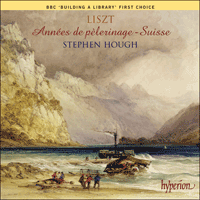

Liszt’s three books of Années de pèlerinage contain some of his most important music and exemplify the fusion of art and nature which was central to the nineteenth-century Romantic movement which the composer epitomized. Book 1, recorded here, reached its final form in 1855 but most of the pieces were written in the 1830s during Liszt’s stay in Switzerland with his mistress Marie d’Agoult. Each piece has an illustrative title and aims to capture the emotion invoked by a particular scene; this was a revolutionary approach to music in its time and allowed Liszt to create a whole new world where piano texture is used purely to create atmosphere.
Music requiring this degree of pianistic sophistication seems perfectly suited to the skills of Stephen Hough, and so it proves, as he captures to perfection the delicate glitter of Au bord d’une source or the grandeur of Vallée d’Obermann.
Unusually, the CD is completed with Liszt’s complete transcriptions from Gounod operas. The three pieces include one virtuoso warhorse – the Faust waltz – and two reflective and lyrical pieces which are almost completely unknown.

Like so much of the piano music Liszt published in the 1850s during his years in Weimar – where he settled with his new partner Princess Carolyne von Sayn-Wittgenstein, having abandoned his life as a touring virtuoso pianist in 1847 – the Années de pèlerinage are largely based on earlier material, written during Liszt’s time as a travelling concert artist. The first book of Années de pèlerinage (Suisse) is, for the most part, a revision of the Album d’un voyageur (recorded on Hyperion, CDA66601/2), most of which was composed during Liszt’s sojourn in Switzerland with Marie d’Agoult in 1835 and 1836. The second book documents his subsequent travels through Italy. (The third book of Années de pèlerinage, a much later work not based on earlier material and quite different in style, character and influence, is also Italian in subject-matter.)
Liszt’s relationship with Countess Marie d’Agoult, a married woman six years his senior with two young children, began in 1833, and they went to considerable lengths to conceal their liaison from the Parisian social scene in which they were both, despite their very different backgrounds, enthusiastically involved. They spent the second half of 1834 apart, before the tragic death that December of Marie’s eldest daughter, Louise, at the age of six. This catastrophe, the couple’s emotional reunion early in 1835, and especially Marie’s becoming pregnant in March, cemented their decision to elope to Switzerland in June 1835 (their daughter Blandine was born in December). At great personal risk (and sacrifice: Marie abandoned not only a husband and palatial family home but also her younger daughter Claire) and leaving behind them a scandal, they started a new life together. They stayed in Switzerland for sixteen months, and much of the Album d’un voyageur – a large collection split into three parts, not all of which was reworked in the first book of Années de pèlerinage – was written during this period. Of the nine pieces in the Années de pèlerinage – Suisse, two do not originate from the earlier collection (Eglogue was originally written in 1836 but stood independently, while Orage was newly composed in 1855); the remaining seven pieces are all revisions – with varying degrees of refinement, cuts, elaboration and recomposition – from the Album d’un voyageur. These revisions were made between 1848 and 1854, and the new volume was published in 1855.
Chapelle de Guillaume Tell, a homage to the Swiss national hero prefaced with the motto ‘Einer für Alle – Alle für Einen’ (‘One for all – and all for one’), opens anthem-like before imitations of the alphorn build to a storm of octaves and powerful chords. There is a magical sense of arrival in the aftermath of this outburst, when the heroic main idea calmly returns over flowing arpeggios, before a retreat to the solemnity of the opening.
Au lac de Wallenstadt is the first of two water pieces. It is retained virtually unaltered from its earlier version in the Album d’un voyageur, which was written shortly after Liszt and Marie arrived in Switzerland, en route from Basel to Geneva. Marie wrote in her Mémoires: ‘The shores of Lake Wallenstadt detained us for a long time. Franz wrote for me there a melancholy harmony, imitative of the sigh of the waves and the cadence of oars, which I have never been able to hear without weeping.’ Liszt heads the score with lines from Byron’s Childe Harold’s Pilgrimage: ‘… thy contrasted lake, / With the wild world I dwelt in, is a thing / Which warns me, with its stillness, to forsake / Earth’s troubled waters for a purer spring.’ The delicate, rocking accompaniment underpins a melody of innocent lyricism.
Pastorale is a charming vignette, its repeated binary structure reflecting the unpretentious simplicity of the music and the country scene it portrays. It acts as an interlude before the second water-study, Au bord d’une source, which in its first version ran on from Au lac de Wallenstadt without a break, both works being in A flat major. The revised version of Au bord d’une source is far more subtle and pianistically elegant, the left hand crossing the right to share the melodic line, freeing the right hand for the sparkling and intricate depiction of the movement of water. Liszt quotes from Schiller: ‘In the whispering coolness begins young nature’s play.’ This is one of the most successful pieces of the set, and according to Humphrey Searle, writing in the 1950s, the only one of these pieces to retain its place in the standard repertoire at a time when Liszt’s music was generally out of favour.
As we have seen, Orage was the only work from the Années de pèlerinage – Suisse to be freshly composed in Weimar. This is a spectacular depiction of an Alpine storm, a torrential octave study revealing many hallmarks of Liszt’s pianistic and melodic style: the opening is strikingly similar to that of Liszt’s Malédiction for piano and orchestra, while the main theme is of a type that occurs in many of the symphonic poems. Again, lines from Byron’s Childe Harold preface the music: ‘But where of ye, O tempests! is the goal? / Are ye like those within the human breast? / Or do ye find, at length, like eagles, some high nest?’ Liszt wrote many representations of nature’s fury, but none that is more focused and compact than this. The finest and most extended piece of the set, Vallée d’Obermann was inspired by Senancour’s French novel Obermann, which is set in Switzerland. The descending left-hand motif that opens the piece undergoes a series of thematic transformations, in the manner of a symphonic poem, being set in a bold range of harmonic and pianistic contexts. Harmonically this piece is extraordinarily adventurous, in places anticipating Wagner (although cast with a different hue in places, the daring harmonies stem from the version in the Album d’un voyageur), and the way Liszt conveys Obermann’s sense of wonder at nature’s impenetrable grandeur is hugely impressive. After a stormy central outburst heralded by misterioso tremolandos, the music melts into a radiant E major, becoming increasingly florid and ecstatic before ending on a note of unresolved emotional ambiguity. Liszt quotes both from Senancour (‘Que veux-je? Que suis-je? Que demander à la nature? …’; ‘What do I want? What am I? What to ask of nature? …’) and once more from Byron’s Childe Harold:
Could I embody and unbosom now
That which is most within me, – could I wreak
My thoughts upon expression, and thus throw
Soul, heart, mind, passions, feelings, strong or weak,
All that I would have sought, and all I seek,
Bear, know, feel, and yet breathe – into one word,
And that one word were Lightning, I would speak;
But as it is, I live and die unheard,
With a most voiceless thought, sheathing it as a sword.
Liszt quotes the very next stanza from Childe Harold to introduce Eglogue (‘The morn is up again, the dewy morn, / With breath all incense, and with cheek all bloom; / Laughing the clouds away with playful scorn, / And living as if earth contain’d no tomb!’). A delicate and fresh-faced pastoral setting, this piece contrasts sharply with the brooding intensity of Vallée d’Obermann. The darker atmosphere returns in Le mal du pays (‘Nostalgia’ or ‘Homesickness’), albeit with a more wistful character, where the opening alphorn calls a melancholy tune whose unharmonized bleakness is twice relieved by the beautifully poignant melody of the Adagio dolente passages. Les cloches de Genève, subtitled Nocturne, is a substantial revision of Les cloches de G***** from the Album d’un voyageur (why Liszt felt the need in the 1830s to suppress the name of Geneva isn’t clear, but in any case he revealed it in this final version); it is dedicated to Liszt’s first daughter Blandine, who was born in the city, and introduced by two lines from Childe Harold: ‘I live not in myself, but I become / Portion of that around me.’ The gentle descending carillon becomes increasingly animated, building to a passionate climax before the collection closes with the distant tolling of bells.
Liszt composed opera paraphrases throughout his creative life, although they underwent a pronounced shift in nature and purpose as he grew older, from the impressive dressing-up of popular tunes with which he dazzled audiences in his youth, through the psychological character-study of some of his finest paraphrases, condensing and juxtaposing the key dramatic scenes of an opera (the ‘reminiscences’ of Mozart’s Don Giovanni, for example), to the more focused attention on single scenes which he favoured in his later years, especially in his treatments of Wagner.
The Gounod paraphrases (there are three opera paraphrases, all of which are presented here, as well as a transcription of the choral Hymne à Sainte Cécile, dating from 1866) are all from Liszt’s maturity. With the exception of the virtuoso treatment of the waltz from Faust these have generally been overlooked. One of the finest of Liszt’s neglected opera paraphrases, Les Adieux – Rêverie sur un motif de Roméo et Juliette, after Gounod’s setting of Shakespeare first produced in 1867 but now largely forgotten, was composed the same year that the opera appeared. It is in fact based on more than one motif from the opera, all concerned with the lovers’ parting (the end of the balcony scene, the morning after the marriage, and the scene at Juliet’s tomb). Liszt interweaves these connected ideas with great skill and invention, creating an atmosphere of reflection and regret, entirely without the ostentatious display of the Faust paraphrase. Gounod’s The Queen of Sheba has disappeared from the repertoire even more emphatically than his Roméo et Juliette, yet Liszt’s Les Sabéennes – Berceuse de l’opéra La Reine de Saba, published in 1865, is another delightfully delicate transcription which deserves to be heard in its own right.
Gounod’s Faust is his only opera to have retained a place on stage, and within two years of its first production in 1859 Liszt had written this witty and ingenious elaboration of the waltz, which also incorporates a lyrical intermezzo based on the Faust–Marguerite love duet ‘Ô nuit d’amour!’ from Act 2. Faust was, of course, a subject close to Liszt’s heart – he composed his own Faust Symphony in 1854 – yet Sacheverell Sitwell observed long ago a curious quality of cynical detachment in this showpiece: ‘Liszt must have seized upon this tune from the most popular opera of the day, determined to make its worldly success his excuse for committing every kind of sacrilege with its body, and yet lifting it, in doing this, on to a higher spiritual plane than it could ever aspire to on its own merits … In this piece he is giving the public their delight and mocking them in that.’ Certainly the pyrotechnical demands are at times disproportionately sophisticated for Gounod’s occasionally banal themes, and with Liszt’s modulations and harmonic twists adding a delicious spice and urbanity to the music, this tremendously effective piece is an example of Liszt’s treatment transcending its origins.
Tim Parry © 2005
Comme tant d’œuvres pour piano publiées par Liszt dans les années 1850 – années de son séjour à Weimar, où il s’était établi avec sa nouvelle compagne, la princesse Carolyne von Sayn-Wittgenstein, après avoir abandonné son existence de pianiste virtuose itinérant, en 1847 –, les Années de pèlerinage reposent largement sur un matériau antérieur, écrit du temps de ses voyages comme concertiste. Le premier recueil des Années de pèlerinage (Suisse) est, pour l’essentiel, une révision de l’Album d’un voyageur (enregistré sur Hyperion CDA66601/2), lui-même composé en grande partie lors du séjour que Liszt effectua en Suisse, en compagnie de Marie d’Agoult, en 1835–1836. Le deuxième recueil illustre les voyages qui le menèrent peu après à travers l’Italie. (Œuvre bien plus tardive et entièrement originale, témoignant d’un style, d’un caractère et d’une influence tout autres, le troisième recueil des Années de pèlerinage affiche, lui aussi, une thématique italienne.)
La liaison de Liszt avec la comtesse Marie d’Agoult, une femme mariée de six ans son aînée, mère de deux jeunes enfants, débuta en 1833, et tous deux se donnèrent beaucoup de mal pour cacher leurs rendez-vous galants à la bonne société parisienne, dans laquelle chacun était, malgré des parcours fort différents, passionnément impliqué. Ils passèrent la seconde moitié de l’année 1834 séparés, jusqu’à la mort tragique, en décembre, de Louise, la fille aînée de Marie, à l’âge de six ans. Cette catastrophe, mais aussi leurs retrouvailles chargées d’émotion, au début de 1835, et, surtout, le fait que Marie tomba enceinte en mars, tous ces éléments scellèrent leur décision de s’enfuir en Suisse en juin 1835 (leur fille Blandine naquit en décembre). Au prix d’un gros risque personnel (et d’un sacrifice: en plus d’un époux et d’une demeure familiale splendide, Marie abandonnait sa petite Claire), laissant derrière eux un scandale, ils commencèrent ensemble une nouvelle vie. Ils passèrent seize mois en Suisse, et une grande partie de l’Album d’un voyageur – vaste recueil divisé en trois parties, qui ne furent pas toutes retravaillées dans le premier livre des Années de pèlerinage – date de cette période. Sept des neuf pièces des Années de pèlerinage – Suisse sont des révisions, effectuées entre 1848 et 1854, de cet Album, avec divers degrés d’épuration, de coupures, d’élaboration et de refonte, seules Églogue et Orage ne provenant pas de ce matériau antérieur – l’une fut originellement écrite en 1836, mais indépendamment du reste, tandis que l’autre est une composition nouvelle, datée de 1855, année de publication du nouveau volume.
Hommage au héros national suisse, précédé de la devise «Einer für Alle – Alle für Einen» («Un pour tous – tous pour un»), Chapelle de Guillaume Tell s’ouvre comme un hymne avant que des imitations du cor des Alpes ne débouchent sur une tempête d’octaves et d’accords puissants. On éprouve un sentiment magique d’après-tempête, quand l’idée héroïque principale revient paisiblement par-dessus des arpèges fluides, avant de se retirer dans la solennité de l’ouverture.
Au lac de Wallenstadt – le premier de deux morceaux aquatiques – est presque inchangé par rapport à sa version initiale dans l’Album d’un voyageur, écrite par Liszt peu après son arrivée en Suisse, alors qu’il voyageait, avec Marie, de Bâle à Genève. Marie nota dans ses Mémoires: «Les bords du lac de Wallenstadt nous retinrent longtemps. Franz y composa pour moi une mélancolique harmonie, imitative du soupir des flots et de la cadence des avirons, que je n’ai jamais pu entendre sans pleurer». En épigraphe de la partition, Liszt plaça des vers du Childe Harold’s Pilgrimage de Byron: «… ton lac en contraste / Avec le monde sauvage où je demeurai est une chose / Qui m’incite, par son immobilité, à quitter / Les eaux troublées de la terre pour une source plus pure». L’accompagnement délicat, berçant, soutient une mélodie au lyrisme innocent.
Pastorale est une charmante vignette dont la structure binaire répétée traduit la simplicité sans prétention et de la musique, et de la scène agreste qu’elle dépeint. Elle est comme un interlude avant la seconde étude aquatique, Au bord d’une source, qui, dans la version originale, venait juste après Au lac de Wallenstadt, les deux pièces étant en la bémol majeur. La mouture révisée d’Au bord d’une source a beaucoup gagné en subtilité et en élégance pianistique: pour partager la ligne mélodique, la main gauche croise la main droite, alors libre de nous brosser le portrait éclatant et complexe du mouvement de l’eau. Et Liszt de citer Schiller: «Dans la fraîcheur bruissante s’éveillent les jeux de la jeune nature». Ce fut l’une des pièces du corpus qui connut le plus de succès et, comme l’écrivit Humphrey Searle dans les années 1950, elle fut aussi la seule à conserver sa place dans le grand répertoire, à une époque où la musique de Liszt connaissait une disgrâce générale.
Comme nous l’avons vu, Orage fut l’unique œuvre des Années de pèlerinage – Suisse à avoir été composée ex nihilo à Weimar. Tableau saisissant d’une tempête alpestre, cette étude d’octaves torrentielles porte en elle bien des sceaux du style pianistico-mélodique de Liszt (l’ouverture offre une ressemblance frappante avec celle de la Malédiction pour piano et orchestre du même compositeur, le thème principal ressortissant, lui, à un type présent dans maints poèmes symphoniques). Là encore, des vers du Childe Harold de Byron précèdent la musique: «Mais où, ô tempêtes, est le dessein? / Êtes-vous comme celles en le sein humain? / Ou trouvez-vous, finalement, comme les aigles, quelque nid élevé?». Liszt composa force représentations de la nature en furie, mais nulle n’est plus déterminée, plus compacte que celle-ci.
Vallée d’Obermann, la plus belle et la plus vaste pièce de ce corpus, s’inspire d’Obermann de Senancour, roman français dont l’action se déroule en Suisse. À la façon d’un poème symphonique, le motif descendant inaugural, à la main gauche, subit une série de transformations thématiques sises dans une palette hardie de contextes harmonico-pianistiques. Cette pièce à l’harmonie incroyablement osée anticipe par endroits Wagner (bien que parfois coulées dans une nuance différente, les harmonies audacieuses émanent de la version de l’Album d’un voyageur) et la manière dont Liszt véhicule l’émerveillement d’Obermann face au grandiose impénétrable de la nature est magique. Passé un déchaînement central tempétueux, annoncé par des tremolandos misterioso, la musique se fond en un radieux mi majeur, devenant de plus en plus fleurie et extatique, avant de s’achever sur une note d’ambiguïté émotionnelle non résolue. Liszt cite Senancour («Que veux-je? Que suis-je? Que demander à la nature? …») et, de nouveau, le Childe Harold de Byron:
Si je pouvais formuler et confesser maintenant
Ce qui est le plus en mois – si je pouvais faire sourdre
Mes pensées en expression, et ainsi jeter
Âme, cœur, esprit, passion, sentiments, forts ou faibles,
Tout ce que j’ai cherché, et tout ce que je recherche,
Porte, connais, ressens et même respire – en un mot,
Et ce mot serait Éclaire, je dirais;
Mais pour l’heure, je vis et meurs sans être entendu,
Avec une pensée des plus aphones, que je rengaine telle une épée.
Liszt introduit Églogue en citant la stance immédiatement suivante du Childe Harold: «Le matin est de nouveau levé, le matin humide de rosée, / Avec une haleine toute d’encens, et des joues toutes en fleurs; / Se riant des nuages d’un dédain espiègle, / Et vivant comme si la terre ne portait pas de tombe!». Cette mise en musique pastorale et délicate, au teint frais, tranche vivement avec l’inquiétante intensité de Vallée d’Obermann. Le mal du pays renoue avec une atmosphère sombre, mais plus nostalgique, où le cor des Alpes initial lance un air mélancolique, dont l’austérité non harmonisée est allégée à deux reprises par la mélodie superbement poignante des passages Adagio dolente. Sous-titrée Nocturne, Les cloches de Genève est une révision substantielle de Les cloches de G*****, tirée de l’Album d’un voyageur (nous ne savons au juste pourquoi Liszt éprouva le besoin, dans les années 1830, de supprimer le nom de Genève, qu’il révéla, de toute façon, dans cette version finale). Dédiée à la première fille de Liszt, Blandine, née à Genève, cette pièce est introduite par deux vers du Childe Harold: «Je vis non en moi-même, mais je deviens / Une portion de ce qui m’entoure.» Le doux carillon descendant se fait de plus en plus animé, jusqu’à atteindre un apogée passionné, puis le recueil s’achève sur la lointaine sonnerie de cloches.
S’il composa des paraphrases d’opéra tout au long de sa vie créative, Liszt leur imposa, avec le temps, de profonds changements de nature et de dessein: abandonnant l’impressionnant déguisement d’airs populaires, qui éblouissait les auditoires de sa jeunesse, il se livra, dans certaines de ses plus belles paraphrases, à l’étude de caractère psychologique, condensant et juxtaposant les scènes dramatiques clés d’un opéra (les «réminiscences» du Don Giovanni de Mozart, par exemple), avant de centrer son attention, vers la fin de sa vie, sur des scènes particulières (cf. surtout ses traitements de Wagner).
Les paraphrases de Gounod (les trois proposées ici, plus une quatrième datée de 1886, d’après l’Hymne à Sainte Cécile) émanent toutes de la maturité de Liszt et ont généralement été négligées, à l’exception du traitement virtuose de la valse de Faust. L’une de ces plus belles paraphrases, Les Adieux – Rêverie sur un motif de Roméo et Juliette, fut composée l’année même de la parution de l’opéra de Gounod – on a largement oublié, depuis, cette mise en musique de Shakespeare, produite pour la première fois en 1867 –, dont elle reprend en fait plusieurs motifs, tous relatifs à la séparation des amants (la fin de la scène du balcon, le lendemain du mariage, et la scène au tombeau de Juliette). Liszt entremêle ces idées connexes avec brio et invention, créant une atmosphère de réflexion et de regret, mais sans l’étalage ostentatoire de la paraphrase de Faust. Plus encore que Roméo et Juliette, La Reine de Saba de Gounod a résolument disparu du répertoire; pourtant, Les Sabéennes – Berceuse de l’opéra La Reine de Saba, publiée en 1865, est, elle aussi, une transcription lisztienne merveilleusement délicate qui vaut d’être entendue pour elle-même.
Dans les deux années qui suivirent la première représentation de Faust (1859), l’unique opéra de Gounod à avoir conservé sa place sur scène, Liszt écrivit cette élaboration spirituelle et ingénieuse de la valse, qui intègre aussi un intermezzo lyrique fondé sur le duo d’amour entre Faust et Marguerite, «Ô nuit d’amour!» (Acte II). Alors même que Faust était, naturellement, un thème cher au cœur de Liszt – il composa sa propre Symphonie Faust en 1854 –, Sacheverell Sitwell décela, il y a bien longtemps, un curieux détachement cynique dans ce joyau: «Liszt a dû se précipiter sur cet air tiré de l’opéra le plus populaire du moment, résolu à faire de son succès bassement matériel une excuse pour commettre sur son corps toutes sortes de sacrilèges et, partant, parvenir à le hausser à un niveau spirituel supérieur à celui auquel ses seules mérites lui eussent jamais permis d’aspirer … Dans cette pièce, il donne aux auditoires leur plaisir et, en cela, se moque d’eux.» De fait, les exigences pyrotechniques sont, par endroits, d’une sophistication disproportionnée par rapport aux thèmes, parfois banals, de Gounod et, avec des modulations et des torsions harmoniques qui ajoutent un délicieux piquant et une urbanité à la musique, cette pièce magnifiquement efficace montre comment le traitement lisztien transcende l’œuvre d’origine.
Tim Parry © 2005
Français: Hyperion Records Ltd
Wie so viele Klavierwerke, die Liszt in den 1850er Jahren während seiner Weimarer Zeit veröffentlichte – wo er sich mit seiner neuen Partnerin, der Prinzessin Carolyne von Sayn-Wittgenstein, niederließ, nachdem er sein Dasein als reisender Klaviervirtuose 1847 aufgegeben hatte – basieren auch die Années de pèlerinage zum größten Teil auf früherem Material, das Liszt während seiner Zeit als reisender Konzertpianist geschrieben hatte. Das erste Buch der Années de pèlerinage (Suisse) ist größtenteils eine Überarbeitung des Album d’un voyageur (aufgenommen auf Hyperion, CDA66601/2), das hauptsächlich auf Liszts Schweiz-Aufenthalt 1835–6 mit Marie d’Agoult entstanden war. Das zweite Buch dokumentiert seine Italienreise kurz darauf. (Das dritte Buch der Années de pèlerinage, ein sehr viel späteres Werk, das nicht auf frühem Material basiert und im Stil recht unterschiedlich ist, geht ebenfalls auf italienische Themen zurück.)
Liszts Liaison mit der Comtesse Marie d’Agoult, die sechs Jahre älter als er und verheiratet war und zwei kleine Kinder hatte, begann im Jahre 1833 und sie gaben sich größte Mühe, ihre Verbindung vor der Pariser Gesellschaft zu verstecken, der sie beide trotz ihrer jeweils völlig unterschiedlichen Herkunft gerne angehörten. Die zweite Hälfte des Jahres 1834, bevor die ältere Tochter Maries, Louise, auf tragische Weise im Alter von sechs Jahren starb, lebten sie getrennt voneinander. Diese Katastrophe, die emotionale Wiedervereinigung des Paars am Anfang des Jahres 1835 und besonders Maries Schwangerschaft ab März bekräftigten ihre Entscheidung, im Juni 1835 zusammen in die Schweiz zu entfliehen (ihre Tochter Blandine wurde im Dezember geboren). Ihr neues Leben zusammen bedeutete nicht nur ein großes persönliches Risiko (und Opfer: Marie verließ nicht nur ihren Ehemann und das palastartige Familienhaus sondern auch ihre jüngere Tochter Claire) sondern auch ein Skandal in Paris. Sie blieben sechzehn Monate lang in der Schweiz und ein großer Teil des Album d’un voyageur – eine große Sammlung in drei Teilen, von der nicht alles in dem ersten Buch der Années de pèlerinage wiederverwertet wurde – entstand während dieser Zeit. Von den neun Stücken der Années de pèlerinage – Suisse stammen zwei nicht aus der früheren Sammlung (Eglogue war ursprünglich 1836 entstanden, jedoch als einzelnes Stück, während Orage 1855 neukomponiert wurde); die restlichen sieben Stücke sind alle Überarbeitungen – mit jeweils unterschiedlichen Graden der Verbesserung, Streichung, Ausschmückung und Neukomposition – des Album d’un voyageur. Diese Überarbeitungen wurden zwischen 1848 und 1854 vorgenommen und der neue Band wurde 1855 herausgegeben.
Chapelle de Guillaume Tell ist eine Hommage an den schweizerischen Nationalhelden und trägt das Motto „Einer für Alle – Alle für Einen“. Es beginnt hymnenartig, bevor die Alphorn-Imitationen sich zu einem Sturm von Oktaven und kraftvollen Akkorden zusammenbrauen. Nach diesem Ausbruch herrscht ein zauberhaftes Ankunftsgefühl vor und das heroische Hauptmotiv kehrt ruhig über fließenden Arpeggien wieder, bevor das Ganze zu der Erhabenheit des Anfangs zurückkehrt.
Au lac de Wallenstadt ist das erste von zwei Wasserstücken. Es ist der Version im Album d’un voyageur gegenüber kaum verändert, die kurz nach der Ankunft Liszts und d’Agoults in der Schweiz entstand, als sie sich auf der Durchreise von Basel nach Genf befanden. Marie d’Agoult hielt in ihren Mémoires fest: „Die Ufer des Wallenstädter Sees hielten uns lange Zeit zurück. Franz schrieb dort für mich eine melancholische Harmonie, in der das Seufzen der Wellen und die Kadenz der Ruder imitiert werden und ich habe sie nie ohne Weinen anhören können.“ Liszt stellt dem Stück mehrere Zeilen aus Byrons Childe Harold’s Pilgrimage voran: „... thy contrasted lake, / With the wild world I dwelt in, is a thing / Which warns me, with its stillness, to forsake / Earth’s troubled waters for a purer spring“ [... dein kontrastierender See, / in der wilden Welt, in der ich mich aufhielt, ist ein Ding / das mich mit seiner Stille davor warnt / die unruhigen Wasser der Erde zugunsten einer reineren Quelle aufzugeben]. Die feingliedrige, wiegende Begleitung untermauert eine Melodie von unschuldiger Lyrik.
Pastorale ist ein anmutiges vignette-artiges Stück, dessen wiederholte zweiteilige Struktur die bescheidene Schlichtheit der Musik sowie die dargestellte Landszene reflektiert. Es ist eine Art Zwischenspiel vor der zweiten Wasserstudie, Au bord d’une source, das in seiner ursprünglichen Version Au lac de Wallenstadt ohne Pause fortsetzte (beide Werke stehen in As-Dur). Die überarbeitete Fassung von Au bord d’une source ist sehr viel subtiler und pianistisch eleganter; die linke Hand überkreuzt die rechte, um die Melodie mitzuspielen, was der rechten Hand wiederum ermöglicht, die Bewegungen des Wassers auf sprühende und vielschichtige Art und Weise darzustellen. Liszt zitiert Schiller: „In säuselnder Kühle / beginnen die Spiele / der jungen Natur“. Es ist dies eines der erfolgreichsten Stücke des Zyklus’ und Humphrey Searle schrieb in den 50er Jahren des 20. Jahrhunderts, dass dieses Stück als einziges seinen Platz im Standardrepertoire behielt, als die Werke Liszts allgemein aus der Mode geraten waren.
Wie wir bereits gesehen haben, war Orage das einzige Stück der Années de pèlerinage – Suisse, das in Weimar entstand. Es ist eine spektakuläre Darstellung eines alpinen Sturms, wobei eine sintflutartige Oktavenstudie viele Charakteristika des pianistischen und melodischen Stils Liszts vorweist (der Anfang erinnert sehr an Liszts Malédiction für Klavier und Orchester, während das Hauptthema von demselben Typus ist, wie in einer Reihe der symphonischen Dichtungen). Auch hier stellt Liszt der Musik Zeilen aus Byrons Childe Harold voran: „But where of ye, O tempests! is the goal? / Are ye like those within the human breast? / Or do ye find, at length, like eagles, some high nest?“ [Aber wo, O Unwetter, ist das Ziel? / Seid Ihr wie die in der menschlichen Brust? / Oder findet Ihr schließlich, wie Adler, ein hohes Nest?] Liszt komponierte viele Darstellungen des Zorns der Natur, doch ist keine fokussierter und kompakter als diese.
Das beste und längste Stück des Zyklus ist Vallée d’Obermann, das von Senancours französischem Roman Obermann, der in der Schweiz spielt, inspiriert war. Das absteigende Motiv in der linken Hand eröffnet das Stück und macht im Laufe des Werks mehrere thematische Veränderungen durch, ähnlich wie in einer symphonischen Dichtung, da es in einen vielfältigen, kühnen harmonischen und pianistischen Kontext gesetzt ist. Harmonisch gesehen ist dieses Stück ungeheuer gewagt und antizipiert zuweilen sogar Wagner (obwohl sie hier anders eingefärbt sind, stammen die kühnen Harmonien aus der Version im Album d’un voyageur) und die Weise in der Liszts Obermanns Erregung angesichts der undurchdringlichen Grandezza der Natur ausdrückt, ist zauberhaft. Nach einem stürmischen zentralen Ausbruch, der durch die misterioso Tremolandi angekündigt wird, geht die Musik in ein strahlendes E-Dur über, wird zunehmend ekstatisch und ausgeschmückt, bevor sie auf einer Note unaufgelöster emotionaler Zweideutigkeit zum Ende kommt. Liszt zitiert sowohl Senancour („Que veux-je? Que suis-je? Que demander à la nature? ...“; „Was will ich? Was bin ich? Was die Natur fragen? ...“) als auch Byrons Childe Harold:
Könnte ich jetzt verkörpern und offenbaren
was am meisten in mir ist – könnte ich
meine Gedanken ausdrücken und damit
Seele, Herz, Verstand, Leidenschaften, Gefühle, stark oder schwach,
alles, was ich gesucht habe und alles, was ich suche,
ertrage, weiß, fühle und doch atme – in ein Wort verpacken,
und das eine Wort wäre ein Blitz, dann würde ich sprechen;
doch so lebe und sterbe ich ungehört,
mit einem stimmlosen Gedanken, der wie ein Schwert in seiner Scheide steckt.
Um Eglogue einzuleiten zitiert Liszt die nächste Strophe aus Childe Harold („The morn is up again, the dewy morn, / With breath all incense, and with cheek all bloom; / Laughing the clouds away with playful scorn, / And living as if earth contain’d no tomb!“; „Der Morgen erhebt sich wieder, der taufeuchte Morgen, / mit Atem wie Weihrauch und blühenden Wangen; / die Wolken mit spielerischer Verachtung weglachend, / und lebend, als hätte die Erde kein Grab!“). Es ist dies eine feine, frische und pastorale Vertonung und steht im krassen Gegensatz zu der düsteren Intensität von Vallée d’Obermann. Die dunklere Atmosphäre kehrt mit Le mal du pays [Heimweh] wieder, jedoch mit einem eher sehnsüchtigen Charakter, wenn die Alphornsignale am Anfang in eine melancholische Melodie übergehen, deren unharmonisierte Kargheit zweimal durch die wunderschöne und ergreifende Melodie der Adagio dolente Passagen gemildert wird. Les cloches de Genève trägt den Untertitel Nocturne und ist eine starke Überarbeitung von Les cloches de G***** aus dem Album d’un voyageur (warum Liszt in den 1830er Jahren den Namen Genf nicht angab, ist unklar, in dieser späteren Version ist er jedenfalls vorhanden). Es ist Liszts erster Tochter Blandine gewidmet, die in der Stadt zur Welt kam, und es wird mit zwei Zeilen aus Childe Harold eingeleitet: „I live not in myself, but I become / Portion of that around me“ [Ich lebe nicht in mir selbst, sondern werde / Teil dessen, was um mich herum ist]. Die sanft absteigende Glockenspielmusik wird immer animierter und erreicht einen leidenschaftlichen Höhepunkt, bevor der Zyklus mit entferntem Glockenläuten endet.
Liszt komponierte in allen seinen Schaffensperioden Opernparaphrasen, doch machten diese, was Stil und Absicht anging, eine deutliche Veränderung durch und entwickelten sich von eindrucksvollen, herausgeputzten beliebten Melodien, mit denen er das Publikum in seiner Jugend bezauberte, über die psychologischen Charakterstudien in seinen besten Paraphrasen, in denen er die dramatischen Schlüsselszenen einer gesamten Oper komprimierte und einander gegenüberstellte (so zum Beispiel die „Reminiszenzen“ von Mozarts Don Giovanni), bis hin zur fokussierteren Behandlung einzelner Szenen, wie er es in seinen späteren Jahren vorzog, besonders in seiner Beschäftigung mit Wagner.
Die Gounod-Paraphrasen (die alle drei auf der vorliegenden CD sind; zudem existiert eine Bearbeitung des Chorwerks Hymne à Sainte Cécile aus dem Jahr 1866) entstanden alle in Liszts Reifeperiode. Mit der Ausnahme der virtuosen Behandlung des Walzers aus Faust werden die Werke zumeist übersehen. Eine der besten dieser vernachlässigten Opernparaphrasen Liszts, Les Adieux – Rêverie sur un motif de Roméo et Juliette, nach Gounods Vertonung des Shakespeare-Dramas, die 1867 erstmals inszeniert wurde heute jedoch in Vergessenheit geraten ist, entstand in dem Jahr, in dem auch die Oper uraufgeführt wurde. Das Werk basiert auf mehreren Motiven aus der Oper, die alle von dem Abschied der Liebenden handeln (das Ende der Balkonszene, der Morgen nach der Hochzeit und die Szene bei Julias Grab). Liszt verwebt diese verbundenen Motive sehr geschickt und einfallsreich miteinander und stellt eine Atmosphäre der Nachdenklichkeit und des Bedauerns her, völlig ohne das ostentative zur-Schau-stellen, wie es in der Faust Paraphrase passiert. Gounods Königin von Saba ist von den Spielplänen noch merklicher verschwunden als seine Oper Roméo et Juliette, doch ist Liszts Les Sabéennes – Berceuse de l’opéra La Reine de Saba, herausgegeben im Jahre 1865, eine feingliedrige Bearbeitung voller ungewöhnlicher harmonischer Wendungen gehört zu werden.
Gounods Faust ist seine einzige Oper, die ihren Platz auf der Bühne behalten hat. Nur zwei Jahre nach der Uraufführung (1859) hatte Liszt bereits eine geistreiche und geschickte Bearbeitung des Walzers komponiert, in der auch ein lyrisches Intermezzo erklingt, das auf dem Liebesduett „Ô nuit d’amour“ zwischen Faust und Marguerite aus dem zweiten Akt basiert. Faust war freilich ein Sujet, das Liszt sehr nahe ging – 1854 komponierte er seine eigene Faust Symphonie – und doch hat Sacheverell Sitwell vor schon einiger Zeit auf die eigenartige, zynische Distanziertheit dieses Bravourstücks hingewiesen: „Liszt muss diese Melodie von der populärsten Oper der Zeit aufgegriffen haben und entschlossen gewesen sein, ihren weltlichen Erfolg als Vorwand dafür zu nehmen, jeden möglichen Frevel an ihrer Gestalt zu begehen. Trotzdem gelang es ihm dadurch, die Melodie auf eine höhere spirituelle Ebene zu befördern, als sie je selbst hätte erreichen können ... Mit diesem Stück gibt er dem Publikum ihre Freude und verspottet es gleichzeitig dafür.“ Freilich stehen die wahnwitzigen Ansprüche des Stücks nicht immer im Verhältnis zu den manchmal eher banalen Themen von Gounod und Liszts Modulationen und harmonischen Wendungen verleihen der Musik angenehme Würze und eine gewisse Urbanität; dieses enorm wirkungsvolle Stück ist ein gutes Beispiel dafür, wie Liszts Bearbeitung weit über die Ursprünge der Musik hinausgeht.
Tim Parry © 2005
Deutsch: Viola Scheffel