Welcome to Hyperion Records, a British classical label devoted to presenting high-quality recordings of music of all styles and from all periods from the twelfth century to the twenty-first.
Hyperion offers both CDs, and downloads in a number of formats. The site is also available in several languages.
Please use the dropdown buttons to set your preferred options, or use the checkbox to accept the defaults.
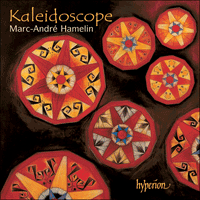

To all his many fans this disc is going to be ‘The Best Marc-André Hamelin Album Ever’ or perhaps ‘The Ultimate Marc-André Album’.
The CD is a collection of the kind of wild and wacky encores that so typify Marc-André’s recitals. Some are fairly well known such as the Rachmaninov and Godowsky but most are gems that have been long forgotten or, in the case of Marc’s own studies, or the Kapustin, are new additions to the encore tradition. All are guaranteed to make the listener either gasp in astonishment or swoon. Look out for the Gimpel paraphrase on a tune known in the US as The Marines Hymn, this is in the tradition of Horowitz at his most brilliant; then there’s our title track Kaleidoscop, written and made famous by the great pianist Joseph Hofmann, it was also much championed by Cherkassky and is another tour de force. Marc-André himself is represented by his outrageously complex take on Liszt’s La Campanella and by his pastiche of a Scarlatti sonata, which is very silly indeed! But it’s not all bravura—our pianist has also made an arrangement of the well known Adagio from Glazunov’s The Seasons which may bring a tear to the eye, as may the nostalgia of Alt Wein. Unmissable!

Edna Bentz Woods – Valse Phantastique
Edna Bentz Woods was an American composer and pianist married to an executive of the Aeolian Company, W Creary Woods. Apart from this snippet, a Duo-Art catalogue of about 1927 provides the sole source of information on the obscure composer of this charming work. From it we learn that Edna Bentz (the name under which her nine or so piano rolls were published) ‘has won success both in recitals of classical and romantic music and in the vaudeville field. She received an excellent musical training from some of the best teachers of America and Europe, among them Busoni and Egon Petri in Berlin, where she was studying when the Great War began. Her compositions number more than fifty pieces, and range from classical models to the most modern, syncopated dance music’.
The catalogue reveals that as well as several piano rolls of foxtrots for Duo-Art, Miss Bentz also recorded Busoni’s ‘All’ Italia!’ (the second of the six Elegien) for them. The Philadelphia publisher Theodore Presser issued several of her pieces, including the Valse Phantastique (1924), the score of which proclaims ‘As played by Mr Josef Hofmann’, who indeed made a piano roll of the work for Duo-Art.
Franz Behr – Polka de W.R. transcribed by Sergei Rachmaninov
Rachmaninov’s father Wassili (or Vassili) was a good amateur pianist (his paternal grandfather, Arkadi, had studied piano with John Field, inventor of the nocturne). Amongst Wassili’s repertoire was a simple polka which he frequently played to the amusement of his talented son. Clearly under the impression that it was a piece his father had written, Rachmaninov composed this deliciously knowing arrangement of the polka in 1911, entitling it Polka de W.R.—(W)assili (R)achmaninov—with a dedication to Leopold Godowsky.
In fact, the polka that Rachmaninov père et fils enjoyed was the Scherzpolka or Turtle Dove Polka, Op 303, by Franz Behr, many of whose numerous other salon works appeared under the pseudonyms of Georges Bachmann, William Cooper, Charles Morley and Francesco d’Orso. Though the middle (B flat) section of the Scherzpolka is not used by Rachmaninov, with Behr’s theme transposed from F major to A flat and an original countermelody to accompany the return of the main theme, the Polka de W.R. is as much a transcription as others by Rachmaninov (Kreisler’s Liebesfreud and Liebesleid, for instance) and, as such, should properly be designated ‘Behr-Rachmaninov’. Rachmaninov himself made one piano roll and three disc recordings of the Polka (1919, 1921 and 1928).
Josef Hofmann – Nocturne (‘Complaint’) from Mignonettes
Without doubt one of the greatest virtuosos of all time, Hofmann composed a handful of pieces, many under the pseudonym of Michel Dvorsky (a transliteration of the literal translation into Polish of his German name, meaning ‘courtyard man’). The delightful little Chopinesque Nocturne (in F sharp minor) with its yearning melody bears more resemblance to a waltz than to one of the Polish composer’s nocturnes. Subtitled ‘Complaint’, it comes from a set of five pieces called Mignonettes published in 1925, though is in fact a reworking of an earlier composition entitled ‘Lament’. Hofmann recorded the work for the Brunswick label in 1923.
Josef Hofmann – Kaleidoskop Op 40 No 4
Kaleidoskop is the dazzling final piece of Hofmann’s four Charakterskizzen (the others are Vision, Jadis and Nenien) published under his own name in 1908 and dedicated to ‘Meinem Freunde Leopold Godowsky in Verehrung zugeeignet’. Hofmann himself left a much-treasured performance of the work captured live in a recital given in April 1938 at Casimir Hall, Philadelphia (incidentally, a few blocks away from Mr Hamelin’s home today).
Marc-André Hamelin – Etude No 3 (d’après Paganini-Liszt)
Liszt was twenty when he first heard Paganini and witnessed for the first time how flawless virtuosity could be used for dramatic effect. Resolving to equip himself with a technique that could wield the same hypnotic effect over an audience, Liszt shut himself away to work assiduously at his goal. Among the earliest compositions reflecting his success are the Sechs grosse Etuden von N. Paganini, all, except No 3, transcriptions of Paganini’s Caprices for solo violin. Etude No 3, La Campanella, uses the main theme from the last movement of Paganini’s Violin Concerto No 2 in B minor, the Rondo which owes its nickname to the little bell with which Paganini presages each return of the rondo theme. Liszt’s version (in G sharp minor) is perhaps the most celebrated of the six ‘Paganini Etudes’—and the most treacherous. Mr Hamelin’s take on La Campanella (using Paganini’s original key but Liszt’s étude numbering) is as astonishing a piece of espièglerie as Liszt’s must have appeared to the audiences of his day. Composed in 1993 and dedicated to ‘arch-pianophile and friend Jay Reise’, Etude No 3 throws a mounting avalanche of devastating pianistic problems at any player brave enough to follow in Mr Hamelin’s footsteps. And yet, is there just the merest hint of tongue-in-cheek with all the unexpected shifts of tempi, dynamics and harmonies? His own nonchalant performance would seem to support this, though the score, littered as it is with punishing requests (fuocoso e velocissimo and the like), is serious enough in its musical intent.
Felix Blumenfeld – Etude pour la main gauche seule Op 36
Remembered today as the teacher of Vladimir Horowitz and Simon Barere (also of Maria Grinberg, Dmitry Tiomkin and Heinrich Neuhaus), Blumenfeld was a more distinguished figure in Russian music than his (albeit influential) pedagogical activity would suggest. As a virtuoso pianist in the grand tradition, he premiered many works by Arensky, Glazunov and Liadov, and frequently appeared as accompanist to the great bass Fyodor Chaliapin. A composition pupil of Rimsky-Korsakov, he conducted the premieres of Rimsky’s Servilia and The Legend of the Invisible City of Kitezh, Scriabin’s Divine Poem and Poem of Ecstasy, as well as the first Russian performances of Wagner’s Tristan und Isolde.
Blumenfeld’s compositions include thirty-four songs, one symphony (‘À la mémoire des chers défunts’), an Allegro de Concert for piano and orchestra, several chamber works and many piano pieces, most of which show the influence of Chopin rather than Anton Rubinstein. Of his eighteen compositions designated ‘studies’, the first (Op 2) was composed in 1886, the last (Op 54) in 1927. The Study in A flat for the left hand alone is Blumenfeld’s best-known work, among the most ingenious and euphonious works of its kind. It is dedicated to Leopold Godowsky, whom Blumenfeld met and greatly admired when the Polish pianist first visited Russia in 1905, the year of the study’s composition.
Jakob Gimpel – Concert Paraphrase of ‘The Song of the Soldiers of the Sea’ (The Marines’ Hymn), after Jacques Offenbach (1819–1880) (ed. Hamelin)
The music was composed in 1868 by Jacques Offenbach for his opéra bouffe Geneviève de Brabant (the three-act version). A comic duet for bass and baritone, to French audiences it is known as ‘Couplets des Deux Hommes d’Armes’; to the British it is ‘The Gendarmes’ Duet’ (‘We’re public guardians, bold, yet wary, And of ourselves we take good care!’ … with its chorus ‘We run them in, we run them in, we show them we’re the bold gendarmes!’); to Americans the tune is, famously, the hymn of the United States Marine Corps. There are various claims to the authorship of the words sung by the Marines (‘From the halls of Mon-te-zu-ma, to the shores of Trip-o-li …’) which first appeared in print in August 1918. The finger-crushing jeu d’esprit heard here was composed in 1942 by the Austrian-born American virtuoso Jakob Gimpel. A rare wartime 16-inch V-disc exists of Gimpel himself playing it, but this is the first time the work has received a commercial recording. Marc-André Hamelin is grateful to the Jakob and Bronislaw Gimpel Archives for providing a copy of the manuscript.
Marc-André Hamelin – Etude No 6: Essercizio per pianoforte (Omaggio a Domenico Scarlatti)
This deft, witty take on the sonatas of Domenico Scarlatti, though only the sixth in a planned cycle of twelve studies by Mr Hamelin (Study No 3 is on track 5, while Nos 9, 10 and 12 can be heard on Hyperion CDA67050), is now, according to the composer, likely to be the last. [2011 undate: The full set is now recorded on CDA67789]. Its five predecessors present enormous technical challenges to the player. ‘The Scarlatti study’, says Hamelin, ‘is probably the easiest of the bunch but still presents some problems, especially at the tempo at which it has to go’—a typical Hamelin understatement. There are no direct quotes from Scarlatti, but the structure and many of the mannerisms from the canon of his nearly six hundred sonatas are incorporated in a whirlwind succession of rapid runs, terrifying leaps and crossed-hand passages (audiences have been known to laugh out loud in performance at the comic visual effect of these) as well as Mr Hamelin’s trademark humourous wrong-note harmonies. The Etude, composed in 1992, is dedicated to Artis Wodehouse and Joe Patrych.
Jules Massenet – Valse folle
To those who know Massenet as the composer of Manon, Werther and the ‘Méditation’ from Thaïs, his Valse folle is the aural equivalent of being hit in the face with a brick. Composed in 1898 (by which time Massenet had become wildly wealthy and famous from his success as an opera composer), the ‘Mad Waltz’ was dedicated to his friend Raoul Pugno (1852–1914). Pugno himself, one of the first internationally acclaimed lions of the keyboard to commit his art to disc, recorded the work in April 1903 for the Gramophone and Typewriter label. Its innocent main theme contrasts with abrupt changes of tempo and (for Massenet) unexpected discords and harmonies, to say nothing of the violent ending, providing a brief glimpse of an unexpected side to the elegant, urbane Massenet.
Moritz Moszkowski – Etude in A flat minor Op 72 No 13
‘After Chopin’, said Paderewski, ‘Moszkowski best understands how to write for the piano’. Turn where you will amongst Moszkowski’s oeuvre, you will find the same beautifully crafted, richly melodic, instantly recognizable voice—200 pieces amid 100 opus numbers (including his Op 74 set of four pieces entitled Kaleidoscope: is it coincidence that Josef Hofmann, see above, studied with Moszkowski for a time?). There are no fewer than 69 separate works to which he assigned the title ‘étude’ or ‘clavierstücke’. These take in single studies as part of an opus number, six studies for the left hand, Op 92, the Twenty Dexterity and Style Etudes, Op 91, and the sixteen studies of Esquisses techniques, Op 97.
The most distinguished collection, however, are the fifteen Etudes de virtuosité, Op 72. Like their companions, all are far from the production-line exercises routinely trotted out by others of the period. Moszkowski’s are more like character pieces. Perhaps the best-known of these, because of their espousal by Vladimir Horowitz, are No 6 in F and No 11 in A flat. While less immediately brilliant than its predecessors, the A flat minor is, arguably, a finer work, its main theme (molto animato and marked con molto leggierezza) in quaver runs of thirds, fourths and sixths, framing a middle section in the tonic major of touching simplicity, typical of the composer.
Francis Poulenc – Intermezzo in A flat
The third of three Intermezzi (No 1 in C was written in 1934, No 2 in D flat, the best known, from the same year) was composed in March 1943 and dedicated to Madame Mante Rostand. Some will hear the influence of Fauré in its simple melody supported by wide figurations. The A flat Intermezzo is a long-time favourite of Mr Hamelin who first heard the piece when it was used regularly on the radio in Philadelphia to introduce the commercial spot for The Steinway Hour.
Leopold Godowsky – Alt Wien (No 11 of Triakontameron)
By far the most popular of all Godowsky’s music, Alt Wien (‘Old Vienna’) comes from Triakontameron, unenticingly subtitled ‘Thirty Moods and Scenes in Triple Measure’. They were composed in 1919 while Godowsky was living in a small cottage near Seattle overlooking the nearby Olympian Mountains and Lake Washington. Just as Boccaccio had allegedly written his Decameron in ten days, so Godowsky aimed to write his collection of thirty pieces in 3/4 time in thirty days (though in truth it took him rather longer—twenty were composed in Seattle in twenty days, the remainder shortly afterwards in Los Angeles, Chicago and New York).
Each short miniature of epigrammatic conciseness conjures up a different mood, place or experience. Several of the set refer to Vienna (Terpsichorean Vindobona, The Temptress, Paradoxical Moods, Rendezvous and Sylvan Tyrol), but Alt Wien evokes most successfully the vanished city that Godowsky knew in the years prior to the First World War. The score tells us that it was composed on 8 August 1919 in Seattle (the title page bears the subscription ‘Whose yesterdays look backwards with a Smile through Tears’) but it is the revised version of 1933, with some slight additions and ossia readings, that is usually heard today. Alt Wien was a great favourite of Jascha Heifetz (he made two recordings of his own transcription) and film buffs can hear it played by the hotel orchestra in MGM’s 1932 classic Grand Hotel.
Aleksander Michalowski – Etude d’après l’Impromptu en la bémol majeur de Fr. Chopin, Op 29
A markedly more sophisticated treatment of Chopin than his brilliant and frankly shallow treatment of the D flat major (‘Minute’) Waltz, Michalowski’s Study after Chopin’s Impromptu No 1 in A flat major is Godowskyian in its delicate contrapuntal refinement. Triplets in fourths and sixths played vivace and leggiero require a discriminating technique, one which Michalowski himself clearly enjoyed if his few recordings are anything to go by. Polish-born Michalowski, who was acquainted with Chopin’s pupil Mikuli, studied with Moscheles, Reinecke and Tausig, subsequently exercising great influence on succeeding generations. Among his best-known pupils were Wanda Landowska and Mischa Levitzki. Michalowski dedicated the Etude to his fellow countryman, the great pianist Ignace Friedman.
Arthur (Vincent) Lourié – Gigue
Lourié, despite his name, was born in St Petersburg and was one of the Russian futurist school during the second decade of the last century (he ended up as an American citizen). Much influenced by Scriabin, Lourié’s early music is modernistic and forward-looking but, after the Soviet Revolution when he was appointed ‘Chief of the Music Department of the Commissariat for Public Instruction’, he left Russia for Paris in 1921. There, his style modified under the influence of Stravinsky and became more tonal. Lourié’s Gigue stretches the definition of the form to its limits, as far from its traditional place as the final movement of an eighteenth-century suite as is conceivable and written not in 6/8 but in common time. Composed in 1927 and dedicated to one Jacques Maritain, it is the last of his Quatre Pièces (the others being Toccata, Valse and Marche), a bruising essay using alternating hands and which, with its relentless drive and rhythmic impulse, bears more than a passing resemblance to some of today’s rock music.
Emile-Robert Blanchet – Au jardin du vieux sérail (Andrianople) Op 18 No 3 (from Turquie, Trois morceaux de piano)
Blanchet was a Swiss composer and pianist (a pupil of Busoni) who taught piano at the Lausanne Conservatory from 1904 to 1917. Thereafter, he retired from teaching to devote himself to his career as a pianist, composing music for his instrument and mountain climbing. Ironically, it is this last pursuit for which he is best remembered in some quarters, for he achieved fame for being the first to climb several of the more difficult Alps and published two books on mountaineering.
In his History of Pianoforte Music, Herbert Westerby describes Blanchet as ‘an advanced disciple of Debussy’ while Grove speaks of his ‘piquant harmony and unusual effects of sound and rhythm’. These are well illustrated in Au jardin du vieux sérail (‘The Garden of the Old Harem’), the third part of Blanchet’s suite Turquie, composed in 1913. The other sections are Caïques and Eïoub, though he later added three other pieces to the opus, and later still appended his Opp 50 and 51, thus making Turquie an eight-movement work. Au jardin du vieux sérail has been recorded once before (by Ervin Nyiregyházi in 1979), though the present recording is the first accurate account of the score.
Alfredo Casella – Deux Contrastes
Casella began life as a pianist (a pupil of Diémer and Fauré). As a composer, he experimented with various styles throughout his life, as a Romantic, then as an Impressionist before moving on to polytonal and later twelve-tone techniques. After Busoni’s death he was hailed as the leading Italian composer of his day and the most influential figure in his country’s musical life.
Deux Contrastes was written in Rome between 1916 and 1918. Grazioso (Hommage à Chopin) is, depending on your point of view, a harmonically distorted or humourously cheeky treatment of Chopin’s Prelude in A major, Op 28 No 7, while Antigrazioso is a brief, dissonant dance (marked ‘Allegro vivace e grottesco’), avant-garde for its day.
John Vallier – Toccatina
Mr Hamelin has loved this dazzling little gem since he was a boy. Marked ‘Presto vivace e con umore’, it was composed in 1950 and first recorded the same year by the incomparable Benno Moiseiwitsch.
Vallier, who was born and died in London, had an impeccable pianistic ancestry: his mother was Adela Verne (1877–1952), who had been taught by Paderewski whose teacher Leschetizky was a pupil of Czerny who in turn taught Liszt; his aunt and first teacher was Matilda Verne (1865–1936), regarded by Clara Schumann as her finest pupil, and who herself also taught Solomon, Moura Lympany and Her Majesty Queen Elizabeth the Queen Mother among others. Having made his debut at the age of four at London’s Wigmore Hall, Vallier had become a well-known prodigy performer throughout Europe by the age of eleven. After the immediate post-war years and some notable first broadcasts, he turned to musicology and composition. His last commission was a piano concerto for the Royal Philharmonic Orchestra completed two days before he died.
Alexander Glazunov, trans. Marc-André Hamelin – Petit Adagio (extrait des ‘Saisons’)
A favourite melody of Mr Hamelin’s since childhood, the ‘Petit Adagio’ is the second section of ‘Autumn’, itself the fourth and final part of Glazunov’s ballet The Seasons first given in St Petersburg in 1900. ‘I thought it would lend itself particularly well to a piano setting,’ says Hamelin. ‘My transcription is based on Glazunov’s own piano reduction but is somewhat amplified. It takes more advantage of the piano’s possibilities, the exploitation of the third pedal, for example, and, as Glazunov’s reduction was probably for ballet rehearsals, I wanted to make something more suitable for concert performance.’ Mr Hamelin completed this arrangement in February 2001.
Nikolai Kapustin – Toccatina Op 36
Oscar Peterson? No, a succinct and dizzying toccata by a Russian composer. Kapustin, born in Gorlovka (Ukraine), was a piano pupil of the great Alexander Goldenweiser at the Moscow Conservatory from which he graduated in 1961. It is no surprise to learn that during the late 1950s he won a reputation as a jazz pianist, arranger and composer and made numerous appearances with his own quintet. Between 1961 and 1972 he toured throughout the Soviet Union and abroad with the Oleg Lundstrem Jazz Orchestra. Kapustin blends West European classical and post-classical art music with the modern idioms of jazz and rock. His early compositions show a predominant interest in the genre of the instrumental concerto (among them are three piano concertos, a concertino and a concert rhapsody for piano and orchestra). More recently he has directed his attention towards solo piano music. As far as playing the Toccatina is concerned, Mr Hamelin insists that a thorough knowledge of all the elements of jazz piano is a prerequisite. ‘You really have to be able to swing correctly and to negotiate all the crossed accents between hands. It’s worth the effort, because it’s a real winner with audiences.’
Jeremy Nicholas © 2001
Edna Bentz Woods – Valse Phantastique
Edna Bentz Woods, compositrice et pianiste américaine, était l’épouse d’un cadre de l’Aeolian Company, W. Creary Woods. Hormis ce renseignement, un catalogue Duo-Art d’environ 1927 est notre seule source d’information sur l’auteur méconnu de cette charmante pièce. Nous y apprenons qu’Edna Bentz (nom sous lequel elle publia environ neuf rouleaux pour piano pneumatique) «s’est distinguée aussi bien dans des récitals de musique classique et romantique que dans le domaine du vaudeville. Elle a reçu une excellente formation musicale auprès de quelques-uns des meilleurs professeurs américains et européens, dont Busoni et Egon Petri à Berlin, où elle faisait ses études lorsque la Grande Guerre a éclaté. Elle a composé plus de cinquante pièces appartenant aussi bien au genre classique qu’à la musique de danse la plus moderne et la plus syncopée».
Ce catalogue révèle qu’en dehors de plusieurs rouleaux de fox-trots, Miss Bentz a aussi gravé «All’ Italia!» de Busoni (deuxième des Elegien) pour Duo-Art. Theodore Presser, éditeur de Philadelphie, a publié plusieurs de ses pièces et notamment la Valse phantastique (1924), dont la partition précise: «Telle que la jouait Mr Josef Hofmann»; celui-ci enregistra en effet l’œuvre sur rouleau pour Duo-Art.
Franz Behr – Polka de W.R. transcr. Sergei Rachmaninov
Le père de Rachmaninov, Wassili (ou Vassili), était un bon pianiste amateur (son grand-père paternel, Arkadi, avait étudié le piano avec John Field, inventeur du nocturne). À son répertoire figurait une polka toute simple qu’il jouait souvent pour le plus grand amusement de son fils prodige. Celui-ci, de toute évidence convaincu que ce morceau était l’œuvre de son père, en réalisa en 1911 un arrangement délicieusement complice qu’il intitula «Polka de W.R.»—pour Wassili Rachmaninov—et dédia à Leopold Godowsky.
En fait, la polka que jouait Rachmaninov père était la Scherzpolka, ou Polka de la colombe, op. 303, de Franz Behr, qui publia une grande partie de son abondante production d’œuvres de salon sous les pseudonymes de Georges Bachmann, William Cooper, Charles Morley et Francesco d’Orso. Même si Rachmaninov n’utilise pas la section centrale (en si bémol) de cette Scherzpolka, s’il reprend en la bémol le thème en fa majeur de Behr et introduit un contre-chant original pour accompagner le retour du thème principal, sa Polka de W. R. n’en est pas moins une transcription au même titre que d’autres (transcription des Liebesfreud et Liebesleid de Kreisler, par exemple) et devrait donc être signée «Behr-Rachmaninov».
Rachmaninov enregistra cette Polka à quatre reprises, une fois sur cylindre et trois fois sur disque (en 1919, 1921 et 1928).
Josef Hofmann – Nocturne («Complainte») extrait de Mignonettes
Indubitablement l’un des plus grands virtuoses de tous les temps, Josef Hofmann a composé une poignée de pièces, souvent sous le pseudonyme de Michel Dvorsky (traduction littérale de «Hofmann» («homme de cour») en polonais). Ce délicieux petit Nocturne chopinesque à la mélodie nostalgique (en fa dièse mineur) ressemble plus à une valse qu’à l’un des nocturnes du compositeur polonais. Sous-titré «Complainte», il est extrait d’un recueil de cinq pièces, Mignonettes, publié en 1925, mais provient en fait du remaniement d’une composition antérieure intitulée «Lamentation». Hofmann enregistra l’œuvre en 1923 pour le label Brunswick.
Josef Hofmann – Kaleidoskop op. 40 no4
Kaléidoscope, publié sous son propre nom, est la conclusion éblouissante d’un recueil de quatre pièces, Charakterskizzen (comprenant aussi Vision, Jadis et Nenien), publié en 1908 et dédié à «Meinem Freunde Leopold Godowsky in Verehrung zugeeignet» (à mon ami Leopold Godowsky, en témoignage de ma profonde admiration). Hofmann a lui-même laissé une interprétation fort précieuse de cette œuvre, enregistrée sur le vif lors d’un récital au Casimir Hall de Philadelphie en avril 1938 (à quelques dizaines de mètres du domicile actuel de Marc-André Hamelin, soit dit en passant).
Marc-André Hamelin – Étude no 3 (d’après Paganini-Liszt)
Liszt avait vingt ans lorsqu’il entendit Paganini pour la première fois et perçut combien une virtuosité sans faille pouvait être utilisée à des fins dramatiques. Résolu à se doter d’une technique capable de produire le même effet hypnotique sur le public, Liszt s’enferma pour travailler assidûment à cet objectif. Parmi les premières compositions reflétant sa réussite figurent les Sechs grosse Etuden von N. Paganini qui toutes, à l’exception de la troisième, sont des transcriptions des Caprices pour violon seul de Paganini. L’Étude no3, La Campanella, emprunte son thème principal au dernier mouvement du Concerto pour violon no2 en si mineur de Paganini, un Rondo qui doit son surnom aux sonorités de clochette annonçant le retour du thème. La transcription lisztienne (en sol dièse mineur) est sans doute la plus célèbre des Six Études d’après Paganini … et la plus traîtresse. Quant à la version de Marc-André Hamelin (qui reprend la tonalité originale de Paganini mais garde le numéro d’étude de Liszt), elle produit un effet sans doute comparable à celui ressenti par le public lisztien en son temps: celui d’une époustouflante espièglerie. Composée en 1993 et dédiée à son «ami et suprême pianophile Jay Reise», l’Étude no3 ensevelit sous une avalanche croissante de problèmes pianistiques dévastateurs le pianiste qui aurait le courage d’emboîter le pas à Marc-André Hamelin. Et pourtant, n’y aurait-il pas un soupçon d’ironie dans tous ces changements de tempo, de dynamique et d’harmonie inattendus? La nonchalance de sa propre interprétation porterait à le croire même si la partition, truffée d’indications à faire reculer les plus braves (comme fuocoso e velocissimo), ne manque pas de sérieux dans ses intentions musicales.
Felix Blumenfeld – Étude pour la main gauche seule op. 36
Si l’on se souvient aujourd’hui de Felix Blumenfeld comme du professeur de Vladimir Horowitz et de Simon Barère (mais aussi de Maria Grinberg, Dimitri Tiomkin et Heinrich Neuhaus), il occupa dans la musique russe une place plus éminente que ne le laisserait présager son activité de pédagogue (quelle qu’ait été son influence). Pianiste virtuose dans la grande tradition, il assura la création de nombreuses œuvres d’Arenski, Glazounov et Liadov, et accompagna souvent la célèbre basse Féodor Chaliapine. Élève de Rimski-Korsakov pour la composition, il dirigea la création de deux de ses opéras, Servilia et La Légende de la ville invisible de Kitèje, du Divin Poème et du Poème de l’extase de Scriabine, ainsi que la première russe de Tristan et Isolde de Wagner.
Les compositions de Blumenfeld comprennent trente-quatre mélodies, une symphonie («À la mémoire des chers défunts»), un Allegro de concert pour piano et orchestre, plusieurs œuvres de chambre et de nombreuses pièces pour piano, dont la plupart révèlent l’influence de Chopin plus que d’Anton Rubinstein. De ses dix-huit «études», la première (op. 2) a été composée en 1886, la dernière (op. 54) en 1927. L’Étude en la bémol pour la main gauche seule est la plus connue des œuvres de Blumenfeld, et l’une des pièces les plus ingénieuses et les plus euphoniques de cette catégorie. Elle est dédiée à Leopold Godowsky, que Blumenfeld avait rencontré et grandement admiré lors de la première visite du pianiste polonais en Russie en 1905, année de la composition de cette étude.
Jakob Gimpel – Paraphrase de concert de «The Song of the Soldiers of the Sea» d’après Jacques Offenbach (ed Hamelin)
La musique fut composée en 1868 par Jacques Offenbach pour son opéra bouffe Geneviève de Brabant (version en trois actes). Le public français la découvrit donc sous forme d’un duo comique pour basse et baryton intitulé «Couplet des deux hommes d’armes»; pour les Britanniques, ce fut le «Duo des gendarmes»; mais tout Américain y reconnaîtra l’hymne du Corps des marines des États-Unis. Les paroles chantées par ces derniers («From the halls of Mon-te-zu-ma, to the shores of Trip-o-li …» / «Des châteaux de Montezuma aux rives de Tripoli …»), attribuées à différents auteurs, ont été publiées pour la première fois en août 1918.
La paraphrase entendue ici—un jeu de l’esprit impitoyable pour les doigts—a été composée en 1942 par Jakob Gimpel, virtuose américain d’origine autrichienne. S’il existe certes une version rare avec Gimpel lui-même au piano gravée pendant la guerre sur disque de 40 cm par V-disc, le présent enregistrement constitue la première édition commerciale. Marc-André Hamelin remercie les Archives Jakob et Bronislav Gimpel, qui lui ont fourni une copie du manuscrit.
Marc-André Hamelin – Etude no6: Essercizio per pianoforte (Omaggio a Domenico Scarlatti)
Ce clin d’œil habile et spirituel aux sonates de Domenico Scarlatti n’est que la sixième étude d’un cycle de douze projeté par Marc-André Hamelin (l’Étude no3 figure en plage 5, et les nos9, 10 et 12 sur le disque Hyperion CDA67050), mais n’en devrait pas moins être finalement la dernière, au dire du compositeur. Les cinq autres présentent de redoutables difficultés techniques à l’interprète. «L’étude d’après Scarlatti est sans doute la plus facile du lot mais n’en présente pas moins quelques problèmes, surtout au tempo auquel il faut la jouer», précise Marc-André Hamelin, fidèle à son goût pour l’euphémisme. Si l’on n’y reconnaît aucune citation littérale de Scarlatti, on y retrouve la structure et nombre de maniérismes présents dans un corpus de près de six cents sonates, inclus en un tourbillon de gammes rapides, de sauts terrifiants et de passages joués mains croisées (l’effet comique ainsi produit fait parfois rire aux éclats le public des concerts), aux côtés des fausses notes harmoniques caractéristiques de l’humour hamelinien. Composée en 1992, cette Étude est dédiée à Artis Wodehouse et à Joe Patrych.
Jules Massenet – Valse folle
Pour ceux qui associent Massenet à Manon, à Werther et à la «Méditation» de Thaïs, cette Valse folle fera l’effet d’un coup de massue. Composée en 1898 (à une époque où ses succès comme compositeur d’opéra l’avaient rendu à la fois richissime et célébrissime), cette Valse folle fut dédiée à son ami Raoul Pugno (1852–1914). Pugno, l’une des premières célébrités internationales du piano à confier son art au disque, enregistra lui-même cette œuvre en avril 1903 pour le label Gramophone and Typewriter. L’innocence du thème principal contraste avec des changements de tempo abrupts et des dissonances et des harmonies inattendues (de la part de Massenet), pour ne rien dire de la violente conclusion, qui nous offre un bref aperçu d’un visage insoupçonné de l’élégant et courtois Massenet.
Moritz Moszkowski – Étude en la bémol mineur op. 72 no13
«Après Chopin, disait Paderewski, Moszkowski est celui qui sait le mieux écrire pour le piano.» Prenez n’importe laquelle de ses œuvres, et vous trouverez la même individualité expressive, magnifiquement travaillée et d’une grande richesse mélodique, dans chacune de ses 200 pièces réparties en 100 numéros d’opus (dont quatre pièces opus 74 intitulées Kaléidoscope: est-ce une coïncidence si Josef Hofmann—voir ci-dessus—fut quelque temps l’élève de Moszkowski?). Pas moins de 69 d’entre elles portent le nom d’«études» ou de «clavierstücke». On y trouve des études isolées au sein d’un opus, six études pour la main gauche op. 92, Vingt Études de dextérité et de style op. 91 et seize Esquisses techniques op. 97.
Mais le recueil le plus remarquable est celui des quinze Études de virtuosité op. 72. Comme dans tous les autres volumes, on y est bien loin de la production de masse d’exercices routiniers commis par tant d’autres compositeurs de l’époque. Les études de Moszkowski sont plus proches de la pièce de genre. Les plus connues sont sans doute la no6 en fa et la no11 en la bémol, adoptées par Vladimir Horowitz. Celle en la bémol mineur, tout en étant moins immédiatement brillante, peut être considérée comme de plus belle eau: son thème principal (molto animato, indiqué con molto leggierezza), en gammes par tierces, quartes et sixtes en croches, encadrant une section centrale dans le ton homonyme majeur d’une touchante simplicité, est typique du compositeur.
Francis Poulenc – Intermezzo en la bémol
Le dernier des trois Intermezzi (dont le premier, en ut, a été écrit en 1934, et le deuxième, en ré bémol, qui est aussi le plus connu, date de la même année) a été composé en mars 1943 et dédié à Mme Mante Rostand. Certains percevront l’influence de Fauré dans sa mélodie simple soutenue par de larges figurations. L’Intermezzo en la bémol est depuis longtemps l’une des pièces favorites de Marc-André Hamelin, qui l’a découvert lorsqu’il servait d’indicatif à une plage publicitaire diffusée par une radio de Philadelphie, «The Steinway Hour».
Leopold Godowsky – Alt Wien (no11 du Triakontameron)
Alt Wien («Vienne autrefois»), de loin la plus populaire de toutes les pièces de Godowsky, est extrait du recueil Triakontameron, sous-titré de manière prosaïque et peu attrayante: «Trente humeurs et scènes à trois temps», composé en 1919 alors que Godowsky habitait une petite maison près de Seattle, avec vue sur les monts Olympiens et le lac Washington tout proches. À l’instar de Boccace, qui aurait écrit son Décaméron en dix jours, Godowsky se fixa pour objectif d’écrire ses trentes pièces à 3/4 en trente jours (le projet lui prit finalement un peu plus de temps: vingt morceaux furent composés à Seattle en vingt jours, les autres le furent peu de temps après à Los Angeles, Chicago et New York).
Chacune de ces courtes miniatures à la concision épigrammatique fait revivre une humeur, une expérience ou un lieu différents. Plusieurs d’entre elles se réfèrent à Vienne (Terpsichorean Vindobona—«Vindobona terpsichoréenne», The Temptress—«La Tentatrice», Paradoxical Moods—«Humeurs paradoxales», Rendezvous et Sylvan Tyrol—«Tyrol sylvestre»), mais Alt Wien est celle qui réussit le mieux à évoquer cette ville disparue qu’avait connue Godowsky avant la Première Guerre mondiale. La partition donne comme date de composition le 8 août 1919, à Seattle (avec en exergue sur la page titre: «Dont les jours anciens contemplent le passé en souriant au travers des larmes»), mais c’est habituellement la version révisée de 1933, comportant de minimes ajouts et ossia, que l’on entend aujourd’hui. Alt Wien était une des pièces favorites de Jascha Heifetz (qui l’enregistra par deux fois dans sa propre transcription), et les cinéphiles l’auront entendu dans un classique de la MGM de 1932, joué par l’orchestre du Grand Hôtel.
Aleksander Michalowski – Etude d’après l’Impromptu en la bémol majeur de Fr. Chopin, op. 29
Beaucoup plus sophistiquée dans son traitement de Chopin que sa version brillante et franchement superficielle de la Valse («Minute») en ré bémol majeur, l’Étude de Michalowski d’après l’Impromptu no1 en la bémol majeur évoque Godowsky par son délicat raffinement contrapuntique. Les triolets de quartes et de sixtes joués vivace et leggiero exigent une technique très sûre, que possédait visiblement Michalowski lui-même à en juger par les quelques disques qu’il nous a laissés. D’origine polonaise, Michal/owski, qui connaissait l’élève de Chopin Mikuli, fut l’élève de Moscheles, de Reinecke et de Tausig et exerça par la suite une grande influence sur les générations ultérieures. Parmi ses élèves les plus connus figurent Wanda Landowska et Mischa Levitzki. Michalowski dédia cette étude à son compatriotre, le grand pianiste Ignace Friedman.
Arthur (Vincent) Lourié – Gigue
Lourié, en dépit de son nom, est né à Saint-Pétersbourg et fut membre de l’école futuriste russe pendant les années 1910–1920 (il prit la nationalité américaine à la fin de sa vie). Très influencées par Scriabine, ses premières compositions sont modernistes et tournées vers l’avenir; nommé «Chef du département de la musique du Commissariat à l’instruction publique» après la révolution soviétique, il quitta cependant la Russie pour Paris en 1921. Son style se modifia alors sous l’influence de Stravinsky, devenant plus tonal. La Gigue de Lourié pousse dans ses derniers retranchements la définition de la forme, l’éloignant autant qu’il est possible de sa fonction traditionnelle de dernier mouvement d’une suite au xviiie siècle; elle est d’ailleurs écrite à 4/4 et non à 6/8. Composée en 1927 et dédiée à un certain Jacques Maritain, la dernière des Quatre Pièces de Lourié (les trois autres étant une Toccata, une Valse et une Marche) est une page redoutable faisant appel à l’alternance des deux mains; sous-tendue par une énergie et une pulsion rythmique implacables, elle n’est pas sans évoquer certaines musiques de rock contemporaines.
Emile-Robert Blanchet – Au jardin du vieux sérail (Andrianople) op. 18 no 3 (extrait de Turquie, Trois morceaux de piano)
Compositeur et pianiste suisse (élève de Busoni), Blanchet enseigna le piano au Conservatoire de Lausanne de 1904 à 1917. Il quitta alors l’enseignement pour se consacrer à sa carrière de pianiste, à la composition de pièces pour son instrument et à l’alpinisme. Paradoxalement, c’est à cette dernière activité qu’on associe son nom dans certains milieux puisqu’il devint célèbre en étant le premier à escalader quelques-uns des sommets les plus difficiles des Alpes et en publiant deux livres sur l’alpinisme.
Dans son Histoire de la musique pour pianoforte, Herbert Westerby décrit Blanchet comme «un disciple avancé de Debussy», tandis que l’encyclopédie Grove évoque son «harmonie piquante et des effets sonores et rythmiques inhabituels». On en trouve une bonne illustration dans le Jardin du vieux sérail, troisième partie d’une suite composée par Blanchet en 1913, Turquie. Les autres sections s’intitulent Caïques et Eïoub, mais le compositeur y ajouta par la suite trois autres morceaux, puis les opus 50 et 51, faisant ainsi de Turquie une œuvre en huit mouvements. Au jardin du vieux sérail avait déjà fait l’objet d’un enregistrement (par Ervin Nyiregyházi en 1979), mais la présente version est la première à refléter fidèlement la partition.
Alfredo Casella – Deux Contrastes
Alfredo Casella commença sa carrière comme pianiste (il fut l’élève de Diémer et de Fauré). En tant que compositeur, il s’essaya à différents styles tout au long de sa vie: au romantisme tout d’abord, puis à l’impressionnisme avant d’évoluer vers la polytonalité et enfin le dodécaphonisme. Après la mort de Busoni, il fut considéré comme le principal compositeur italien de son époque et comme la personnalité la plus influente de la vie musicale de son pays.
Ces Deux Contrastes furent écrits à Rome entre 1916 et 1918. Grazioso (Hommage à Chopin) sera considéré par les uns comme une déformation harmonique, par les autres comme une relecture impertinente et humoristique du Prélude en la majeur, op. 28 no7 de Chopin, tandis qu’Antigrazioso, danse brève et dissonante (indiquée «Allegro vivace e grottesco»), est d’avant-garde pour son époque.
John Vallier – Toccatina
Marc-André Hamelin s’est pris d’affection pour cet éblouissant petit joyau dès son enfance. Marqué «Presto vivace e con umore», il fut composé en 1950 et enregistré pour la première fois cette même année par l’incomparable Benno Moiseiwitsch.
John Vallier, né et mort à Londres, était issu d’une impeccable lignée pianistique: sa mère, Adela Verne (1877–1952), avait été l’élève de Paderewski, dont le professeur, Leschetizki, avait été l’élève de Czerny, lui-même professeur de Liszt; sa tante, Matilda Verne (1865–1936), qui lui donna ses premiers cours de piano, était considérée par Clara Schumann comme son élève la plus remarquable et fut à son tour le professeur de Solomon, de Moura Lympany et de Sa Majesté la reine mère Elizabeth parmi d’autres. Après des débuts en concert à l’âge de quatre ans au Wigmore Hall de Londres, John Vallier se fit connaître dans toute l’Europe comme prodige dès l’âge de onze ans. Passées les années d’immédiat après-guerre et quelques premières diffusions radiophoniques remarquées, il se tourna vers la musicologie et la composition. Sa dernière commande fut un concerto pour piano pour le Royal Philharmonic Orchestra, achevé deux jours avant sa mort.
Alexander Glazunov, arr. Marc-André Hamelin – Petit Adagio (extrait des «Saisons»)
Ce «Petit Adagio»—une des pages favorites de Marc-André Hamelin depuis son enfance—constitue la deuxième section de l’«Automne», quatrième et dernière partie du ballet de Glazounov Les Saisons, créé à Saint-Pétersbourg en 1900. «J’ai songé qu’il se prêterait particulièrement bien à une version pianistique, confie Marc-André Hamelin. Ma transcription est basée sur une réduction pour piano de Glazounov lui-même, quelque peu amplifiée. Elle exploite plus à fond les possibilités du piano, celles de la troisième pédale par exemple; par ailleurs, comme la réduction de Glazounov était probablement destinée aux répétitions du ballet, je voulais une partition mieux adaptée à une interprétation de concert.» Cet arrangement a été achevé en février 2001.
Nikolai Kapoustine – Toccatina op. 36
Oscar Peterson? Non, une toccata succincte et étourdissante d’un compositeur russe. Kapoustine, né à Gorlovka (aujourd’hui Horlivka, en Ukraine), a été l’élève du célèbre Alexandre Goldenweiser au Conservatoire de Moscou, remportant son prix de piano en 1961. On ne s’étonnera guère d’apprendre qu’il s’est fait une réputation de pianiste, d’arrangeur et de compositeur de jazz à la fin des années 1950 et qu’il s’est produit à de multiples reprises avec son propre quintette. De 1961 à 1970, il a enchaîné les tournées en Union soviétique et à l’étranger avec l’Orchestre de jazz Oleg Lundstrem. Kapoustine mêle la musique savante occidentale classique et post-classique au langage contemporain du jazz et du rock. Ses premières compositions révèlent un intérêt prépondérant pour le genre du concerto instrumental (elles incluent notamment trois concertos pour piano, un concertino et une rhapsodie de concert pour piano et orchestre). Plus récemment, il s’est intéressé à la musique pour piano seul. Pour l’interprétation de la présente Toccatina, Marc-André Hamelin insiste sur l’importance d’une parfaite connaissance de toutes les composantes du jazz pianistique. «Il faut vraiment être capable de swinguer correctement et de maîtriser tous les décalages de l’accentuation entre les deux mains. Mais cette pièce en vaut vraiment la peine, car c’est un succès assuré auprès du public.»
Jeremy Nicholas © 2001
Français: Josée Bégaud
Edna Bentz Woods – Valse Phantastique
Edna Bentz Woods war eine amerikanische Komponistin und Pianistin, die mit W. Creary Woods verheiratet war, einem leitenden Angestellten der Aeolian Company, einem Hersteller mechanischer Klaviere. Von dem vorliegenden kleinen Stück abgesehen ist ein um 1927 erschienener Katalog der Firma Duo-Art die einzige Informationsquelle über die unbekannte Komponistin dieses charmanten Werks. Daraus erfahren wir, daß Edna Bentz (unter diesem Namen wurden ihre Klavierrollen, insgesamt etwa neun, herausgegeben) „sowohl mit Recitals klassischer und romantischer Musik als auch auf dem Gebiet des Variétés Erfolge gefeiert hat. Sie genoß bei einigen der besten Lehrer Amerikas und Europas eine hervorragende Musikausbildung, so auch bei Busoni und Egon Petri in Berlin, wo sie sich zum Studium aufhielt, als der Weltkrieg begann. Ihre Kompositionen belaufen sich auf mehr als fünfzig Stücke und reichen vom klassischen Stil bis hin zur modernsten synkopierten Tanzmusik“.
Der Katalog offenbart, daß Edna Bentz im Auftrag von Duo-Art außer mehreren Klavierrollen mit Foxtrotts auch Busonis „All’Italia!“ (die zweite seiner Elegien) eingespielt habe. Der in Philadelphia ansässige Verleger Theodore Presser brachte mehrere ihrer Stücke heraus, darunter auch den Valse phantastique (1924), dessen Partitur verkündet, er sei „von Mr. Josef Hofmann gespielt“ worden; Hofmann hat auch tatsächlich für Duo-Art eine Klavierrolle des Werks aufgenommen.
Franz Behr, bearb. Sergei Rachmaninow – Polka de W.R.
Rachmaninows Vater Wassili war ein guter Amateurpianist (Arkadi, sein Großvater mütterlicherseits, hatte bei John Field, dem Erfinder der Nocturne, Klavierunterricht erhalten). Zu Wassilis Repertoire gehörte eine schlichte Polka, die er häufig zur Freude seines begabten Sohns spielte. Offenbar in der Überzeugung, sein Vater habe das Stück geschrieben, schuf Rachmaninow 1911 dieses herrlich verschmitzte Arrangement der Polka, nannte es Polka de W.R.—(W)assili (R)achmaninow—und widmete es Leopold Godowsky.
Tatsächlich war die Polka, die Vater Rachmaninow kannte, die Scherzpolka (bzw. Turteltaubenpolka) op. 303 von Franz Behr, von dessen zahlreichen Salonstücken viele unter den Pseudonymen Georges Bachmann, William Cooper, Charles Morley und Francesco D’Orso erschienen. Auch wenn Rachmaninow den Mittelteil (B-Dur) der Scherzpolka nicht benutzt, Behrs Thema von F-Dur nach As-Dur transponiert und eine eigene Gegenmelodie geschaffen hat, um die Rückkehr des Hauptthemas zu begleiten, ist die Polka de W.R. eine Transkription wie jede andere, die Rachmaninow vorgenommen hat (z.B. von Kreislers Liebesfreud und Liebesleid), und sollte als solche korrekt mit „Behr/Rachmaninow“ gekennzeichnet werden.
Rachmaninow hat die Polka einmal auf Klavierrolle und dreimal auf Schallplatte eingespielt (1919, 1921 und 1928).
Josef Hofmann – Nocturne („Complaint“) aus Mignonettes
Hofmann, zweifellos einer der bedeutendsten Virtuosen aller Zeiten, hat eine Handvoll Stücke komponiert, davon viele unter dem Pseudonym Michel Dvorsky (sein Name in polnischer Übersetzung). Diese reizende kleine Chopinsche Nocturne (in fis-Moll) mit ihrer sehnsüchtigen Melodie gleicht eher einem Walzer als einer Nocturne des polnischen Komponisten. Das Stück mit dem Untertitel „Complaint“ [Klage] ist eines von fünfen, die 1925 als Mignonettes herausgegeben wurden, und ist die Bearbeitung einer älteren Komposition namens „Lament“. Hofmann hat das Werk 1923 für die Plattenfirma Brunswick auf Tonträger aufgenommen.
Josef Hofmann – Kaleidoskop op. 40 Nr. 4
Kaleidoskop, das unter Hofmanns eigenen Namen erschien, ist das glanzvolle Schlußstück der vier Charakterskizzen (die anderen heißen Vision, Jadis und Nenien), die 1908 herausgegeben wurden und „meinem Freunde Leopold Godowsky in Verehrung zugeeignet“ sind. Hofmann persönlich hat eine hoch geschätzte Live-Aufnahme einer Aufführung im April 1938 in der Casimir Hall in Philadelphia hinterlassen (der Konzertsaal befindet sich übrigens ganz in der Nähe von Marc-André Hamelins heutigem Wohnsitz).
Marc-André Hamelin – Etude Nr. 3 (d’après Paganini-Liszt)
Liszt war zwanzig Jahre alt, als er zum ersten Mal Paganini hörte und erlebte, wie sich makellose Virtuosität mit dramatischer Wirkung einsetzen ließ. Er beschloß, sich eine Technik anzueignen, die einen ebenso hypnotischen Effekt auf das Publikum auszuüben vermochte, und zog sich von allem zurück, um gewissenhaft auf sein Ziel hinzuarbeiten. Unter den ersten Kompositionen, an denen man seinen Erfolg ablesen kann, befinden sich die sechs großen Etüden d’après Paganini, außer der Nr. 3 alles Transkriptionen von Paganinis Caprices für Solovioline. La campanella, die dritte Etüde, verwendet das Hauptthema aus dem letzten Satz von Paganinis Klavierkonzert Nr. 2 in h-Moll, jenes Rondo, das seinen Titel der kleinen Glocke verdankt, mit der Paganini jedes erneute Auftreten des Rondothemas ankündigt. Liszts Bearbeitung (in gis-Moll) ist wohl die bekannteste der sechs „Paganini-Etüden“—und zugleich die tückischste. Marc-André Hamelins Version von La Campanella (in Paganinis Originaltonart, aber unter Verwendung der von Liszt gewählten Numerierung) ist ein genauso erstaunlicher Schelmenstreich wie jener, den Liszt mit seiner Fassung seinerzeit dem Publikum geboten haben muß. Die 1993 komponierte und „dem eingefleischten Pianophilen und Freund Jay Reise“ gewidmete Etüde Nr. 3 läßt auf jeden Interpreten, der es wagt, in Marc-André Hamelins Fußstapfen zu treten, eine immer größer werdenden Lawine niederschmetternder pianistischer Probleme los. Und doch: Haben all die überraschenden Tempowechsel, dynamischen und harmonischen Veränderungen nicht etwas von einem Spaß an sich? Seine eigene nonchalante Darbietung bestärkt die Vermutung, obwohl die mit mörderischen Anweisungen (wie fuocoso e velocissimo und dergleichen) gespickte Partitur von der musikalischen Intention her durchaus ernst gemeint ist.
Felix Blumenfeld – Etude pour la main gauche seule op. 36
Blumenfeld, der als Lehrer von Vladimir Horowitz und Simon Barere (sowie Maria Grinberg, Dmitri Tiomkin und Heinrich Neuhaus) in Erinnerung geblieben ist, war eine erlauchtere Gestalt des russischen Musiklebens, als seine (wenn auch einflußreiche) pädagogische Tätigkeit vermuten läßt. Als virtuoser Pianist der erhabenen Tradition hat er viele Werke von Arenski, Glasunow und Ljadow uraufgeführt und ist häufig als Begleitpianist des großen Basses Fjodor Schaljapin aufgetreten. Der Kompositionsstudent Rimski-Korsakows war Dirigent der Uraufführung von Rimskis Servilia und Die Sage von der unsichtbaren Stadt Kitesch, von Skrjabins Poème divin und Poème de l’extase sowie der ersten russischen Aufführungen von Wagners Tristan und Isolde.
Zu Blumenfelds Kompositionen zählen vierunddreißig Lieder, eine Sinfonie („À la mémoire des chers défunts“), ein Allegro de concert für Klavier und Orchester, mehrere Kammermusikwerke und viele Klavierstücke, die überwiegend den Einfluß Chopins, nicht Anton Rubinsteins verraten. Von den achtzehn als „Etüde“ bezeichneten Kompositionen wurde die erste (op. 2) 1886, die letzte (op. 54) 1927 komponiert. Die Etüde in As-Dur nur für die linke Hand ist Blumenfelds bekannteste Schöpfung und gehört zu den einfallsreichsten und wohlklingendsten Werken seiner Art.
Jakob Gimpel – Konzertparaphrase „The Song of the Soldiers of the Sea“ nach Jacques Offenbach (Bearbeitung Hamelin)
Die Musik hat Jacques Offenbach 1868 für seine Buffo-Oper Geneviève de Brabant komponiert (in der Fassung mit drei Akten). Das komödiantische Duett für Baß und Bariton ist dem französischen Publikum als „Couplets des deux hommes d’armes“ vertraut, den Briten als „The Gendarmes’ Duet“, und in den USA ist die Melodie weithin als die Hymne des US Marine Corps bekannt. Auf die Urheberschaft des Textes, den die Marines singen („From the halls of Mon-te-zu-ma, to the shores of Trip-o-li …“) und der zum ersten Mal im August 1918 im Druck erschien, wird von verschiedener Seite Anspruch erhoben.
Das fingerbrecherische jeu d’esprit, das hier zu hören ist, hat 1942 der in Österreich geborene amerikanische Virtuose Jakob Gimpel komponiert. Es liegt eine seltene, im Krieg aufgenommene 16-Zoll-Vinylplatte vor, auf der Gimpel selbst seine Bearbeitung spielt, aber dies ist das erste Mal, daß das Werk kommerziell eingespielt wurde. Marc-André Hamelin dankt den Jakob und Bronislaw Gimpel Archiven für die Überlassung einer Kopie des Manuskripts.
Marc-André Hamelin – Etude Nr. 6: Essercizio per pianoforte (Omaggio a Domenico Scarlatti)
Diese gekonnte, geistreiche Auseinandersetzung mit den Sonaten Domenico Scarlattis ist zwar erst die sechste eines von Hamelin ursprünglich auf zwölf Etüden angelegten Zyklus (Nr. 3 ist hier als Track 5 zu hören, Nr. 9, 10 und 12 auf Hyperion CDA67050), wird jedoch dem Komponisten zufolge wohl die letzte bleiben. Ihre fünf Vorläufer stellen für den Interpreten eine ungeheure technische Herausforderung dar. „Die Scarlatti-Etüde“, so Hamelin, „ist vermutlich die einfachste von allen, wirft aber doch einige Probleme auf, schon gar bei dem Tempo, das sie vorlegen muß.“ Eine typisch Hamelinsche Untertreibung. Sie enthält keine direkten Zitate von Scarlatti, aber der Aufbau und viele Eigenheiten aus dem Kanon seiner fast sechshundert Sonaten sind in das vorliegende Werk eingegangen, eine turbulente Folge rascher Läufe, beängstigender Sprünge und Übersetzpassagen (es ist schon vorgekommen, daß das Publikum bei dem komischen Anblick, den ihre Ausführung bietet, laut herausgelacht hat) samt Marc-André Hamelins typisch humorvollen falsch klingenden Akkorden. Die 1992 komponierte Etüde ist Artis Wodehouse und Joe Patrych gewidmet.
Jules Massenet – Valse folle
Wer Massenet als den Komponisten von Manon, Werther und der „Méditation“ aus Thaïs kennt, für den ist sein Valse folle das akustische Äquivalent zu einem Schlag ins Gesicht mit einem Backstein. Der 1898 komponierte „Verrückte Walzer“ (Massenet war damals dank seines Erfolgs als Opernkomponist schon unglaublich reich und berühmt) ist seinem Freund Raoul Pugno (1852–1914) gewidmet. Pugno selbst, einer der ersten international berühmten Klavierlöwen, der seine Kunst auf Schallplatte bannte, hat das Werk im April 1903 für das Label „Gramophone and Typewriter“ eingespielt. Sein unschuldig klingendes Hauptthema kontrastiert mit jähen Tempowechseln und (für Massenet) unerwarteten Diskordanzen und Akkorden, von dem gewaltsamen Schluß ganz zu schweigen, der einen kurzen Blick auf einen unerwarteten Aspekt des eleganten, weltmännischen Massenet gewährt.
Moritz Moszkowski – Etude in as-Moll op. 72 Nr. 13
Nach Chopin, meinte Paderewski, verstehe sich Moszkowski am besten darauf, für das Klavier zu schreiben. Wohin man sich auch wendet in Moszkowskis Oeuvre: Überall findet man die gleiche feinsinnige, üppig melodische, individuelle Stimme—zweihundert Werke, verteilt auf einhundert Opuszahlen (darunter auch op. 74, eine Zusammenstellung von vier Stücken unter dem Titel Kaleidoskop; ist es ein Zufall, daß Josef Hofmann [siehe oben] eine Zeit lang bei Moszkowski Unterricht genommen hat?). Nicht weniger als neunundsechzig verschiedene Werke hat er mit der Bezeichnung „étude“ oder „Clavierstück“ versehen. Darunter befinden sich einzelne Etüden als Teil eines Opus, sechs Etüden für die linke Hand op. 92, die zwanzig kleinen Etüden op. 91 (Fingerfertigkeit und Stil) und die sechzehn Etüden op. 97 (Esquisse-Spiel).
Die anspruchsvollste Sammlung sind jedoch die fünfzehn Etudes de virtuosité op. 72. Wie die anderen genannten Stücke ist keines eine jener genormten Etüden, die andere damals routinemäßig hervorbrachten. Moszkowskis Kompositionen gleichen eher Charakterstücken. Wahrscheinlich am bekanntesten, da sich Vladimir Horowitz für sie eingesetzt hat, sind die Nr. 6 in F-dur und Nr. 11 in As-Dur. Die Etüde in as-Moll wirkt zwar auf den ersten Blick weniger brillant als die vorgenannten, ist aber wohl das gelungenere Werk, dessen Hauptthema (molto animato und con molto leggierezza bezeichnet), bestehend aus Achtelläufen in Terzen, Quarten und Sexten, einen Mittelteil in der Durtonikavariante von typischer rührender Schlichtheit einrahmt.
Francis Poulenc – Intermezzo in As-Dur
Das dritte der drei Intermezzi (Nr. 1 in C wurde 1934 geschrieben, Nr. 2 in Des, das bekannteste, im selben Jahr) entstand im März 1943 und ist Madame Mante Rostand gewidmet. Der eine oder andere wird in seiner schlichten, durch weite Figurationen gestützten Melodie den Einfluß Faurés erkennen. Das Intermezzo in As ist seit langem ein Lieblingsstück von Marc-André Hamelin, der es zum ersten Mal gehört hat, als es in Philadelphia im Rundfunk regelmäßig als Ankündigung des Werbespots für „The Steinway Hour“ benutzt wurde.
Leopold Godowsky – Alt Wien (Nr. 11 des Triakontameron)
Alt Wien, Godowskys bei weitem populärstes Werk, entstammt der Sammlung Triakontameron mit dem prosaischen, wenig anregenden Untertitel „Thirty Moods and Scenes in Triple Measure” [“30 Stimmungsbilder und Szenen im Dreivierteltakt“]. Sie sind 1919 entstanden, als Godowsky in der Umgebung von Seattle in einem kleinen Haus mit Blick auf die nahegelegenen Olympian Mountains und Lake Washington lebte. So wie Boccaccio sein Decameron angeblich in zehn Tagen schrieb, hatte Godowsky sich vorgenommen, seine dreißig Stücke im 3/4-Takt in dreißig Tagen zu komponieren (in Wahrheit brauchte er länger—zwanzig entstanden binnen zwanzig Tagen in Seattle, die übrigen kurz danach in Los Angeles, Chicago und New York).
Jede der kurzen, epigrammatisch prägnanten Miniaturen beschwört eine andere Stimmung herauf, einen anderen Ort oder ein anderes Erlebnis. Mehrere beziehen sich auf Wien (Terpsichorean Vindobona, The Temptress, Paradoxical Moods, Rendezvous und Sylvan Tyrol), aber Alt Wien läßt am anschaulichsten die seither verschwundene Stadt auferstehen, die Godowsky in den Jahren vor dem Ersten Weltkrieg gekannt hatte. Aus der Partitur entnehmen wir, daß das Werk am 8. August 1919 in Seattle komponiert wurde (auf der Titelseite steht: „Whose yesterdays look backwards with a Smile through Tears“), doch es ist die überarbeitete Fassung von 1933 mit geringfügigen Zusätzen und Ossia-Ausdeutungen, die heute üblicherweise zu hören ist. Alt-Wien war ein Lieblingsstück von Jascha Heifetz (der zwei Einspielungen seiner eigenen Transkription vorgenommen hat), und Cineasten können in dem MGM-Klassiker Grand Hotel von 1932 seine Darbietung durch das Hotelorchester hören.
Aleksander Michalowski – Etude d’après l’Impromptu en la bémol majeur de Fr. Chopin op. 29
Michalowskis Etüde nach Chopins Impromptu Nr. 1 in As-Dur, eine wesentlich anspruchsvollere Behandlung Chopins als seine brillante und offen gestanden seichte Bearbeitung des „Minutenwalzers“ in Des-Dur, erinnert in ihrer feinsinnigen kontrapunktischen Kultiviertheit an Godowsky. Vivace und leggiero gespielte Triolen mit Quart- und Sextsprüngen bedürfen einer geschliffenen Spielweise, über die Michalowski, wenn man den seinen wenigen Einspielungen glauben darf, eindeutig verfügte. Der geborene Pole Michal/owski, der mit Chopins Schüler Mikuli bekannt war, nahm Unterricht bei Moscheles, Reinecke und Tausig und übte später großen Einfluß auf die nachfolgenden Generationen aus. Zu seinen berühmtesten Schülern zählen Wanda Landowska und Mischa Levitzki. Michalowski hat die vorliegende Etüde seinem Landsmann gewidmet, dem großen Pianisten Ignaz Friedman.
Arthur (Vincent) Lourié – Gigue
Lourié wurde, was man bei seinem Namen nicht vermuten würde, in St. Petersburg geboren und gehörte im zweiten Jahrzehnt des vergangenen Jahrhunderts der russischen Schule der Futuristen an (schließlich wurde er amerikanischer Staatsbürger). Louriés frühe, stark von Skrjabin beeinflußte Musik ist modernistisch und vorausblickend, doch nach der Sowjetrevolution, während der er zum „Leiter der Musikabteilung im Kommissariat für Volksaufklärung“ ernannt wurde, verließ er Rußland und ging 1921 nach Paris. Dort änderte sich sein Stil unter dem Einfluß Strawinskis und wurde tonaler. Louriés Gigue führt deren Definition an ihre Grenzen, so weit weg von ihrem angestammten Platz als letzter Satz einer Suite des achtzehnten Jahrhunderts, wie man es sich nur denken kann, und ist nicht im 6/8-Takt, sondern im Vierertakt angelegt. Das 1927 komponierte und einem gewissen Jacques Maritain gewidmete Stück ist das letzte von Louriés Quatre pièces (die anderen heißen Toccata, Valse und Marche), ein anstrengendes Unterfangen, bei dessen Ausführung die Hände alternieren und das mit seinem unerbittlichen Vorwärtsdrängen und seiner rhythmischen Stoßkraft eine mehr als nur flüchtige Ähnlichkeit mit heutiger Rockmusik aufweist.
Emile-Robert Blanchet – Au jardin du vieux sérail (Andrianople) op. 18 Nr. 3 (aus Turquie, Trois morceaux de piano)
Blanchet war ein Schweizer Komponist und Pianist (ein Schüler Busonis), der von 1904 bis 1917 am Konservatorium von Lausanne Klavierunterricht gab. Danach zog er sich aus seiner Lehrtätigkeit zurück, um sich seiner Karriere als Pianist, dem Komponieren von Musik für sein Instrument und dem Bergsteigen zu widmen. Ironischerweise war es die letztgenannte Betätigung, die ihn berühmt machte, denn er war der erste, der mehrere der schwierigeren Berge der Alpen bezwang, und veröffentlichte mehrere Bücher über das Bergsteigen.
In seiner Geschichte der Klaviermusik (History of Pianoforte Music) nennt Herbert Westerby Blanchet „einen fortgeschrittenen Schüler Debussys“, während im Musiklexikon Grove von seiner „pikanten Harmonik“ und seinen „ungewöhnlichen klanglichen und rhythmischen Effekten“ die Rede ist. Die werden in Au jardin du vieux sérail [Im Garten des alten Serail], dem dritten Teil von Blanchets 1913 komponierter Suite Turquie, anschaulich demonstriert. Die anderen beiden Teile heißen Caïques und Eïoub, doch später fügte er dem Werk drei weitere Stücke hinzu und noch später sein op. 50 und op. 51, so daß Turquie zu einem achtsätzigen Werk wurde. Au jardin du vieux sérail ist schon einmal (1979, von Ervin Nyiregyházi) eingespielt worden, doch die vorliegende Aufnahme ist die erste akkurate Wiedergabe der Partitur.
Alfredo Casella – Deux Contrastes
Casella begann seinen Werdegang als Pianist (er war ein Schüler von Diémer und Fauré). Als Komponist experimentierte er zeit seines Lebens mit diversen Stilrichtungen, erst als Romantiker, dann als Impressionist, ehe er zur polytonalen und später zur Zwölftontechnik überging. Nach Busonis Tod galt er als führender italienischer Komponist seiner Zeit und einflußreichste Persönlichkeit im Musikleben seines Landes.
Deux Contrastes wurde 1916–1918 in Rom geschrieben. Grazioso (Hommage à Chopin) ist je nach Standpunkt eine harmonisch verzerrte oder humorig freche Bearbeitung von Chopins Prélude in A-Dur op. 28 Nr. 7, Antigrazioso ein kurzer, dissonanter („Allegro vivace e grottesco“ bezeichneter) und für seine Zeit avantgardistischer Tanz.
John Vallier – Toccatina
Marc-André Hamelin liebt dieses funkelnde kleine Juwel, seit er ein kleiner Junge war. Die Toccatina mit der Bezeichnung „Presto vivace e con umore“ wurde 1950 komponiert und im selben Jahr von dem unvergleichlichen Benno Moiseiwitsch auf Schallplatte aufgenommen.
Vallier, der in London geboren wurde und starb, hatte eine tadellose pianistische Ahnenreihe: Seine Mutter war Adela Verne (1877–1952), eine Schülerin Paderewskis, dessen Lehrer Leschetizky ein Schüler Czernys war, der auch Liszt unterrichtet hat; seine Tante und erste Lehrerin war Matilda Verne (1865–1936), die Clara Schumann als ihre beste Schülerin betrachtete und die unter anderem auch Solomon, Moura Lympany und die britische Königinmutter unterrichtete. Nachdem er im Alter von vier Jahren in der Londoner Wigmore Hall debütiert hatte, war Vallier bereits mit elf Jahren in ganz Europa als pianistisches Wunderkind bekannt. Nachdem die ersten Nachkriegsjahre vorbei waren und er mit beachtlichem Erfolg seine ersten Auftritte im Rundfunk hinter sich hatte, wandte er sich der Musikwissenschaft und der Komposition zu. Seine letzte Auftragsarbeit war ein Klavierkonzert für das Royal Philharmonic Orchestra, das er zwei Tage vor seinem Tod vollendete.
Alexander Glasunow, bearb. Marc-André Hamelin – Petit Adagio (Auszug aus „Die Jahreszeiten“)
Das „Petit Adagio“, eine Lieblingsmelodie Hamelins seit seiner Kindheit, ist der zweite Abschnitt von „Herbst“, der vierten und letzten Szene von Glasunows Ballett Die Jahreszeiten, das 1900 in St. Petersburg uraufgeführt wurde. „Ich dachte, daß sie sich besonders gut für eine Klavierbearbeitung eignen würde“, sagt Hamelin dazu. „Meine Transkription stützt sich auf Glasunows eigenhändigen Klavierauszug, ist jedoch um einiges ausführlicher. Sie zieht besseren Nutzen aus den Möglichkeiten des Klaviers, zum Beispiel des dritten Pedals, und da Glasunows Auszug wahrscheinlich für die Ballettproben gedacht war, wollte ich etwas schaffen, das zur Aufführung im Konzert geeigneter ist.“ Marc-André Hamelin hat das vorliegende Arrangement im Februar 2001 fertiggestellt.
Nikolai Kapustin – Toccatina op. 36
Oscar Peterson? Nein, die prägnante, schwindelerregende Toccata> eines russischen Komponisten. Kapustin, der in Gorlowka in der Ukraine geboren wurde, war Klavierschüler des großen Alexander Goldenweiser am Moskauer Konservatorium, wo er 1961 sein Studium abgeschlossen hat. Es überrascht nicht, zu erfahren, daß Kapustin sich Ende der 1950er Jahre einen Namen als Jazzpianist, Arrangeur und Komponist gemacht hat und zahllose Male mit seinem eigenen Quintett aufgetreten ist. Zwischen 1961 und 1972 unternahm er mit dem Oleg Lundstrem Jazzorchester Konzertreisen durch die Sowjetunion und ins Ausland. Kapustin vermengt die klassische und nachklassische Kunstmusik Westeuropas mit dem modernen Idiom von Jazz und Rock. Seine ersten Kompositionen zeugen von besonderem Interesse an der Gattung Instrumentalkonzert (es sind drei Klavierkonzerte darunter, ein Concertino und eine Konzertrhapsodie für Klavier und Orchester). In neuerer Zeit hat er seine Aufmerksamkeit der Musik für Soloklavier zugewandt. Voraussetzung für das Spielen der Toccatina, davon ist Marc-André Hamelin überzeugt, ist die gründliche Kenntnis sämtlicher Elemente des Jazzklaviers. „Man muß wirklich richtig swingen können und die vielen zwischen beiden Hände wechselnden Akzente bewältigen. Sie ist die Mühe wert, denn sie kommt beim Publikum hervorragend an.“
Jeremy Nicholas © 2001
Deutsch: Anne Steeb/Bernd Müller