Welcome to Hyperion Records, a British classical label devoted to presenting high-quality recordings of music of all styles and from all periods from the twelfth century to the twenty-first.
Hyperion offers both CDs, and downloads in a number of formats. The site is also available in several languages.
Please use the dropdown buttons to set your preferred options, or use the checkbox to accept the defaults.
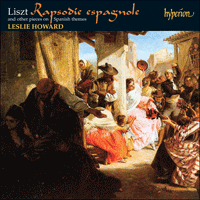



This forty-fifth volume in Leslie Howard's encyclopaedia of Liszt's solo piano music turns to the composer's impressions from his tour of Spain and Portugal in 1844/5.
These six pieces vividly capture the dance motifs and melodies that the composer must have heard on these travels, and the Spanish Rhapsody (initially published alongside the first collection of Hungarian Rhapsodies) has firmly established itself as a favourite in the repertoire.
All of the music on this album is also available as part of the specially priced box set Liszt: Complete Piano Music: 'Almost any way you choose to look at it, this is a staggering achievement … the grand scope of this project gives us the chance, as listeners, to experience the almost incomprehensible breadth and depth of Liszt's imagination' (International Record Review).

Liszt toured Spain and Portugal for six months from October 1844, and it was certainly on this trip that he became acquainted at first hand with some of the melodies he was to incorporate into various piano pieces, although, like so much of his music, none of them seems ever to have been performed by him in public. Liszt never visited this part of the world again but maintained contacts through his music and his Iberian students for the rest of his life.
The manuscript of the Grand Concert Fantasy upon Spanish Themes is dated ‘Lisbonne, 2 Février, [18]45’, but the work was not published until after Liszt’s death. It appeared in 1887, with a dedication to Liszt’s first biographer, Lina Ramann. We do not know why Liszt kept this piece to himself for so many years, but he must have thought about it quite late in life to apply the dedication. The later Spanish Rhapsody shares one theme with the piece, and an unfinished manuscript in Weimar also contains some material in common. The present enormous piece is based upon three melodies: a fandango, which is heard in an opening flamboyant fantasy, and will be recognized immediately by anyone who recollects the third act of Mozart’s Figaro; the Jota aragonesa, encountered in a number of famous musical homages to Spain and here treated in a slow and rhapsodic manner; and a cachuca, which first appears as a subsidiary melody to the jota, and then returns—after further development of the fandango—as a section in its own right and at the proper tempo, now with fragments of the jota which eventually gains supremacy in the coda.
La romanesca is a Spanish dance melody which used to be strangely ascribed to Italy in various Liszt catalogues. Liszt published his first elaboration of it as a ‘fameux air de danse du seizième siècle’ in 1840. Unusually for Liszt in a secular composition, it is laid out in 4/2 (with a little 3/2 in the introduction), and the first statement of the melody is presented by the left hand alone. The only secondary material is a repeated foot-stamping gesture on a C major chord with trills in both hands; otherwise the theme is subjected to ornamental variation. It is of no small interest to compare this version with the later one, published in 1852 as a ‘nouvelle édition entièrement revue et corrigée par l’auteur’ (how often Liszt used that expression for his second thoughts!), where the note-values—but also the tempo—are halved, the whole thing is more nostalgically viewed, and the coda is largely recomposed.
The Spanish Rhapsody has become one of Liszt’s best-known compositions, although it took some while to establish itself in the repertoire. Liszt told Lina Ramann that he had written the piece in recollection of his Spanish tour whilst in Rome in about 1863. The work was published in 1867—subtitled Folies d’Espagne et Jota aragonesa. Later it was often found published alongside the first fifteen Hungarian Rhapsodies, which might have helped its popularity but contributes nothing towards understanding it. The work is a great deal less rhapsodic than its Hungarian cousins, and needs a certain elegant detachment in performance. Its nature is rather staid and noble—even the coda is marked ‘non troppo allegro’—and the opening flourishes, however dramatic, recall the sound-world of the recently-composed Légende: St François d’Assise—La prédication aux oiseaux. Then the ensuing variations on La folia form a passacaglia in C sharp minor. The last variation slips gently into D major for the delicate presentation of the jota, mostly in the upper register of the piano. One further theme, also heard as part of the jota in the Grand Fantasy provides the opportunity for a further change of key, and F major, A flat major, E major and E flat major all vie for attention before the dominant of D major is finally established for a grand reprise of the jota, finally covering the whole keyboard, and marked fff. Brief excursions and a short cadenza in thirds finally lead to the recall of La folia, now in D major, for the conclusion.
Liszt may well have met Mariano Soriano Fuertes y Piqueras (1817–1880) in Córdoba in 1844, but he has left us no clue as to the provenance of the Feuille morte, which may come from a zarzuela. (The title is probably Liszt’s.) Liszt’s piece was published around 1845 (with a double ‘r’ in the Spaniard’s name on the title page) and promptly disappeared from view—the only reprint since seems to be that made by the Liszt Society in its 1989 Journal. Liszt’s piece is typical of his imaginative paraphrases upon a single song or aria. The three themes are punctuated by a questioning refrain, and the whole is then varied with a coda which recalls the sombre introduction.
Manuel García (1775–1832) was a very successful composer of zarzuelas and the fifth number of his one-act piece El poeta calculista of 1804 is entitled ‘Yo que soy contrabandista’. Liszt settled for ‘El contrabandista’ (‘The smuggler’) in his hair-raising paraphrase of it—the Rondeau fantastique—and so may we. Liszt’s piece was published in 1837, with a dedication to George Sand, as his Opus 5 No 3—the companion pieces being the Clochette-Fantaisie and the Fantaisie romantique sur deux mélodies suisses. It remains one of the most impressive works of his early maturity, and its current neglect—difficulties notwithstanding—is a testimony to the want of a spirit of enquiry in many of today’s pianists.
Leslie Howard © 1997
À partir d’octobre 1844, Liszt effectua une tournée de six mois en Espagne et au Portugal, et ce fut sans aucun doute lors de ce voyage qu’il découvrit de première main certaines des mélodies qu’il allait incorporer dans diverses pièces pour piano, même s’il ne semble jamais en avoir interprété une seule en public—comme nombre de ses œuvres, d’ailleurs. Liszt ne retourna jamais dans cette partie du monde, mais sa musique et ses étudiants ibériques lui permirent d’y préserver des contacts pour le reste de ses jours.
Le manuscrit de la Grande fantaisie de concert sur des thèmes espagnols porte la mention «Lisbonne, 2 Février [18]45», mais l’œuvre ne fut publiée qu’après la mort de Liszt, en 1887, avec une dédicace à Lina Ramann, sa première biographe. Nous ignorons pourquoi Liszt garda si longtemps cette pièce pour lui, mais il dut y penser tout à la fin de sa vie, pour apposer la dédicace. La Rapsodie espagnole, plus tardive, partage un thème avec ce morceau, tandis qu’un manuscrit inachevé de Weimar présente, lui aussi, quelque matériau commun. La Grande fantaisie, énorme, repose sur trois mélodies: un fandango, qui est entendu dans une fantaisie initiale flamboyante, et sera immédiatement reconnu par quiconque se remémore le troisième acte du Figaro de Mozart; la Jota aragonesa, rencontrée dans un certain nombre de célèbres hommages musicaux à l’Espagne, et traitée ici de manière lente, rhapsodique; et une cachuca, qui apparaît pour la première fois sous forme de mélodie subsidiaire à la jota, avant de revenir—après un développement ultérieur du fandango—comme une section à part entière, au tempo propre, désormais avec des fragments de la jota, qui finit par avoir la suprématie dans la coda.
La romanesca est une mélodie de danse espagnole, étrangement attribuée à l’Italie dans plusieurs catalogues du compositeur. Liszt en publia la première élaboration en 1840, sous l’appellation «fameux air de danse du seizième siècle». Fait rare pour une composition profane lisztienne, cette pièce est conçue à 4/2 (avec un petit 3/2 dans l’introduction) et la première énonciation de la mélodie est présentée par la main gauche seule. L’unique matériau secondaire est un tapement de pieds répété sur un accord en ut majeur, avec des trilles dans les deux mains; autrement, le thème est soumis à une variation ornementale. Il est fort intéressant de comparer cette version à celle parue en 1852 sous le titre «nouvelle édition entièrement revue et corrigée par l’auteur» (une expression que Liszt appliqua ô combien souvent à ses nouvelles versions!), où les valeurs des notes—mais aussi du tempo—sont réduites de moitié, avec un traitement plus nostalgique et une coda largement recomposée.
La Rapsodie espagnole est devenue une des compositions les plus célèbres de Liszt, bien qu’il lui fallût un certain temps pour s’établir dans le répertoire. Liszt déclara à Lina Ramann qu’il l’avait écrite en souvenir de sa tournée espagnole, lors d’un séjour à Rome, vers 1863. L’œuvre parut en 1867, avec le sous-titre Folies d’Espagne et Jota aragonesa. Par la suite, elle fut souvent publiée aux côtés des quinze premières Rhapsodies hongroises, ce qui a pu aider à sa popularité, mais nullement à sa compréhension. Beaucoup moins rhapsodique que ses cousines hongroises, elle requiert un certain détachement élégant dans l’exécution. Et les fioritures initiales, quoique dramatiques, de cette pièce de nature plutôt affectée, noble—même la coda est marquée «non troppo allegro»—, rappellent l’univers sonore de Légende: St François d’Assise—La prédication aux oiseaux, de composition légèrement antérieure. Puis, les variations suivantes sur La folia forment une passacaille en ut dièse mineur. Quant à la dernière variation, elle glisse doucement vers le ré majeur pour la délicate présentation de la jota, essentiellement dans le registre supérieur du piano. Un autre thème, qui fait également partie de la jota de la Grande fantaisie, fournit l’opportunité d’un autre changement de tonalité, et fa majeur, la bémol majeur, mi majeur et mi bémol majeur rivalisent tous pour attirer l’attention, avant que la dominante de ré majeur soit finalement établie pour une grandiose reprise de la jota, marquée fff et couvrant l’ensemble du clavier. De brèves digressions et une courte cadence en tierces conduisent au rappel de La folia, désormais en ré majeur, pour la conclusion.
Liszt a fort bien pu rencontrer Mariano Soriano Fuertes y Piqueras (1817–1880) à Córdoba, en 1844, mais il ne nous a laissé aucun indice quant à la provenance de la Feuille morte, peut-être née d’une zarzuela. (Le titre est probablement de Liszt.) La pièce de Liszt fut publiée aux environs de 1845 (avec deux «r» dans le nom de l’Espagnol, sur la page de titre) avant d’être rapidement perdue de vue—la seule réimpression depuis semble avoir été celle de la Liszt Society, dans son Journal de 1989. Cette œuvre est typique des paraphrases imaginatives de Liszt sur une chanson ou une aria unique. Les trois thèmes sont ponctués par un refrain interrogateur, avant que l’ensemble soit varié, avec une coda qui rappelle l’introduction sombre.
Manuel García (1775–1832) fut un compositeur de zarzuelas à très grand succès, et la cinquième chanson de sa pièce en un acte El poeta calculista (1804) s’intitule «Yo que soy contrabandista». Dans son effrayante paraphrase—Le Rondeau fantastique—, Liszt se contenta de «El contrabandista» («Le contrebandier»), et nous aussi. Cette pièce fut publiée en 1837, en tant qu’op. 5 no3, avec une dédicace à George Sand—en même temps que les pièces Clochette-Fantaisie et Fantaisie romantique sur deux mélodies suisses. Elle demeure l’une des œuvres les plus impressionnantes des débuts de la maturité de Liszt, et le désintérêt dont elle est actuellement victime—nonobstant les difficultés—témoigne du manque d’esprit d’investigation de nombre des pianistes de notre temps.
Leslie Howard © 1997
Français: Hyperion Records Ltd
Im Oktober 1844 begab sich Liszt auf eine sechsmonatige Tournee durch Spanien und Portugal. Auf dieser Reise lernte er zweifelsohne einige jener Melodien kennen, die er später in seine zahlreichen Klavierwerke integrieren sollte, von denen jedoch, wie so viele andere seiner Werke, offenbar keines in den Genuß einer öffentlichen Aufführung kam. Diese Tournee blieb Liszts einziger Besuch in diesem Teil der Welt, doch durch seine Musik und seine iberischen Studenten riß die Verbindung zu diesen Ländern zeitlebens nie ab.
Das Manuskript der Großen Konzertfantasie über spanische Themen ist zwar mit dem Datum „Lissabon, 2. Februar [18]45“ versehen, doch das Werk wurde erst nach Liszts Tod veröffentlicht. Es wurde im Jahre 1887 mit einer Widmung an Liszts erste Biographin Lina Ramann herausgegeben. Warum Liszt der Öffentlichkeit dieses Werk so viele Jahre lang vorenthielt, ist nicht bekannt. Zu einem relativ späten Zeitpunkt in seinem Leben muß er sich jedoch daran erinnert haben, da er es mit besagter Widmung versah. Ein Thema dieses Stückes ist auch in der späteren Rapsodie espagnole zu finden, und ein unvollendetes, in Weimar aufbewahrtes Manuskript enthält ebenfalls daraus entlehntes Material. Dieser gewaltigen Konzertfantasie liegen drei Melodien zugrunde: ein Fandango, der in einer prächtigen Eröffnungsfantasie erklingt und von jedem, der mit dem dritten Akt aus Mozarts Figaro vertraut ist, unmittelbar wiedererkannt wird; eine Jota aragonesa, die in einer Reihe berühmter musikalischer Hommages an Spanien zu finden ist und hier einer langsamen und rhapsodischen Behandlung unterzogen wird; eine Cachuca, die zuerst als Nebenmelodie zur Jota in Erscheinung tritt und dann nach einer weiteren Entwicklung des Fandango als eigenständiger Teil mit angemessenem Tempo und Jota-Fragmenten, die sich schließlich in der Coda durchsetzen, wiederkehrt.
La Romanesca ist eine spanische Tanzmelodie, die in zahlreichen Liszt-Katalogen eigenartigerweise mit Italien assoziiert wurde. Liszt veröffentlichte die erste Version dieses Stückes im Jahre 1840 als „un fameux air de danse du seizième siècle“. Der 4/2-Takt (mit einer kleinen 3/2-Passage in der Einleitung) ist ein eher ungewöhnlicher Zug für eine weltliche Liszt-Komposition, und die Melodie findet ihre allererste Erwähnung in der linken Hand alleine. Das einzig vorhandene Nebenmaterial ist eine wiederholte stampfende Bewegung auf einem C-Dur-Akkord mit Trillern in beiden Händen. Ansonsten wird das Thema verzierten Variationen unterzogen. Ein Vergleich dieser Version mit der späteren Bearbeitung, die 1852 als eine „nouvelle édition entièrement revue et corrigée par l’auteur“ (eine häufig von Liszt verwendete Bezeichnung für seine Überarbeitungen!) erschien, ist nicht ganz uninteressant, da die Notenwerte sowie das Tempo der zweiten Version halbiert sind und das ganze Werk an sich nostalgischer wirkt, wobei die Coda größtenteils neu komponiert wurde.
Die Rapsodie espagnole wurde eine von Liszts berühmtesten Kompositionen, obgleich ihr erst nach einiger Zeit ein fester Platz im Repertoire zuteil wurde. Liszt berichtete Lina Ramann, daß er das Stück im Rückblick auf seine Spanientournee während eines Aufenthalts in Rom in circa 1863 geschrieben hatte. Das Werk wurde 1867 mit dem Untertitel Folies d’Espagne et Jota aragonesa veröffentlicht. Später erschien es dann zusammen mit den ersten fünfzehn Ungarischen Rhapsodien, was zwar möglicherweise zur Popularität, doch nicht zu einem besseren Verständnis des Werkes beigetragen hat. Die spanische Rhapsodie ist wesentlich weniger rhapsodisch als ihre ungarischen Gegenstücke, und ihr Vortrag erfordert eine gewisse elegante Distanzierung. Sie ist von seriöser und vornehmer Natur—selbst die Coda ist mit der Anweisung „non troppo allegro“ versehen—, und ihre eröffnenden Fanfaren erinnern trotz ihrer Dramatik an die Klangwelt der späteren Komposition Légende: St. François d’Assise—La prédication aux oiseaux. Die nachfolgenden Variationen über La Folia bilden eine Passacaglia in cis-Moll. Die letzte Variation gleitet für den Auftritt der Jota sanft zu D-Dur über, hauptsächlich in den höheren Klavierlagen. Ein anderes Thema, das ebenfalls als Teil der Jota in der Großen Fantasie zu hören ist, bietet die Gelegenheit für einen erneuten Tonartwechsel, und die Tonarten F-Dur, As-Dur, E-Dur und Es-Dur buhlen um der Zuhörer Aufmerksamkeit, bevor sich die D-Dur-Dominante schließlich für die große fff-Reprise der Jota durchsetzt und letztlich die gesamte Tastatur mit einbezieht. Auf einige kurze Exkursionen und eine kurze Kadenz in Terzen folgt dann als Abschluß eine Rückkehr von La Folia, diesmal in D-Dur.
Es ist durchaus möglich, daß Liszt in Córdoba im Jahre 1844 die Bekanntschaft von Mariano Soriano Fuertes y Piqueras (1817–1880) machte. Doch er hinterließ uns keinerlei Hinweise auf den Ursprung von Feuille morte, das möglicherweise von einer Zarzuela herrührt. (Der Titel stammt wahrscheinlich von Liszt.) Liszts Werk wurde um etwa 1845 veröffentlicht (der auf der Titelseite erwähnte Name des Spaniers wurde mit zwei „r“ geschrieben) und verschwand unmittelbar darauf in der Versenkung—die einzige Neuauflage seit jenen Tagen scheint die Ausgabe im Journal der Liszt-Gesellschaft von 1989 zu sein. Dieses Liszt-Werk ist ein typisches Beispiel für seine phantasievollen Paraphrasen über ein einzelnes Lied oder eine einzige Arie. Die drei Themen werden von einem fragenden Refrain unterbrochen, und das Ganze wird dann variiert, wobei die Coda an die dunkel-düstere Einleitung erinnert.
Ein überaus erfolgreicher Komponist von Zarzuelas war Manuel García (1775–1832). Die fünfte Nummer seines einaktigen Stückes El poeta calculista aus dem Jahre 1804 trägt den Titel „Yo que soy contrabandista“. Liszt gab sich für seine unglaubliche Paraphrase—dem Rondeau fantastique—mit „El contrabandista“ („Der Schmuggler“) zufrieden, und wir folgen seinem Beispiel. Liszts Stück, das 1837 mit einer Widmung an George Sand als sein Opus 5 Nr. 3 (in Begleitung der Clochette-Fantaisie und der Fantaisie romantique sur deux mélodies suisses) erschien, ist und bleibt eines der eindrucksvollsten Werke aus den frühen Tagen seiner reifen Schaffensphase. Daß das Stück heutzutage, ungeachtet seiner technischen Schwierigkeiten, vernachlässigt wird, belegt lediglich, daß es vielen Pianisten unserer Zeit an Unternehmungsgeist mangelt.
Leslie Howard © 1997
Deutsch: Manuela Hübner
A partir de octubre de 1844, Liszt recorrió España y Portugal durante seis meses; sin duda fue durante este viaje cuando escuchó directamente algunas de las melodías que incorporaría en distintas obras para piano, aunque, al parecer, como ocurrió con tanta de su música, no llegó a interpretar ninguna de ellas en público. Liszt no volvió a visitar nunca más aquella parte del mundo, pero mantuvo contactos con la misma a través de su música y sus estudiantes de la Penísula Ibérica durante el resto de sus días.
El manuscrito de la Gran fantasía concierto sobre temas españoles está fechado en ‘Lisbonne, 2 Février, [18]45’, pero la obra no se publicó hasta después del fallecimiento del compositor. Apareció en 1997, dedicada a Lina Ramann, la primera biógrafa de Liszt. Desconocemos el motivo de que Liszt conservara esta pieza inédita durante tantos años, pero debió pensar en ella en su edad avanzada para ponerle dicha dedicatoria. La Rapsodia española posterior comparte un tema con la pieza, y un manuscrito inacabado de Weimar contiene también cierto material común. La presente obra enorme se basa en tres melodías: un fandango, que se escucha al comienzo de una extravagante fantasía, inmediatamente reconocible por cualquiera que recuerde el tercer acto del Figaro de Mozart; la Jota aragonesa, que aparece en diversas composiciones de homenajes musicales a España, tratada aquí de forma lenta y rapsódica, y una cachucha, que aparece primero como melodía subsidiaria de la jota, para retornar, tras un nuevo desarrollo del fandango, como una sección por derecho propio y a su tempo normal, esta vez con fragmentos de la jota que por último se hace con la supremacía en la coda.
La romanesca es una melodía de baile española que en diversos catálogos de Liszt curiosamente solía atribuirse a Italia. El compositor publicó su primera elaboración de la misma como un ‘fameux air de danse du seizième siècle’ en 1840. Inusitadamente para Liszt en una composición no religiosa, el compás es de 4/2 (con un breve 3/2 en la introducción), y la melodía aparece establecida por vez primera sólo en la mano izquierda. El único material secundario es un zapateado repetido en un acorde de Do mayor con trinos en ambas manos; el resto del tema carece de variaciones ornamentales. Resulta interesante comparar esta versión con la posterior, publicada en 1852 como una ‘nouvelle édition entièrement revue et corrigée par l’auteur’ (¡cuantas veces empleó Liszt esta expresión para sus modificaciones!), donde los valores de las notas (pero también el tempo) se reducen a la mitad, el conjunto se interpreta de forma más nostálgica y gran parte de la coda ha sido vuelta a componer.
La Rapsodia española se ha convertido en una de las composiciones más conocidas de Liszt, si bien tardó cierto tiempo en establecerse en el repertorio. Liszt le dijo a Lina Ramann que la había escrito en recuerdo de su viaje por España durante su permanencia en Roma hacia 1863. La obra se publicó en 1867, subtitulada Folies d’Espagne et Jota aragonesa. Más tarde se la encontró frecuentemente publicada junto con las quince primeras rapsodias húngaras, lo que pudo contribuir a su popularidad, aunque en nada ayuda a entenderla. La obra es mucho menos rapsódica que las húngaras y su ejecución requiere cierta objetividad elegante. Su naturaleza es bastante formal y noble, (incluso en la coda se indica ‘non troppo allegro’—y los floreos del comienzo, por dramáticos que sean, recuerdan el mundo, el sonido de la recién compuesta Leyenda: San Francisco de Asís predicando a las aves. Las variaciones sobre La folia forman un pasacalle en Do sostenido menor. La última variación se desliza con suavidad a Re mayor para la delicada presentación de la jota, principalmente en el registro superior del piano. Otro tema más, escuchado también como parte de la jota en la Gran Fantasía, es la oportunidad para un nuevo cambio de clave y Fa mayor, Si bemol mayor Mi mayor y Mi bemol mayor compiten por la atención antes de que la dominante de Re mayor se establezca por último para la gran reaparición de la jota, hasta llegar a cubrir por último todo el teclado, y con la anotación de fff. Breves salidas y una corta cadencia en terceras desembocan por último en una nueva aparición de La folia, ahora en Re mayor, para la conclusión.
Es posible que Liszt conociera a Mariano Soriano Fuertes y Piqueras (1817–1880) en Córdoba en 1844, pero no nos ha dejado la menor pista sobre el origen de la Feuille morte (hoja muerta), que puede proceder de una zarzuela. (El título es probablemente de Liszt.) La obra de Liszt se publicó hacia 1845 (en la portada, el nombre del español aparece con dos erres) y pronto desapareció de la circulación: desde entonces la única reedición desde entonces parece haber sido la de la revista de la Liszt Society de 1989. La pieza del compositor es típica de sus imaginativas paráfrasis sobre una canción o un aria. Un estribillo interrogativo puntúa los tres temas, hay variaciones sobre el conjunto, con una coda que recuerda la solemne introducción.
Manuel García (1775–1832) fue un compositor de zarzuelas de gran éxito. El quinto número de su obra en un acto, El poeta calculista de 1894 se titula ‘Yo que soy contrabandista’. Liszt se conformó con ‘El contrabandista’ para su espeluznante paráfrasis de dicha pieza—el Rondeau fantastique—y también nos bastará a nosotros. La composición de Liszt se publicó en 1837, con una dedicatoria a George Sand, como su Opus 5 Nº 3—siendo las piezas acompañantes Clochette-Fantaisie y la Fantaisie romantique sur deux mélodies suisses. Sigue siendo una de las obras más impresionantes del comienzo de su madurez, y su presente abandono (aparte de su dificultad) es testimonio de la falta de espíritu investigador entre muchos de los pianistas de hoy día.
Leslie Howard © 1997
Español: Karmelín Adams