Welcome to Hyperion Records, a British classical label devoted to presenting high-quality recordings of music of all styles and from all periods from the twelfth century to the twenty-first.
Hyperion offers both CDs, and downloads in a number of formats. The site is also available in several languages.
Please use the dropdown buttons to set your preferred options, or use the checkbox to accept the defaults.
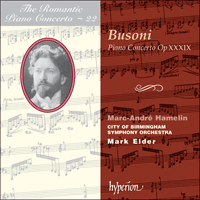



This has to be our Romantic Piano Concerto for the millennium!
The Busoni concerto, with its five movements, choral finale and a length of over 70 minutes, is surely the most grandiose ever written. But this is no over-ambitious monster; Busoni was one of the greatest pianists the world has known, but he was also a great intellectual with very strong views on art and culture. This work is the masterpiece of his middle years, more of a symphony in the breadth and scope of its ideas, but at the same time almost casually requiring the most formidable technical ability from the soloist. There is no doubt that this is one of music's major neglected masterpieces.
Marc-André Hamelin needs no introduction as a champion of the greatest challenges in the piano literature. Here he is joined by Mark Elder who has a particular reputation as a Busoni conductor. He conducted this work with Peter Donohoe in their famed Proms performance of 1988 and he has also conducted Busoni's rarely performed magnum opus 'Doctor Faust' at ENO.

I. Prologo e Intrioto
The Prologo contains one main broad idea in C major presented simply on strings, followed by a cadence-group in two sections: a descending melody and an arresting horn-call. These ideas are expanded in tutti, when a chordal string figure surges under the horn-call and presages the Introito and the soloist’s entry, which continues the surging chords. The orchestra interposes subdued dramatic tremoli and the soloist’s melody is emblazoned on woodwind and then on trumpet. The orchestra’s comments become more explicit in scalic ejaculations, contrasting the tonalities of D flat and D. The piano welds these into a continuous passage which provides the bass to woodwind reminiscences of the opening. After a cadenza, the second subject emerges (E major saraband rhythm) on lyric woodwinds, with piano and strings etching in the background. The second subject in turn accompanies a tender Italianate melody on the oboe, later joined by clarinet and flute. Episodic development leads to the central cataractous cadenza in D flat, which gradually subsides into a rippling accompaniment over which solo oboe, then flute recall the first subject in the E major key and lyric mood of the second subject. A chain of trills leads to the recapitulation in variation form, with the piano in treble figures over the theme in pizzicato. A sudden drop to B major, pp. The accumulative passionate intensifications consciously parody Wagner. Anxiety abates and the orchestra again recalls the opening. The strings come to rest on a softly held dramatic chord, above which the piano begins its final cadenza in a veiled mist of sound. The orchestra modulates to a dominant pedal in C and the piano has a free passage in triple trills. The cadence-theme rings out heroically on the trumpet above tremolando strings and piano scales. Then a serene coda on a tonic pedal recalls the opening and stretches out like a vista, a vision of the Roman Campagna.
II. Pezzo giocoso
The piano leaps in with light fantastic runs, over a drumroll, will-o’-the-wisp trills on strings and Berliozian woodwind cackles. In its highest register, the piano glistens like shattering stained glass above a mock-heroic fanfare, and the point is reached in a spirited 6/8 orchestral danza in A major. A most diabolical dance follows in the piano’s lowest register, punctuated by the cloven-hoofed thud of bass drum and cymbal. Syrinx-like gales of hollow woodwind laughter greet the rounds of the dance and spur it on to a whirling vortex. A dynamic tutti is unleashed, quasi con brutalità. The piano enters the fray with a bold cadenza which accompanies a new round of the dance. The storm ultimately cedes to a barcarolle of arpeggi low on the piano. A shuddering pizzicato dance accompaniment introduces the Neapolitan sailors’ song Fenesta ca lucive (‘The light from yon window’) played with the deep melancholy of chalumeau clarinet and divisi cellos. It is the résumé of the song—the best of it—remembered long afterwards, with the phrases coming slow and long pauses in between, filled in by the piano’s lapping arpeggios. Then the piano sings a Caruso-like serenade and plucked strings pulse like a big guitar. Memory is distilled, time is momentarily arrested and the solo continues alone in a somnambulent cadenza. The orchestra enters with a grisly memory of the diabolic dance and draws the solo along with it, until the piano assumes veritably orchestral sonority. A sudden diminuendo, and a low tremolo on the piano rumbles like distant thunder. Above this, the solo makes valedictory reference to the Neapolitan song in sombre low octaves, answered by opaque woodwind echoes. Gloom submerges everything in the diabolic darkness of the dance of death. Oriental scales on the piano vanish like vapour. A sad defeated fanfare on a ruined glory of D major, and a string chord hangs like a breath on the air.
III. Pezzo serioso
This master-building in music contains an introduction and three parts conceived on the grandest scale and executed in the grandest manner. The lower strings initiate a baroque bass in D flat, and clarinet, bassoon and viola intone a stark recitative. A full close leads to agitated woodwind tremolandos under the dramatic dirge of unison oboe and cor anglais. The lament becomes more clamorous as clarinets are added and strings take over the tremolando from the woodwind. Basses darkly echo the lamentation. After a brief quasi-improvised solo, the brass and low woodwind suggest an E major chorale, the piano commenting with descending scales of chords at every pause, scales echoed by the lower strings, when the piano accompanies in dominant preparation which leads to Part I and the full solo statement of the chorale. An orchestral chorale-prelude variation ensues. The piano then alludes lyrically to the Chopin Nocturne, Op 62, whereupon the chorale returns on the winds over tremolando strings. A sudden brilliant solo arpeggio pyramid terminates the first part.
Part II opens in C major with pulsating strings and low winds accompanying a bold sculptured theme in single notes in the piano’s middle register. The orchestra assumes the melody. Over hieroglyphic pyramids of pianistic figuration, the orchestra develops the previous ideas. The initial baroque bass is now electrified into tempestuous piano chords that seethe under an impassioned iteration of the dirge, now treated in stretto. The piano traces spectral shadows of the dirge, with orchestral reminiscences interposed. A curtailed restatement of the introduction follows, and there are two more chorale-variations (always in D flat), increasingly intricate but constantly tranquil. Cellos evoke the Chopinesque nocturne-theme, set against a lace-work of piano figuration. A long dominant pedal finally yields to a last intensified statement of the dirge.
Part III begins with a throbbing horn dominant-pedal in F sharp minor below plangent Italian cries on the woodwinds. The music modulates back to D flat and reposes in an orchestral idyll.
IV. All’ Italiana
Muted violins shimmer and colloquies of woodwinds cascade: fountains in sunlight. The piano establishes a low rumbling accompaniment against which the woodwinds suggest scraps of the previously heard Neapolitan song, transmogrified into a canzone a ballo in F minor. A solo cadenza leads the music on through various keys, like dancing through streets festooned for a festival. The strings take mutes off when the sun comes out in C major. Piano solo is pitted against orchestra in mock combat. A slightly graver section suggests a passing reminiscence of the slow movement. A new danza in B flat minor, in modo popolare, adds a note of insistence, and the piano heightens its brilliance by transposing it up a semitone and treating it in Italianate 3rds and 6ths that reek of garlic and tar. An unusual comic effect results from treating a popular Italian march as a Rossinian acceleration without the expected crescendo. This ‘cuckoo’ song will not be missed in its pointed bassoon and pizzicato orchestration. The march-song (in dialect with optional facetiae) is known to all Roman bersaglieri, those colourful counterparts of the dashing Highland soldiers. Its burden is: E si e si e si / Che la porteremo. Perhaps Scots best conveys its braggadocio panache: Och aye och aye och aye / Wi’ yon fedder i’ your bonnet / Quick merch to the bloody colonel / Tae Hell wi’ Houghmagandie [fornication] / An’ pledge ye’re sodgers leal. The march is prostituted into a tarantella. Audacity accumulates until the piano hammers out a chord, as though to silence the charivari. But it summonses it to fresh assault instead. La stretta commences innocuously with a silly music-hall vamp, continues with two clarinets in licentious harmony, and goes on gathering orchestration, speed, and, this time, volume also. The idea of out-Rossini-ing Rossini by presenting the accelerando twice—once without crescendo and once with it—is a throw of theatric genius and builds the music up to an unbelievable breaking-point of excitement. Then, as if that were not enough, we have yet another stretto, superimposing march on tarantella. The soloist eclipses everything in a brilliant cadenza which reaches a frenetic climax, after which it only remains for the orchestra to re-assert the tonic chord of C in a battery of sound. When all seems over, one learns that the silence is deceptive. Three soft pizzicato chords unexpectedly turn the music into the minor key and make it disappear like fantastic shadows of the last merrymakers vanishing into unimaginably mysterious alleyways.
V. Cantico
This opens gravely in E minor with piano and string arpeggios and sustained trumpets. Bassoons and horns recall the sculptured theme of the slow movement’s middle section, and trumpets and trombones answer while the glockenspiel casts its magical aura over all. The oboe remembers a melody from the first movement: everything seems to return now in memory’s kaleidoscope. The idyllic end of the middle movement is resumed in E major on low muted strings, and the invisible male chorus adds another registration to the music and sings a mystic hymn in German words by the Danish poet, Adam Oehlenschläger: Hebt zu der ewigen Kraft Eure Herzen (Lift up your hearts to the Eternal Almighty / Draw ye to Allah). It is also an ode to the great enduring achievements of ancient civilizations. The music of the chorus is taken from the grandiose piano entry in the first movement. The C major middle section of the slow movement is again recalled, the bold sculptured theme this time being sung. The surging chordal figure of the Prologo returns like the tide. Below it we hear a whole-tone variation of the Neapolitan sailors’ song. Then the unexpected: profundity is brushed aside by a brilliant bravura peroration. Professor Dent was in error when he dismissed this ending as ‘merely conventional’. It is a gesture of despair but not of exhausted invention. Its message is vanitas vanitatum. It is like the Babylonian woman in the Book of Revelation: upon its forehead is MYSTERY and in its heart is despair. MULTAE TERRICOLIS LINGUAE, COELESTIBUS UNA.
Postscript
Busoni’s Piano Concerto is the summation of his youth, his first period. My long programme note was written (for John Ogdon) in my early manhood. Maturity should read it in perspective, rather than critically in hindsight. Effusion is germane to both the music and my writing on it.
This mammoth concerto, though composed in Busoni’s late 30s, was indeed begun at 16! He composed an Etude in D flat in 1883. This retained his interest, for he played it to his American student Augusta Cottlow and rewarded her enthusiasm by dedicating it to her.
In early manhood he contemplated writing music for the Danish poet Oehlenschläger’s play Aladdin. This ultimately became the male chorus of the Busoni Concerto.
Re-considering his composer’s career in perspective, Busoni judged that his first period, which culminated with his Piano Concerto, was characterised by a mastery of prodigality. From there he progressed to mastery of refinement, his later works being more condensed.
The same process is observed and heard in Busoni’s first opera, Die Brautwahl (‘The Bridal Choice’) of 1911: a huge comic opera. His later operas—Arlecchino, Turandot and Doktor Faust—refine on his first opera, just as his Indianische Fantasie Op 44 refines on his Piano Concerto.
His Piano Concerto was not conceived as an extrovert work but rather as a symphonic oeuvre with a large scale piano obbligato. He later thought of it as his ‘Italian Symphony’.
The sobriety—modesty even—of Busoni’s approach has remarkable restraint in a great virtuoso. This is already indicated in his tempo mark for the first movement. He does not write ‘Allegro brillante’, which a listener might expect, but he writes ‘Allegro, dolce e solenne’ (a sweet and solemn allegro). His restraint indicates his new classicality, close to anti-Romanticism. He pays his listener the compliment of assuming that he is discerning.
Ronald Stevenson ©
I. Prologo e Introito
Le Prologo recèle une idée principale, ample, en ut majeur, présentée simplement aux cordes et suivie d’un groupe cadentiel en deux sections: une mélodie descendante et un saisissant appel de cor. Ces idées sont étendues au tutti, où une figure en accords (cordes) déferle sous l’appel de cor pour présager l’Introito et l’entrée du soliste, qui poursuit les accords déferlants. L’orchestre interpose alors des tremoli dramatiques, contenus, et la mélodie du soliste est célébrée aux bois et à la trompette. Les commentaires de l’orchestre se font plus explicites, sous forme de projections en gammes, mettant en contraste les tonalités de ré bémol et ré. Le piano les amalgame en un passage continu qui fournit la basse aux réminiscences (bois) de l’ouverture. Passé une cadenza, le second sujet émerge (rythme de sarabande en mi majeur) aux bois lyriques avec, en toile de fond, une eau-forte piano/cordes. Le second sujet, à son tour, accompagne une tendre mélodie italianisante au hautbois, ultérieurement rejoint par les clarinette et flûte. Le développement épisodique conduit à une cascadante cadenza centrale, en ré bémol, qui se retire peu à peu pour laisser place à un accompagnement ondoyant, par-dessus lequel le hautbois solo, puis la flûte, rappellent le premier sujet en mi majeur et l’atmosphère lyrique du second sujet. Une chaîne de trilles mène à la réexposition, sous forme de variation, avec le piano dans des figures, au soprano, au-dessus du thème en pizzicato. Puis, soudaine chute à si majeur, pp. Les intensifications cumulatives passionnées parodient délibérément Wagner. L’anxiété s’apaise et l’orchestre redonne, de nouveau, l’ouverture. Les cordes viennent se reposer sur un accord dramatique, doucement tenu, par-dessus lequel le piano entame sa cadenza finale, en une brume sonore voilée. L’orchestre module à une pédale de dominante en ut et le piano a un passage libre, en triples trilles. Le thème cadentiel retentit héroïquement à la trompette, au-dessus de cordes tremolando et de gammes pianistiques. Puis, une sereine coda, sur une pédale de tonique, reprend l’ouverture et s’éploie tel un panorama, une vue de la Campagna romaine.
II. Pezzo giocoso
Le piano bondit avec de fantastiques passages rapides, légers, au-dessus d’un roulement de tambour, de trilles en feu follet (cordes) et de caquetages berlioziens (bois). Dans son registre le plus aigu, le piano miroite, tel un vitrail volant en éclats, par-dessus une fanfare pseudo-héroïque, et le paroxysme est atteint dans une danza orchestrale animée, à 68, en la majeur. S’ensuit une danse des plus diaboliques, dans le registre le plus grave du piano, ponctuée par le satanique bruit sourd de la grosse caisse et des cymbales. Des éclats de rire forcés, aux bois, accueillent les rondes de la danse, l’incitant à un effarant maelström. Puis, un tutti dynamique est lâché, quasi con brutalità. Le piano se jette alors dans la mêlée avec une cadenza hardie, qui accompagne une nouvelle ronde. Finalement, la tempête fait place à une barcarolle d’arpèges, dans le bas du piano. Un frémissant accompagnement de danse, en pizzicato, introduit le chant de marins napolitain Fenesta ca lucive («La lumière de la fenêtre là-bas»), exécuté avec la profonde mélancolie du chalumeau de la clarinette et des violoncelles divisi. C’est un résumé du meilleur de ce chant, remémoré longtemps après, avec les phrases venant s’intercaler en de longues et lentes pauses, comblées par les arpèges clapotants du piano. Puis, le piano chante une sérénade à la Caruso et un rythme de cordes pincées, comme une grosse guitare. Le souvenir est distillé, le temps est arrêté, l’espace d’un instant, et le solo poursuit seul, en une somnambule cadenza. L’orchestre entre avec un macabre souvenir de la danse diabolique et entraîne avec lui le solo, jusqu’à ce que le piano assume une véritable sonorité orchestrale. Puis, soudain dimunendo: un tremolo grave, au piano, gronde comme un lointain tonnerre. Par-dessus, le solo fait une référence d’adieu au chant napolitain, en de sombres et graves octaves, référence à laquelle répondent d’opaques échos aux bois. L’obscurité submerge tout dans la diabolique ténèbre de la danse de la mort. Des gammes orientales au piano s’évanouissent, vaporeuses. Une triste fanfare défaite, sur une gloire ruinée de ré majeur, et un accord (cordes) pend, tel un souffle, dans les airs.
III. Pezzo serioso
Cette construction maîtresse de la musique comporte une introduction et trois parties conçues à la plus grandiose échelle et exécutées de la plus grandiose manière. Les cordes graves amorcent une basse baroque en ré bémol, puis clarinette, basson et alto entonnent un austère récitatif. Une cadence parfaite mène à un tremolando agité (bois), sous le chant lugubre, dramatique, du hautbois et du cor anglais à lunisson. La lamentation gagne en intensité lorsque les clarinettes sont ajoutées et que les cordes reprennent le tremolando des bois. Les contrebasses font sombrement écho à cette lamentation. Passé un bref solo quasi improvisé, les cuivres et les bois graves suggèrent un choral en mi majeur, le piano commentant chaque pause par des gammes d’accords descendantes, qui trouvent écho dans les cordes inférieures, quand il accompagne, à la dominante, la préparation conduisant à la Partie I et à la totale énonciation solo du choral. S’ensuit un prélude-choral varié orchestral. Puis, le piano fait lyriquement allusion au Nocturne, op.62 de Chopin, sur quoi le choral revient, aux vents, par-dessus des cordes tremolando. Une soudaine et brillante pyramide d’arpèges termine seule la première partie.
La Partie II, s’ouvrant en ut majeur, voit les cordes vibrantes et les vents graves accompagner un thème hardiment sculpté en notes isolées, dans le registre central du piano. L’orchestre assume la mélodie. Par-dessus de hiéroglyphiques pyramides de figurations pianistiques, l’orchestre développe les idées précédentes. La basse baroque initiale est désormais électrifiée en de tempétueux accords pianistiques, qui bouillonnent sous une itération passionnée du chant lugubre, désormais traité en stretto. Le piano suit la trace d’ombres spectrales de ce chant avec, interposées, des réminiscences orchestrales. Une réénonciation écourtée de l’introduction suit; puis viennent deux autres chorals variés (toujours en ré bémol), sans cesse plus complexes mais toujours tranquilles. Les violoncelles évoquent le thème de nocturne chopinesque, sis contre une dentelle de figuration pianistique. Une longue pédale de dominante s’incline finalement devant une ultime énonciation, intensifiée, du chant lugubre.
La Partie III débute par une lancinante pédale de dominante de cor (fa dièse mineur), sous de plaintifs cris italiens aux bois. La musique module de nouveau à ré bémol pour se reposer en une idylle orchestrale.
IV. All’ Italiana
Les violons con sordini scintillent et les bavardages des hautbois cascadent: fontaines au soleil. Le piano instaure un accompagnement grondant, grave, contre lequel les bois suggèrent des bribes du chant napolitain précédemment entendu, métamorphosé en une canzone a ballo en fa mineur. Une cadenza solo promène la musique via différentes tonalités, comme si elle dansait dans des rues enguirlandées pour quelque fête. Les cordes ôtent les sourdines à la disparition du soleil, en ut majeur. Le solo pianistique est dressé contre l’orchestre en un simulacre de combat. Une section légèrement plus grave suggère une éphémère réminiscence du mouvement lent. Une nouvelle danza en si bémol mineur, in modo popolare, ajoute une note d’insistance, et le piano rehausse sa brillance en la transposant au demi-ton supérieur, en la traitant en tierces italianisantes et en sixtes empestant l’ail et le goudron. Traiter une marche populaire italienne comme une accélération rossinienne sans le crescendo attendu produit un insolite effet comique. Ce chant du «coucou» ne sera pas manqué, avec son basson peu équivoque et son orchestration en pizzicato. La marche-chant (en dialecte avec obscénités en option) est connue de tous les bersaglieri romains, ces pittoresques homologues des fringants soldats des Highlands. En voici le refrain: E si e si e si / Che la porteremo. Peut-être l’erse véhicule-t-il mieux son panache gascon: Och aye och aye och aye / Wi’ yon fedder i’ your bonnet / Quick merch to the bloody colonel / Tae Hell wi’ Houghmagandie / An’ pledge yere sodgers leal (Eh oui! Eh oui! Eh oui! / La plume au béret / Rejoignez vite le cruel colonel / En enfer avec la Fornication / Et jurez d’être de fidèles soldats). La marche est prostituée en une tarentelle. L’audace s’accumule jusqu’à ce que le piano martèle un accord, comme pour mettre un terme au charivari. Mais non, il le rappelle pour un nouvel assaut. La stretta commence inoffensivement par une comique improvisation de music-hall, se poursuit avec deux clarinettes en licencieuse harmonie et ne cesse d’accumuler orchestration, vitesse et, cette fois-ci, volume. L’idée d’être plus rossinien que Rossini en présentant l’accelerando deux fois—une fois sans crescendo, une fois avec—est un trait de génie théâtral, qui échafaude la musique jusqu’à un inpensable point de rupture de l’excitation. Puis, comme si cela ne suffisait pas, une autre strette vient surimposer la marche à la tarentelle. Le soliste éclipse tout en une brillante cadenza qui parvient à un apogée frénétique, après quoi l’orchestre n’a plus qu’à réaffirmer l’accord de tonique (ut) en une batterie de sons. Quand tout semble fini, l’on apprend que le silence est délusoire. Trois doux accords en pizzicato font brusquement passer la musique en mineur et la font disparaître, telles les ombres fantastiques des derniers fêtards s’estompant dans des venelles inimaginables de mystères.
V. Cantico
Ouverture grave, en mi mineur, avec piano, arpèges aux cordes et trompettes tenues. Bassons et cors rappellent le thème sculpté de la section centrale du mouvement lent, tandis que les trompettes et trombones leur répondent et que le glockenspiel enchâsse l’ensemble de son aura magique. Le hautbois rappelle une mélodie du premier mouvement: tout semble revenir dans le kaléidoscope du souvenir. La conclusion idyllique du mouvement central est reprise en mi majeur, aux cordes graves con sordini, et le chœur d’hommes, invisible, ajoute une nouvelle registration à la musique avec une hymne mystique, en allemand, du poète danois Oehlenschläger: Hebt zu der ewigen Kraft Eure Herzen (Élevez vos cœurs à la puissance éternelle). Il s’agit également d’une ode aux grandes réalisations durables des civilisations anciennes. La musique de ce chœur est empruntée à la grandiose entrée pianistique du premier mouvement. La section centrale, en ut majeur, du mouvement lent est de nouveau rappelée, le thème sculpté, hardi, étant cette fois chanté. La figure déferlante, en accords, du Prologo revient comme la marée. En dessous, nous pouvons entendre une variation anhémitonique du chant de marins napolitain. Puis, l’inattendu: la profondeur est chassée par une brillante péroraison de bravoure. Le professeur Dent se fourvoya lorsqu’il rejeta cette conclusion, «simplement conventionnelle». Elle est un geste de désespoir, non d’inventivité épuisée. Vanitas vanitatum: voici son message. Elle est comme la Babylonienne de l’Apocalypse: sur son front, MYSTÈRE, en son cœur, désespoir. MULTAE TERRICOLIS LINGUAE, COELESTIBUS UNA.
Post-scriptum
Le Concerto pour piano de Busoni récapitule parfaitement la jeunesse du compositeur, sa première période. J’ai écrit ma longue note de programme (pour John Ogdon) alors que je venais de faire mon entrée dans l’âge adulte. Ayant atteint la maturité, je me dis maintenant qu’il convient de mettre ces notes en perspective, plutôt que de les critiquer rétrospectivement. L’effusion est ce qui caractérise à la fois cette musique et ce que j’ai pu écrire d’elle.
Bien qu’il l’ait composé alors qu’il approchait de la quarantaine, Busoni avait seize ans lorsqu’il commença à travailler à ce concerto aux proportions herculéennes! Il composa une Etude en ré bémol en 1883. Celle-ci retint son intérêt, puisqu’il l’interpréta devant son élève américaine Augusta Cottlow et la remercia de son enthousiasme en la lui dédicaçant.
Jeune homme, il envisagea de composer une musique inspirée de la pièce du poète danois Oehlenschläger intitulée Aladin. Ce projet donna naissance en fin de compte au chœur masculin du Concerto.
Se penchant rétrospectivement sur sa carrière de compositeur, Busoni estimait que sa première période, dont le Concerto pour piano constitue l’apogée, se caractérisait par une grande maîtrise de la profusion. Il progressa ensuite vers la maîtrise du raffinement, ses travaux tardifs étant plus condensés.
On observe et on entend le même processus dans son premier opéra, Die Brautwahl («Le choix des mariés»), daté de 1911: c’est un opéra comique démesuré. Les opéras qui suivirent—Arlecchino, Turandot et Doktor Faust—sont des variations plus raffinées de celui-ci, tout comme l’Indianische Fantasie op.44 reprend son Concerto pour piano en lui donnant davantage de finesse.
Le Concerto pour piano n’était pas conçu comme une démonstration d’extroversion mais plutôt comme une œuvre symphonique comportant un piano obbligato de grande envergure. Plus tard, il déclara de ce concerto qu’il s’agissait de sa «Symphonie italienne».
La sobriété—la modestie, même—de l’approche de Busoni témoigne d’une remarquable retenue chez ce grand virtuose. On en trouve déjà l’indication dans le tempo du premier mouvement. Son écriture n’est pas allegro brillante, comme l’auditeur pourrait s’y attendre, mais allegro, dolce et sollenne (un allegro doux et solennel). Sa retenue témoigne d’un classicisme nouvellement adopté et qui se rapproche de l’anti-romantisme. Busoni fait à son auditeur l’honneur de supposer que celui-ci est doué de discernement.
Ronald Stevenson ©
Français: Hyperion Records Ltd
I. Prologo e Introito
Der Prologo enthält ein breit angelegtes Hauptmotiv in C-Dur, das schlicht von Streichern vorgetragen wird, gefolg von einer Kadenzgruppe in zwei Abschnitten: einer absteigenden Melodie und einem auffälligen Hornsignal. Diese Motive werden im Tutti ausgearbeitet, wo eine akkordische Streicherfigur unter dem Hornsignal aufbrandet und sowohl das Introito als auch den Einsatz des Solisten ankündigt, der die aufbrandenden Akkorde fortsetzt. Das Orchester schiebt gedämpfte dramatische Tremoli ein, und die Melodie des Solisten wird erst von Holzbläsern, dann von der Trompete verziert. Die Kommentare des Orchesters in Form von Tonleiterergüssen werden immer unverhohlener und setzen die Tonalitäten Des und D in Kontrast zueinander. Das Klavier verschweißt sie zu einer kontinuierlichen Passage, die zu Holzbläserreminiszenzen der Eröffnung den Baß bildet. Im Anschluß an eine Kadenz kommt, von lyrischen Holzbläsern gespielt, das zweite Thema zum Vorschein (E-Dur im Sarabandenrhythmus), während Klavier und Streicher den Hintergrund ausmalen. Das zweite Thema begleitet wiederum eine zärtliche, italienisch anmutende Melodie auf der Oboe, zu der sich später Klarinette und Flöte gesellen. Die episodische Durchführung mündet in der zentralen kataraktartigen Kadenz in Des, die allmählich zu einer sacht wogenden Begleitung verebbt, über der erste eine Solo-Oboe, dann eine Flöte in E-Dur und in der lyrischen Stimmung des zweiten Themas das erste Thema in Erinnerung rufen. Eine Trillerkette führt zur Reprise in Variationsform mit Klavierfiguration im Sopran über dem pizzicato gespielten Thema. Es folgt ein unerwarteter Abstieg nach H-Dur pp. Die akkumulierende Verstärkung der Leidenschaft ist eine bewußte Parodie auf Wagner. Dann läßt die Beklemmung nach, und das Orchester ruft erneut den Anfang in Erinnerung. Die Streicher kommen auf einem leise ausgehaltenen dramatischen Akkord zur Ruhe, über dem das Klavier in einem verhüllenden Klangnebel zur abschließenden Kadenz ansetzt. Das Orchester moduliert zu einem dominantischen Orgelpunkt in C, und das Klavier trägt eine freie Passage mit dreifachen Trillern vor. Das Kadenzthema erklingt über Tremolandostreichern und Klavierläufen heroisch auf der Trompete. Dann erinnert eine gelassene Coda auf einem tonischen Orgelpunkt an die Eröffnung und breitet sich aus wie ein Panorama, ein Ausblick auf die Campagna di Roma.
II. Pezzo giocoso
Das Klavier setzt hüpfend mit phantastisch verstiegenen Läufen über einem Trommelwirbel, hauchzarten Trillern der Streicher und Holzbläsergegacker im Stil von Berlioz ein. Im höchsten Register funkelt das Klavier wie zerbrechendes Buntglas über einer komisch-heroischen Fanfare, und die Pointe wird mit einer beschwingten danza des Orchesters im 68-Takt erreicht. Ein überaus diabolischer Tanz im tiefsten Register des Klaviers schließt sich an, untermalt vom schwerfällig dumpfen Schlag von Baßtrommel und Becken. Panflötenartige Stürme hohlen Holzbläsergelächters begrüßen die Runden des Tanzes und spornen ihn zum rasanten Strudel an. Ein dynamisches Tutti wird quasi con brutalità entfesselt. Das Klavier wirft sich ins Getümmel, und zwar mit einer kühnen Kadenz, die eine neue Runde des Tanzes begleitet. Zuletzt weicht der Sturm einer Barcarolle tiefer Klavierarpeggien. Eine bebende, pizzicato ausgeführte Tanzbegleitung leitet das neapolitanische Seemannslied Fenesta ca lucive („Das Licht aus jenem Fenster“) ein, gespielt mit der tiefen Melancholie von Chalumeauklarinette und geteilten Celli. Es handelt sich um die Zusammenfassung des Liedes—der besten Teile daraus—, an das man viel später erinnert wird, mit langsam aufeinander folgenden Phrasen und langen Pausen dazwischen, die von den plätschernden Phrasen des Klavier gefüllt werden. Dann singt das Klavier eine Caruso-Serenade, und gezupfte Streichinstrumente pulsieren wie eine große Gitarre. Erinnerung wird herausdestilliert, die Zeit vorübergehend ausgesetzt, und das Solo geht allein mit einer schlafwandlerischen Kadenz weiter. Das Orchester stößt mit einer grausigen Erinnerung an den diabolischen Tanz dazu und zerrt das Solo mit sich, bis das Klavier einen wahrhaftigen Orchesterklang annimmt. Ein plötzliches Diminuendo, dann grollt ein leises Tremolo auf dem Klavier wie ferner Donner. Darüber verweist das Solo abschiednehmend in wehmütigen leisen Oktaven auf das neapolitanische Lied, während dunkle Holzbläserechos antworten. Düstere Stimmung hüllt alles in die teuflische Finsternis des Todestanzes. Orientalisch anmutende Klavierläufe verwehen wie Dunst. Noch eine traurige, von Scheitern kündende Fanfare auf der zertrümmerten Herrlichkeit von D-Dur, und dann hängt ein Streicherakkord wie ein Atemzug in der Luft.
III. Pezzo seriosos
Dieses meisterhafte musikalische Konstrukt enthält eine Einleitung und drei Teile, die im größten Maßstab angelegt und ausgeführt sind. Die tieferen Streicher setzen einen barocken Baß in Des in Gang, und Klarinette, Fagott und Bratsche stimmen ein sprödes Rezitativ an. Ein Ganzschluß führt zu einem erregten Holzbläsertremolando unter dem dramatischen einstimmigen Klagelied von Oboe und Englischhorn. Die Klage wird lärmender, sobald Klarinetten hinzukommen und Streicher das Tremolando von den Holzbläsern übernehmen. Bässe lassen die Lamentation dunkel widerhallen. Nach einem kurzen, quasi improvisierten Solo deuten Blechbläser und tiefe Holzbläser einen Choral in E-Dur an, und das Klavier kommentiert mit abfallenden akkordischen Läufen, wann immer eine Pause eintritt. Die Läufe werden von den tieferen Streichern wiederholt, während das Klavier in dominantischer Vorbereitung begleitet, die zum I. Teil und der vollständigen Solodarbietung des Chorals überleitet. Eine jähe brillante Arpeggiopyramide des Solisten beendet den ersten Teil.
Der II. Teil beginnt in C-Dur mit pulsierenden Streichern und tiefen Bläsern, die ein kühn aus Einzeltönen modelliertes Thema im mittleren Register des Klaviers begleiten. Das Orchester greift die Melodie auf. Über hieroglyphischen Pyramiden pianistischer Figuration führt das Orchester die vorausgegangenen Themen durch. Der anfangs gehörte Barockbaß wird nun unter Strom gesetzt und in stürmische Klavierakkorde verwandelt, die unter einer leidenschaftlichen, jetzt stretto verarbeiteten Wiederholung des Klageliedes aufbranden. Das Klavier zeichnet gespenstische Schatten des Klageliedes nach, derweil Orchesterreminiszenzen eingeschoben werden. Eine erneute Darbietung der Einleitung in verkürzter Form schließt sich an, und es folgen zwei weitere Choralvariationen (immer in Des), zunehmend kompliziert, aber immer ruhig. Celli beschwören vor dem Hintergrund eines Geflechts aus Klavierfiguren das an Chopin gemahnende Nocturne-Thema herauf. Ein langer dominantischer Orgelpunkt macht zum Abschluß einem letzten eindringlichen Vortrag des Klageliedes Platz.
Der III. Teil fängt unter klangvollen, italienisch anmutenden Rufen der Holzbläser mit einem pochenden dominantischen Horn-Orgelpunkt in fis-Moll an. Die Musik moduliert zurück nach Des und findet Ruhe in einem Orchesteridyll.
IV. All’ Italiana
Gedämpfte Violinen schimmern und Holzbläserplaudereien ergießen sich: Springbrunnen im Sonnenlicht. Das Klavier schafft eine tiefe, grollende Begleitung und die Holzbläser setzen Fragmente des zuvor gehörten neapolitanischen Liedes dagegen, wundersam verwandelt in ein canzone a ballo in f-Moll. Eine Solokadenz führt die Musik durch diverse Tonarten weiter, als würde sie durch festliche geschmückte Straßen tanzen. Die Streicher nehmen ihre Dämpfer ab, sobald die Sonne in C-Dur hervorkommt. Das Soloklavier mißt sich im Scheingefecht mit dem Orchester. Eine etwas ernstere Passage deutet eine flüchtige Reminiszenz des langsamen Satzes an. Eine neue danza in b-Moll und in modo popolare sorgt für eine gewisse Dringlichkeit, und das Klavier steigert die Brillanz des Tanzes, indem es ihn einen Halbton höher transponiert und in italienisch wirkende Terzen und in Sexten verarbeitet, die nach Knoblauch und Teer riechen. Ein ungewöhnlicher komischer Effekt entsteht dadurch, daß ein populärer italienischer Marsch zur Beschleunigung des Tempos im Sinne Rossinis eingesetzt wird, jedoch ohne das erwartete Crescendo. Dieser ‘Kuckucksgesang’ mit seiner pointierten Orchestrierung, bestehend aus Fagott und Pizzicato, dürfte nicht zu verfehlen sein. Das Marschlied (im Dialekt, wahlweise mit eingestreuten Witzen) ist allen Bersaglieri bekannt, Angehörigen einer italienischen Elitetruppe, die das schmucke Gegenstück der feschen Soldaten aus dem schottischen Hochland darstellt. Sein Refrain lautet E si e si e si / Che la porteremo und erinnert in seinem prahlerischen Elan wiederum an das schottische Äquivalent: Och aye och aye och aye / Wi’ yon fedder i’ your bonnet / Quick merch to the bloody colonel / Tae Hell wi’ Houghmagandie / An’ pledge ye’re sodgers leal. Der Marsch wird zur Tarantella umfunktioniert. Die Dreistigkeiten häufen sich, bis das Klavier einen Akkord hämmert, wie um die Katzenmusik zum Verstummen zu bringen. Doch statt dessen ruft es sie erneut zum Angriff. La stretta beginnt harmlos mit einer albernen Varieté-Improvisation, setzt sich mit zwei ausschweifend harmonisierenden Klarinetten fort und vergrößert ständig die Besetzung, das Tempo und diesmal auch die Lautstärke. Die Idee, Rossini auszustechen, indem das Accelerando zweimal dargeboten wird—einmal ohne, einmal mit Crescendo—ist ein bühnenreifer Geniestreich und steigert die Musik zu unglaublicher, der Belastungsgrenze naher Erregung. Als wäre das noch nicht genug, bekommen wir dann eine weitere Stretta vorgesetzt, die den Marsch über die Tarantella stülpt. Der Solist stellt alles in den Schatten mit einer brillanten Kadenz, die einen stürmischen Höhepunkt erreicht, wonach dem Orchester nur noch die Aufgabe bleibt, mit einer Klangsalve den Tonika-Akkord C wiederherzustellen. Wenn dann alles vorbei zu sein scheint, erfährt man, daß die Stille trügerisch ist. Drei leise Pizzicatoakkorde verkehren die Musik unerwartet in Moll und lassen sie schwinden wie die bizarren Schatten der letzten Festgäste, die sich in unvorstellbar geheimnisvolle Gassen verlieren.
V. Cantico
Der Satz beginnt tiefernst in e-Moll mit Klavier- und Streicherarpeggien und ausgehaltenen Trompetenklängen. Fagotte und Hörner rufen das ausgeformte Thema aus dem Mittelteil des langsamen Satzes ins Gedächtnis und die Trompeten und Posaunen antworten, während das Glockenspiel über das Ganze seine magische Aura fallen läßt. Die Oboe erinnert sich an eine Melodie aus dem ersten Satz: Nun scheint alles im Kaleidoskop der Erinnerung zurückzukehren. Das idyllische Ende des Mittelsatzes wird in E-Dur auf tiefen gedämpften Streichern wiederaufgenommen, der unsichtbare Männerchor fügt der Musik ein weiteres Klangregister hinzu und singt eine mystische Hymne auf einen deutschen Text des dänischen Dichters Oehlenschläger: Hebt zu der ewigen Kraft Eure Herzen. Sie ist unter anderem auch eine Ode an die großen, beständigen Leistungen antiker Zivilisationen. Die Musik des Chors ist aus dem grandiosen Einsatz abgeleitet, den das Klavier im ersten Akt gespielt hat. Ein weiteres Mal wird des Mittelteils in C-Dur aus dem langsamen Satz gedacht, ebenso des kühn modellierten Themas, und zwar diesmal in gesungener Form. Die aufbrandende Akkordfigur des Prologo kehrt wie die Flut zurück. Darunter hören wir eine Ganztonvariation über das neapolitanische Seemannslied. Dann geschieht das Unerwartete: Jeglicher Tiefsinn wird von einem bestechend bravourösen Schlußabschnitt hinweggefegt. Der Musikforscher Edward Dent hat sich geirrt, als er diesen Schluß als ‘lediglich konventionell’ abtat. Er ist eine Geste der Verzweiflung, nicht jedoch der erschöpften Erfindungsgabe. Seine Botschaft lautet: vanitas vanitatum. Er gleicht der Babylonierin aus der Offenbarung des Johannes (17): Auf seiner Stirn steht geschrieben ein Geheimnis und in seinem Herzen herrscht Verzweiflung. MULTAE TERRICOLIS LINGUAE, COELESTIBUS UNA.
Nachschrift
Busoni’s Klavierkonzert ist der Höhepunkt seiner Jugend, seiner ersten Schaffensperiode. Meine lange Einleitung schrieb ich (für John Ogdon) in meiner Jugend. Heute, als gereifter Mann, sollte ich sie in ihrem perspektivischen Umfeld lesen und nicht kritisch im Rückblick betrachten. Überschwenglichkeit gehört sowohl zur Musik wie zu meinen Abhandlungen über sie.
Busoni komponierte dieses Mammutkonzert zwar erst in seinen späten Dreißigern, hatte es jedoch bereits mit 16 begonnen! Er schrieb 1883 eine Etüde in Des-Dur, die ihn offensichtlich nie ganz losließ: Er spielte sie seiner amerikanischen Schülerin Augusta Cottlow vor und bedankte sich für ihren Enthusiasmus damit, dass er sie ihr widmete.
Als junger Mann plante er für das Märchenspiel Aladdin des dänischen Dichters Oehlenschläger die Musik zu schreiben; aus dem Entwurf wurde der Männerchor des Klavierkonzerts.
Als sich Busoni seine Karriere als Komponist genauer betrachtete, kam er zu dem Schluss, dass seine erste Schaffensperiode, die in diesem Klavierstück kulminierte, von einer meisterhaften Kunst der Überfülle gekennzeichnet war. Er entwickelte sich weiter zum Meister der Verfeinerung, wobei seine Spätwerke eine noch größere Dichte aufweisen.
Diese Entwicklung kann man in seiner ersten, herrlich komischen Oper Die Brautwahl (1911) verfolgen. Seine späteren Opern—Arlecchino, Turandot und Doktor Faust—sind eine Vervollkommnung seiner ersten, genau wie seine Indianische Fantasie op. 44 ein Ausfeilen des Klavierkonzerts darstellt.
Man betrachtete das Klavierkonzert nicht so sehr als ein Werk für sich, sondern eher als ein symphonisches Vorspiel mit einem ausgedehnten Klavierpart. Busoni nannte es später bei sich seine ‘Italienische Oper’.
Die Nüchtern-, ja selbst Bescheidenheit von Busonis Ansatz zeigt eine erstaunliche Zurückhaltung von Seiten eines solchen Virtuosen und ist bereits bei den Tempobezeichnungen des ersten Satzes ersichtlich: Er gibt nicht „Allegro brillante“ an, was man vielleicht erwartet hätte, sondern „Allegro, dolce e solenne“ (ein sanftes, feierliches Allegro). Diese Zurückhaltung verweist auf die „junge Klassizität“, für die er sich einsetzte und die einer Gegenbewegung zur Romantik gleichkam. Busoni zollt seinem Hörer das Kompliment, dass er zuhören und unterscheiden kann.
Ronald Stevenson ©
Deutsch: Anne Steeb/Bernd Müller
The Busoni Piano Concerto holds a unique place in the tradition of the concerto—there really is nothing else quite like it. It is certainly the longest concerto in the repertoire, usually coming in at around 75 minutes; it is in five movements; it has a choral finale; it is formidably, perhaps uniquely, difficult for the soloist, and yet finally the piano and orchestra are blended in such a way that the conventional conflict expected in the Romantic concerto is completely removed; what we have instead is a choral symphony with obbligato piano.
The uniqueness of this work has meant that, despite its greatness, it is a piece that has hovered on the fringes of the musical repertoire from its birth. For most of the twentieth century, after the 1904 premiere given by Busoni himself, pupils of the composer and others in his circle were the sole champions of the work. These included Eduard Erdmann, Mark Hambourg, Leo Sirota and particularly Egon Petri who, among many other performances, gave the British premiere in 1909 and also prepared the piano reduction of the orchestral score for the two-piano edition. This score notably contains Busoni’s revised cadenza to the All’ Italiana movement which is not included in the earlier full score.
With the passing away of those Busoni disciples the concerto’s fate may have appeared sealed, but one pianist in particular took up the piece and made it his own. This was the late John Ogdon, and his subsequent recording of the work has undoubtedly been the most significant factor in the renaissance of the concerto over the last twenty years. The composer, pianist and ardent champion of Busoni, Ronald Stevenson, was Ogdon’s senior by a few years at what was then the Royal Manchester College of Music. He relates an encounter which was probably Ogdon’s first with the music. Apparently Stevenson was reading through the concerto in one of the practice rooms with the door slightly ajar. After some time the door opened and a young, rather chubby lad from the junior department entered and, obviously fascinated by the music, asked what it was. A few years later Ogdon had the piece in his repertoire and we are pleased to reprint below the analytical note that Stevenson wrote for the first of those pioneering performances on 29 November 1958.
Michael Spring ©
Le Concerto pour piano de Busoni occupe une place unique dans la tradition du concerto—rien ne lui ressemble vraiment. Avec un peu plus de soixante-quinze minutes, il est assurément le plus long concerto du répertoire. En cinq mouvements, il possède un finale choral et est formidablement, voire exceptionnellement, difficile pour le soliste, même si, en définitive, piano et orchestre sont mêlés d’une manière telle que le conflit conventionnel des concertos romantiques est totalement évincé, nous confrontant plutôt à une symphonie chorale avec piano obbligato.
Nonobstant son grandiose, cette œuvre a, de par son unicité même, été d’emblée refoulée aux marges du répertoire musical. Pendant la majeure partie du XXe siècle, après la première donnée par Busoni en personne (1904), elle eut pour seuls champions les élèves et connaissances du compositeur, dont Eduard Erdmann, Mark Hambourg, Leo Sirota et surtout Egon Petri—lequel donna, entre autres, la première britannique (1909) et prépara la réduction pour piano de la partition orchestrale destinée à l’édition pour deux pianos. Cette version contient notamment la cadenza, révisée par Busoni, du mouvement All’Italiana, non incluse dans la grande partition antérieure.
La mort de ces disciples de Busoni aurait pu sceller le sort du concerto, mais un pianiste le reprit et le fit sien. Ce fut le feu John Ogdon, dont l’enregistrement subséquent joua sans conteste un rôle déterminant dans la renaissance de ce concerto au cours des vingt dernières années. Ronald Stevenson, compositeur, pianiste et ardent défenseur de Busoni, fut de quelques années l’aîné d’Ogdon au Royal Manchester College of Music. Il relata comment Ogdon découvrit probablement le Concerto de Busoni. Apparemment, Stevenson était en train de le jouer, dans l’une des salles de répétitions, la porte légèrement entrebâillée, lorsqu’un jeune élève, plutôt joufflu, de la section des primaires, entra et, manifestement fasciné par la musique, demanda ce que c’était. Quelques années plus tard, Ogdon inscrivait cette œuvre à son répertoire et nous sommes ravis de reproduire ici les notes analytiques rédigées par Stevenson pour la première de ces exécutions pionnières, le 29 novembre 1958.
Michael Spring © 1999
Français: Hyperion Records Ltd
Busonis Klavierkonzert nimmt in der Geschichte der Konzertform einen einzigartigen Platz ein—es gibt kein anderes, das ihm völlig gleichkäme. Auf jeden Fall ist es mit gewöhnlich knapp über 75 Minuten Spieldauer das längste Konzert im Repertoire; es besteht aus fünf Sätzen; es hat ein chorisches Finale; es bietet dem Solisten gewaltige, womöglich einmalige Schwierigkeiten. Und doch verschmelzen Klavier und Orchester letztlich auf eine Weise, daß der im romantischen Konzert erwartete konventionelle Konflikt ganz und gar ausbleibt. Was wir statt dessen haben, ist eine Chorsinfonie mit obligatem Klavier.
Die Einzigartigkeit des Werks hat dazu geführt, daß es trotz seiner Bedeutung seit seiner Entstehung in die Randzonen des musikalischen Repertoires verbannt war. Im zwanzigsten Jahrhundert waren nach der 1904 von Busoni persönlich gegebenen Uraufführung Schüler des Komponisten und andere aus seinem Kreis meist die einzigen, die sich für das Werk eingesetzt haben. Unter ihnen waren Eduard Erdmann, Mark Hambourg, Leo Sirota und vor allem Egon Petri, der unter vielen anderen Darbietungen 1909 auch die britische Erstaufführung besorgt und den Klavierauszug der Orchesterpartitur für die Ausgabe für zwei Klaviere erstellt hat. Das Besondere an dieser Ausgabe ist, daß sie Busonis überarbeitete Kadenz zum Satz All’ Italiana enthält, die in der zuerst entstandenen Gesamtpartitur nicht vorkommt.
Mit dem Tod der genannten Anhänger Busonis hätte das Schicksal des Konzerts besiegelt sein können, doch ein Pianist nahm sich seiner an und machte es sich zueigen. Es handelt sich um den inzwischen verstorbenen John Ogdon, und seine spätere Einspielung des Werks war zweifellos der wichtigste Faktor für die Wiedergeburt des Konzerts in den letzten zwanzig Jahren. Der Komponist, Pianist und begeisterte Befürworter Busonis Ronald Stevenson war einige Jahre älter als Ogdon und wie er Student am damaligen Royal Manchester College of Music. Von ihm stammt die Schilderung eines Vorfalls, der vermutlich Ogdons erste Begegnung mit der Musik darstellt. Stevenson spielte offenbar in einem der Übungsräume bei nicht ganz geschlossener Tür das Konzert durch. Nach einer Weile ging die Tür auf, ein junger, recht pausbäckiger Bursche aus dem ersten Semester kam herein und fragte, offenbar fasziniert von der Musik, was das wohl sei. Wenige Jahre später hatte Ogdon das Stück in seinem Repertoire, und wir freuen uns, unten die analytische Anmerkung abdrucken zu können, die Stevenson für erste jener bahnbrechenden Aufführungen am 29. November 1958 verfaßt hat.
Hyperion Records Ltd ©