Welcome to Hyperion Records, a British classical label devoted to presenting high-quality recordings of music of all styles and from all periods from the twelfth century to the twenty-first.
Hyperion offers both CDs, and downloads in a number of formats. The site is also available in several languages.
Please use the dropdown buttons to set your preferred options, or use the checkbox to accept the defaults.
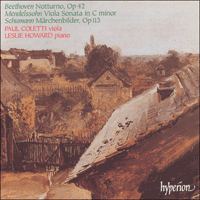



Surprisingly, the repertoire for viola and piano from the nineteenth century is extremely small; the works recorded here are just about the only three to have withstood the test of time.
The Beethoven Notturno is an arrangement (by Franz Xaver Kleinheinz) of the Serenade for string trio, Op 8. The arrangement was sanctioned, albeit somewhat reluctantly, by Beethoven and includes a small amount of expansion and imitative development over the familiar original work. Mendelssohn's Viola Sonata is an early work (1823) and contains the genesis of melodies now more usually associated with his First Symphony and the Variations sérieuses, Op 54. Schumann's Märchenbilder draw their inspiration from the nineteenth-century predilection for fairy-tale and folklore; the four pieces are not based on any particular stories but are linked by a common D tonality and, as the title suggests (Bilder = pictures), give an impression of the ethos behind the fairy-tale fascination of the Romantic era.

Beethoven Notturno, Op 42, (arranged by Franz Xaver Kleinheinz)
The growing amateur market for music in the late eighteenth and early nineteenth centuries encouraged publishers to increase their profits by issuing suitable works in all manner of instrumental arrangements. In the great majority of cases the task of making the arrangement would be entrusted to someone other than the original composer; publishers must have maintained a ‘stable’ of small-time musicians prepared to undertake a job which did not in theory prevent the display of genuine musical creativity and sensitivity, but which in practice was largely a matter of routine hack-work. It goes without saying that, in the absence of any copyright protection, the original composer might be the last person to be involved or even consulted. And payment was of course entirely out of the question: this was a publishers’ market.
Beethoven’s early-won popularity, like that of Haydn, made his music a natural resource for the arrangement industry, though he had little respect for the practice and attempted to exercise some control over it. The Notturno, Op 42, is not an original work for viola and piano but an arrangement of his Serenade for string trio, Op 8 (‘notturno’ and ‘serenade’ were essentially synonyms; the former term is not to be equated with the piano nocturne). Beethoven had composed the Serenade in 1796/7 and it had been published by Artaria in the latter year. The Notturno, published by the Leipzig firm of Hoffmeister and Kühnel in 1804, is not his own work but that of Franz Xaver Kleinheinz (c1770-1832) who was also responsible for Beethoven’s Op 41, an arrangement for piano and flute (or violin) of the Serenade, Op 25, for flute, violin and viola. Beethoven corrected and approved Kleinheinz’s score in each case, however, so Op 42 may safely be regarded as an ‘authorized’ arrangement, even if grudgingly so: ‘I have gone through [the arrangements] and made drastic corrections in some passages. So do not dare to state in writing that I have arranged them’, he wrote to the publishers; ‘If you do, you will be telling a lie, seeing that, moreover, I could never have found the time, or even had the patience, to do work of that kind.’ (In addition to straightforward correction of the transcription, Beethoven permitted himself an odd extra bar and occasional new imitative counterpoint.)
The seven movements of the Serenade/Notturno typically alternate fast and slow tempi, although this bare description does not do justice to the central (fourth) movement, which alternates a D minor Adagio with a tiny D major Scherzo (Allegro molto). The overall scheme of this movement is Adagio – Scherzo – Adagio – Scherzo – Adagio. Moreover, the second appearance of the Scherzo is truncated, consisting of a modified first section followed by a new ending which leads directly into the closing (again, modified and shortened) Adagio. The idea of building a movement out of two discrete and opposed bodies of material was one that Beethoven was to exploit further, most immediately in the finale of the String Quartet in B flat, Op 18 No 6, and more remotely in several movements from the late quartets. Another connection to the Op 18 quartets is discernible in the sixth movement of the Serenade/Notturno, a theme and variations. Not only does this share its key (D) and form with the slow movement of Op 18 No 5, but both movements also make a surprise turn to the key of B flat near their end. In the Serenade/Notturno this turn heralds a free variation which acts simultaneously as a transition to the reprise of the opening march movement.
Mendelssohn Sonata for viola and piano in C minor
Mendelssohn’s Viola Sonata in C minor was written between November 1823 and February 1824. The fifteen-year-old composer’s choice of key may have been inspired by Beethoven’s important corpus of works in C minor, including the Violin Sonata, Op 30 No 2; he certainly seems to have felt impelled here to accentuate the traditionally dark and troubled connotations of C minor with a rich vein of chromaticism. And just as Beethoven’s Op 8 was to re-emerge in its arrangement as Op 42, so part of Mendelssohn’s Sonata was destined to receive a new identity as early as March 1824 when the composer reworked the Menuetto as the third movement of his Symphony No 1 in C minor, Op 11 (he also reinvented the theme of the variations for his great Variations sérieuses, Op 54). The Symphony was published in 1828; the Viola Sonata itself remained unpublished until 1966.
The overall scheme of the work bears extended discussion. Taken by itself, the sequence of movement titles seems to suggest an orthodox four-movement sonata, notwithstanding the (common) reversal of the customary order of the inner pair. But this is deceptive, since the closing Allegro molto is not an independent piece but a virtuosic coda to the series of variations that forms the third movement. Nor is that movement itself without sign of an original approach to a form that can lead easily to inconsequential, repetitive and static structures. The theme already moves beyond the commonplace in its 8 + 10 bar structure, and the individual variations are prevented from being isolated one from the next by Mendelssohn’s linkage technique, which ensures a seamless continuity from beginning to end. The harmonic structure of the theme begins to be modified as early as Variation 4, until with Variation 8 (Adagio in contrast to the preceding Andante) it is set completely aside in favour of a free rhapsodic section, in C major rather than minor, scored largely for piano solo: the effect is as of a Lied ohne Worte being suddenly intruded upon the scene. This section provides the perfect foil for the closing minor-key coda, to which it is connected by a recitative passage given over largely to the viola.
These events at the end of the third and final movement of the Sonata may be conceived as a kind of magnification of the scheme of the first movement. This is a relatively straightforward sonata design with the main Allegro being preceded by a slow introduction. In the recapitulation, the second-group material is brought back in the tonic major (C major). Rather than closing in that key, however, a short coda using material that had not been recapitulated reintroduces C minor, just as at the end of the work. This first-movement coda, though, is pianissimo; the music simply fades away. And the quiet ending at this stage throws additional weight on to the third-movement coda: it responds not only to the third movement but to the first also. In organizing the Sonata along these lines Mendelssohn was both demonstrating his understanding of the end-weighted dynamic structures so powerfully exploited by Beethoven and also foreshadowing the importance as a closural device of the virtuosic coda in the mature works of some of his contemporaries, such as the first and fourth of Chopin’s Ballades.
Schumann Märchenbilder, Op 113
With its espousal of the irrational and the fantastic, and its witness to a national consciousness, the Märchen, or fairy-tale, could not but emerge as an important category of Romantic literature, whether in the form of the traditional stories collected by the brothers Grimm or the invented tales (Kunstmärchen) of Goethe, Tieck, Brentano and others. It comes as no surprise to find that Schumann was particularly attracted to the genre. His Haushaltbuch records that he composed the Märchenbilder, which are not given programmatic titles or identified with particular tales, in the first few days of March 1851; he tried them out with his friend (later to become his first biographer) Wilhelm Joseph von Wasielewski on the 15th. Typically the Haushaltbuch records various titles for the set: Violageschichten, Märchengeschichten, Märchen, and Märchenlieder. It is interesting that Schumann eventually chose to align these pieces with a visual art-form (Bilder = pictures) rather than with the textual genres of the story (Geschichte) or song (Lied). His devotion to literature as well as music is well known and documented; less often stressed is his enjoyment of painting. Dresden and Düsseldorf, where Schumann lived and worked from 1844 to 1850 and from 1850 respectively, each boasted an important school of painters with which Schumann had considerable contact. Another, later chamber work invoking the fairy-tale was, however, to allude to the story-teller in its title: this was the Märchenerzählungen, Op 132, for clarinet, viola and piano, composed in 1853 (erzählen = to relate, narrate).
The four Märchenbilder, Op 113 (they were published in 1852, and with an alternative, ad libitum violin part) consist of a series of contrasting short pieces which form a musical whole not through any obviously shared thematic or motivic content, but rather through a common D tonality: the first and third pieces are in D minor, the second in its relative major, F; the final piece turns to D major, despite the evocation of melancholy in the performance direction. The only real tonal surprise comes with the middle section of the third piece, which starts out Étude-like, as a study in rapid arpeggios for the viola; following the D minor cadence at the end of the first section, the new and unlikely key of B major is as it were superimposed upon the music with no warning whatsoever.
Nicholas Marston © 1997
Beethoven Notturno, op. 42, (arrangé par Franz Xaver Kleinheinz)
A la fin du XVIIIe siècle et au début du XIXe siècle, le marché croissant des amateurs de musique incita les éditeurs à augmenter leurs profits en publiant des œuvres convenant à tous les types d’arrangements instrumentaux. Dans la grande majorité des cas, l’écriture de ces arrangements n’était pas confiée au compositeur original, et les éditeurs devaient entretenir une «écurie» de musiciens de petite envergure disposés à effectuer un travail qui n’excluait pas, en théorie, la créativité et la sensibilité musicales authentiques, mais qui consistait largement, dans les faits, en une écrivaillerie routinière. Il va sans dire que le compositeur originel était, en l’absence de toute protection du droit d’auteur, la dernière personne impliquée, voire consultée. Et tout paiement était, bien sûr, totalement hors de question dans ce marché réservé aux éditeurs.
La popularité précoce de Beethoven, comparable à celle de Haydn, fit de sa musique une ressource naturelle pour l’industrie de l’arrangement, quoique le compositeur eût peu de respect pour cette pratique, sur laquelle il tenta d’exercer quelque contrôle. Le Notturno, op. 42, n’est pas un morceau original pour alto et piano mais un arrangement de la Sérénade pour trio à cordes, op. 8 («notturno» et «sérénade» étaient fondamentalement synonymes et le notturno ne doit pas être assimilé au nocturne pour piano), composée par Beethoven en 1796/7 et publiée par Artaria en 1797. Le Notturno, édité en 1804 par la firme Hoffmeister et Kühnel (Leipzig), n’est pas l’œuvre de Beethoven mais de Franz Xaver Kleinheinz (ca 1770-1832), également responsable de l’op. 41, un arrangement pour piano et flûte (ou violon) de la Sérénade, op. 25, pour flûte, violon et alto. Toutefois, Beethoven corrigea et approuva systématiquement la partition de Kleinheinz et l’op. 42 peut être considéré, avec certitude, comme un arrangement «autorisé», même s’il le fut à contrecœur: «J’ai parcouru [les arrangements] et effectué des corrections drastiques dans certains passages. Aussi n’osez pas déclarer que je les ai arrangés», écrivit-il aux éditeurs. «Si vous le faites, vous mentirez, étant donné que je n’aurais jamais trouvé le temps, ni même eu la patience, d’accomplir un travail de ce genre».
Les sept mouvements de la Sérénade/Notturno présentent une alternance typique de tempi rapides et lents, bien que cette description brute ne rende pas justice au mouvement central (quatrième), qui fait alterner un adagio en ré mineur avec un minuscule scherzo en ré majeur (allegro molto). Le schéma global de la pièce est adagio-scherzo-adagio-scherzo-adagio. La seconde apparition du scherzo, qui est tronquée, consiste de surcroît en une première section modifiée, suivie par une fin nouvelle conduisant directement à l’adagio conclusif (à nouveau modifié et accourci). Cette idée d’un mouvement construit à partir de deux corpus de matériau distincts et opposés allait être exploitée par Beethoven, d’abord dans le finale de son Quatuor à cordes en si bémol, op. 18 n° 6, puis, plus vaguement, dans divers mouvements de ses derniers quatuors. Les quatuors op. 18 présentent également une analogie – un thème et variations – avec le sixième mouvement de la Sérénade/Notturno, qui partage non seulement la tonalité (ré) et la forme du mouvement lent de l’op. 18 n° 5 mais effectue aussi, comme lui, un revirement surprise jusqu’au si bémol, près de la conclusion. Dans la Sérénade/Notturno, ce virage annonce une variation libre, qui agit simultanément comme une transition à la reprise du mouvement de marche initial.
Mendelssohn Sonate pour alto en ut mineur
La Sonate pour alto en ut mineur de Mendelssohn fut écrite entre novembre 1823 et février 1824. Le compositeur, alors âgé de quinze ans, a pu se voir inspirer le choix de sa tonalité par l’important corpus d’œuvres en ut mineur de Beethoven, dont la Sonate pour violon, op. 30 n° 2; et il s’est apparemment senti obligé d’accentuer les connotations traditionnellement sombres et troublées de l’ut mineur par une riche veine de chromatisme. A l’instar de l’op. 8 de Beethoven – qui allait réapparaître, une fois arrangé , sous la forme de l’op. 42 –, la Sonate de Mendelssohn reçut partiellement une nouvelle identité dès mars 1824, lorsque le compositeur retravailla le menuetto pour en faire le troisième mouvement de sa Symphonie n° 1 en ut mineur, op. 11. Cette Symphonie parut en 1828, tandis que la Sonate pour alto demeura non publiée jusqu’en 1966.
Le schéma global de l’œuvre véhicule un vaste débat. En elle-même, la séquence des titres des mouvements semble suggérer une sonate orthodoxe à quatre mouvements, en dépit de l’inversion (courante) de l’ordre habituel de la paire interne. Mais cette suggestion est décevante, car l’allegro molto conclusif n’est pas une pièce indépendante mais une coda virtuose à la série de variations qui forme le troisième mouvement. Lequel n’est pas, non plus, sans approcher avec originalité une forme qui peut aisément aboutir à des structures insignifiantes, répétitives et statiques. La structure de 8+10 mesures mène déjà le thème au-delà du lieu commun, et la technique du lien mendelssohnienne, qui assure une continuité homogène du début à la fin, empêche chaque variation individuelle d’être isolée de sa suivante. La structure harmonique du thème, modifiée dès la variation 4, est complètement délaissée avec la variation 8 (adagio contrastant avec l’andante précédent) au profit d’une section rhapsodique libre, en ut majeur plutôt que mineur, écrite en grande partie pour piano solo: l’effet qui en résulte est comparable à celui d’un Lied ohne Worte faisant soudain irruption sur la scène. Cette section est le faire-valoir parfait de la coda conclusive en mineur, à laquelle elle est rattachée par un passage récitatif confié essentiellement à l’alto.
Ces événements de la fin du troisième et dernier mouvement de la Sonate peuvent être envisagés comme une sorte de glorification du schéma du premier mouvement. Dans ce concept de sonate relativement direct, l’allegro principal est précédé d’une lente introduction. A la reprise, le matériau du second groupe est ramené au majeur de la tonique (ut majeur). Mais, au lieu de terminer dans cette tonalité, une brève coda utilisant un matériau qui n’a pas été repris réintroduit l’ut mineur, juste à la fin de l’œuvre. Cette coda du premier mouvement est, cependant, pianissimo et la musique s’évanouit simplement. Et la conclusion paisible, à ce stade, jette un poids supplémentaire sur la coda du troisième mouvement: elle répond non seulement au troisième mouvement mais aussi au premier. En organisant la Sonate selon ces lignes, Mendelssohn démontrait sa compréhension des structures dynamiques à la fin lestée, si puissamment exploitées par Beethoven, et présageait l’importance de la coda virtuose comme procédé conclusif dans les œuvres de la maturité de certains de ses contemporains, telles les première et quatrième Ballades de Chopin.
Schumann Märchenbilder, op. 113
Avec leur adoption de l’irrationnel et du fantastique, avec leur témoignage d’une conscience nationale, les Märchen, ou contes de fées, ne pouvaient qu’émerger comme une catégorie majeure de la littérature romantique, que ce fût sous la forme des histoires traditionnelles recueillies par les frères Grimm ou des contes inventés (Kunstmärchen) par Goethe, Tieck, Brentano, etc. Et découvrir que Schumann fut particulièrement attiré par ce genre n’a rien de surprenant. Son Haushaltbuch rapporte qu’il composa les Märchenbilder – lesquels ne présentent ni titres programmatiques, ni associations à des contes particuliers – dans les premiers jours de mars 1851; il les essaya avec son ami (qui allait devenir son premier biographe) Wilhelm Joseph von Wasielewski le 15 mars. Comme à son habitude, le Haushaltbuch consigne divers titres envisagés pour ce corpus: Violageschichten, Märchengeschichten, Märchen et Märchenlieder. Il est intéressant de noter que Schumann choisit finalement d’aligner ces pièces sur un moyen d’expression artistique visuel (Bilder = images) plutôt que sur les genres textuels de l’histoire (Geschichte) ou du chant (Lied). Sa dévotion envers la littérature et la musique est bien connue et documentée, mais l’accent est moins souvent mis sur le plaisir que lui procurait la peinture. Dresden et Düsseldorf, où Schumann vécut et travailla respectivement de 1844 à 1850 et à partir de 1850, se targuèrent chacune d’une importante école de peintres, avec lesquels le compositeur eut d’importants contacts. Plus tard, le titre d’une autre œuvre de chambre invoquant le conte de fées allait cependant faire allusion au raconteur d’histoires: ce furent les Märchenerzählungen, op. 132, pour clarinette, alto et piano, composés en 1853 (erzählen = raconter, narrer).
Les quatre Märchenbilder, op. 113 (publiés en 1852, avec une partie de violon supplémentaire, ad libitum) consistent en une série de courtes pièces contrastantes, ensemble musical dont la cohérence tient non à un contenu thématique ou motivique manifestement commun, mais à une tonalité commune (ré): les première et troisième pièces sont en ré mineur, tandis que la deuxième est sise dans son majeur relatif, fa; quant à la dernière, elle se tourne vers le ré majeur, malgré l’évocation de la mélancolie dans la direction d’interprétation. La seule véritable surprise tonale vient avec la section centrale de la troisième pièce, qui débute comme une Étude, une étude en arpèges rapides pour l’alto; après la cadence en ré mineur à la fin de la première section, la nouvelle tonalité, inattendue, de si majeur apparaît comme surimposée à la musique, sans le moindre avertissement.
Nicholas Marston © 1997
Français: Hypérion
Beethoven Notturno, Op. 42, (arrangiert von Franz Xaver Kleinheinz)
Der stark expandierende Markt für Amateurmusiker im späten 18. und frühen 19. Jahrhundert veranlaßte die Verleger zur Herausgabe geeigneter Werke in allen erdenklichen Instrumentalarrangements, um somit ihre Gewinne zu vergrößern. In den meisten Fällen fiel die Ausarbeitung der Arrangements jedoch nicht dem ursprünglichen Komponisten, sondern einem Dritten zu. Die Verleger hielten sich offenbar einen Stab von ‘Schmalspurmusikern’, die eine solche Arbeit, die eine Demonstration wahrer musikalischer Kreativität und Feinfühligkeit theoretisch betrachtet zwar nicht ausschließt, doch in der Praxis meist stumpfsinniger Routinearbeit glich, auszuführen bereit waren. Daß der eigentliche Komponist in jenen Tagen, als noch kein Urheberrechtsschutz existierte, mitunter die letzte Person war, die mit einbezogen oder konsultiert wurde, ist wohl nicht verwunderlich. Und Tantiemen waren natürlich völlig indiskutabel, denn dies war schließlich ein Verlegermarkt.
Beethovens frühe Popularität, ähnlich der Haydns, machte seine Musik zu einer Goldgrube für die Arrangementindustrie, obgleich Beethoven selbst wenig Respekt für diese Praktik hatte und eine gewisse Kontrolle darüber zu erlangen versuchte. Das ursprüngliche Notturno, Op. 42, war nicht für Viola und Klavier bestimmt, sondern ein Arrangement seiner Serenade für Streichtrio, Op. 8 (‘Notturno’ und ‘Serenade’ waren im Grunde genommen Synonyme, obgleich der erste Begriff nicht mit einer Klaviernocturne zu verwechseln ist). Beethoven hatte die Serenade um 1796/7 komponiert, und sie wurde noch im Jahr ihrer Vollendung von Artaria herausgegeben. Das 1804 vom Leipziger Unternehmen Hoffmeister und Kühnel publizierte Notturno ist nicht Beethovens eigenes Werk, sondern die Schöpfung von Franz Xaver Kleinheinz (ca. 1770-1832), der auch das Arrangement von Beethovens Op. 41 vornahm, ein Arrangement für Klavier und Flöte (oder Violine) der Serenade Op. 25 für Flöte, Violine und Viola. In beiden Fällen korrigierte und billigte Beethoven die Partitur von Kleinheinz jedoch, weswegen Op. 42 durchweg als ‘autorisiertes’ Arrangement betrachtet werden kann, wenngleich auch mit Widerwillen: ‘Ich habe sie [die Arrangements] durchgesehen und radikale Korrekturen in einigen Passagen vorgenommen. Doch wagt nicht, auf dem Papier zu behaupten, ich hätte sie selber arrangiert’, so schrieb Beethoven an seinen Verleger. ‘Tut Ihr es doch, so seid Ihr ein Lügner, insbesondere da ich weder Zeit noch Geduld für eine solche Arbeit aufzubringen vermocht hätte.’
In den sieben Sätzen der Serenade/des Notturnos wechseln sich schnelle und langsame Tempi auf typische Weise ab, wobei gesagt werden muß, daß diese generelle Aussage dem zentralen (vierten) Satz nicht gerecht wird, da dort ein d-Moll-Adagio und ein winziges D-Dur-Scherzo (Allegro molto) im Wechsel aufeinanderfolgen.; das gesamtheitliche Schema lautet hier Adagio-Scherzo-Adagio-Scherzo-Adagio. Zudem ist das Scherzo bei seinem zweiten Auftritt gekürzt und setzt sich aus einem modifizierten ersten Teil und einem neuen Schluß zusammen, der direkt zum abschließenden (ebenfalls modifizierten und gekürzten) Adagio überleitet. Mit der Idee eines Satzaufbaus auf der Grundlage zweier dezenter und gegensätzlicher Materialgruppen sollte sich Beethoven später noch stärker auseinandersetzen: zuerst im Finale des Streichquartetts in B-Dur, Op. 18 Nr. 6, und nachfolgend in mehreren Sätzen seiner letzten Quartette. Eine weitere Parallele zu den Op. 18-Quartetten wird im sechsten Satz der Serenade/des Notturnos deutlich, d.i. ein Thema und seine Variationen. Dieser Satz verwendet nicht nur die gleiche Tonart (D-Dur) und Form wie der langsame Satz von Op. 18 Nr. 5, sondern überrascht gegen Satzende ebenfalls mit einem Sprung nach B-Dur. In der Serenade/dem Notturno kündigt dieser Sprung eine freie Variation an, die gleichzeitig als Übergang zur Reprise des eröffnenden Marsch-Satzes fungiert.
Mendelssohn Sonate für Viola in c-Moll
Mendelssohns Sonate für Viola in c-Moll entstand zwischen November 1823 und Februar 1824. Die Tonartwahl, die der fünfzehnjährige Komponist traf, wurde möglicherweise durch Beethovens bedeutende Gruppe von c-Moll-Werken, darunter die Violinsonate, Op. 30 Nr. 2, inspiriert. Mendelssohn sah sich hier jedoch offenbar gezwungen, die traditionellen dunklen und beunruhigenden Konnotationen der Tonart c-Moll durch einen reichen chromatischen Fluß zu akzentuieren. Gleichzeitig mit dem Erscheinen von Beethovens Op. 8 in seiner arrangierten Form als Op. 42 sollte auch ein Teil von Mendelssohns Sonate eine neue Identität erhalten, und zwar als letzterer bereits im März 1824 das Menuett des dritten Satzes seiner Sinfonie Nr. 1 in c-Moll, Op. 11, überarbeitete. Die Sinfonie erschien 1828, während die eigentliche Violasonate bis 1966 unveröffentlicht blieb.
Das gesamtheitliche Schema des Werkes ist seit eh und je Diskussionsgegenstand. Die Reihenfolge der Satztitel an sich scheint eine traditionelle viersätzige Sonate nahezulegen, ungeachtet der (häufig vorgenommenen) Umkehrung der üblichen Anordnung der beiden Mittelsätze. Doch der Schein trügt, denn weder ist das abschließende Allegro molto ein unabhängiges Stück – es ist tatsächlich die virtuose Coda der Variationsreihe, die den dritten Satz darstellt –, noch ist dieser Satz selbst ohne Anzeichen eines originellen Formansatzes, der leicht zu beziehungslosen, monotonen oder statischen Strukturen führen kann. Das Thema bricht die Tradition allein schon durch seinen 8+10-Takte-Aufbau, und eine Isolierung der einzelnen Variationen voneinander wird durch Mendelssohns Verbindungstechnik, die einen nahtlosen Fluß von Anfang bis Ende gewährleistet, vermieden. Der harmonische Aufbau des Themas wird bereits in der vierten Variation erstmals modifiziert, bis er schließlich in der achten Variation (Adagio als Gegensatz zum vorhergegangenen Andante) zugunsten eines freieren rhapsodischen Teils in C-Dur statt c-Moll, größtenteils für Soloklavier geschrieben, ganz aufgegeben wird; die Wirkung gleicht der eines Liedes ohne Worte, das plötzlich ins Bild gedrängt wird. Dieser Teil liefert den perfekten Hintergrund für die abschließende Coda in Moll, die durch eine rezitative, größtenteils der Viola zugedachten Passage daran angeschlossen ist.
Diese Entwicklungen gegen Ende des dritten und abschließenden Satzes der Sonate können als eine Art Vergrößerung des Schemas des ersten Satzes betrachtet werden. Der Sonatenaufbau ist mit seiner langsamen Einleitung vor dem Haupt-Allegro relativ schlicht und einfach. In der Reprise kehrt die zweite Materialgruppe in die Tonika-Durtonart (C-Dur) zurück. Doch statt den Satz in dieser Tonart enden zu lassen, setzt Mendelssohn eine kurze Coda ein, die Material verwendet, das nicht in der Reprise behandelt wurde, und c-Moll wieder einführt, genauso wie am Ende des Werkes. Die Coda des ersten Satzes wird pianissimo gespielt, wobei die Musik ganz einfach verhallt. Zudem verleiht der ruhige Schluß an dieser Stelle der Coda des dritten Satzes noch mehr Gewicht: Er ist nicht nur eine Antwort auf den dritten, sondern auch auf den ersten Satz. Der hier ersichtliche Sonatenaufbau ist nicht nur ein Beweis für Mendelssohns Kenntnisse in dynamischen Strukturen mit Schwerpunkt auf den Schluß, von denen Beethoven so eindrucksvoll Gebrauch machte, sondern auch ein Vorgriff auf ihre Bedeutung als Schlußfunktionen in den virtuosen Codas der reifen Werke einiger seiner Zeitgenossen wie zum Beispiel der ersten und vierten von Chopins Ballades.
Schumann Märchenbilder, Op. 113
Da Märchen Irrationalität und Phantasterei zum Gegenstand haben und zudem die Existenz eines nationalen Gewissens bezeugen, wurden sie zwangsläufig zu einer bedeutenden Kategorie der romantischen Literatur, sei es in Form der überlieferten Geschichten, die von den Gebrüdern Grimm gesammelt wurden, oder der Kunstmärchen von Goethe, Tieck, Brentano und anderen. Angesichts dessen ist es wenig erstaunlich, daß auch Schumann stark von diesem Genre fasziniert war. Sein Haushaltsbuch belegt, daß er die Märchenbilder, die weder über programmatische Titel verfügen, noch mit bestimmten Märchen identifizierbar sind, in den ersten Märztagen des Jahres 1851 komponierte. Am 15. März probte er sie dann zusammen mit seinem Freund (und späteren Biographen) Wilhelm Joseph von Wasielewski. Bezeichnenderweise nennt das Haushaltsbuch diverse Titel für diese Sammlung: Violageschichten, Märchengeschichten, Märchen und Märchenlieder. Es ist interessant, daß Schumann letztlich beschloß, diese Stücke mit einer visuellen Kunstform, ‘Bilder’, statt mit den textlichen Genres ‘Geschichte’ oder ‘Lied’ in Verbindung zu setzen. Seine Leidenschaft für die Literatur und die Musik ist wohlbekannt und bestens dokumentiert. Weniger häufig wird jedoch seine Vorliebe für das Malen erwähnt. Dresden und Düsseldorf, wo Schumann von 1844 bis 1850 beziehungsweise seit 1850 lebte und arbeitete, beherbergten beide bedeutende Schulen für Maler, mit denen Schumann häufig verkehrte. Ein weiteres, späteres Kammerstück mit Bezug auf Märchen verweist hingegen in seinem Titel auf die erzählende Dichtung: die 1853 komponierten Märchenerzählungen, Op. 132, für Klarinette, Viola und Klavier.
Die vier Märchenbilder, Op. 113 (die 1852 mit einem zusätzlichen ad libitum-Geigenpart veröffentlicht wurden) setzen sich aus einer Reihe kurzer kontrastierender Stücke zusammen, die sich nicht aufgrund eines gemeinsamen thematischen oder motivischen Inhalts, sondern aufgrund tonaler Übereinstimmung (D-Tonalität) zu einem musikalischen Ganzen verbinden: Das erste und dritte Stück sind in d-Moll geschrieben, das zweite Stück in der verwandten Durtonart F, und das Schlußstück geht trotz der nach Melancholie verlangenden Spielanweisung zu D-Dur über. Die einzig wirkliche tonale Überraschung offenbart sich im Mittelteil des dritten Stückes, das mit einer Studie schneller Arpeggios für die Viola etüdenartig beginnt: Der d-Moll-Kadenz am Ende des ersten Teils schließt sich die neue und unvermutete Tonart H-Dur an, die quasi ohne Vorwarnung plötzlich über die Musik hereinbricht.
Nicholas Marston © 1997
Deutsch: Manuela Hübner