Welcome to Hyperion Records, a British classical label devoted to presenting high-quality recordings of music of all styles and from all periods from the twelfth century to the twenty-first.
Hyperion offers both CDs, and downloads in a number of formats. The site is also available in several languages.
Please use the dropdown buttons to set your preferred options, or use the checkbox to accept the defaults.
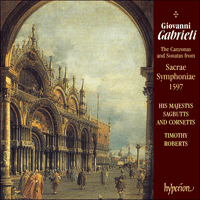

This recording features what we believe to be the largest group of cornett and sackbut players to have been assembled from one city since the seventeenth century, and represents the fruition of a long-held aspiration of the original members of His Majestys Sagbutts and Cornetts.
It was one evening in 1981, over dinner and a bottle or two of wine, that we first got together and shared our ideas. The result of this meeting was the bringing together of a rather unlikely bunch of characters and the formation of ‘HMSC’. Some years later a rather zealous critic paid us this great compliment: ‘While every member of the group is a virtuoso in his or her own right, the listener always has a clear sense that the whole is greater than the sum of the parts.’
In 1608 Thomas Coryat had described hearing ‘the best musicke that ever I did in all my life … that I would willingly goe an hundred miles a foote at any time to hear the like’ after attending a rendition of Gabrieli in Venice. He goes on to record these Venetian musicians as ‘having their master or moderator to keepe them in order’. We accordingly invited our keyboard player Timothy Roberts to be our ‘moderator’, a position in keeping with the ethos of HMSC, and thankfully he agreed both to prepare the performances and to ‘keep the sessions in order’.
Over the years the pool of suitably talented London-based players has become ever larger, gradually making the recording of Gabrieli’s polychoral masterpieces feasible. The first rehearsal for this recording was a joy that we have seldom encountered, and the project as a whole saw our chamber group transformed into a willing and sensitive ‘extended family’. We are truly indebted to all who took part.
Sacrae Symphoniae is a monumental collection comprising forty-five vocal works in addition to the sixteen instrumental pieces recorded here. The canzonas and sonatas are unsurpassed—in scale, expressive range, and sheer idiomatic flair—in the entire sixteenth-century instrumental repertoire.
These glorious works range from eight parts to fifteen, with the instruments arrayed in up to three separate 'choirs'.

The 1597 Sacrae Symphoniae is a monumental, retrospective collection reflecting the earlier part of Gabrieli’s work as one of the organists of St Mark’s, Venice, the post that he held from 1585 until his death in 1612. Gabrieli’s years at the great Byzantine basilica coincided with the most brilliant period of its instrumental ensemble—already established for a century or more around the Doge’s personal group of wind players, or piffari—which had become a permanent ensemble in 1568 and been strengthened in the 1580s to a group of six core players to which extras were regularly added for high feasts throughout the liturgical year.
The St Mark’s ensemble of the late-sixteenth century was fundamentally a wind group in which cornetts and sackbuts (trombones) were pre-eminent; one or more violins or violas were occasionally added as a contrasting colour. It employed some of Italy’s outstanding virtuosi, including its capo de’ concerti Girolamo Dalla Casa and the renowned cornettist Giovanni Bassano, both of whom published treatises on the art of diminution (the adding of ornaments to the individual lines of vocal polyphony) during the 1580s. Such players achieved a peak of brilliance and subtlety in this improvisatory skill, which in turn was reflected in Gabrieli’s compositions.
The instruments were not heard only in consort with voices—which they might double, or accompany on independent lines—for there was also scope in the liturgy for purely instrumental pieces, predominantly in the form of canzonas that would be substituted for portions of the Mass, such as the Epistle, Post Communion or Deo Gratias. (The text for these might be spoken by a priest while the music was playing.)
It may seem curious that, as instrumental music intended mainly for the Church, the canzon per sonar—literally, a ‘song for playing’—had its origins in a form of vocal music based on amorous, if not downright bawdy, texts—the rich repertoire of Franco-Flemish chansons of the High Renaissance. Yet certain typical musical features of the chanson made it an ideal basis for instrumental performance: its clear-cut melodic shapes, often based on stereotyped patterns of repeated notes; its easily understood and memorable harmony; and its logical form which, unlike most sacred polyphony, often included repeated sections that give a sense of musical architecture independent of the poetic text.
In due course instrumentalists adopted and adapted many of these works, often adding ornamentation to make the music more idiomatic. Such pieces gave rise to others based more freely on a particular chanson, or else composed from scratch in the chanson style, and these found their way into the liturgy either as solo organ music or, where the resources were available, as music for a group of instrumentalists.
As the canzona developed it adopted features from other types of vocal polyphony, most notably the practice of cori spezzati, or ‘split choirs’, whereby the parts were grouped in two or more choirs of voices or instruments. Gabrieli was not the first to introduce the cori spezzati style to the canzona, but he quickly surpassed his contemporaries in both the complexity and the unpredictable imaginative variety of his polychoral writing. All but two of the 1597 canzonas are written for two or three ‘choirs’ of four, five or six parts; even the two that are not require a quite exceptional ensemble of ten instruments, giving much internal scope for the dialogues, echoes and other effects of musical perspective that are so vital to Gabrieli’s art.
The two sonatas in Sacrae Symphoniae seem to be the first pieces ever to be so titled. Musically, no hard-and-fast distinction between canzona and sonata can be made, but liturgically the sonata may have been associated with the heart of the Mass, the Elevation of the Host; the organist Banchieri, for example, recommended that una suonata grave be played at this point. Gabrieli’s two 1597 sonatas, one of them being the famous Sonata pian’ e forte, are sober and dignified, being written in a rich, low register alla quarta bassa, without the dance-like triple-time sections so typical of the canzona, and full of rich harmonies that anticipate the durezze e ligature (‘dissonances and suspensions’, symbolizing the sufferings of Christ) with which Italian organists of the next generation would fill their Elevation toccatas.
The wonder of Gabrieli’s instrumental music is his use of a rather limited range of musical clichés to create works of endlessly refreshing variety and imagination. Nearly all his canzonas start with repeated notes in a dactylic rhythm (long–short–short), yet these launch melodies—whether announced in transparent fugal imitation, or harmonized in block chords—that have individual beauty, and are often as catchy as folk songs.
Unlike the organ ricercar, which was usually devoted to a thorough exploration of a single theme, the canzona was full of variety, often resembling the contemporary madrigal in which each line of poetry would give birth to a fresh musical idea. Gabrieli explores all sorts of ways to make his textless pieces hang together convincingly. Several bring back the opening theme, whether as an immediate repeat, a rondo-like ritornello, or a ‘recapitulation’ towards the end. Elsewhere an internal section, often a tripla (section in triple time), may recur as a refrain, like the ‘Alleluia’ in a festal motet. Other canzonas contain no literal repetition, though their various themes are often subtly related.
It is a relatively straightforward matter to analyse these architectural patterns, to trace the proportions of Gabrieli’s masterly musical draughtsmanship. What is harder to pin down is his sure feeling for instrumental sound, for texture, and for the effective placing and spacing of simple chords—in one, perhaps anachronistic word, his ‘orchestration’. Underlying all is his unmistakable, remarkably modern harmony. While Gabrieli’s melodic style is still coloured by the old ecclesiastical modes (or ‘tones’), and his counterpoint has the strength of a master trained in the best traditions of the Renaissance, it is arguably his lucid, resonant use of simple chords that contributes most to his music’s directness and fervour.
Numbering of the Canzonas and Sonatas
The 1597 publication of Sacrae Symphoniae orders the individual works according to the size of the ensemble, from eight parts up to fifteen. The ‘C’ numbers printed in this booklet refer to the thematic catalogue (1996) of Gabrieli’s works by Richard Charteris.
For the present recording we have followed the ascending order of the modes, though for variety the six canzonas in the 12th mode have been distributed throughout the sequence.
(1): No 10 Canzon duodecimi toni a 10 C.179
A compact, lively work in the festive 12th mode and one of only two in the collection – the other being the Sonata pian’ e forte—to contrast a high with a low instrumental choir. Much of the music for each choir, too, is contrasted, as at the opening where figural writing in close imitation for the cornetts is answered by sonorous block harmony for the sackbut choir. But there is much agreement between the choirs too, as ideas are thrown wittily back and forth.
The harmony is consistently bright, based almost entirely on major chords, and Gabrieli’s feeling for contrasts of key seems remarkably modern; the ‘white-note’ harmony of the mode is punctuated by four cadences in the ‘dominant’, G major, and a delightful sprinkling of more distant major chords: B flat, D, A and E major.
(2): No 1 Canzon primi toni a 8 C.170
The first of five canzonas for two equal four-part choirs in Sacrae Symphoniae, relatively traditional pieces clearly reflecting the symmetrical formal patterns of the old chanson. The Canzon primi toni a 8 (here transposed down a fourth) is dance-like, its pavan-like rhythms and regular sequences appropriate to the ‘worthy and pleasing harmony’ (Diruta), ‘halfway between sad and cheerful’ (Zarlino) of the 1st mode, giving way twice to a tripla in sedate galliard style.
The two choirs are very much of one mind, their conversation consisting mainly of dignified agreement, and the beautiful division-like sequences (here embellished ad libitum by the cornettists) create a quality of serene nobility.
(3): No 7 Canzon primi toni a 10 C.176
A similar mood is evident in this second work in the 1st mode, whose initial theme (the opening bars are identical to those of one of Gabrieli’s organ canzonas) closely resembles that of its companion. Here, though, the scoring is not for separate choirs, but for an ensemble of ten equal parts. No instrumentation is specified; we have allocated pairs of cornetts, violins, alto cornetts and bass sackbuts, and a coupling of alto and tenor sackbut, each pair being separated, right and left, for clarity.
The canzona starts seriously, but leads through a madrigalian succession of contrasted, though related, melodies, each section rounded off by a clear cadence. The texture varies kaleidoscopically, the mid-point marked by a strikingly simple phrase in four-part harmony. A straightforward tripla, heard twice, leads into the closing canonic ‘Amen’.
(4) (8) (11) (15) (19): The Organ Solos
The organists of St Mark’s were expected to be able to improvise fluently in the various forms required by the liturgy, and thus, typically for the period, relatively little of Gabrieli’s organ music survives in notated form. A set of Intonazioni in all the modes was published in 1593, exemplifying the Venetian tradition of brief preludes based on, and designed to introduce, plainchant (for example, the Intonazione noni toni).
Such functional pieces are one of the roots of the keyboard toccata, which in Venice usually showed off the player’s dexterity with lively divisions in one hand or the other, accompanied by simple chords, in pieces that often run to considerable length. A few such pieces by Gabrieli survive; the four toccatas recorded here are attributed to him in early-seventeenth-century German organ tablatures, though their authenticity has recently been questioned by Richard Charteris. The toccata in the fifth mode is attributed in another source to the Bavarian organist Christian Erbach; the other three, all fine pieces, may be by one of Gabrieli’s many pupils and emulators.
(5): No 9 Canzon duodecimi toni a 10 C.179
The triumphant character of the 12th mode could hardly be more fully expressed than in this joyful work. The instrumentation is not specified, but the top two parts are almost certainly intended for violins: they descend to the tenor G, just off the range of the treble cornett. These concertante parts, full of scales and arpeggios, show how brilliantly Gabrieli could incorporate the virtuoso diminutions of the instrumentalists into a formal structure of the utmost simplicity and clarity.
The brief opening tutti recurs five times, framing a series of episodes in which the soloists cavort in athletic competition, accompanied at first only by the lowest sackbuts and then by the other members of the ten-part band in a subtle display of cumulative orchestration. Gabrieli seems to invent the ethos of the Vivaldian double-violin concerto, over a century before its time.
(6): No 16 Canzon quarti toni a 15 C.185
Scored for three contrasting five-part choirs, this work is the richest and perhaps most imposing of the collection. However, like all the best orchestrators, Gabrieli refrains from over-using his tutti: the full ensemble is heard in only thirteen of the work’s seventy-one bars. The music starts in the manner of a sonata, with deep harmonies and with one instrument being followed in rhythmic canon by its fellows; later, more canzona-like features emerge, including a brief tripla just before the end.
For Zarlino, the 4th was most lachrymose of the modes, ‘even sadder’ than the 3rd, which itself could ‘move to tears’. The harmony, full of mournful semitones, gravitates repeatedly to E major, usually through a ‘dying fall’ from D minor.
Gabrieli specifies the scoring; the characteristic appearance of a single viola among the wind instruments serves to clarify the texture and also recalls a typical Venetian vocal scoring, in which a solo singer on the top voice of a low ‘choir’ would be accompanied by a group of sackbuts. The rhythms of the viola’s opening bars certainly suggest music ‘to an imaginary text’.
(7): No 8 Canzon duodecimi toni a 10 C.177
Less brilliant than some of the other 12th-mode canzonas, this masterly work (like No 7, composed for an undivided ten-part ensemble) is based on an accumulation of ideas that overlap seamlessly like the lines of a polyphonic motet or an idealized organ ricercar (did the ten instruments perhaps symbolize the organist’s ten digits?). After the rising fifths of the opening, all the parts move almost entirely by step, creating a lilting regularity in the harmony, with very few perfect cadences; the two bass instruments move as mellifluously as the others.
This evident simplicity is deceptive; there is some skilful counterpoint, especially towards the end where the instruments pair off and follow each other up and down the scale in delightful, close canon.
(9): No 6 Sonata pian’ e forte a 8, alla quarta bassa C.175
This celebrated masterpiece, one of the collection’s two sonatas, is based on a dialogue between two choirs contrasted in both pitch and timbre: the higher choir, of cornett and three sackbuts, is answered by a lower group with a viola on the top line. The piece is essentially an elegiac melody, expressively harmonized, that is passed from choir to choir; the long-breathed lines do not in themselves create much contrast, until the greater animation of the final tutti. Thus Gabrieli’s indications of loud and soft, though not unique in his work, do play a vital role in articulating the structure and are one of his many imaginative solutions to the problems of instrumental composition.
The Sonata pian’ e forte is the only one of the 1597 instrumental pieces without a designated mode. Each of the modes could be used at a high or a low pitch; here the words alla quarta bassa may indicate that the sonata, conceived outside the modal system, is already notated at low pitch and—unlike the eight-part canzonas?—should not be transposed down.
(10): No 2 Canzon septimi toni a 8 C.171
A symmetrical canzona in three sections, each of which ends with a tripla and a brief, duple-time tutti with the basses moving in sonorous canon. The first and second sections are started by choir one, the third by choir two. The almost carol-like opening tune is answered by choir two playing a more robust, leaping motif, and this discussion of contrasting themes is a feature of the whole canzona.
(12): No 3 Canzon septimi toni a 8 C.172
Zarlino describes the 7th mode as apt for texts of a ‘lascivious, angry, or cheerful’ nature, a range of moods that seems to be well represented by both this and the preceding canzona. But whereas No 2 opened with music of deceptive simplicity, the memorably energetic opening of No 3, which the late Denis Arnold described as ‘fizzing like champagne’, is based on repeated notes that both recall the military motifs of the batalla and also point towards Monteverdi’s stile concitato. This leads directly into a sequence of strongly contrasting ideas, including (unusually) two different triplas, the first of which appears twice, and a mournful passage in the ‘dominant minor’ which makes the final recapitulation of the opening section all the more effective.
(13): No 11 Canzon in echo duodecimi toni a 10 C.180
This remarkable work seems closest among the six 12th-mode canzonas to real military music, partly because of its unique, treble-dominated scoring of eight cornetts and two sackbuts, divided into two choirs, and also because of its simple, regular harmonic structure and processional feel. Was this perhaps a symbolic evocation of a military band of antiquity?
Echo-writing is one manifestation of composers’ liking, around the turn of the seventeenth century, for special effects of musical perspective. Here the effect depends on the dynamic possibilities of the cornetts rather than their physical placing, for each choir takes turns to echo the other.
Like some other canzonas, the Canzon in echo anticipates the ritornello form of the later concerto, the soloistic echo passages being framed by full ten-part sections. This structure is especially clear in the alternative version of the piece (No 12).
(14): No 5 Canzon duodecimi toni a 8 C.174
The cheerful, folksong-like opening tune, reminiscent of the opening of No 10, is heard in close imitation. Choir two soon interrupts with a lively tripla leading into a brief duple-time tutti. The central section of the canzona is based largely on a dialogue between the choirs, each of which plays mostly in block harmony. A recapitulation of the opening leads to a triumphant coda in which the basses are finally given the lead. (Transposed down a 4th.)
(16): No 13 Canzon septimi et octavi toni a 12 C.182
The 1615 collection of Gabrieli’s canzonas and sonatas would conclude with a revolutionary work, a sonata for three violins and organ in which the increasingly elaborate sonorities of the polychoral canzona are abandoned in favour of the simple, continuo-accompanied textures of Baroque chamber music. Yet the seeds of this development were already present in earlier works, and the present canzona is, despite the opulence of its scoring for three four-part choirs, in essence a work for three treble instruments, each with its own three-part accompaniment.
The three trebles (violins in our performance) exchange short melodic tags, all clichés of the canzona style. The harmony and rhythm are simple and the effect predominantly lyrical. Monotony, to which lesser composers succumbed all too easily in this kind of piece, is avoided by the unpredictability of the conversation; new ideas are instigated by all three choirs at different times, and are echoed sometimes once, sometimes twice.
The musical content is at times reminiscent of No 3, though here the vigour of the 7th mode is tempered by what Zarlino described as the ‘natural grace and sweetness’ of the 8th.
(17): No 15 Sonata octavi toni a 12 C.184
Like the Sonata pian’ e forte, this imposing piece is essentially a seamless, harmonized melody, whose wide reaches are passed from one choir to the other in a fine display of Gabrieli’s genius for controlled musical tension. Note the powerfully effective repetition of the penultimate section, and superb sense of new harmonies in the final tutti. The texture is remarkable, too, the centre of gravity in each of the six-part choirs being very low; the bottom four instruments are closely spaced, the top two wider apart, which helps the leader to shine and the second part (the top sackbut in our scoring) to emerge from the texture from time to time.
(18): No 12 Canzon in echo duodecimi toni a 10 C.181
It is uncertain why Gabrieli chose to present this echo canzona in an alternative version, in which the lower wind parts are replaced during the soloistic echo sections by the organ (in this performance, two organs). Did he wish to present an alternative way of performing an already exceptionally scored piece; or to demonstrate a new style of scoring that could be applied to other comparable canzonas? Or is this the original conception, and No 11 an alternative, perhaps for outdoor use?
(20): No 4 Canzon noni toni a 8 C.173
At first sight, the harmonies created by the 9th mode, with their many semitones, may seem similar to those of the ‘tearful’ 4th. But here the effect is sad and wistful rather than tragic, as Zarlino implies: the mode has ‘a pleasing severity, mixed with a certain cheerfulness, and soft sweetness’. This description seems apt for the conflicting tensions created by Gabrieli’s opening harmonies, with its three semitones (between the 5th and 6th, 3rd and 4th, and also 1st and flattened 2nd degrees of the scale). The tripla, heard twice, features sequential harmony whose hypnotic effect complements well the melancholy of the duple-time music. (Transposed down a 4th.)
(21): No 14 Canzon noni toni a 12 C.183
This canzona is among the finest in the collection. Perhaps in response to the special qualities of the 9th mode, it contains a great variety of themes (most of the canzona clichés appear at some point), and these are treated on a broad scale with masterly freedom. The three choirs engage in unpredictable dialogue—the opening two phrases are already irregular, two and three bars long respectively—and also digress into internal discussions, forming pairs and trios. There seems to be a teasing humour, in the uncertainty of the length of sequences, the whimsical syncopations within the uninterrupted duple metre, the expectations created then frustrated. There is no tripla and no recapitulation, yet the lively falling theme of the final bars is a perfect reply to the questioning dialogue of the opening. This, of all the varied works in the 1597 collection, perhaps shows most fully how sophisticated Gabrieli’s instrumental language had become.
Timothy Roberts © 1997
Les Sacrae Symphoniae de 1597 forment un monumental recueil rétrospectif, reflet des premières œuvres de Gabrieli, composées à l’époque où il était l’un des organistes de Saint-Marc de Venise—poste qu’il occupa de 1585 à sa mort, en 1612. Ces années vénitiennes de Gabrieli coïncidèrent avec la période la plus brillante de l’ensemble instrumental de la grande basilique byzantine; cet ensemble, qui s’était déjà constitué depuis plus d’un siècle autour du groupe de vents (piffari) personnel du doge, devint permanent en 1568 et fut renforcé dans les années 1580 pour obtenir un groupe de base de six instrumentistes, auquel des joueurs supplémentaires venaient régulièrement se joindre, pour les grandes fêtes de l’année liturgique.
A la fin du XVIe siècle, l’ensemble de Saint-Marc était essentiellement un groupe de vents dominé par les cornets à bouquin et les saqueboutes (trombones); un ou plusieurs violons, ou altos, étaient occasionnellement ajoutés en guise de couleur contrastante. Cet ensemble employait quelques-uns des éminents virtuoses d’Italie, dont Girolamo Dalla Casa (capo de’ concerti du groupe) et le célèbre cornettiste Giovanni Bassano, tous deux auteurs, durant les années 1580, de traités sur l’art de la diminution (l’art d’ajouter des ornements aux lignes individuelles de la polyphonie vocale). De tels instrumentistes atteignirent à un apogée de somptuosité, de subtilité dans cet art de l’improvisation, et cette maîtrise imprégna à son tour les compositions de Gabrieli.
Les instruments ne s’entendaient pas uniquement dans des ensembles instrumentaux avec voix—voix qu’ils pouvaient doubler, ou accompagner sur des lignes indépendantes—, car la liturgie offrait, elle aussi, des potentialités pour des pièces purement instrumentales, surtout sous la forme de canzones se substituant à des portions de la messe, telles l’épître, la postcommunion ou le Deo Gratias (le prêtre pouvait déclamer les textes, mais très doucement, de manière à ne pas troubler la musique).
Il peut sembler curieux que, la musique instrumentale étant essentiellement destinée à l’Église, la canzon per sonar—littéralement, un «chant à jouer»—puisât ses origines dans une forme de musique vocale fondée sur des textes amoureux, voire franchement paillards: le riche répertoire des chansons franco-flamandes de la Haute Renaissance. Pourtant, certains traits musicaux typiques firent de la chanson une base idéale pour l’interprétation instrumentale: des formes mélodiques clairement définies, reposant souvent sur des schémas stéréotypés de notes répétées; une harmonie facile à comprendre et à retenir; et une forme logique qui, contrairement à ce qui se passe dans la majeure partie de la polyphonie sacrée, inclut souvent des sections répétées, source d’une sensation d’architecture musicale indépendante du texte poétique.
Par la suite, des joueurs de clavier et d’autres instrumentistes adoptèrent et adaptèrent nombre de ces œuvres, ajoutant fréquemment une ornementation pour rendre la musique plus idiomatique. Ces pièces en engendrèrent d’autres—fondées plus librement sur une chanson particulière, ou encore composées ex nihilo, dans le style de la chanson—, qui s’intégrèrent à la liturgie, soit comme musique pour orgue solo, soit, là où les ressources le permettaient, comme musique pour un groupe d’instrumentistes.
A mesure qu’elle se développa, la canzone emprunta des caractéristiques à d’autres types de polyphonie vocale, la plus remarquable étant la pratique des cori spezzati, ou «chœurs scindés», dans laquelle les parties étaient groupées en deux ou plusieurs chœurs vocaux ou instrumentaux. S’il ne fut pas le premier à introduire le style des cori spezzati dans la canzone, Gabrieli surpassa rapidement ses contemporains tant dans la complexité que dans l’imprévisible variété imaginative de son écriture polychorale. A deux pièces près, toutes les canzones de 1597 sont écrites pour deux ou trois «chœurs» à quatre, cinq ou six parties; même les deux exceptions requièrent un ensemble tout à fait extraordinaire de dix instruments, ouvrant moult possibilités internes de dialogues, d’échos et d’autres effets de perspective musicale si essentiels à l’art de Gabrieli.
Les deux sonates des Sacrae Symphoniae semblent être les premières pièces jamais intitulées comme telles. Musicalement, aucune dissimilitude stricte ne sépare la canzone de la sonate, mais liturgiquement, la sonate a pu être associée au cœur de la messe, l’élévation de l’hostie; l’organiste Banchieri, par exemple, recommandait que una suonata grave fût jouée à ce moment. Les deux sonates de Gabrieli (1597), dont la célèbre Sonata pian’ e forte, sont sobres et dignes, écrites dans un riche registre grave alla quarta bassa, sans les sections ternaires dansantes si typiques de la canzone, et pénétrées d’harmonies riches annonciatrices des durezze e ligature («dissonances et suspensions», symbolisant les souffrances du Christ), que les organistes italiens de la génération suivante allaient utiliser à foison dans leurs toccatas d’élévation.
Le génie de la musique instrumentale de Gabrieli réside dans l’emploi d’un éventail assez limité de clichés musicaux pour créer des œuvres d’une variété et d’une imagination toujours originales. Presque toutes ses canzones débutent sur des notès répétées, sises dans un rythme dactylique (longue–brève–brève), et aboutissent pourtant à des mélodies—qu’elles soient annoncées dans une imitation fuguée transparente ou harmonisées en blocs d’accords—recelant chacune une beauté propre, et souvent aussi faciles à retenir que des chansons populaires.
A la différence du ricercare pour orgue, généralement voué à l’exploration minutieuse d’un thème unique, la canzone était des plus variées, ressemblant souvent au madrigal contemporain, dans lequel chaque vers poétique donnait naissance à une idée musicale nouvelle. Gabrieli explore toutes les façons de faire concorder, de manière convaincante, ses pièces dépourvues de textes. Plusieurs d’entre elles restaurent le thème initial, sous forme de reprise immédiate, de ritornello de type rondo, ou de «récapitulation» vers la fin. Ailleurs, une section interne, souvent une tripla (section sise dans une mesure ternaire), peut réapparaître comme refrain, à l’image de l’«Alleluia» d’un motet de fête religieuse. Les autres canzones ne présentent aucune répétition littérale, bien que leurs divers thèmes soient souvent subtilement connexes.
Analyser ces schémas architecturaux, retrouver les proportions du magistral art du dessin musical de Gabrieli est relativement aisé. En revanche, sa sensibilité assurée pour tout ce qui concerne la sonorité instrumentale, la texture, le placement efficace et l’espacement des accords simples—en un mot, peut-être anachronique, son «orchestration»—est plus difficile à discerner, le tout étant sous-tendu par une harmonie simple, facilement reconnaissable et remarquablement moderne. Quoique le style mélodique de Gabrieli soit encore coloré par les modes (ou «tons») ecclésiastiques anciens, et que son contrepoint recèle la puissance d’un maître formé aux meilleures traditions renaissantes, l’on peut arguer que son usage lucide, retentissant des accords simples est l’élément majeur du caractère direct, de la ferveur de sa musique.
Timothy Roberts © 1997
Français: Hypérion
Bei den Sacrae Symphoniae von 1597 handelt es sich um eine ist eine monumentale, rückblickende Sammlung, die den früheren Teil von Gabrielis Werken widerspiegelt, als er einer der Organisten an der Markuskirche in Venedig war, einer a Stellung, die er von 1585 bis zu seinem Tod im Jahr 1612 innehatte. Gabrielis Jahre an der großen byzantinischen Basilika fielen mit der Hochzeit seines Instrumentalensembles zusammen, das bereits seit einem Jahrhundert oder mehr um die persönliche Bläsergruppe des Dogen, die sogenannten Piffari, herum bestanden hatte, und das 1568 zu einem festen Ensemble wurde. In den achtziger Jahren des sechzehnten Jahrhunderts war die Gruppe auf sechs Kernmusiker angewachsen, zu denen zu den hohen Festen des Kirchenjahres regelmäßig zusätzliche Musikanten hinzukamen.
Das St.-Markus-Ensemble des späten sechzehnten Jahrhunderts war im wesentlichen eine Bläsergruppe, in der Zinken und Posaunen die größte Bedeutung hatten; gelegentlich wurden eine oder mehrere Violinen oder Violen als Kontrast hinzugefügt. Das Ensemble zählte einige von Italiens hervorragendsten Virtuosen, darunter sein Capo de’ Concerti, Girolamo Dalla Casa, und der namhaften Zinkspieler Giovanni Bassano, die beide in den achtziger Jahren des sechzehnten Jahrhunderts Abhandlungen über die Kunst der Diminution (Praxis der Verzierung einzelner Melodielinien in der vokalen Vielstimmigkeit) veröffentlichten. Diese Spieler erreichten in dieser improvisatorischen Kunst, einer Fertigkeit, die sich wiederum in Gabrielis Kompositionen widerspiegelte, einen Höhepunkt der Brillanz und Subtilität.
Man hörte die Instrumente nicht nur mit Vokalstimmen—die sie manchmal nachspielten oder in unabhängigen Linien begleiteten—denn es gab in der Liturgie auch Raum für reine Instrumentalstücke, hauptsächlich in der Form von Kanzonen, die Teile der Messe wie die Epistel, das Postcommunio oder das Deo Gratias ersetzen würden (und deren Text der Priester manchmal sprach, jedoch leise genug, damit er die Musik nicht störte).
Es mag merkwürdig erscheinen, daß der Canzon per sonar—wörtlich ein „Lied zum Singen“—als Instrumentalmusik, die hauptsächlich zum Einsatz in der Kirche gedacht war, seinen Ursprung in einer Form der Vokalmusik hatte, die auf amurösen, wenn nicht gar unflätigen Texten basiert: dem reichen Repertoire der franko-flämischen Chansons der Hochrenaissance. Die typischen musikalischen Merkmale der Chanson machten sie jedoch zur idealen Grundlage für das Instrumentalspiel: klare Melodieformen, die häufig auf festen Mustern wiederholter Noten basieren, ihre leicht verständliche und eingängige Harmonie sowie ihre logische Form, die im Gegensatz zum Großteil der geistlichen Polyphonie oft wiederholte Abschnitte beinhaltete, die das Gefühl einer vom poetischen Text unabhängigen musikalischen Struktur vermitteln.
Bald schon übernahmen Tasteninstrumentalisten und andere Musiker viele dieser Werke, adaptierten sie und fügten häufig Verzierungen hinzu, um die Musik den Eigenarten des jeweiligen Instruments anzupassen. Solche Stücke führten zu weiteren, die freier auf einer bestimmten Chanson basierten oder von Grund auf im Stil der Chanson komponiert wurden. Diese fanden entweder als Musik für Orgel allein, oder, wo die Ressourcen zur Verfügung standen, als Musik für eine Gruppe von Instrumentalisten, Eingang in die Liturgie.
Im Laufe ihrer Entwicklung übernahm die Kanzone Merkmale anderer Arten von vokaler Polyphonie, insbesondere die Cori-spezzati-Technik mit „geteilten Chören“, wobei die Stimmen in zwei oder mehrere vokale oder instrumentale Klanggruppen eingeteilt werden. Gabrieli war nicht der erste, der die Cori-spezzati-Technik auf die Kanzone anwandte, doch er übertraf seine Zeitgenossen schnell in Hinsicht auf die Komplexität und die unvorhersehbare erfinderische Vielfalt seiner vielchörigen Komposition. Bis auf zwei sind alle Kanzone von 1597 für zwei oder drei „Chöre“ von vier, fünf oder sechs Stimmen geschrieben; selbst die beiden, die es nicht sind, benötigen ein recht ansehnliches Ensemble von zehn Instrumenten und bieten einen großen inneren Spielraum für Dialoge, Echos und andere Effekte aus musikalischer Sicht, die so wichtig für Gabrielis Kunst sind.
Bei den beiden Sonaten in Sacrae Symphoniae handelt es sich anscheinend um die ersten Stücke, die diese Bezeichnung tragen. Musikalisch gesehen gibt es keine ausnahmslos gültige Unterscheidung zwischen einer Kanzone und einer Sonate, doch in der Liturgie, würde man die Sonate wohl eher mit dem Herz der Messe, der Elevation, in Verbindung bringen. Der Organist Banchieri empfahl beispielsweise, daß an dieser Stelle una suonata grave gespielt werden solle. Gabrielis zwei Sonaten von 1597, von denen eine die berühmte Sonata pian’ e forte ist, sind nüchtern und würdevoll, da sie in einem vollen, tiefen Register alla quarta bassa ohne die tanzhaften Abschnitte im Dreiertakt, die so typisch für die Kanzone sind, und voller satter Harmonien, die die durezze e ligature („Dissonanzen und Vorhalte“, die das Leiden Christi symbolisieren) antizipieren, gespielt werden, mit der die nächste Generation italienischer Organisten ihre Elevations-Tokkaten füllen würden.
Das Wunderbare an Gabrielis Instrumentalmusik ist seine Verwendung einer recht limitierten Palette musikalischer Klischees, um Werke von endlos erfrischender Vielfalt und Phantasie zu schaffen. Fast alle seine Kanzonen beginnen mit wiederholten Noten in daktylischem Rhythmus (lang–kurz–kurz), doch diese führen zu Melodien—seien sie in einer transparenten Fugennachahmung oder harmonisiert in Akkordblöcken—die alle eine individuelle Schönheit besitzen und oft ebenso eingängig sind wie Volkslieder.
Im Gegensatz zum Orgel-Ricercar, das gewöhnlich der gründlichen Erkundung eines einzelnen Themas gewidmet war, war die Kanzone abwechslungsreich und ähnelte häufig dem zeitgenössischen Madrigal, bei dem jede Gedichtzeile eine frische musikalische Idee hervorbrachte. Gabrieli erforscht alle möglichen Wege, um sicherzustellen, daß seine textlosen Stücke überzeugend zusammenhingen. Bei mehreren bringt er das Anfangsthema zurück—entweder als unmittelbare Wiederholung, als rondo-ähnliches Ritornello oder als „Reprise“ gegen Ende. An anderer Stelle kann ein Innenabschnitt, häufig eine tripla (Abschnitt in einem Dreiertakt) wie das „Alleluja“ in einer Festmotette als Refrain noch einmal auftauchen. Andere Kanzonen enthalten keine wörtliche Wiederholung, doch die verschiedenen Themen sind hängen oft subtil zusammen.
Diese strukturellen Muster zu analysieren, das Ausmaß von Gabrielis meisterhafter musikalischer Konzipierkunst zu verfolgen, ist relativ unkompliziert. Schwieriger ist es, sein sicheres Gefühl für den Instrumentalklang, für den Aufbau und für die wirksame Plazierung und Verteilung der Akkorde auf die einzelnen Stimmen—in einem, vielleicht anachronistischen Wort seine „Orchestrierung“—präzise zu definieren. All diesem liegt eine einfache, unverkennbare und bemerkenswert moderne Harmonie zugrunde. Während Gabrielis Melodiestil noch von den alten geistlichen Modi (oder „Toni“) gefärbt ist, und sein Kontrapunkt die Stärke eines Meisters, der nach bester Tradition der Renaissance ausgebildet ist, aufweist, ist es wohl seine klare, resonierende Verwendung von einfachen Akkorden, die den größten Beitrag zur Direktheit und Inbrunst seiner Musik leistete.
Timothy Roberts © 1997
Deutsch: Anke Vogelhuber
No organ part was printed with the 1597 collection. However, by this date organ participation was probably assumed, the organist(s) making up a partitura from the printed partbooks, as Gabrieli seems to have expected for No 12, the alternative version of the ‘echo’ canzona and the only work in which the organ is specified by name. We have omitted organ from Nos 7 and 8 for clarity in the ten-part texture and, for variety, from the first version of the ‘echo’ piece (No 11).
The Modes: All but one of the 1597 canzonas and sonatas are specified as being composed in one of the ‘tones’, or ecclesiastical modes, which since medieval times had been used to classify plainchant and which thus served as a basis for the composition of polyphony. Each of the twelve modes was based on a scale with its own distinctive sequence of tones and semitones, and many musicians developed ideas as to which emotions each mode was most fitted to express. One such theorist was Gioseffo Zarlino, maestro di capella at St Mark’s until his death in 1590, whose influential book Le istitutioni harmoniche (1558) revised the traditional numbering of the modes and included detailed comments on the character of each. In the 1590s these ideas were also reflected in the writings of practical musicians such as Orazio Vecchi and the organists Girolamo Diruta and Adriano Banchieri, who advised, for example, that organ registrations be chosen according to the character of the relevant mode.
Although Gabrieli’s music, with its copious changes of key, is clearly on the brink of abandoning the old modal system altogether, such remarks by his contemporaries would seem, at least, not to be contradicted by the character of the individual canzonas and sonatas. Six of the 1597 canzonas are in the 12th mode, which Vecchi associates with ‘victory, triumph’; their music is in effect in C major, the bright tonality of trumpet music. At the other extreme, the fifteen-part canzona, No 16, is in the ‘Phrygian’ 4th mode, and exploits its ‘sad’ and ‘tearful’ (Zarlino) falling minor harmonies to the full.
Other of Zarlino’s remarks suggest more subtle, mixed moods. Those on the 1st, 7th, 8th and 9th modes (mentioned below in the notes on the individual pieces) encouraged us to explore a variety of tempos and ‘affects’, leading us to what we felt was a wider emotional range than we had previously recognized in this music.
Transposition: The first five canzonas in the collection are printed in chiavette, a particular combination of ‘high’ clefs that in Renaissance polyphony normally implied that the music should be performed at a lower pitch than written—the usual intervals for transposition being a fourth or fifth downwards. It is uncertain to what extent this convention applies to instrumental music in general, or to Gabrieli’s music in particular. Some similarly-notated pieces in the 1615 collection have high violin parts, which (quite exceptionally for the period) take the instrument into third position if played as written; taken together with what we know of the Venetians’, and in particular Gabrieli’s, liking for sumptuous, low sonorities, this suggests that the transposition convention may indeed be appropriate. Regarding the question as open, we have opted here to transpose three of the five chiavette canzonas (Nos 1, 4 and 5) to the lower fourth, and play the other two come stá, ‘as written’.
Timothy Roberts © 1997
Aucune partie d’orgue ne semble avoir été imprimée avec le recueil de 1597. Cependant, à cette date, la participation de l’orgue était probable, le(s) organiste(s) se constituant une partitura à partir des éditions des parties séparées, comme Gabrieli paraît l’avoir souhaité pour la n°12, la seconde version de la canzone en «écho», unique œuvre dans laquelle l’orgue est nommément spécifié. Nous avons omis l’orgue dans les n°7 et 8, pour des raisons de clarté dans la texture à dix parties, et dans la première version de la pièce en «écho» (n°11), pour des questions de diversité.
Toutes les canzones et sonates de 1597, sauf une, sont désignées comme étant composées dans un des «tons» ou modes ecclésiastiques, qui étaient utilisés depuis l’époque médiévale pour classifier le plain-chant et servirent donc de base pour la composition polyphonique. Ces désignations modales permettent d’identifier les canzones, tout en donnant probablement une idée de leur caractère.
Chacun des douze modes reposait sur une gamme dotée de sa propre séquence de tons et de demi-tons, et quantité de musiciens développèrent des théories quant aux émotions que chaque mode pouvait le mieux exprimer. L’un de ces théoriciens fut Gioseffo Zarlino— maestro di capella à Saint-Marc jusqu’à sa mort, en 1590—, dont le livre influent, Le istitutioni harmoniche (1558), comprenait des commentaires détaillés sur le caractère de chaque mode. Dans les années 1590, ces idées se retrouvèrent également dans les écrits de musiciens pratiques, Orazio Vecchi, tels Girolamo Diruta et Adriano Banchieri, qui conseilla que les registrations de l’orgue fussent choisies selon le caractère du mode approprié.
Avec ses copieux changements de tonalité, la musique de Gabrieli est manifestement sur le point d’abandonner entièrement le vieux système modal, et nous ne savons exactement dans quelle mesure Gabrieli—musicien pratique plus que théorique—se considérait, dans son usage des modes, comme fidèle à la tradition. Six des canzones de 1597 sont sises dans le douzième mode, que Vecchi associe à la «victoire», au «triomphe»; et de fait, leur musique est en ut majeur, la tonalité éclatante de la musique pour trompette. A contrario, la canzone n°16 à quinze parties est sise dans le quatrième mode «phrygien», dont elle exploite entièrement les harmonies mineures descendantes, «tristes» et «larmoyantes» (Zarlino).
Les autres remarques de Zarlino suggèrent des humeurs plus subtiles, plus mêlées. Celles sur les premier, septième, huitième et neuvième modes nous incitèrent ainsi à explorer toute une variété de tempos et d’«affections», nous conduisant à ressentir une gamme émotionnelle plus large que celle que nous avions décelée jusqu’alors dans cette musique.
Transposition: Les cinq premières canzones du recueil sont imprimées en chiavette, une combinaison particulière de clefs hautes qui, dans la polyphonie renaissante, impliquait normalement que la musique fût exécutée à un diapason inférieur à celui écrit—la transposition s’effectuant habituellement à la quarte inférieure. Nous ignorons à quel point cette convention s’applique à la musique instrumentale en général, ou à celle de Gabrieli en particulier. Des pièces notées de manière similaire dans le recueil de 1615 présentent d’occasionnelles parties de violon aiguës qui—chose tout à fait exceptionnelle pour l’époque—emmènent l’instrument en troisième position, si elles sont jouées telles quelles; ce qui, ajouté à ce que nous savons de l’amour des Vénitiens, et surtout de Gabrieli, pour les sonorités somptueuses, graves, suggère que la convention de transposition pouvait être, en effet, appropriée. Nous avons opté ici pour la transposition de trois des cinq canzones en chiavette (n°1, 4 et 5) à la quarte inférieure, et pour l’exécution des deux autres come stá, «comme c’est écrit».
Timothy Roberts © 1997
Français: Hypérion
Anscheinend wurde mit der Sammlung von 1597 kein Orgelpart gedruckt. Doch zu diesem Zeitpunkt wurde das Mitwirken einer Orgel vermutlich angenommen, und der oder die Organisten würden anhand der gedruckten Stimmbücher eine Partitura ausarbeiten, was Gabrieli anscheinend für Nr. 12, der Alternativversion zur „Echo“-Kanzone und dem einzigen Werk, in dem die Orgel namentlich genannt ist, erwartet hat. Wir haben die Orgel aus Nr. 7 und 8 aus Gründen der Klarheit in der zehnstimmigen Struktur und der Abwechslung halber im ersten „Echo“-Stück (Nr. 11) weggelassen.
Mit Ausnahme einer einzigen ist für alle der Kanzonen und Sonaten von 1597 angegeben, daß sie in einer der „Kirchentonarten“, der „Modi“ komponiert sind, die seit dem Mittelalter verwendet worden waren, um gregorianische Gesänge zu klassifizieren, und die daher als Grundlage für die polyphone Komposition dienen. Diese Modusbezeichnungen dienen zur Unterscheidung der Kanzone und geben wohl auch ein wenig Aufschluß über den Charakter der einzelnen Stücke. Jeder der zwölf Modi basierte auf einer Tonleiter mit ihrer eigenen unverwechselbaren Folge von Tönen und Halbtönen, und zahlreiche Musiker entwickelten Vorstellungen darüber, welche Emotionen mit welchem Modus wohl am besten ausgedrückt werden könnten. Ein solcher Theoretiker war Gioseffo Zarlino, der bis zu seinem Tod im Jahr 1590 Maestro di Capella an der Markuskirche war, und dessen einflußreiches Buch Le istitutioni harmoniche (1558) ausführliche Anmerkungen zum Charakter jedes Modus enthielt. In den neunziger Jahren des 16. Jahrhunderts spiegelten sich diese Ideen auch in den Schriften praktischer Musiker wie Orazio Vecchi, Girolamo Diruta und Adriano Banchieri wider, der dazu riet, daß die Orgelregistrierungen nach dem Charakter des jeweiligen Modus gewählt werden sollten.
Gabrielis Musik mit ihren reichlichen Tonartwechseln ist deutlich nahe daran, das alte Modalsystem ganz und gar hinter sich zu lassen, und es ist unklar, in welchem Ausmaß Gabrieli—der eher ein praktischer Musiker als Theoretiker war—sich selbst bei seiner Verwendung der Modi als traditionstreu bezeichnet hätte. Sechs der Kanzone von 1597 sind im zwölften Modus geschrieben, den Vecchi mit „Sieg, Triumph“ assoziiert; dies ist einfach, denn die Musik ist tatsächlich in C-Dur und besitzt die helle Tonalität von Trompetenmusik. Am anderen Extrem ist die fünfzehnstimmige Kanzone Nr. 16 im vierten „phrygischen“ Modus angesiedelt, die ihre „traurigen“ und „schmerzlichen“ (Zarlino) abfallenden Mollharmonien voll ausnutzt.
Eine andere Bemerkung Zarlinos schlägt subtilere, gemischte Stimmungen vor. Jene im 1., 7., 8. und 9. Modus führen dazu, eine Vielfalt an Zeitmaßen und ‘Gefühlsbewegungen’ zu erkunden, was uns wiederum zu einem breiteren emotionalen Spektrum führte, als wir es zuvor in dieser Musik erkannt haben.
Transposition: Die ersten fünf Kanzone in der Sammlung sind in Chiavetten gedruckt, einer besonderen Kombination „hoher“ Schlüssel, die in der Polyphonie der Renaissance normalerweise bedeutete, daß die Musik in einer tieferen Tonlage als sie geschrieben war gespielt werden sollte—wobei das normale Transpositionsintervall eine Quarte nach unten betrug. Es ist nicht sicher, in welchem Maß dieser anerkannte Brauch für Instrumentalmusik im allgemeinen oder für Gabrielis Musik im besonderen gilt. Einige ähnlich notierte Stücke in der Sammlung von 1615 enthalten gelegentliche hohe Violinstimmen, die (was für die Zeit recht außergewöhnlich ist) das Instrument in die Terzlage bringen, wenn sie so gespielt werden, wie auf dem Blatt steht. Zusammen mit dem, was wir über die Vorliebe der Venezianer und insbesondere Gabrielis für üppige, tiefe Zusammenklänge wissen, deutet alles darauf hin, daß die Transkriptionsregel in der Tat Geltung haben mag. Wir haben uns hier entschieden, drei der fünf Chiavette-Kanzonen (Nr. 1, 4 und 5) eine Quarte tiefer zu transponieren, und die beiden anderen come stá, „wie es dasteht“, zu spielen.
Timothy Roberts © 1997
Deutsch: Anke Vogelhuber