
Welcome to Hyperion Records, a British classical label devoted to presenting high-quality recordings of music of all styles and from all periods from the twelfth century to the twenty-first.
Hyperion offers both CDs, and downloads in a number of formats. The site is also available in several languages.
Please use the dropdown buttons to set your preferred options, or use the checkbox to accept the defaults.
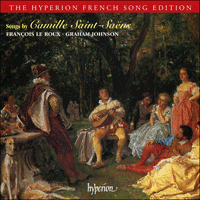



This issue in our French Song Edition is a single disc devoted to the songs of Camille Saint-Saëns, the composer of Carnival of the Animals, Danse Macabre and Samson and Dalila. During his long life (he lived to the age of eighty-six) he wrote a surprisingly large number of songs, few of which are well known. Here are twenty-seven of them. Saint-Saëns drew his texts from a wide variety of sources, old and new, including the greatest French writers of his time – Victor Hugo particularly. But, as Graham Johnson wittily says in his notes to the disc, 'they were all grist to Camille'.

The life
There can have been few composers who got off to such an auspicious start. Mozart (to whom he was frequently compared) perhaps? But like Mozart, Saint-Saëns had to struggle for recognition as an adult, and he paid a heavy price for his childhood celebrity. He acquired very early a flawless command of musical ways and means, but his career as an adult, not to mention his personality, suffered as a result. When one thinks how famous he was as an old man at the turn of the Century, it is difficult to realise that after his glittering career as a child prodigy, his progress through the world of music was blighted for many years by indifference and misfortune. For a long time his works were regarded as outré and impossibly ‘academic’, the worst possible epithet in the high-living, carefree (and essentially philistine) Paris of Napoléon III. With dogged application he continued to compose, receiving the sort of bad notices which would have obliterated the confidence of a lesser man. But then there was something absolutely indomitable about Saint-Saëns, and those who have studied his long life in depth are filled with admiration for his gifts, his industry, and his determination to compose only in the way that he wished. He had almost nothing of Massenet’s endless wish to please; indeed there was a side of him which almost relished being at war with anyone and everyone, the musical establishment above all. For many years he was the spokesman of modernism, a voice in the wilderness composing symphonies and chamber music when the French, drunk on Meyerbeer, had no use for such things. But in those years when ardent Wagnerism, and later Debussyism, seemed to be all the rage, he was as implacably opposed to the modems as he had been enthusiastically on their side earlier in his career. Indeed there seems to have been only a brief period at the end of the nineteenth century when his fame coincided with his reputation as an innovator. Even then the main musical agenda had already moved on, for by the 1890s Saint-Saëns’ mortal enemy Claude Debussy was the coming man, and everyone of importance in Paris, except the public at large, knew it.
After many years in the wilderness as far as the Parisian critics were concerned, Saint-Saëns eventually reaped the rewards of a lifetime’s hard work and achieved great celebrity. Little by little, and then with the speed of the Wall Street Crash, his reputation declined. Composers of Poulenc’s generation dismissed him as a ranting old reactionary, and this is more or less what he had become by as early as 1913, his ex cathedra pronouncements embittered by loneliness and spleen. His posthumous reputation plummeted to such an extent that it has still not recovered. We await a new catalogue of Saint-Saëns’ works and a biography in depth (both in preparation) which will take into account not only his many writings on music, but also the vast and fascinating correspondence. Whether this will restore him to the level of adored master that he enjoyed at the turn of the century is doubtful, but it should provoke a major reassessment of one of the most interesting musical personalities of the time. Who else could claim to have performed for the Citizen King, Louis-Philippe, at the Tuileries, and yet lived long enough to compose a chorus (Aux conquérants de l’air) in honour of ‘those magnificent men in their flying machines’, the brave airmen of the First World War and the Roaring Twenties?
The ‘Infant prodigy and Wunderkind’ 1835–1853
Charles-Camille Saint-Saëns was born on 9 October 1835. His father, Victor Saint-Saëns, died only a few months after his birth, and the frail child was brought up by his mother who was the daughter of a carpenter. Despite her lowly background Mme Saint-Saëns was an amateur painter of some ability, and had enormous artistic ambitions for her son. Her aunt Charlotte Masson, who had moved in to help in the upbringing of the boy, gave him piano lessons from the age of two-and-a-half, and it was soon clear that young Camille had absolute pitch and musical gifts of a high order. The composer remembered his fury at this age whenever he was taken away from the piano. His first composition was dated 22 March 1839 when he was three years and five months old. The first song dates from May 1841, a setting of Marceline Desbordes-Valmore entitled Le Soir (the composer was five-and-a-half years old). This is a little ditty in A minor with a sparse but surprisingly effective accompaniment noted down in astonishingly sophisticated calligraphy. (The time signature, for example, is simply 3, not the usual 3/4—an abbreviation that Saint-Saëns was to use throughout his life.) As a reward for writing another early song he was given a score of Mozart’s Don Giovanni, a gift which remained a talisman for the composer and a work which was a source of almost sacred inspiration for his entire life.
His mother seems to have been rather a severe woman (judging from her portrait) who was determined that Camille was not to be spoiled by the usual adulation surrounding a child prodigy. On the other hand he did not enjoy the freedoms of a normal boyhood; all his teachers carne to the house, and his thin build and pale complexion were signs not only of his generally frail health, but of a child raised in a hothouse. In 1843 he was sent to study the piano with Camille Stamaty, pupil of Frédéric Kalkbrenner, who in turn had studied with Haydn. By means of Kalkbrenner’s patented hand-guide, an adjustable horizontal rail parallel to the piano on which the forearm rested, Saint-Saëns was trained to have absolute independence of the fingers. These were astonishingly fleet (as we can hear on the few recordings he made as an old man), even if the playing was lacking in warmth of tone by the standards of the later nineteenth century. It seems to have been masterful and precise, almost free from extraneous rubato, the transparent jeu perlé of an earlier pianistic epoch, and utterly different from that of Liszt who was already an established virtuoso. On this disc, the song Tournoiement (track 15) from the Mélodies Persanes perhaps best illustrates the sort of difficult accompaniment which Saint-Saëns wrote from time to time to display his own technical accomplishment. He made his début in 1846 at the Salle Pleyel performing, among other things, Mozart’s Piano Concerto K450, and was duly hailed as a new Mozart.
One of the young Saint-Saëns’ first set-backs was his failure to win the Prix de Rome in 1852. (He tried again, also unsuccessfully, twelve years later.) In December 1853, under the auspices of this society, Saint-Saëns’ Symphony in E flat was announced as the work of an unknown German composer. It was received rapturously, and only then was its creator’s true identity revealed. Gounod, who had watched the young composer’s development for a number of years, wrote Saint-Saëns a generous letter which predicted that he would become a great composer. Rossini was also an admirer of Saint-Saëns’ precocious talents, as was Berlioz who said with typical acuity ‘He knows everything, but he lacks inexperience’. Even at this early stage Saint-Saëns’ formidable ability to manipulate the materials of music was seen to be at odds with the sheer quality of musical invention. Even then people noticed that his facility masked his human vulnerability, that indefinable quality which gives to music an unmistakable provenance.
The Revolutionary 1854–1870
The E flat major Symphony was published in 1855 as Opus 2, the first work by Saint-Saëns to appear in print. In this year he also composed L’Attente (Hugo, track 4) which alongside Le pas d’armes du Roi Jean [6] ranks as the composer’s best known work in the field of the mélodie, and which is included in American song albums at the expense of many other delights. A photograph from this period shows the composer to be a rather thin and sickly individual, a pale face hidden by an unimpressive beard, hardly the man-about-town and scarcely a convincing picture of a devout lover. Another symphony (in F major this time) followed with the subtitle Urbs Roma. All through this period Saint-Saëns was making part of his living by being an organist, first at the church of St Séverin, then St Merry (where his Messe Op 4 was given its first performance, a work which Liszt much admired) and later (from 1857) as organist at the Madeleine where he remained until 1876. The latter post was the most important of its kind in Paris and earned the composer a handsome 3000 francs a year. Saint-Saëns’ amazing ability to improvise at the organ drew visitors to the Madeleine from all over the world to hear him play: Clara Schumann, Sarasate, Anton Rubinstein and Robert Franz were all pilgrims to this particular shrine. Liszt himself pronounced Saint-Saëns the greatest organist in the world. This position was also something of a social one, and to permit him to entertain luminaries in the appropriate manner the composer bought a new apartment in the Rue du Faubourg Saint-Honoré where he lived in some style together with his mother and great aunt. His weekly Monday salons became a celebrated part of the Parisian music scene.
It was during this period that Saint-Saëns began his career as a teacher at the École Niedermeyer where he met the young Gabriel Fauré. A special bond of friendship was formed between the sixteen-year-old pupil and the professor who, after all, was only a decade older. It was thanks to Saint-Saëns that Fauré first heard the works of Schumann, Liszt and Wagner—not prescribed composers for students at a school which concentrated on church music. Fauré was to remain a lifelong friend, and his family was to be adopted by the older composer as his own in his later, lonely years.
Ars gallica 1870–1886
Political upheavals change the artistic climate of any age, and the Franco-Prussian War and the period of the Commune which followed it were a watershed for French art. The opening of the newly-built opera house of the Palais Garnier in 1875 seemed to serve notice on the sort of grand opera which had been so much a part of the Second Empire. Gounod’s successes on the lyric stage were now the model to follow, not the heavy and ornate works of Meyerbeer which had adapted Italian bel canto to the plush French taste. Much of this new mood of optimism in the musical world was to do with the founding of the Société Nationale de la Musique of which Saint-Saëns was vice-president. Also involved were the composers Alexis de Castillon, Henri Duparc, Saint-Saëns’ protégé Gabriel Fauré, César Franck, Edouard Lalo and so on. The motto of this organisation was ‘Ars gallica’. Of course there was still massive opposition to ‘music of the Future’ from the public, a tag which implied German modem madness. But this organisation was truly devoted to defending the home-grown music of France which had been so ignored. This was the period of Saint-Saëns’ tone poems (Le rouet d’Omphale [1872], Phaéton [1873], Danse macabre [1874]), a form which owed much to Liszt. These were not successful with the critics. Another major disappointment for the composer was that, despite the advocacy of the renowned mezzo soprano Pauline Viardot, he was unable to convince the director of the Opéra to stage Samson et Dalila. A concert performance of the first act of this work met with critical hostility.
In 1872 the composer had lost the woman who had first brought him to music, his great aunt Charlotte. He now lived alone with his mother, and up until 1875 we know almost nothing about his emotional life and his relationship to women. Madame Saint-Saëns was a difficult character who kept such distractions away from her son. It is all the more strange then that the composer should decide to marry a nineteen-year-old girl, Marie-Laure-Émilie Truffot, the sister of one of his school friends. Nothing is known about the background to this marriage, or why, for example, the ceremony took place far from Paris. Why was it that the composer seemed anxious to avoid the publicity? Was Madame Saint-Saëns informed, or did he marry the girl without his mother’s knowledge and to escape her influence? In any case, within a short time the married couple was living under the same roof as Madame Saint-Saëns, and the seeds of the destruction for this fragile relationship (the bride was uninterested in music) were sown. The composer’s mother was autocratic and exigent, and not only in personal matters; she seems to have remained Saint-Saëns’ sternest musical critic, and it is known that he composed a new finale to the Cello Sonata in C minor because she was not satisfied with the first. Certainly there is no reason to suppose that she would have made an easy mother-in-law.
The composer had two sons from this marriage (born in 1875 and 1877). In late May 1878 the elder of the little boys, aged two-and-a-half, fell to his death from the balcony of the house in Paris. Six weeks later the second son perished as a result of pneumonia. It seems that Saint-Saëns blamed his wife for both catastrophes. By 1881 the marriage was at an end. The composer simply walked out on his spouse when they were on holiday together; he left her a note saying that he would not return, and moved back to his mother. There is some parallel here with the behaviour of Paul Verlaine who had left his wife in a scandalous fashion a few years earlier, and whose choice of marriage partner had seemed peculiarly cavalier, quite apart from the fact that he was fundamentally unsuited to marriage. Saint-Saëns did not let these events get in the way of his productivity. A great many first performances of new works were given at this time, almost all of them roundly damned by the Parisian critics. In Weimar Samson et Dalila (in German translation of course) had a triumphant success under the auspices of Liszt. It is astonishing that this work, certainly the best-known of all Saint-Saëns’ stage works, should have had to wait fifteen years for a performance in Paris.
He was by now a feared critic, able to write polemical articles which seethed with anger and fury, and which recalled the acerbic literary style of Berlioz. He was also a respected scholar and editor, undertaking the preparation of a complete edition of Gluck’s works. Gradually the tide of public opinion in France began to turn in favour of Saint-Saëns’ music. If at long last he was no longer a prophet unappreciated in his own land, the troubling tide of modernity was beginning to wash over the composer just at the moment that his own music was being seriously countenanced by the French public. The Société Nationale was somewhat hijacked by Vincent d’Indy and other Wagnerians who wanted to promote the performance of foreign music—Wagner above all. Saint-Saëns left the society, and this period of ‘Ars gallica’ was at an end. From now on, and increasingly, he began to have reservations about the Wagnerian passions of his younger colleagues.
The Celebrity 1887–1901
The greatest emotional setback that the composer had to face in his life was the death of his mother in 1888. He had been passionately devoted to her, although there is no doubt that their relationship was far from healthy, and it left Saint-Saëns emotionally stunted in certain respects. The composer decided to turn his back on Paris which had been the scene of so many artistic frustrations and personal tragedies. Between 1890 and 1904 he had no fixed address, astonishing enough for a busy professional pianist, but almost unthinkable for a composer. Nevertheless he continued to write and work unabated, indeed with ever-increasing productivity. In addition to writing his own music he undertook the editing of the complete works of Rameau for Durand. More importantly he at last found success in the world of opera. The first performance in Paris of Samson et Dalila in November 1892 (fifteen years after the Weimar première) was a resounding triumph. From now on the composer could do no wrong, and his participation in various grandiose projects (for example Déjanire, an outdoor spectacle at Béziers) was cheered to the rafters and given serious critical approbation.
One might have imagined that this state of affairs would have encouraged the composer to enjoy the fruits of his Parisian success and settle down in some splendour and comfort. But without his mother it seems it was impossible for him to establish a conventionally comfortable household. Without a home of his own he continued to be the most nomadic of all composers, living out of suitcases and composing in railway carnages and ships’ cabins. The extent of this wandering exceeded the composer’s professional need for the itinerant life (to make money as a virtuoso): it became an end in itself, a flight from his memories and from his own ghosts. It is truly astonishing that he continued to write as much as he did, sending manuscripts back to his publishers in Paris. He was always accompanied by his pet dogs (the most famous of these was called Dalila and photographed by Nadar) and by his ever-faithful manservant Gabriel Geslin. Algeria and Egypt were favourite ports of call and this exotic travel is reflected often in the music. The Fifth Piano Concerto (1896) is known as the ‘Egyptian’ and there were two huge works for orchestra, Suite Algérienne and Africa. Of course Saint-Saëns’ fondness for these sunny destinations (also Spain, Portugal, Italy, Greece, Uruguay) was partly to do with his health. His weak chest made it necessary for him to seek out comfortable climates. But there was no doubt another agenda for his visits to North Africa, and one calls to mind many French visitors to those parts of the world (Pierre Louys, Flaubert, Gide among others) who were drawn there by the beauty of the inhabitants, and the air of sexual freedom so different from a Europe still reeling from the Oscar Wilde trial. In North Africa, compliant girls and boys were readily available to the well-to-do visitor, as well as older, more dominating paramours. It was thus far away from Paris that Saint-Saëns made whatever arrangements were necessary to give him passing moments of happiness, illusions of intimacy, the coming-to-terms with love that had eluded him in the normal channels of life. The composer was said to have been one of Proust’s models for the notorious Baron Charlus in À la recherche du temps perdu.
The Reactionary 1901–1914
It was now the younger composers whom Saint-Saëns had reason to fear. The success of the opera Les Barbares (1901) with certain older critics gave rise to a critical review by Claude Debussy, writing as his alter ego ‘Monsieur Croche’. Debussy accused Saint-Saëns of having written a mish-mash. ‘Is there no one who values Saint-Saëns enough’, he wrote, ‘to tell him that he has now written enough operas?’ From now on certain phrases begin to appear which describe the composer’s music as ‘bad, but well-written’. Nadia Boulanger once remarked, late in life, that ‘Saint-Saëns knew his business admirably well. He only lacked what no one could give him’, and of course this perception of the music is familiar because it is a legacy from the epoch of Debussy. Of course the composer carried on regardless, continuing to write operas. Hélène was given in Monte Carlo and London and achieved moderate success. The composer even bought a Paris apartment (after fourteen years of using hotels for his visits to the capital) in the Rue de Longchamp. And the travelling continued unabated, though in slightly more grandiose style as the retinue now consisted of a cook, chauffeur and housekeeper as well as the ever faithful Gabriel Geslin. On a personal level the composer’s reputation as a misanthrope continued to grow. It seemed that Fauré and his family were the composer’s only really close friends in the world of music, and even this relationship was subject to periods of cool withdrawal. Saint-Saëns seems positively to have enjoyed his reputation as a ‘difficult man’ and liked nothing better than to engage critics in polemical debate in various newspapers and journals.
There is no doubt that the composer was slowly winding down, in both his composing and playing. Nevertheless he displayed reserves of energy and will-power that astounded his peers. He occupied himself with turning the outdoor spectacle Déjanire into an opera for Monte Carlo, and travelled to London to play the complete Mozart piano concertos. His name is a footnote in the history of cinema by being the first to compose a score for moving pictures. This was for the silent film L’Assassinat du Duc de Guise made by Henri Lavedan, André Calmette and Charles le Bargy in 1908.
World War and Death 1914–1921
The war years were less productive of music. Saint-Saëns became a fiery patriot during this time and turned his considerable wrath on German music in general, Wagner in particular. His book Germanophilie made him many enemies, not only in Germany where he had almost always been well treated as a musician and where he had had some of his best successes, but in France as well. Many people saw it as a sign of senility that the composer should politicise music to this extent. A picture of Saint-Saëns at the age of eighty-five shows someone in remarkably good health, reading a score without the aid of glasses, the beard white but the hair on his head still dark. The final song on this record is a setting of Ronsard and has a demonic energy and humour which do not suggest a composer who had written himself out; indeed it is every bit as effective as young Poulenc’s settings honouring the same poet at about the same time.
Camille Saint-Saëns died in his beloved Algiers where he went on holiday after giving a concert in Dieppe, which he somehow knew would be his last in that town. He contracted pneumonia and was too weak to shake off the infection. He died on 16 December in 1921. His remains were brought back to Paris where there was a service at the Madeleine where he had been organist for so long. After a state funeral he was buried at the cemetery of Montparnasse.
The man and the songs
It would be idle to pretend that we find in the songs of Saint-Saëns the same chronicle of spiritual development that would unfold in a retrospective exhibition of Fauré mélodies (if it were possible to turn aural pictures into visual ones). In a gallery of that composer’s songs we would walk through a number of rooms marking a gradual evolution from charmer of the salon (when Saint-Saëns was his teacher) to the astounding depths of the late cycles—music which is unlike any other, and sometimes seems to have been conceived on, and for, another planet. At this late stage Fauré, who was ten years younger than Saint-Saëns, seems to be without doubt the older composer—deaf, withdrawn into his own rarefied world. By contrast Saint-Saëns is still witty and sprightly at eighty; there is a type of agelessness about him, and there is not a world of difference between the first song on this disc and the last. Thus he had Peter Pan qualities, the composer who never grew up perhaps—a lost boy. Maybe this is to do with a troubled childhood, and a deep desire ever to remain there, or at least compulsively to return to this infantile world in fleeting visits.
There was a great deal about Saint-Saëns which remained a big baby, childish despite his white beard and lofty air of a grand maître. His rages and petulant outbursts (both in the press and in his private life) were probably little different to his fury when his great aunt attempted to remove him from the piano at three-and-a-half. It is unlikely that he ever had a mature love affair, and at times he seems to have been utterly impervious to the misfortunes that befell him (particularly in terms of his failure, for years on end, with the French critics). It is all as if he was safely protected in the fortress of a mother’s love where no one ever ages but where one runs the risk of perishing in other ways. After the death of his sons he returned to his mother, abandoning his wife as if she had never existed. If we accept that there was a part of his psyche that lived in Never Never Land and that we should not attempt to look in his work for the insights of those who submit to the ageing processes of the real world, there is much to recommend this music. Indeed the boyishness of Saint-Saëns is one of his special strengths. There are many things worse than the imaginative fantasy of a child, the energy of perpetual youth, and the ability to dress up in brilliant fancy dress at the drop of a hat. And of course the mastery of the medium of song is astonishing, where everything is so well written for the voice, and where the accompaniments (demanding though some of them are) are always interesting and grateful. In this respect he was the seasoned professional, merciless in his attitude to the slipshod, anything but child-like.
Graham Johnson © 1997
Peu de compositeurs connurent des débuts aussi favorables, excepté peut-être Mozart (auquel il fut souvent comparé). Mais, à l’instar de ce dernier, Saint-Saëns dut lutter pour être reconnu en tant qu’adulte, et sa célébrité d’enfant lui coûta un lourd tribut. Certes, il acquit très tôt une parfaite maîtrise de la mécanique musicale, mais sa carrière d’adulte, sans parler de sa personnalité, en pâtit. Longtemps, ses œuvres furent jugées extrêmement «académiques», la pire épithète qui fut dans le Paris luxueux, insouciant (et essentiellement philistin) de Napoléon III. Avec une application obstinée, il continua néanmoins de composer, malgré des critiques qui auraient ruiné l’assurance d’un homme moindre.
Après des années de traversée du désert, du moins pour les critiques parisiens, Saint-Saëns récolta les récompenses d’une vie de labeur et connut une grande célébrité. Après tout, il possédait un vaste catalogue de compositions, dans presque toutes les formes, et ses voyages incessants de par le monde lui avaient acquis une réputation à l’étranger peut-être supérieure à celle de tout autre musicien français. Qui d’autre pourrait se targuer d’avoir joué pour le «roi-citoyen» Louis-Philippe aux Tuileries, mais aussi d’avoir vécu assez longtemps pour composer un chœur (Aux conquérants de l’air) en l’honneur de ‘ces hommes magnifiques dans leurs machines volantes’, ces courageux aviateurs de la Première Guerre mondiale et des Années folles? Il est désormais temps de se livrer à un réexamen majeur du rôle considérable de Saint-Saëns dans l’histoire de la musique française.
Il serait vain de prétendre trouver dans les chants de Saint-Saëns une chronique du développement spirituel identique à celle qui se dégagerait d’une rétrospective des mélodies de Fauré. À quatre-vingts ans, Saint-Saëns demeurait alerte et plein d’esprit, comme touché par une sorte d’intemporalité, et rien ne sépare le tout premier du tout dernier chant du présent enregistrement. Être aux qualités d'un Peter Pan, il fut le compositeur qui ne grandit jamais—un garçon perdu, qui n’eut probablement aucune liaison amoureuse mature et semble avoir été parfois totalement insensible aux infortunes qui lui échurent (surtout pour ce qui concerne ses années d’échec auprès des critiques français). Pourtant, sa maîtrise du chant est stupéfiante: tout est tellement bien écrit pour la voix, avec des accompagnements (très exigeants dans certains cas) toujours intéressants et sincères. À cet égard, il était un professionnel chevronné, impitoyable dans son attitude envers le style négligé, tout sauf enfantin.
Le présent enregistrement s’ouvre sur neuf chants de Victor Hugo, poète que Saint-Saëns fut un des premiers à mettre en musique. L’on pourrait d’ailleurs arguer qu’il réussit mieux qu’aucun de ses successeurs, en tout cas mieux que Fauré, à trouver une musique pour ces poèmes lyriques. Les chants de la période moyenne reflètent un amour du voyage tant ils sont surtout l’œuvre d’un homme qui a visité des lieux éloignés et est parvenu, grâce à ses découvertes musicologiques, à une grande compréhension des styles antérieurs. Quant aux chants des dernières années, ils présentent un classicisme chaste et baigné de lune, signe d’un individu qui se défait des ornements de velours d’un vieux siècle élimé. Fauré et lui sont en harmonie dans leur méfiance vis-à-vis du profond ou du sublime: ils ne s’autorisent pas à être dominés par l’esthétique du cercle de Franck, et leurs chants saisissent le lied allemand sans le considérer comme un principe vital. L’art de Saint-Saëns suit la même direction que, plus tard, sa vie de nomade: toujours en avant, toujours en mouvement, sans jamais se laisser déborder par des choses qui fouilleront trop profond et poseront trop de questions. Nous touchons là à une des qualités les plus séduisantes pour l’auditeur moderne: presque tous ces chants sont dépourvus de sentimentalité et débarrassés d’un manque de goût spécieux. (Sur ce disque, seul le chant Aimons-nous frise la sublimité.) Si les mélodies de Saint-Saëns nous semblent simples comparées à celles de son élève Fauré et de son «petit-élève» Ravel, rappelons-nous que son esthétique influença énormément ces maîtres plus jeunes. Ses chants surpassent sans peine les nombreux personnages moindres qui s’imaginaient beaucoup plus profonds que le pauvre vieux Saint-Saëns, qu'ils traitaient avec condescendance. Un regard sur le vaste catalogue de son œuvre et sur l’ampleur de ses réalisations aurait pourtant suffi à les stopper net. Car Saint-Saëns n’est pas à traiter avec condescendance, et il mérite mieux du monde moderne que le semi-oubli dans lequel sa réputation décrépit désormais.
Graham Johnson © 1997