Welcome to Hyperion Records, a British classical label devoted to presenting high-quality recordings of music of all styles and from all periods from the twelfth century to the twenty-first.
Hyperion offers both CDs, and downloads in a number of formats. The site is also available in several languages.
Please use the dropdown buttons to set your preferred options, or use the checkbox to accept the defaults.
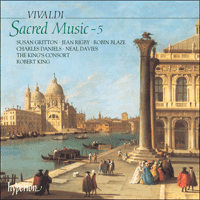



The fifth volume in Robert King's acclaimed series opens with Susan Gritton singing the highly virtuosic In turbato mare, the metaphorical ship of the soul truly having a rough time at sea. This flamboyance leads to the more contemplative Non in pratis, the introduction to a Miserere setting, now lost. The famous Stabat mater then becomes the ideal vehicle to reveal the vocal sweetness of young countertenor Robin Blaze.
Three further motets round off the programme: O qui coelis includes the extraordinary aria 'Rosa qui moritur' ('The rose which dies'), plaintively sung by Susan Gritton; Deus tuorum is a simple strophic setting of this famous Hymn, but one which is strangely captivating; and the trio Confitebor tibi, Domine ranks among Vivaldi's supreme achievements in the genre.
All of the music on this album is also available as part of the specially priced box set Vivaldi: The Complete Sacred Music: ‘King has given us the ultimate Vivaldi anthology, abundant in energy, rich with emotion, animation, and color, and enshrined in Hyperion's fabled, warm, and incomparable sound’ (Fanfare, USA).

Raised as a violinist, Vivaldi probably wrote little or no church music until the second decade of the eighteenth century. But his travels with his father as a ‘jobbing’ player often placed him in situations where commissions for sacred works might have occurred. Such was the probable origin of the earliest sacred work by him on which a date can be set, the Stabat mater, RV621 (‘RV’ numbers refer to the standard modern catalogue of Vivaldi’s works by Peter Ryom). Vivaldi had visited Brescia in 1711 to play in the patronal festival of the Philippine church, Santa Maria della Pace; among the compositions acquired by this church in the following year and listed in its account book we find the Stabat mater for alto and strings, commissioned for the Feast of the Seven Sorrows of the Blessed Virgin, which in 1712 fell on 18 March.
In 1713 an event of the greatest importance for Vivaldi’s career occurred. Francesco Gasparini, who was choirmaster at the Pietà, the Venetian charitable institution for foundlings where Vivaldi worked as a violin master and orchestral director, went on a leave from which he never returned. Until as late as 1719 the Pietà failed to replace him, which meant that Vivaldi (together with a colleague, the singing teacher Pietro Scarpari) found himself invited to take over the main task of the maestro di coro: to supply the singers of the institution with a steady stream of new compositions which would attract a well-heeled congregation to the chapel services and so encourage donations and bequests. For reasons of decorum, mixed church choirs were not acceptable in Catholic Europe at this time, and since the Pietà’s male wards left the institution during adolescence to take up apprenticeships, it had no option but to train and use exclusively female residents as musicians. Remarkably, the choir was laid out exactly as a normal male choir, with tenors and basses in addition to the expected sopranos and altos. The tenor parts, which have rather high compasses, were certainly sung as written; the bass parts were probably also sung much of the time at notated pitch by a handful of women with exceptionally deep voices. In case of difficulty, the bass parts could be transposed up an octave without damage to the harmony, since they were nearly always doubled by instruments. Solo parts, however, were overwhelmingly for high voices: soprano or alto. More than the choir, the orchestra or even the composers of the music, these soloists were the ‘star attraction’ of music-making at the Pietà—their names recorded for posterity in the letters and memoirs of visitors to its chapel. The triumphant solismo of the contemporary opera houses could hardly fail to spill over into the sacred domain.
Little of Vivaldi’s church music composed during this period (1713–1719) circulated in Italy outside the Pietà’s walls, but some works reached the Habsburg domains in central Europe. A visitor from Bohemia, Balthasar Knapp, acquired a number before his return to Prague in 1717, and his collection appears to have been the nucleus of a modest Vivaldi cult which flourished in such centres as Prague, Osek (in north Bohemia), Brno (in Moravia) and even Breslau (in Silesia). Vivaldi’s sacred works were also known in the capital of Saxony, Dresden, where the Bohemian composer Jan Dismas Zelenka took a few pieces into his extensive collection of church music.
The surviving works from this ‘first’ period account for just under half of the total. A similar number date from a ‘middle’ period stretching from the mid-1720s to the early 1730s. These include nearly all the compositions laid out for two ensembles (in due cori, as Vivaldi describes this form of setting). Whereas the earlier works are restrained in expression and generally quite simple in texture, this second group is characterized by flamboyance and contrapuntal ostentation. Many of these works appear to have a connection with the Feast of St Lawrence Martyr on 10 August; Vivaldi may have written them for the convent church of San Lorenzo in Venice (which every year celebrated its patronal festival with great pomp, commissioning music for Mass and Vespers from external composers), or perhaps for the church of San Lorenzo in Damaso, whose protector was his Roman patron, Cardinal Pietro Ottoboni. What is certain is that these works were composed for male voices—the energetic writing for the bass voices in such works as the Dixit Dominus, RV594, would be unthinkable for a female singer.
Near the end of his career, in 1739, Vivaldi once again supplied sacred vocal compositions to the Pietà during an interregnum between choirmasters—this time for payment, since he was no longer its employee. Only three of the works, apparently written for Easter Sunday, are extant today. They exemplify very clearly Vivaldi’s turn, in his last years, to the fashionable galant style cultivated by younger Neapolitan composers, among them Vinci, Leo and Porpora.
A clear majority of the surviving works are for solo voice or voices. These include all the motets, introduzioni (an introduzione is a special kind of motet designed to precede the setting of a Psalm or a section of the Mass), hymns and votive antiphons, besides a few of the Psalms themselves. The remaining works are either—in the language of the time—pieno (for choir only) or concertato (for choir with one or more soloists). The supporting orchestra is most often made up merely of strings and continuo, but several of the compositions include wind instruments or obbligato parts. The vitality and idiomatic quality of the instrumental writing in these works is unrivalled in Italian sacred vocal music of the period.
A clear distinction must be made between the works on liturgical texts—texts which are unalterable and have their appointed place in the church calendar—and those on freely invented poetic texts (motets and introduzioni). The former mostly employ forms either peculiar to church music (for example, the so-called ‘church aria’ resembling the outer section of a da capo aria) or freely derived from instrumental music, while the latter follow secular models in their adoption of recitative and the da capo aria. A very few movements in the ‘liturgical’ works observe the stile antico based (at some remove, and not without modification) on the polyphonic language of sixteenth-century vocal music. Vivaldi seems to have had great difficulty in reproducing this style, since the specimens contained in his works include several instances of plagiarism.
The greatness of Vivaldi’s sacred vocal music resides not in its historical influence, for it seems not to have circulated very widely in his day and (unlike his concertos) not to have initiated any practice copied by other composers, but rather in its consummate artistry and high level of inspiration. If Vivaldi does not quite have the musical gifts of a Bach, a Handel or even a Pergolesi, he has a manner of expression which is entirely individual and unmistakable, even in his least substantial works. In his best movements one discerns an almost shocking radicalism: a willingness to strip music down to its core and reconstitute it from these simplest elements. There is also a powerful instinct for thematic integration at work; time and again, analysis reveals how the same simple ideas inform each movement of a composite work and impart unity to it. The often unexpectedly subtle word-painting testifies to the thoughtfulness which Vivaldi brought to these compositions. They can accurately be described as the bridge between his imagination as a musician and his conviction as a priest: the point on which all facets of his complex personality converged.
In turbato mare RV627
In the late 1720s Vivaldi’s connections with the court at Dresden became strengthened. His loyal advocate and former pupil Johann Georg Pisendel took over the direction of the court orchestra in 1728, and a group of seven singers who had been trained in Venice for six years at the court’s expense (two of them as fee-paying boarders at the Pietà) arrived in 1730. The two motets collected by Zelenka (see above) very possibly reached him soon afterwards via one of these singers. The text of this motet for soprano employs the standard operatic metaphor of a ship buffeted by heavy seas that the helmsman is able to steer safely into port—in this case with the aid of the stella maris, the Virgin Mary. One progressive feature of the first aria is the use of a different metre and slower tempo for the central (‘B’) section. This strong musical contrast parallels the difference in mood between the ‘A’ and ‘B’ sections of the text. The final ‘Alleluia’ demonstrates Vivaldi’s rhythmic and harmonic inventiveness even when the texture becomes reduced to only two ‘real’ parts.
Non in pratis aut in hortis RV641
One of the most important tasks of the choirmaster at the Pietà was to compose music for Holy Week, including a setting of Psalm 50, the Miserere. If Vivaldi composed one, it has been lost, although a setting in C minor (c1733) by Giovanni Porta (maestro di coro from 1726 to 1737) survives. Vivaldi did, however, leave two introduzioni to the Miserere for solo alto—Non in pratis aut in hortis, RV641, and Filiae maestae Jerusalem, RV638 (recorded in Volume 2 of this series, CDA66779). Both works date from around 1715 and allow the final recitative to cadence finally in C minor, although RV641 opens irregularly in F major. My surmise is that these were alternative ‘introductions’ to the same Miserere, the key of which was later adopted also by Porta. Their exceptionally narrow vocal compasses and generally restrained style correspond to those of Geltruda, one of the Pietà’s most celebrated singers during this period.
The emotional core of RV641 is its solitary central aria, which successfully conveys a mood of dignified lamentation appropriate to Passiontide. This movement epitomizes Vivaldi’s ability to achieve overpowering expression by the very simplest means. Geltruda reportedly had a soft voice, and one notes Vivaldi’s constant efforts (by muting, or temporarily omitting, the strings) to ensure that the singer is never drowned.
It is impossible to carry out Vivaldi’s original intention by appending the Miserere, but to allow RV641 to have no sequel at all is equally impossible. This recording resolves the problem pragmatically by following this introduzione with the Stabat mater, which is at least related by key, mood, subject, season and period of composition, even if it belongs to a different liturgy.
Stabat mater RV621
This justly popular work belongs to the very first generation of Vivaldi sacred vocal music to be discovered and revived in the twentieth century. Alfredo Casella included it, alongside the even more celebrated Gloria, RV589, in his pioneering ‘Vivaldi Week’ at Siena in 1939, and it has been available in print since 1949. The circumstances that led to its composition for Brescia in 1712 were described earlier. One point needs to be made very clear: unlike the composers of other famous settings of the time—who include Pergolesi, the two Scarlattis, Steffani and D’Astorga—Vivaldi does not set the complete poem of twenty three-line stanzas plus an ‘Amen’, as appropriate for the liturgy of the Mass; instead, he sets only the first ten stanzas, as prescribed when the text is used as a hymn at Vespers. As Deus tuorum militum, RV612, makes plain, the normal way of setting hymns was to repeat the same music for successive verses. Perhaps the Stabat mater text was too long for a purely strophic setting to be contemplated, or perhaps Vivaldi’s ambition and imagination did not permit this. At any rate, the result is a fascinating and unique mixture of the strophic approach (the music for movements 1 to 3 being repeated for movements 4 to 6) and the through-composed approach normal in Psalms.
Moving and expertly written though RV621 is, it betrays the hand of a composer still much more experienced at writing for instruments than for voices. Within each movement, the musical motifs tend to be developed autonomously in a manner that would later be called ‘symphonic’, irrespective of the changing images and emphases in the words. The breath of L’estro armonico, Op 3 (1711), Vivaldi’s first published collection of concertos, is clearly felt. On occasion, however, Vivaldi achieves spectacular effects of word-painting—notably in the seventh movement, ‘Eia mater’, where jagged rhythms express, almost as in a Bach Passion, the scourging of Jesus. The mood is solemn and tragic throughout; Vivaldi restricts himself to the two keys of F minor and C minor, and the tempo moves between moderately slow and extremely slow in a manner prescient of Haydn’s Seven Last Words from the Cross or Shostakovich’s String Quartet No 15.
O qui coeli terraeque serenitas RV631
This is one of three surviving solo motets that we know (from the evidence of the paper on which the manuscript was written) to have been composed during Vivaldi’s sojourns in Rome during the carnival seasons of 1723 and 1724. These works were most likely written for some of the singers who performed in his three operas written for the Capranica theatre in Rome: Ercole su’l Termodonte, Il Tigrane and Giustino. RV631 is a motet per ogni tempo—‘for all seasons’. Its Latin text, contaminated as always by Arcadian language borrowed from the secular sphere, is a prayer for the deliverance of the believer from earthly delights and for his espousal of heavenly ones. Vivaldi chooses the gentle E flat major as his central key, and the abundant ‘sighing’ appoggiaturas in the first aria conjure up very well the ever-present blandishments of the world. The second aria, in C minor, uses the traditional lamento bass (a descent by chromatic steps from tonic to dominant), perhaps a little ironically, to convey the wilting of a rose. In a final ‘Alleluia’ the soprano dissolves all the argument in an exultant display of virtuosity.
Deus tuorum militum RV612
This unpretentious composition is a Vesper hymn that belongs to the ‘Common of One Martyr’, that is, the part of the liturgy used for all male saints and martyrs, including St Lawrence. The use of two obbligato oboes, in addition to the normal strings, is foreign to the Pietà; all indices point to a date of composition in the 1720s. As usual, Vivaldi sets only alternate stanzas (1, 3 and 5) of the hymn, leaving the others for performance in plainsong or paraphrase on the organ.
Confitebor tibi, Domine RV596
This three-voice setting of a Psalm (110 in the Vulgate numbering) that belongs to several Vesper liturgies, including those of Sundays and male martyrs, ranks among Vivaldi’s supreme achievements in church music. It is relatively late (c1732) and, once again, appears to be unconnected with the Pietà (whose voices certainly could not have coped with the strenuous tenor and bass parts). Vivaldi coaxes the ten verses of the Psalm into four movements, to which two movements are added for the Lesser Doxology (‘Gloria Patri …’), which is always appended to a Psalm setting. The style exemplifies Vivaldi’s turn to counterpoint in his middle-period (c1720–c1735) works, as described earlier. The fugal expositions and imitative episodes of the fourth movement, ‘Intellectus bonus’, would do credit to any composer. Vivaldi uses the two solo oboes in much the same way as in RV612; they certainly add élan and vitality to the sound.
The final movement, ‘Et in saecula saeculorum’, is a transposed version of the outer (‘A’) section of a terzet in da capo form from Vivaldi’s opera La fida ninfa (Verona, 1732). The text of the operatic terzet expresses the gyrations of the wheel of fortune, whereas the second part of the Doxology expresses the immutability of eternity. By using musical motifs that can be held to represent both circular motion (the opening of the tenor line) and the constancy of the ages (its continuation as a counter-subject in long notes), Vivaldi manages to have things both ways. This borrowing has an appositeness worthy of Handel’s best efforts in the same direction.
Michael Talbot © 1999
Non in pratis aut in hortis RV641
L’une des plus importantes tâches du maître de chœur à la Pietà consistait à composer pour la Semaine sainte, ce qui incluait une mise en musique du psaume 50, le Miserere. Si Vivaldi en a réalisé une, elle a été perdue—bien que celle de Giovanni Porta (maestro di coro de 1726 à 1737), en ut mineur (ca1733), nous soit parvenue. Vivaldi laissa cependant deux introduzioni au Miserere pour alto solo—Non in pratis aut in hortis, RV641 et Filiae maestae Jerusalem, RV638 (enregistrée dans le volume 2 de la présente série, CDA66779). Ces deux œuvres, qui datent approximativement de 1715, laissent finalement le dernier récitatif s’achever sur une cadence en ut mineur, lors même que RV641 s’ouvre irrégulièrement en fa majeur. Ces pièces furent, à mon sens, deux «introductions» possibles au même Miserere, dont la tonalité fut également adoptée, plus tard, par Porta. Leurs ambitus vocaux exceptionnellement étroits et leur style généralement retenu correspondent à ceux de Geltruda, l’une des plus célèbres chanteuses de la Pietà de l’époque.
Cœur émotionnel de RV641, l’aria centrale, solitaire, parvient à véhiculer une atmosphère de lamentation digne, appropriée aux deux dernières semaines quadragésimales. Ce mouvement incarne la capacité de Vivaldi à obtenir une expression irrépressible avec les moyens les plus simples. Geltruda passait pour posséder une voix douce, et Vivaldi fit de constants efforts (en étouffant les cordes, ou en les omettant temporairement) pour s’assurer qu’elle ne fût jamais noyée.
S’il est impossible de respecter l’intention originelle de Vivaldi en enchaînant avec le Miserere, il est tout aussi impossible de laisser RV641 sans suite. Le présent enregistrement résout le problème de manière pragmatique, en programmant le Stabat mater qui, bien qu’issu d’une toute autre liturgie, n’est pas sans un lien de tonalité, d’atmosphère, de sujet, de saison et de période de composition.
Stabat mater RV621
Cette œuvre, populaire à juste titre, appartient à la toute première génération de la musique vocale sacrée de Vivaldi découverte et ressuscitée au XXe siècle. Alfredo Casella l’inclut—aux côtés d’une pièce encore plus célèbre, le Gloria, RV589—dans sa novatrice «Semaine Vivaldi», à Sienne, en 1939, et sa version imprimée est disponible depuis 1949. Contrairement aux compositeurs des autres mises en musique fameuses de l’époque (tels Pergolese, les deux Scarlatti, Steffani et D’Astorga), Vivaldi mit en musique non l’ensemble du poème—savoir vingt strophes de trois vers plus un «Amen», comme le requiert la liturgie de la messe—, mais les dix premières strophes, prescrites lorsque le texte est utilisé comme hymne vespérale. Comme l’atteste Deus tuorum militum, RV612, mettre des hymnes en musique consistait habituellement à répéter la même musique à chaque strophe. Peut-être le texte du Stabat mater était-il trop long pour envisager une mise en musique purement strophique, ou peut-être l’ambition et l’imagination de Vivaldi s’y opposèrent-elles. Quoi qu’il en soit, le résultat est un mélange, fascinant et unique, de l’approche strophique (la musique des mouvements 1 à 3 étant répétée aux mouvements 4 à 6) et de l’approche durchkomponiert, usuelle dans les psaumes.
Pour émouvante et expertement écrite qu’elle soit, cette pièce n’en trahit pas moins la main d’un compositeur encore beaucoup plus aguerri à l’écriture pour instruments que pour voix. À l’intérieur de chaque mouvement, les motifs musicaux tendent à être développés isolément, d’une manière que l’on devait ultérieurement qualifier de «symphonique», indépendamment des images changeantes et des emphases sémantiques. Le souffle de L’estro armonico, op.3 (1711), le premier recueil de concertos vivaldien publié, est évident, malgré de spectaculaires effets d’illustration textuelle—notamment dans le septième mouvement «Eia mater», où les rythmes déchiquetés expriment, presque comme dans une Passion de Bach, la flagellation de Jésus. L’atmosphère ne quitte jamais le solennel et le tragique; Vivaldi se limite aux deux tonalités de fa mineur et ut mineur, cependant que le tempo se meut entre le modérément lent et l’extrêmement lent, d’une façon qui préfigure les Sept dernières paroles du Christ en croix de Haydn ou le Quatuor à cordes no15 de Chostakovitch.
O qui coeli terraeque serenitas RV631
Cette pièce est l’un des trois motets solistes connus; le papier du manuscrit nous apprend que ces motets—très probablement destinés à certains des interprètes des trois opéras vivaldiens composés pour le théâtre Capranica de Rome: Ercole su’l Termodonte, Il Tigrane et Giustino—furent écrits lors des séjours romains de Vivaldi, durant les saisons carnavalesques de 1723 et 1724. RV631 est un motet per ogni tempo, «pour toutes les saisons». Son texte latin, contaminé, comme toujours, par le langage arcadien emprunté au domaine profane, est une prière pour que le croyant soit délivré des charmes terrestres et épouse les délices célestes. Vivaldi choisit pour tonalité centrale le doux mi bémol majeur, et les abondantes appoggiatures «soupirantes» de la première aria symbolisent très bien les blandices perpétuelles du monde. La seconde aria, en ut mineur, recourt à la traditionnelle basse de lamento (une descente, par degrés chromatiques, de la tonique à la dominante), peut-être un peu ironiquement, pour traduire la flétrissure d’une rose. Dans un ultime «Alléluia», la soprano dissout tout l’argument en une exultante démonstration de virtuosité.
Deus tuorum militum RV612
Cette composition sans prétention est une hymne vespérale appartenant au «commun d’un martyr», i.e. à la partie de la liturgie utilisée pour tous les saints et martyrs, y compris saint Laurent. Le recours à deux hautbois obbligato, en sus des cordes normales, est étranger à la Pietà; tous les indices donnent à penser que cette œuvre fut composée dans les années 1720. Comme à l’accoutumée, Vivaldi ne mit en musique qu’une strophe sur deux (1, 3 et 5), réservant les autres au plain-chant ou à une paraphrase à l’orgue.
Confitebor tibi, Domine RV596
Cette mise en musique, à trois voix, d’un psaume (110 de la Vulgate) appartenant à plusieurs liturgies vespérales—dont celles des dimanches et des martyrs—compte parmi les réalisations suprêmes de Vivaldi en matière de musique d’église. Relativement tardive (ca1732), elle semble, elle aussi, sans rapport avec la Pietà (dont les voix n’auraient certainement pu assumer les parties ardues de ténor et de basse). Vivaldi parvient à englober les dix strophes du psaume dans quatre mouvements, auxquels il adjoint deux mouvements pour la petite doxologie («Gloria Patri …»)—laquelle accompagne toujours une mise en musique psalmique. Le style illustre le tournant vers le contrepoint pris par Vivaldi dans les œuvres de sa période moyenne (ca1720–ca1735). Les expositions fuguées et les épisodes en imitation du quatrième mouvement, «Intellectus bonus», feraient honneur à tout compositeur. Vivaldi utilise les deux hautbois solos de la même manière que dans RV612, ce qui apporte certainement élan et vitalité à la sonorité.
Le mouvement final, «Et in saecula saeculorum», est une version transposée de la section extrême («A») d’un tercet, de forme da capo, extrait de l’opéra vivaldien La fida ninfa (Vérone, 1732). Le texte de ce tercet exprime les girations de la roue de la fortune, tandis que la seconde partie de la doxologie traduit l’immuabilité de l’éternité. En recourant à des motifs musicaux pouvant être tenus pour des symboles du mouvement circulaire (l’ouverture de la ligne de ténor) et de la constance des siècles (sa continuation comme contre-sujet en longues), Vivaldi parvient à couvrir les deux notions. Cet emprunt est d’une pertinence digne des meilleurs efforts de Haendel dans le même sens.
Michael Talbot © 1999
Français: Hypérion
Non in pratis aut in hortis RV641
Eine der wichtigsten Aufgaben des Chorleiters an der Pietà war es, Musik für die Karwoche zu komponieren, unter anderem eine Vertonung des 50. Psalms, des Miserere. Sollte Vivaldi eine komponiert haben, so ist sie verlorengegangen, während eine (um 1733 entstandene) Vertonung in c-Moll von Giovanni Porta, dem maestro di coro von 1726 bis 1737, erhalten ist. Immerhin hat uns Vivaldi jedoch zwei introduzioni zum Miserere für Soloalt hinterlassen—Non in pratis aut in hortis RV641 und Filiae maestae Jerusalem RV638. Beide Werke stammen aus der Zeit um 1715 und lassen das jeweils letzte Rezitativ abschließend in c-Moll kadenzieren, obwohl RV641 regelwidrig in F-Dur einsetzt. Ich nehme an, daß es sich um alternative „Einleitungen“ zu ein und demselben Miserere handelt, dessen Tonart später auch von Porta übernommen wurde. Ihr außergewöhnlich geringer Stimmumfang und der insgesamt zurückhaltende Stil entsprechen den Mitteln von Geltruda, einer der bekanntesten Sängerinnen dieser Epoche an der Pietà.
Emotionaler Kern von RV641 ist seine einzige, zentral angesiedelte Arie, die mit Erfolg eine der Passionszeit angemessene Atmosphäre würdevollen Klagens vermittelt. Der Satz spiegelt Vivaldis Fähigkeit wider, mit einfachsten Mitteln überwältigende Ausdruckstiefe zu erzeugen. Geltruda soll eine zarte Stimme gehabt haben, und man vermerkt Vivaldis ständiges Bemühen (indem er die Streicher dämpft oder gelegentlich ganz wegläßt), dafür zu sorgen, daß die Sängerin nicht übertönt wird.
Es ist nicht möglich, Vivaldis ursprünglicher Intention zu entsprechen und das Miserere anzuhängen, aber ebenso unmöglich wäre es, überhaupt nichts dahinter zu setzen. Die vorliegende Aufnahme löst das Problem pragmatisch, indem sie dieser introduzione das Stabat mater folgen läßt, das ihr wenigstens durch seine Tonart, seine Stimmung, sein Thema, seine Aufführungs- und Entstehungszeit verwandt ist, auch wenn es einer anderen Liturgie angehört.
Stabat mater RV621
Dieses zu Recht beliebte Werk gehört zur allerersten Generation der sakralen Vokalmusik Vivaldis, die im 20. Jahrhundert wiederentdeckt und zu neuem Leben erweckt wurde. Alfredo Casella nahm es zusammen mit dem noch berühmteren Gloria RV589 in die bahnbrechende „Vivaldi-Woche“ auf, die er 1939 in Siena veranstaltete, und es ist seit 1949 im Druck erhältlich. Im Gegensatz zu anderen Komponisten bekannter Vertonungen seiner Zeit—darunter Pergolesi, Alessandro und Domenico Scarlatti, Steffani und D’Astorga—setzt Vivaldi nicht das vollständige Gedicht von zwanzig dreizeiligen Strophen plus einem „Amen“, wie es für die Messeliturgie angemessen wäre; statt dessen vertont er nur die ersten zehn Strophen, wie es vorgesehen ist, wenn der Text als Vesperhymne eingesetzt werden soll. Wie aus Deus tuorum militum RV 612 eindeutig zu ersehen ist, war es beim Vertonen von Hymnen üblich, für aufeinanderfolgende Verse jeweils die Musik zu wiederholen. Vielleicht war der Text des Stabat mater zu lang, um einen rein strophischen Satz sinnvoll erscheinen zu lassen, oder vielleicht gestatteten Vivaldis Ehrgeiz und Phantasie ihm so etwas einfach nicht. Das Ergebnis ist jedenfalls eine faszinierende und einzigartige Mischung aus strophischem Herangehen (die Musik der Verse 1 bis 3 wird für die Abschnitte 3 bis 6 wiederholt) und der Methode des Durchkomponierens, das bei Psalmen die Regel war.
So bewegend und gekonnt verfaßt RV621 auch ist, verrrät es doch die Handschrift eines Komponisten, der noch erheblich mehr Erfahrung im Instrumentalsatz als im Schreiben für Gesangsstimmen hatte. Innerhalb jedes Satzes werden die musikalischen Motive meist unabhängig auf eine Weise durchgeführt, die man später „sinfonisch“ nennen sollte, ungeachtet der wechselnden Bildsprache und Betonung im Text. Man spürt deutlich den Hauch von L’estro armonico op. 3 (1711), Vivaldis erster veröffentlichter Zusammenstellung von Konzerten. Hin und wieder gelingen Vivaldi jedoch spektakuläre Wortmalerei-Effekte—insbesondere im siebten Satz „Eia mater“, wo die schroffen Rhythmen, die der Geißelung Christi Ausdruck geben, beinahe an eine Bach-Passion gemahnen. Die Stimmung ist durchweg feierlich und tragisch; Vivaldi beschränkt sich auf die beiden Tonarten f-Moll und c-Moll, und die Tempi wechseln auf eine Weise zwischen mäßig langsam und extrem langsam, die auf Haydns Sieben letzte Worte unseres Erlösers am Kreuze oder Schostakowitschs Streichquartett Nr. 15 vorausweisen.
O qui coeli terraeque serenitas RV631
Dies ist eine von drei erhaltenen Solomotetten, von denen wir (auf Grund von Untersuchungen des Manuskriptpapiers) wissen, daß sie während Vivaldis Aufenthalten in Rom 1723 und 1724 jeweils zur Karnevalzeit entstanden sind. Höchstwahrscheinlich wurden sie für einige der Sänger geschrieben, die in seinen drei für das Capranica-Theater in Rom verfassten Opern auftraten: in Ercole su’l Termodonte, Il Tigrane und Giustino. RV631 ist eine Motette per ogni tempo—„für jede Witterung“. Ihr lateinischer Text, in den sich wie immer aus der säkularen Sphäre entlehnte arkadische Elemente einschleichen, ist ein Gebet darum, daß sich der Gläubige von irdischen Genüssen lösen und denen des Himmels hingeben möge. Vivaldi wählt das sanfte Es-Dur als Grundtonart, und die zahllosen „seufzenden“ Appoggiaturen der ersten Arie beschwören höchst gekonnt die allgegenwärtigen Verlockungen der Welt herauf. Die zweite Arie in c-Moll verwendet, möglicherweise ein wenig ironisch, den traditionellen Lamento-Baß (einen chromatischen Abstieg von der Tonika zur Dominanten), um das Welken einer Rose darzustellen. Im abschließenden „Alleluja“ löst der Sopran die ganze Auseinandersetzung in einer frohlockend virtuosen Darbietung auf.
Deus tuorum militum RV612
Diese unprätentiöse Komposition ist ein Versperhymnus aus dem „Martyrologium Romanum“, also jenem Teil der Liturgie, der für alle männlichen Heiligen und Märtyrer benutzt wird, also auch für den hl. Laurentius. Der Einsatz zweier Obligato-Oboen zusätzlich zu den üblichen Streichern ist der Praxis der Pietà fremd; alle Anzeichen deuten auf ein Kompositionsdatum in den 1720er Jahren hin. Wie gehabt vertont Vivaldi nur jede zweite Strophe der Hymne (1, 3 und 5) und überläßt die anderen der Darbietung als Choral oder der Paraphrase auf der Orgel.
Confitebor tibi, Domine RV596
Diese dreistimmige Psalmenvertonung (Nr. 110 in der Vulgata-Numerierung), die mehreren Vesperliturgien angehört (darunter jene für Sonntage und für männliche Märtyrer), ist eines der großartigsten Werke Vivaldis im Bereich der Kirchenmusik. Sie entstand relativ spät (um 1732) und scheint wiederum keinen Bezug zur Pietà zu haben (deren Stimmen die anstrengenden Tenor- und Baßpartien nicht hätten bewältigen können). Vivaldi faßt die zehn Strophen des Psalms zu vier Sätzen zusammen; hinzu kommen zwei Sätze für die Doxologie („Gloria Patri …“), die stets einer Psalmenvertonung angefügt wird. Der Stil veranschaulicht Vivaldis Hinwendung zum Kontrapunkt in den Werken seiner mittleren Schaffensperiode (etwa 1720 bis 1735). Die fugalen Expositionen und imitativen Episoden des vierten Satzes „Intellectus bonus“ würden jedem Komponisten Ehre machen. Vivaldi setzt die zwei Solo-Oboen ganz ähnlich wie in RV612 ein; sie verleihen dem Klangbild zweifelsohne zusätzlichen Schwung und Vitalität.
Der letzte Satz „Et in saecula saeculorum“ ist eine transponierte Version des Kopfabschnitts eines Terzetts im Dakapoformat aus Vivaldis Oper La fida ninfa (Verona, 1732). Der Text des Opernterzetts setzt die Drehungen eines Glücksrads um, während der zweite Teil der Doxologie das Unabänderliche der Ewigkeit darstellt. Indem er musikalische Motive benutzt, die sowohl eine Kreisbewegung (so zu Beginn der Tenorpartie) als auch die Beständigkeit der Zeitläufte andeuten können (in deren weiterem Verlauf als Kontrasubjekt mit langen Notenwerten), gelingt es Vivaldi, beidem zu genügen. Die Entlehnung ist so gelungen, daß sie sich mit Händels erfolgreichsten Bemühungen auf diesem Gebiet messen kann.
Michael Talbot © 1999
Deutsch: Anne Steeb/Bernd Müller