
Welcome to Hyperion Records, a British classical label devoted to presenting high-quality recordings of music of all styles and from all periods from the twelfth century to the twenty-first.
Hyperion offers both CDs, and downloads in a number of formats. The site is also available in several languages.
Please use the dropdown buttons to set your preferred options, or use the checkbox to accept the defaults.
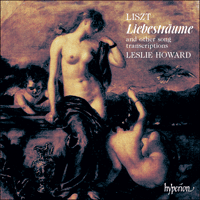



All of the music on this album is also available as part of the specially priced box set Liszt: Complete Piano Music: 'Almost any way you choose to look at it, this is a staggering achievement … the grand scope of this project gives us the chance, as listeners, to experience the almost incomprehensible breadth and depth of Liszt's imagination' (International Record Review).

The two Liszt Songbooks contain twelve of his early songs in very straightforward transcriptions, in the sense that the music basically follows the original song bar-for-bar, with a certain amount of cadential licence but without the addition of extended variation. Liszt makes every effort to preserve all of the character, if not the actual text, of the original accompaniment, and he adds the vocal line to the texture, often distributed between the two hands and sometimes doubled at the octave. All of these transcriptions are rarities, largely due to Liszt’s acute self-criticism in the matter of his songs. All six of the transcriptions in the first book follow upon an issue in one volume of the six original songs. But Liszt withdrew the songs and revised them, and allowed the transcriptions to fade away because they no longer represented his attitude to the poems. Eventually he made a transcription of the revised setting of Heine’s Die Lorelei which was for a time rather popular, but the others remained in only the one-piano version. The second book suffered a worse fate: all six transcriptions remained in manuscript. Four of the songs later underwent revision. The transcriptions were believed lost for many years, although they were tantalisingly mentioned in a few catalogues, and it was not until the excellent Neue Liszt-Ausgabe volume I/18 of 1985 that they were finally published.
The poetry which inspired all these works is generally familiar. Heine’s Die Lorelei tells the familiar story of the siren-like witch who haunts a rock in the river Rhine—Liszt’s dramatic setting (in either version) is vastly superior to the tawdry little Silcher version beloved of amateur children’s choruses, but the revised version is more subtle, less four-square, and there may even be a deliberate hint of the Tristan prelude in the introduction; Am Rhein im schönen Strome (‘In the beautiful waters of the Rhine’) is also by Heine and best known in Schumann’s setting in Dichterliebe—but Schumann changes ‘schönen’ to ‘heiligen’ and, having thus canonised the river, makes his song an allegory, whereas Liszt remains faithful to the beauty of the waters which he reflects in a florid accompaniment of either 9 or 12 notes to the bar (he used the 12-note version in the transcription); Mignons Lied from Goethe’s Wilhelm Meister—Kennst du das Land, wo die Zitronen blühn (‘Do you know the land where the lemons bloom’)—has been set by many a composer (Liszt made a transcription of Beethoven’s setting, for example, recorded on volume 15 of the present series) and Liszt’s setting has proved one of his more durable songs. The music reflects the growing intensity of each verse of the poem, and the faster refrain: ‘Dahin!’ (‘Return!’) eventually requires the most impassioned expression. Goethe’s ballad of the king of Thule and his golden goblet—the gift of his dying lady love which brought tears to his eyes whenever he drank from it, and which he threw into the sea as he was dying rather than allow it to be inherited—is one of Liszt’s finest dramatic songs, and the transcription contains no superfluous decoration. Der du von dem Himmel bist (‘You who are from Heaven’) is again from Goethe and much beloved of composers. Subtitled ‘Invocation’, the piece is held together by a felicitous motif of pair of rising and falling semiquavers. The last of the collection, actually the first-composed of all the Liszt songs, was originally set in Italian —Bocella’s poem Angiolin dal biondo crin (‘Little angel with the golden locks’)—and later issued in German as ‘Englein du mit blondem Haar’. Both titles and the poems in both languages appear at the head of the piano transcription. The piece is a very simple love song in six verses, which becomes almost like a set of variations in the transcription.
All of the songs chosen for the second songbook are settings of Victor Hugo, and the first four, at least, have always been amongst Liszt’s most performed songs. His setting of the French language came easier to him at first than German setting, and his melodic style was often more expansive as a result. In Oh! quand je dors (‘Oh! when I sleep’) the poet asks for his lover to appear to him as Laura did to Petrarch. Comment, disaient-ils (‘How? say the lads’) is one of Liszt’s few songs at an animated tempo and suits to perfection Hugo’s little dialogue of questions and answers from the lads to the lasses. Enfant, si j’étais roi (‘Child, if I were king’)—a marvellous poem of love, telling first of what the poet would do for the child if he were king, and if he were God—set by Liszt with real majesty. S’il est un charmant gazon (‘If it is a charming green’) is a graceful setting of another love poem whose conceits are that the poet would like to be the path beneath the lover’s foot, or a nest for the lover’s heart (the text of the Liszt transcription presents a few minor problems towards the end: this performance transposes the right hand down by an octave in bars 48-56). La tombe et la rose is an allegorical conversation between a grave and a rose, each pressing its merits upon the other, the grave’s final observation being that out of every soul it receives it makes an angel. Liszt’s intense tremolos and dotted rhythms make it a powerful piece indeed. Gastibelza is the song of an eponymous carabiniero in the form of a bolero-cum-love-song of the man with the rifle who is made mad by ‘le vent qui vient à travers le montagne’ (‘the wind that comes over the mountain’). Here Liszt wisely shortened the number of verses of the original song in order to make a tighter construction for the piano piece and a fitting conclusion to the collection as a whole.
Leslie Howard © 1992
Les deux recueils de poésies lyriques de Liszt offrent douze de ses premiers lieder dans des transcriptions directes car, fondamentalement, la musique suit la chanson originale mesure par mesure, avec une certaine licence de cadence mais sans y ajouter de variation. Liszt prend grand soin de préserver tout le caractère, sinon le texte actuel, de l’accompagnement original, et il ajoute la ligne vocale à la texture, qui est souvent partagée entre les deux mains et quelquefois doublée à l’octave. Si toutes ces transcriptions sont des raretés, c’est à cause de l’extrême critique à laquelle Liszt soumettait ses lieder. Les six transcriptions du premier recueil suivent la publication en un volume des six poésies lyriques originales. Mais Liszt retira celles-ci et les révisa, et laissa les transcriptions disparaître parce qu’elles ne correspondaient plus à son attitude envers les poèmes. Finalement, il fit une transcription de la mise en musique révisée de Die Lorelei (La Loreley) de Heine, qui fut populaire pendant un certain temps, mais les autres ne subsistèrent que dans la version pour piano seul. Le sort du second recueil fut pire encore: les six transcriptions restèrent toutes au stade manuscrit. Quatre des chansons furent révisées plus tard. On crut pendant longtemps les transcriptions perdues, bien que quelques catalogues en fassent cruellement mention, et ce n’est qu’avec l’excellent Neue Liszt-Ausgabe volume I/18, de 1985, qu’elles furent finalement publiées.
La poésie qui a inspiré toutes ces œuvres nous est dans l’ensemble familière. Die Lorelei de Heine raconte l’histoire bien connue de la sorcière qui a pris la forme d’une sirène et hante un rocher sur le Rhin—la mise en musique dramatique de Liszt (dans les deux versions) est bien supérieure à la version médiocre de Silcher que les chœurs amateurs d’enfants aiment tant, mais la version révisée est plus subtile, moins définitive, et il peut même y avoir une allusion délibérée au prélude de Tristan dans l’introduction; Am Rhein im schönen Strome («Dans les belles eaux du Rhin») est aussi de Heine et mieux connu dans la mise en musique de Schumann dans Dichterliebe —mais Schumann change «schönen» en «heiligen» et, ayant ainsi canonisé le fleuve, transforme son lied en allégorie, tandis que Liszt demeure fidèle à la beauté des eaux qu’il exprime dans un accompagnement très orné, de 9 ou 12 notes par mesure (il utilise la version à 12 notes dans la transcription); Mignons Lied, inspiré de Wilhelm Meister de Goethe—Kennst du das Land wo die Zitronen blühn («Connais-tu le pays où fleurit l’oranger»)—a été mis en musique par de nombreux compositeurs. (Ainsi, par exemple, Liszt fit une transcription de la mise en musique de Beethoven, enregistrée dans le volume 15 de la série actuelle) et celle de Liszt est devenue une de ses mélodies les plus durables. La musique reflète l’intensité grandissante de chaque strophe du poème, et le refrain plus rapide: «Dahin!» («Reviens») exige finalement une expression des plus passionnées. La Ballade du roi de Thulé, de Goethe, et son gobelet d’or—cadeau de sa maîtresse mourante, dont il ne pouvait se servir sans avoir les larmes aux yeux, et qu’il jeta à la mer avant de mourir plutôt que de le laisser à un autre—est une des plus belles chansons dramatiques de Liszt et la transcription ne contient aucune décoration superflue. Der du von dem Himmel bist («Toi qui viens du Ciel») est une fois encore un poème de Goethe, très aimé par les compositeurs. Sous-titré «Invocation», un heureux motif de paires de double-croches ascendantes et descendantes forme la trame de ce morceau. Le dernier lied de la collection—en fait, le premier de tous ceux que Liszt composa—était à l’origine en italien, le poème de Bocella Angiolin dal biondo crin («Petit ange aux boucles blondes») et il parut plus tard en allemand sous le titre «Englein du mit blondem Haar». Les deux titres et les deux poèmes, dans les deux langues, sont imprimés en tête de la transcription pour piano. Le morceau est un chant d’amour très simple en six couplets, qui devient presque une série de variations dans la transcription.
Toutes les mélodies choisies pour le second recueil sont des mises en musique de poèmes de Victor Hugo; et du moins les quatre premières ont toujours figuré parmi les mélodies de Liszt les plus souvent jouées. Il était plus facile, au début, pour Liszt de mettre en musique le français que l’allemand, et son style mélodique s’en trouvait souvent plus démonstratif. Dans Oh! quand je dors, le poète demande à sa maîtresse de lui apparaître comme Laure apparut à Pétrarque. Comment, disaient-ils est une des rares mélodies de Liszt avec un tempo animé et convient à la perfection au petit dialogue de demandes et réponses écrit par Victor Hugo pour les jeunes gens et jeunes filles. Liszt met en musique Enfant, si j’étais roi, merveilleux poème d’amour qui raconte avec beaucoup de grandeur ce que le poète ferait pour l’enfant d’abord s’il était roi, ensuite s’il était Dieu. S’il est un charmant gazon est l’élégante mise en musique d’un autre poème d’amour qui exprime le rêve du poète d’être le sentier sous les pas de sa maîtresse, ou un nid pour le coeur de la femme qu’il aime (le texte de la transcription de Liszt présente quelques légères difficultés vers la fin: dans cet enregistrement, nous avons transposé la main droite un octave plus bas entre les mesures 48-56). La tombe et la rose est une conversation allégorique entre une tombe et une rose, chacune vantant ses mérites à l’autre; le dernier argument de la tombe est qu’elle fait un ange de chaque âme qu’elle reçoit. Les trémolos intenses et les rythmes pointés de Liszt en font un morceau très émouvant. Gastibelza est la chanson d’un éponyme carabiniero, sous forme d’un boléro-chant d’amour de l’homme au fusil que «le vent qui vient à travers la montagne» rend fou. Ici Liszt a judicieusement abrégé le nombre des couplets de la version originale afin de donner une construction plus rigoureuse à la musique pour piano et une conclusion satisfaisante à l’ensemble de la collection.
Leslie Howard © 1992
Français: Alain Midoux
Die beiden Liederbücher Liszts enthalten zwölf seiner frühen Lieder, deren Transkription insofern äußerst schlicht ist, als sie der Liedvorlage Takt für Takt folgt, sich zwar gewisse kadenziale Freiheiten herausnimmt, aber ohne längere Variation auskommt. Liszt gibt sich alle Mühe, die Originalbegleitung vom Charakter her, wenn schon nicht notengetreu zu erhalten, und diesem Grundgerüst fügt er die Gesangslinie hinzu, oft auf beide Hände verteilt und manchmal oktavisch verdoppelt. Die Transkriptionen sind ausnahmslos Raritäten, was auf Liszts scharfe Selbstkritik bezüglich seines Liedschaffens zurückzuführen ist. Alle sechs Transkriptionen im ersten Buch der Lieder folgen der Ausgabe der sechs Originallieder in einem Band. Aber Liszt zog die Lieder zurück und bearbeitete sie, und die Transkriptionen ließ er in der Versenkung verschwinden, da sie nicht mehr seiner Beziehung zu den Liedern entsprachen. Später schuf er eine Transkription der revidierten Vertonung von Heines Lorelei, die einige Zeit recht beliebt war, während die anderen nur in der Fassung für Klavier allein erhalten blieben. Das zweite Buch erlitt ein noch traurigeres Schicksal: Die sechs Transkriptionen kamen nicht über das Manuskriptstadium hinaus. Vier der Lieder wurden später neu bearbeitet. Die Transkriptionen galten trotz ihrer aufreizenden Erwähnung in einigen Werksverzeichnissen jahrelang als verschollen und wurden erst im 1985 erschienenen Band I/18 der ausgezeichneten Neuen Liszt-Ausgabe endgültig veröffentlicht.
Die Gedichte, die sämtliche vorliegenden Werke inspiriert haben, sind allgemein bekannt. Die Lorelei von Heine erzählt die vertraute Geschichte von der Zauberin, die auf einem Felsen am Rhein ihr Unwesen treibt. Liszts dramatische Vertonung (in beiden Versionen) ist der bei Kinderchören so beliebten geschmacklosen kleinen Version von Silcher haushoch überlegen, doch wirkt die revidierte Fassung subtiler, weniger grob und weist in der Einleitung einen möglicherweise bewußten Verweis auf das Tristan-Vorspiel auf. Am Rhein, im schönen Strome stammt ebenfalls von Heine und ist bekanntgeworden durch Schumanns Vertonung in Dichterliebe. Allerdings wechselt Schumann „schön“ gegen „heilig“ aus und macht nach dieser Heiligsprechung des Flusses sein Lied zur Allegorie. Liszt dagegen hält sich an die Schönheit des Stroms, den er mit einer kunstvollen Begleitung von entweder neun oder zwölf Noten pro Takt darstellt (die Variante mit zwölf Noten benutzte er für die Transkription). Mignons Lied aus Goethes Wilhelm Meister—„Kennst du das Land, wo die Zitronen blühen“—ist von zahlreichen Komponisten vertont worden (Liszt unternahm beispielsweise eine Transkription von Beethovens Vertonung, die im 15. Teil dieser Serie eingespielt vorliegt), und Liszts eigene Liedvertonung hat sich als einer seiner anhaltenden Erfolge erwiesen. Die Musik spiegelt die zunehmende Intensität jeder Strophe des Gedichts wieder, und der schnellere Refrain „Dahin, dahin“ verlangt nach überaus leidenschaftlichem Ausdruck. Goethes Ballade Der König von Thule berichtet vom goldenen Becher des Herrschers: Das Geschenk seiner sterbenden Liebsten hat ihn jedesmal zu Tränen gerührt, wenn er daraus trank, und er wirft es, als er selbst im Sterben liegt, lieber ins Meer, als es zu hinterlassen. Liszts Vertonung zählt zu seinen gelungensten dramatischen Liedern, und die Transkription kommt ohne überflüssige Verzierungen aus. Der du von dem Himmel bist („Wandrers Nachtlied“) stammt ebenfalls von Goethe und war unter Komponisten sehr gefragt. Das Stück mit dem Untertitel „Anrufung“ wird durch ein geglücktes Motiv aus paarig ansteigenden und fallenden Sechzehntelnoten zusammengehalten. Das letzte Werk der Zusammenstellung, das übrigens als erstes aller Lieder von Liszt komponiert worden ist, wurde zunächst in italienischer Sprache vertont—nach Bocellas Gedicht Angiolin dal biondo crin—und erst später auf deutsch als „Englein du mit blondem Haar“ herausgegeben. Beide Titel und die Gedichte in beiden Sprachen sind vor der Klaviertranskription abgedruckt. Das Stück ist ein sehr schlichtes Liebeslied mit sechs Strophen, die in der Transkription fast zur Variationsfolge geraten.
Die für das zweite Buch ausgewählten Lieder sind ausschließlich Vertonungen von Texten Victor Hugos, und zumindest die ersten vier haben immer zu den meistaufgeführten Liedern von Liszt gehört. Vertonungen in französischer Sprache fielen ihm zunächst leichter als in der deutschen, und seine Melodik war dementsprechend oft viel überschwenglicher. In Oh! quand je dors („O, wenn ich schlafe“) fordert der Dichter seine Geliebte auf, ihm zu erscheinen, wie Laura Petrarca erschienen sei. Comment, disaient-ils („Wie? sagen die Burschen“) ist eines der wenigen Lieder von Liszt in lebhaftem Tempo und paßt perfekt zu Hugos kleinem Frage- und Antwortspiel zwischen Burschen und Mädchen. Enfant, si j’étais roi („Kind, wenn ich König wär“)—ein herrliches Liebesgedicht, das erst davon erzählt, was der Dichter für das Kind tun würde, wenn er König wäre, und dann, wenn er Gott wäre—ist von Liszt mit wahrer Majestät vertont worden. S’il est un charmant gazon („Wenn es ein reizender Rasen“) ist die anmutige Vertonung eines weiteren Liebesgedichts, das vom Wunsch des Dichters ausgeht, der Pfad unter den Füßen der Geliebten zu sein, oder ein Nest für ihr Herz (die Niederschrift der Lisztschen Transkription wirft gegen Ende gewisse Probleme auf: Für diese Darbietung wurde die rechte Hand der Takte 48–56 eine Oktave herabtransponiert). La tombe et la rose ist ein allegorisches Zwiegespräch zwischen einem Grabmal und einer Rose, die gegeneinander mit ihren Vorzügen auftrumpfen; so gibt das Grab abschließend damit an, daß es jede Seele, die es aufnimmt, in einen Engel verwandle. Liszts intensive Tremoli und punktierte Rhythmen jedenfalls sorgen dafür, daß ein eindrucksvolles Stück daraus wird. Gastibelza ist das Lied eines Carabiniero gleichen Namens; es ist als Bolero und Liebeslied angelegt und handelt vom Mann mit dem Gewehr, den der „vent qui vient travers le montagne“ („Wind, der übers Gebirge weht“) um den Verstand bringt. Hier hat Liszt die Strophenzahl des Originalliedes geschickt verringert, um für das Klavierstück einen strafferen Aufbau zu schaffen, und einen passenden Abschluß für die ganze Serie.
Leslie Howard © 1992
Deutsch: Anne Steeb/Bernd Müller