Welcome to Hyperion Records, a British classical label devoted to presenting high-quality recordings of music of all styles and from all periods from the twelfth century to the twenty-first.
Hyperion offers both CDs, and downloads in a number of formats. The site is also available in several languages.
Please use the dropdown buttons to set your preferred options, or use the checkbox to accept the defaults.
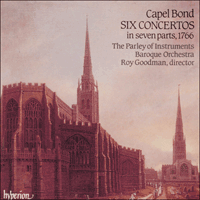



The mainstay of their repertory was the concerto grosso, or 'grand concerto' as it was often called in England. The genre had originally been developed in Italy for professional orchestras, particularly in churches, and it was first popularised in England by London's theatre orchestras. Handel used his concertos as interval music for his operas and oratorios. It was soon realised, however, that concerti grossi were ideal material for amateur orchestral societies, for the difficult concertino parts (usually two violins and cello, or two violins, viola and cello) could be taken by the hired hands, leaving the easy ripieno parts to their employers. At first, the repertory of provincial orchestral societies came from London; favourite items were Corelli's Op 6 Concertos (in Walsh's London reprints), Geminiani's Opp 2 and 3, and Handel's Opp 3 and 6. In the 1750s and '60s, however, a number of provincial composers began to cater for the insatiable demand for concertos. Charles Avison began to write them for his concerts in Newcastle in the late 1730s, and he was followed by, among others, John Alcock in Lichfield, the Rev. Richard Mudge in Birmingham, the Dutch immigrant Pieter Hellendaal in King's Lynn and Cambridge, and by Capel Bond in Coventry.
Capel Bond was born in December 1730, the son of a Gloucester bookseller. Not much is known of his early life beyond the fact that he was apprenticed to the cathedral organist in 1742 at the age of twelve, and later became deputy organist at the cathedral. He moved to Coventry in 1749, becoming organist of St Michael's Church (later Coventry Cathedral); in 1752 he added the post of organist at the church of Holy Trinity. Like many provincial organists at the time, Bond also organised the concerts in his area, beginning, as far as is known, in 1754 with performances of Handel's Messiah and Samson in Wolverhampton and Coventry. In the 1760s Bond extended his activities to the rapidly-expanding town of Birmingham, and seems to have been responsible for founding the festival there in 1767; he certainly conducted a number of the early festival concerts. His activities slackened after about 1770 when he seems to have been ill (he drew up his will on 2 December), though he did not die until 14 February 1790. He was buried at St Bartholomew's Church in the Coventry suburb of Binley, where his tombstone can still be seen, and read in part:
H[ic] J[acet]
CAPEL BOND
40 years organist of the Churches
of St Michael and Holy Trinity in
COVENTRY
He [wa]s an eminent musician
…[and] indulgent husband
…[an]d steady in his friendships
…[exempl]ary in the constant practise
[of his Ch]ristian and social duties
he died February 14th 1790 / aged 59.
All of Capel Bond's surviving music comes from his Six Concertos in Seven Parts of 1766 and the Six Anthems in Score of 1769. Both publications were issued by the author in conjunction with a London bookseller — Mrs Johnson for the Concertos, and Longman, Lukey and Co for the anthems — and were sold in London and Coventry. They seem to have been successful. The anthems went into six editions, while the concertos achieved two editions and attracted subscriptions from most of the notable musical figures in the Midlands, including the Earl of Aylesford, Handel's librettist Charles Jennens (who ordered six sets), the Leicester composer John Valentine, and the Hereford clergyman-composer William Felton, as well as many musical societies up and down the country.
It is not clear when Bond wrote his concertos. No 1 may go back to 1754, for 'Mr. Adcock, the first trumpet of the Vauxhall Gardens, London' is mentioned as a soloist in a newspaper advertisement for Bond's concerts in that year, and Adcock is known to have played a trumpet concerto by Bond in the 1768 Birmingham festival. It was clearly influenced by the trumpet concerto that opens Mudge's Six Concertos of Seven Parts of 1749: both works consist of a French Overture followed by a slow Minuet, though Bond's is much the more accomplished of the two. Bond also adopt ed the overall plan of Mudge's set — four concerti grossi framed by two solo concertos — though Mudge's No 6 is for keyboard rather than bassoon. Bond's bassoon concerto is fairly galant in style, and sounds as if it was composed in the 1760s, shortly before the collection was published. But much of the writing in the first movement is remarkably similar to the famous bassoon solo in 'Softly rise, O southern breeze!' from William Boyce's Solomon of 1742 (recorded on Hyperion CDA66378), and the Concerto as a whole may have been inspired by Boyce's lost Bassoon Concerto, which was certainly in existence by 1745.
Bond's four Concerti Grossi have been almost entirely neglected in modern times, though by and large they are finer works than his two solo concertos. They are laid out in the pattern popularised hy Geminiani's Concertos in which a slow introduction leads to a fugue, and then to one or more movements, mostly based on dance rhythms. Concertos 4 and 5 open with a passage in dotted rhythms, creating the impression of a French Overture, though only the first movement of No 5 has the repeat usually associated wlth the form. The opening movements of Concertos 1 and 2 are more unusual and individual. In both cases chordal passages in a severe, antique style give way several times to more modern, ornamented material — the Baroque, as it were, succumbing to the Galant. Here, as elsewhere, Bond shows a remarkable a bility to create idiomatic and unusual string textures, often underpinned by striking progressions. Bond's fugues are less idiomatic, and probably derive from organ improvisations, as many of Handel's fugues seem to do, though they are worked out with vigour and imagination. Two of them seem to have been inspired directly by Handel's fugues. The one in Concerto 5 uses an idea similar to Handel's keyboard fugue No 6 in C minor (also found in the Trio Sonata Op 5/5), while the fugue in Concerto 3 uses a favourite Handelian idea, best-known from the Chandos anthem 'As pants the hart' and the chorus 'These pleasures, Melancholy, give' from L'Allegro ed il Penseroso. Bond is known to have directed L'Allegro in the 1768 Birmingham festival, and his concerto was perhaps written as interval music for earlier performances of the oratorio.
The models for the dance movements are more varied. The last movement, with its sophisticated textures and tremolando writing, was probably inspired by the fifth movement of Handel's Op 6/5, while the fugal jig that ends Concerto 2 recalls similar movements in Op 6/12 and John Stanley's Op 2/4 (recorded on Hyperion CDA66338). The last movement of Concerto 5, a fast and furious Italianate Minuet, is a good example of the sort of writing that was popularised in England by Domenico Scarlatti's harpsichord sonatas; the idiom came into the concerto grosso by way of Handel's Op 6, some of which use Scarlattian ideas, and Charles Avison's concerto arrangements of Scarlatti sonatas, published in 1744. Capel Bond's concertos were evidently popular in their time, and remained long in the repertory — in London as well as in the Midlands. Two of them, Nos 2 and 5, continued to be played in the Concerts of Ancient Music until 1812. They are arguably the best set written by an English eighteenth-century provincial composer, and are eloquent testimony to the vigour of musical life outside London.
Peter Holman © 1992
Leur répertoire reposait sur le concerto grosso, ou 'grand concerto', comme on l'appelait souvent en Angleterre. Ce genre avait été élaboré à l'origine en Italie pour les orchestres professionnels, surtout dans les églises, et avait été rendu populaire en Angleterre par les orchestres de théâtre de Londres. Handel utilisait ses concertos comme musique d'entr'acte pour ses opéras et ses oratorios. Mais on s'aperçut vite que les concerti grossi étaient le matériau idéal pour les sociétés de musique orchestrales amateurs, car les musiciens professionnels pouvaient interpréter les parties concertino difficiles (généralement deux violons et violoncelle, ou deux violons, alto et violoncelle), laissant ainsi à leurs employeurs les parties ripieno faciles. Tout d'abord, c'est de Londres que vint le répertoire des sociétés orchestrales de province; les morceaux préférés étaient les Concertos opus 6 de Corelli (dans les réimpressions de Londres de Walsh), ceux de Geminiani opus 2 et opus 3, et ceux de Handel, opus 3 et opus 6. Mais peu à peu, dans les années 1750 et '60, un certain nombre de compositeurs de province se mirent à répondre à l'insatiable demande pour concertos. Charles Avison commença à écrire des concertos pour ses concerts à Newcastle, à la fin des années 1730 et d'autres suivirent son exemple, parmi lesquels John Alcock à Lichfield, le Révérend Richard Mudge à Birmingham, l'immigré hollandais Pieter Hellendaal à King's Lynn et Cambridge, et Capel Bond à Coventry.
Capel Bond était le fils d'un libraire de Gloucester, et était né en décembre 1730. Nous ne savons pas grand-chose sur la première partie de sa vie, si ce n'est qu'il fut placé comme élève de l'organiste de la cathédrale en 1742, quand il avait douze ans, et qu'il devint plus tard organiste adjoint dans cette cathédrale. Il fut nommé organiste de l'église de Saint Michael (plus tard la cathédrale) à Coventry en 1749; en 1752, il cumula ces fonctions avec celles d'organiste à l'église de la Sainte Trinité. Tout comme de nombreux organistes provinciaux de son époque, Bond organisait aussi les concerts de sa région; il commença, pour autant que nous le sachions, en 1754 avec des représentations du Messie et de Samson de Handel à Wolverhampton et à Coventry. Dans les années 1760, les activités de Bond s'étendaient jusqu'à la ville de Birmingham qui se développait rapidement, et il semble avoir été l'instigateur de la fondation du festival de cette ville en 1767; il a certainement dirigé un certain nombre des premiers concerts du festival. Vers 1770, quand il paraît avoir été malade, ses activités semblent avoir diminué (il rédigea son testament le 2 décembre) mais ce n'est que le 14 février 1790 qu'il mourut. Il fut enterré à l'église de Saint Barthélemy de Binley, dans la banlieue de Coventry. On peut encore voir sa tombe dans le cimetière, et déchiffrer en partie :
H[ic] J[acet]
CAPEL BOND
organiste pendant 40 ans des églises de
Saint Michael et Holy Trinity à
COVENTRY
Il [fu]t un musicien éminent
[et] un mari indulgent
…[et] fidèle dans ses amitiés
…[exempl]aire dans la pratique constante
[de ses] devoirs chrétiens et sociaux.
Il mourut le 14 février 1790, âgé de 59 ans
Toute la musique de Capel Bond qui a survécu provient de ses Six concertos en sept parties de 1766 et des Six hymnes en partition de 1769. L'auteur fit paraître ces deux publications conjointement avec un libraire londonien — Mrs Johnson pour les Concertos, et Longman, Lukey and Co pour les hymnes — et elles furent mises en vente à Londres et à Coventry. Ces oeuvres paraissent avoir eu du succès. Il y eut six tirages des hymnes, et les Concertos arrivèrent à deux tirages et la majeure partie des personnalités du monde musical des Midlands y souscrirent, y compris le Comte de Aylesford, le librettiste de Handel Charles Jennens (qui commanda six séries), le compositeur John Valentine, de Leicester, et le pasteur/compositeur William Fenton, de Hereford, ainsi que de nombreuses sociétés musicales à travers tout le pays.
La date à laquelle Bond écrivit ses Concertos n'est pas connue. Le No 1 peut remonter à 1754, car 'M. Adcock, premier trompette de Vauxhall Gardens, Londres' est mentionné comme soliste dans l'annonce, publiée dans un journal, d'un des concerts de Bond cette année-là, et l'on sait que Adcock avait interprété un concerto pour trompette de Bond au festival de Birmingham de 1768. L'influence du concerto pour trompette qui est le premier des Six concertos de sept parties de Mudge (qui date de 1749) est manifeste: les deux oeuvres consistent en une Ouverture à la française suivie d'un menuet lent, bien que celui de Bond soit le plus réussi des deux. Bond a aussi adopté le plan général que Mudge avait choisi pour la série — quatre concerti grossi encadrés par deux concertos solo — bien que le No 6 de Mudge soit pour le clavier plutôt que pour le basson. Le style de ce concerto pour basson de Bond est assez galant et sa musique laisse à penser qu'il fut composé dans les années 1760, peu avant la publication de la collection. Mais une grande partie de l'écriture du premier mouvement ressemble remarquablement au célèbre solo de basson dans 'Softly rise, O southern breeze!' ('O vent du sud, lève ton léger souffle!') du Salomon de William Boyce, qui date de 1742 (enregistré sur Hyperion CDA66278); le Concerto entier peut d'ailleurs avoir été inspiré par le Concerto pour Basson de Boyce, qui est perdu, mais qui existait certainement en 1745.
Les quatre Concerti Grossi de Bond ont été presque complètement ignorés dans les temps modernes, bien que, généralement parlant, ce soient des oeuvres supérieures aux deux concertos solo. Ils sont écrits suivant la formule que les Concertos de Geminiani avaient rendue populaire: une lente introduction mène à une fugue, puis à un mouvement ou plus, dont la base est généralement des rythmes de danse. Les Concertos 4 et 5 débutent sur un passage de rythmes pointés, qui crée l'impression d'une Ouverture à la française, bien que seul le premier mouvement du No 5 ait la répétition que l'on associe d'habitude avec cette forme. Les mouvements d'introduction des Concertos 1 et 2 sont plus exceptionnels et individuels. Dans les deux cas, des passages d'accords écrits dans un style antique et sévère cèdent le pas à un matériau plus moderne, avec de nombreux agréments — le Baroque cédant, pour ainsi dire, au Galant. Ici, une fois encore, Bond fait preuve d'un remarquable talent pour créer des textures pour cordes idiomatiques et surprenantes, souvent étayées par de saisissantes progressions. Les fugues de Bond sont moins idiomatiques et proviennent sans doute d'improvisations à l'orgue, comme tant de fugues de Handel, bien qu'elles aient été conçues avec vigueur et imagination. Deux de ces fugues semblent avoir été inspirées directement des fugues de Handel. Celle du Concerto 5 se sert d'une idée similaire à celle de la fugue pour clavier de Handel No 6 en ut mineur (que l'on retrouve aussi dans la Sonate pour Trio opus 5/5), tandis que la fugue du Concerto 3 utilise une idée handelienne favorite, dont les exemples les mieux connus se trouvent dans l'hymne de Chandos 'As pants the hart' ('Comme la biche palpite') et dans le choeur 'These pleasures, Melancholy, give' ('Donne ces plaisirs, mélancolie') de l'Allegro et il Penseroso. On sait que Bond dirigea l'Allegro en 1768 au Festival de Birmingham et son Concerto fut peut-être écrit comme musique d'entr'acte pour les représentations précédentes de l'oratorio.
Les modèles pour les mouvements de danse sont plus variés. Le dernier mouvement, avec ses textures sophistiquées et son écriture trémolando, s'inspire probablement du cinquième mouvement de l'opus 6/5 de Handel, tandis que la gigue fugale qui conclut le Concerto 2 rappelle des mouvements similaires dans l'opus 6/12 et l'opus 2/4 de John Stanley (enregistré sur Hyperion CDA66338). Le dernier mouvement du Concerto 5, un menuet rapide et déchaîné à la façon italienne, est un excellent exemple de la sorte d'écriture que les sonates pour clavecin de Domenico Scarlatti avaient rendue populaire en Angleterre. Cet idiome fut introduit dans le concerto grosso dans l'opus 6 de Handel, dans lequel quelques-unes des idées de Scarlatti sont utilisées, et dans les arrangements pour concerto des sonates de Scarlatti par Charles Avison, qui furent publiés en 1744. Les Concertos de Capel Bond avaient manifestement du succès à leur époque, et demeurèrent longtemps au répertoire — aussi bien à Londres que dans les Midlands. Deux d'entre eux, les No 2 et No 5, continuèrent à être joués dans les Concerts de Musique Ancienne jusqu'en 1812. On pourrait soutenir que ce sont les meilleurs concertos écrits par un compositeur provincial anglais au dix-huitième siècle, et ils sont une preuve éloquente de la vigueur de la vie musicale dans les provinces anglaises.
Peter Holman © 1992
Français: Alain Midoux
Hauptstütze ihres Repertoire war das Concerto Grosso oder 'Grand Concerto', wie es in England oft genannt wurde. Die Gattung war ursprünglich in Italien für professionelle, insbesondere kirchliche Orchester entwickelt worden und wurde in England von Londons Theaterorchestern eingeführt. Händel setzte seine Concerti als Pausenmusik für seine Opern und Oratorien ein. Doch man erkannte rasch, daß Concerti Grossi das ideale Material für von Amateuren getragene Orchestervereinigungen waren, denn die schwierigen Concertino-Parts (gewöhnlich zwei Violinen und Cello oder zwei Violinen, Bratsche und Cello) konnten von den bezahlten Kräften übernommen werden, so daß die leichten Ripieno-Parts für deren Geldgeber übrig blieben. Zunächst wurde das Repertoire provinzieller Orchestervereinigungen von London bestimmt; beliebte Stücke waren Corellis Concerti Op. 6 (in der Londoner Ausgabe von Walsh), Geminianis Op. 2 und 3 sowie Händels Op. 3 und 6. In den 50er und 60er Jahren des 18. Jahrhunderts begann jedoch eine Anzahl in der Provinz ansässiger Komponisten, die unerschöpfliche Nachfrage nach immer neuen Werken zu bedienen. Charles Avison fing schon Ende der 30er Jahre an, Concerti für seine Konzerte in Newcastle zu schreiben, und ihm folgten unter anderem John Alcock in Lichfield, der anglikanische Geistliche Richard Mudge in Birmingham, der holländische Einwanderer Pieter Hellendaal in King's Lynn bzw. Cambridge und Capel Bond in Coventry.
Capel Bond wurde im Dezember 1730 als Sohn eines Buchhändlers in Gloucester geboren. Über seine ersten Lebensjahre ist kaum etwas bekannt, bis auf die Tatsache, daß er 1742 mit 12 Jahren beim Organisten der Kathedrale in die Lehre gegeben und später zum stellvertretenden Organisten ernannt wurde. 1749 siedelte er als Organist von St Michael's Church nach Coventry über (die Kirche ist heute als Coventry Cathedral bekannt); 1752 kam der Posten des Organisten der Church of Holy Trinity (Dreifaltigkeitskirche) hinzu. Wie viele Provinzorganisten der damaligen Zeit organisierte Bond außerdem die Konzerte, die in seiner Region stattfanden, angefangen wahrscheinlich 1754 mit Aufführungen von Händels Messias und Samson in Wolverhampton und Coventry. In den 60er Jahren des Jahrhunderts dehnte Bond seine Betätigung auf die rasch expandierende Stadt Birmingham aus und war offenbar 1767 für die Einführung der dortigen Festspiele verantwortlich; mit Sicherheit leitete er eine Reihe der frühen Festspielkonzerte. Nach ca. 1770 ließen, vermutlich wegen einer Erkrankung, seine Aktivitäten nach (am 2. Dezember des Jahres machte er sein Testament), doch starb er erst am 14. Februar 1790. Er wurde in der Kirche St Bartholomew in Binley beigesetzt, einem Vorort von Coventry, wo sein Grabstein nach wie vor zu besichtigen und teilweise lesbar ist:
Hier ruht
CAPEL BOND
40 Jahre Organist der Kirchen
St Michael und Holy Trinity in
COVENTRY
Er war ein herausragender Musiker
und nachsichtiger Ehegatte
…beständig in seinen Freundschaften
beispielhaft in der standhaften Ausübung
seiner christlichen und gesellschoftlichen Pflichten
starb er am 14. Februar 1790 / mit 59 Jahren.
Alle Musik, die von Capel Bond erhalten ist, entstammt den Bänden Six Concertos in Seven Parts von 1766 und den Six Anthems in Score von 1769. Beide Publikationen wurden vom Author in Verbindung mit Londoner Buchhändlern herausgegeben — Mrs Johnson im Falle der Konzerte und Longman, Lukey and Co im Falle der Anthems — und standen in London und Coventry zum Verkauf. Sie scheinen sehr gefragt gewesen zu sein. Die Anthems brachten es auf sechs Auflagen, während die Konzerte zweimal aufgelegt wurden und von den meisten angesehenen Gestalten des Musikbetriebs in den englischen Midlands bestellt wurden, beispielsweise vom Earl of Aylesford, von Händels Librettist Charles Jennens (der sechs Exemplare anforderte), von John Valentine, einem Komponisten aus Leicester, von William Felton, einem Geistlichen und Komponisten aus Hereford, sowie landauf, landab von zahlreichen Musikvereinen.
Es ist nicht klar, wann Bond seine Concerti geschrieben hat. Daß erste könnte bereits 1754 entstanden sein, denn in einer Zeitungsanzeige für Bonds Konzerte dieses Jahres wird ein 'Mr Adcock, erster Trompeter der Vauxhall Gardens London' als Solist genannt, und von Adcock weiß man, daß er beim Birmingham Festival von 1768 ein Konzert für Trompete von Bond spielte. Es ist eindeutig beeinflußt von dem Trompetenkonzert, das Mudges Six Concertos of Seven Parts von 1749 einleitet; beide Werke bestehen aus einer französischen Ouvertüre, gefolgt von einem langsamen Menuett, doch das von Bond ist bei weitem das vollendetere. Auch den Gesamtaufbau der Serie übernahm Bond von Mudge — vier Concerti Grossi, eingerahmt von zwei Solokonzerten. Allerdings ist Mudges Nr. 6 für ein Tasteninstrument statt für Fagott angelegt. Bonds Fagottkonzert ist vom Stil her recht galant und klingt, als wäre es in den 60er Jahren des Jahrhunderts komponiert worden, kurz vor Veröffentlichung der Serie. Andererseits finden sich in der Ausführung des ersten Satzes viele bemerkenswerte Ähnlichkeiten zu dem berühmten Fagottsolo in 'Softly rise, O southern breeze!' aus William Boyces Solomon von 1742 (aufgezeichnet auf Hyperion CDA66378), und das Konzert als Ganzes könnte von Boyces verschollenem Fagottkonzert inspiriert worden sein, das 1745 mit Sicherheit vorgelegen hat.
Bonds vier Concerti Grossi wurden in der Neuzeit beinahe völlig vernachlässigt, obwohl sie generell gelungenere Kompositionen sind als seine zwei Solokonzerte. Sie sind nach dem Modell von Geminianis Konzerten angelegt, wonach eine langsame Introduktion in eine Fuge übergeht und dann in einen weiteren Satz oder auch mehrere, die meist auf Tanzrhythmen beruhen. Die Concerti Nr. 4 und 5 beginnen mit einer Passage in punktiertem Rhythmus, wodurch der Eindruck einer französischen Ouvertüre erweckt wird, doch nur der erste Satz der Nr. 5 weist die Wiederholung auf, die man bei dieser Form gewohnt ist. Die einleitenden Sätze der Concerti Nr. 1 und 2 sind ungewöhnlicher und individueller. In beiden Fällen machen Akkordpassagen in strengem, altertümlichem Stil mehrfach modernerem figuriertem Material Platz — das Barock beugt sich dem galanten Stil, könnte man sagen. Hier wie an anderer Stelle läßt Bond eine bemerkenswerte Gabe erkennen, idiomatische und ungewöhnliche Streichergefüge zu schaffen, oft untermauert durch eindrucksvolle Progressionen. Bonds Fugen sind weniger idiomatisch und, wie wohl auch viele von Händels Fugen, wahrscheinlich aus Orgelimprovisationen hervorgegangen, obwohl sie mit Tatkraft und Phantasie ausgeführt sind. Zwei davon wurden vermutlich direkt von Händels Fugen inspiriert. Die aus dem Concerto Nr. 5 bedient sich eines Motivs, das in ähnlicher Form in Händels Klavierfuge Nr. 6 in c-Moll zu finden ist (und außerdem in der Triosonate Op. 5, 5 vorkommt), während die Fuge aus dem Concerto Nr. 3 ein Lieblingsmotiv Händels verwendet, das am ehesten aus dem Chandos-Anthem 'As pants the hart' und dem Chorlied 'These pleasures, Melancholy, give' aus L'Allegro ed il Penseroso bekannt ist. Wir wissen, daß Bond beim Birmingham Festival 1768 L'Allegro dirigiert hat, und sein Konzert wurde möglicherweise als Pausenmusik für frühere Aufführungen des Oratoriums geschrieben.
Die Vorbilder für die Tanzsätze sind vielfältiger. Der letzte Satz mit seiner anspruchsvollen Struktur und seiner Tremolandoführung wurde vermutlich durch den fünften Satz von Händels Op. 6, 5 angeregt, während die fugale Gigue, die das 2. Konzert beschließt, an ähnliche Sätze aus Op. 6, 12 erinnert, und an John Stanleys Op. 2, 4 (aufgezeichnet auf Hyperion CDA66338). Der Schlußsatz des Concerto Nr. 5, ein schnelles und furioses Menuett italienischer Art, ist ein gutes Beispiel für die Ausdrucksformen, die von Domenico Scarlattis Cembalosonaten in England populär gemacht wurden; sie gelangten in das Concerto Grosso auf dem Umweg über Händels Op. 6, das in einigen Stücken an Scarlatti gemahnende Motive einsetzt, und über Charles Avisons Konzertbearbeitungen einzelner Sonaten von Scarlatti, die 1744 veröffentlicht wurden. Capel Bonds Konzerte waren seinerzeit offenkundig beliebt und blieben länge Zeit im Repertoire — sowohl in London als auch in den Midlands. Zwei davon, Nr. 2 und Nr. 5, wurden noch bis 1812 bei den 'Concerts of Ancient Music' gespielt. Insgesamt sind die sechs wohl die besten, die von einem englischen Provinzkomponisten des 18. jahrhunderts geschrieben wurden, und legen beredtes Zeugnis ab von der Lebendigkeit des Musiklebens in der englischen Provinz.
Peter Holman © 1992
Deutsch: Anne Steeb/Bernd Müller