
Welcome to Hyperion Records, a British classical label devoted to presenting high-quality recordings of music of all styles and from all periods from the twelfth century to the twenty-first.
Hyperion offers both CDs, and downloads in a number of formats. The site is also available in several languages.
Please use the dropdown buttons to set your preferred options, or use the checkbox to accept the defaults.
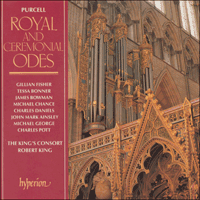


All of the music on this album is also available as part of the specially priced box set Purcell: The Complete Odes & Welcome Songs: ‘A treasure house of shamefully neglected music. Over nine hours of wonderful invention … this major recording achievement must be an irresistible temptation’ (BBC Music Magazine).

Like the forty or so plays for which Purcell provided incidental music and songs, many of the libretti for the Odes are undistinguished. These texts accounted, in part at least, for the Odes’ neglect in the twentieth century. Purcell himself appears to have been less concerned by the texts he was given, consistently turning out music of astonishing imagination and high quality and frequently reserving his finest music for some of the least distinguished words. Seventeenth century audiences were perhaps not so preoccupied by texts as their modern counterparts—Purcell’s ravishing music must have been more than adequate compensation for poor poetry—and John Dryden, translating Virgil in 1697 backs this up: ‘The tune I still retain, but not the words.’ There was in any case a conventionally obsequious attitude to royalty, and Purcell’s music always wins, as the satirist Thomas Brown summed up:
For where the Author’s scanty words have failed,
Your happier Graces, Purcell, have prevailed.
Records of payments made to instrumentalists and singers for special occasions show the forces (and indeed the actual venues) utilized to have been surprisingly small. The ‘vingt-quatre violons’, modelled on the French version, were almost never at that strength by the 1690s, with the English musical establishment firmly in decline following the royal realization that music did not make money. All but the largest of Purcell’s Odes (notably Come ye sons of Art and Hail! bright Cecilia) seem to have been intended for performance by up to a dozen instrumentalists and a double quartet of singers, who between them covered all the solos and joined forces for the choruses. We believe therefore that the ensemble recorded here parallels the number of performers that took part in seventeenth-century performances.
Arise, my muse dates from 1690, the second of six years in which Purcell was commissioned to write an Ode for the birthday of Queen Mary. That year saw a change in the orchestral scoring of Purcell’s Odes, with the addition of wind and brass instruments (other than the pair of recorders that had featured on various previous occasions) to the established string texture. For this work, with an unusually inspired libretto, Purcell added pairs of oboes, recorders and trumpets, and also a second viola to the string section, making possible sounds of great richness.
The overture, like so many of Purcell’s works, is in the French style, with a grand introduction (using the pairs of trumpets and oboes particularly effectively) followed by an imitative section in triple time. The solo alto’s first entry finds Purcell’s imagination stirred by D’Urfey’s text, as indeed it is again later on for the same voice at ‘See how the glitt’ring ruler of the day’ where, over an eight-bar ground bass in minuet style, the sun summons the planets to ‘Dance in a solemn ball’. Opportunities for pathetic texts are obviously limited in joyous Odes, but the section ‘But ah, I see Eusebia drown’d in tears’ enables Purcell to show genuine emotion, despite the fact that ‘Eusebia’ refers to the Anglican Church, regretting the fact that William III has to champion her cause in Ireland. Nonetheless, the piece ends in triumphant manner, with the text exhorting the illustrious Prince not to leave his work unfinished.
Welcome to all the pleasures is the earliest of the three Odes on disc 1, and the smallest in scale. An organization called ‘The Musical Society’ commissioned Purcell to set Christopher Fishburn’s libretto for their first celebration of St Cecilia’s Day in 1683. The event proved popular, for Purcell’s setting of the Ode was published the next year, and the Musical Society had to move to larger premises for its next celebration, although they did not call on Purcell again until 1692 when he produced Hail! bright Cecilia. For the 1683 occasion the youthful Purcell, only twenty-four, produced a work of great freshness, notable amongst many features for its wonderfully original string ritornelli with which he concludes many of the vocal sections. The work also produced one particularly successful alto solo over a ground bass, ‘Here the Deities approve’ (which moves into a most elegant string ritornello) published separately in 1689 under the title ‘A new Ground’ in the second part of Musick’s Hand-Maid. Fishburn’s text gave the composer an opportunity for gentle word-setting at ‘Beauty, thou scene of love’, and Purcell obliged with a movement given first to a solo tenor (with a delicious, and maybe slightly malicious, discord at the mention of the lute), and then taken up by the string ensemble. Unusually, Purcell employs a quiet ending to the work, with the texture of the last line of music ‘Iô Cecilia’ fading away to leave just the bass instruments and singers to conclude the Ode.
Now does the glorious day appear was Purcell’s first Ode written to celebrate the birthday of Queen Mary (on 30 April 1689), and so dates from exactly a year before Arise, my muse. Thomas Shadwell was the author of the text, which Purcell altered quite extensively, even to the extent of cutting the last fifteen lines. Purcell restricted the orchestral scoring to that of a string ensemble, but added a ‘third violin’ (actually a small viola) and thus provided himself with a five-part orchestral texture. This rich texture is immediately apparent in the French-style overture which at times has stylistic elements in common with the instrumental writing of Georg Muffat. The tenor solo ‘This does our fertile isle’ is set to what must be one of Purcell’s shortest ground basses, on just two notes, but one that is nonetheless effective, especially in its transformation into an orchestral ritornello.
But the highlight of the work, a movement which surely ranks as one of Purcell’s greatest, is the alto solo, set over a wistfully sighing four-bar dropping ground bass, ‘By beauteous softness’. One of Purcell’s most ravishing solos, especially with its quietly ecstatic vocal line at ‘She with such sweetness’, the voice’s final phrase is overlapped with an exquisite five-part string ritornello of quite melting beauty.
Robert King © 2010
Tout comme les quarante et quelques pièces de théâtre pour lesquelles Purcell conçut des musiques et des chansons, les livrets des Odes sont très souvent quelconques—ce qui explique en grande partie l’oubli dans lequel ces œuvres ont sombré au XXe siècle. Purcell semble s’être lui-même peu soucié des textes qu’on lui fournissait, produisant régulièrement une musique étonnamment imaginative, de grande facture, et réservant même souvent ses plus belles partitions à certains des textes les moins remarquables. Les auditoires du XVIIe siècle n’étaient peut-être pas aussi attentifs aux textes que leurs homologues modernes—la ravissante musique de Purcell devait plus que compenser la piètre poésie—, comme le confirme John Dryden, traduisant Virgile en 1697: «L’air je le garde, mais pas les paroles.» Quoi qu’il en soit, les textes étaient conventionnellement obséquieux envers la royauté, et la musique de Purcell remporte toujours la partie, ce que le satiriste Thomas Brown résuma ainsi:
Car là où les maigres mots de l’auteur ont échoué,
Tes ornements plus heureux, Purcell, l’ont emporté.
À en croire les registres de paiement des musiciens et des chanteurs, les effectifs (et partant les lieux) étaient de taille étonnamment réduite lors des événements spéciaux. Les «vingt-quatre violons», imités de la version française, n’étaient presque jamais au complet dans les années 1690, l’institution musicale anglaise ayant périclité du jour où la royauté réalisa que la musique ne rapportait rien. Les plus vastes Odes de Purcell (notamment Come ye sons of Art et Hail! bright Cecilia) semblent presque toutes avoir été conçues pour une douzaine d’instrumentistes, tout au plus, et un double quatuor de chanteurs assumant à eux seuls l’intégralité des solos et des forces conjointes pour les chœurs. Les effectifs des présents enregistrements correspondent donc, selon nous, à ceux qui exécutèrent les œuvres au XVIIe siècle.
Arise, my muse date de 1690 quand, pour la deuxième fois en six ans, Purcell se vit commander une ode pour l’anniversaire de Marie. Cette année-là, il modifia l’écriture orchestrale de ses Odes par l’adjonction de vents et de cuivres (autres que les deux flûtes à bec présentes lors des événements précédents) à l’habituelle texture de cordes. Pour cette œuvre au livret exceptionnellement inspiré, en plus d’ajouter des paires de hautbois, de flûtes et de trompettes, il renforça la section des cordes par un second alto, d’où des possibilités sonores d’une grande richesse.
Comme si souvent chez Purcell, l’ouverture est à la française, avec une introduction grandiose où trompettes et hautbois par deux sont utilisés avec une singulière efficacité avant une section imitative en mesure ternaire. À la première entrée de la voix d’alto solo, l’imagination de Purcell est stimulée par le texte de D’Urfey, comme elle le sera de nouveau, pour la même voix, à «See how the glitt’ring ruler of the day» quand, par-dessus un ground bass de huit mesures en style de menuet, le soleil somme les planètes de «danser en un bal solennel» («Dance in a solemn ball»). Les occasions d’écrire un texte pathétique sont, bien sûr, limitées dans les Odes joyeuses; pourtant, la section «But ah, I see Eusebia drown’d in tears» permet à Purcell de montrer une authentique émotion, même si «Eusebia» fait référence à l’Église anglicane, déplorant que Guillaume III eût à défendre sa cause en Irlande. L’œuvre ne s’en conclut pas moins de manière triomphante, le texte exhortant l’«illustrious Prince» à ne pas laisser sa tâche inachevée.
Des trois Odes de ce disque, Welcome to all the pleasures est la plus ancienne et la moins imposante. En 1683, pour sa première célébration de la Sainte-Cécile, une organisation appelée «The Musical Society» confia à Purcell la mise en musique d’un livret de Christopher Fishburn. L’événement s’avéra populaire car l’Ode musiquée par Purcell parut l’année suivante et, pour sa deuxième célébration, The Musical Society dut emménager dans des locaux plus grands, même si elle ne refit pas appel à Purcell avant 1692, date de Hail! bright Cecilia. Pour la fête de 1683, le jeune Purcell (il avait seulement vingt-quatre ans) produisit une œuvre d’une grande fraîcheur qui vaut, entre autres, par ses ritornelli de cordes merveilleusement originaux venant conclure nombre des sections vocales. On y découvre aussi un solo d’alto particulièrement réussi, sur un ground bass, «Here the Deities approve» (qui se meut en un fort élégant ritornello de cordes), publié séparément en 1689 sous le titre «A new Ground», dans la seconde partie de Musick’s Hand-Maid. Grâce au texte de Fishburn, Purcell put concevoir une mise en musique toute en douceur à «Beauty, thou scene of love»; il s’acquitta d’un mouvement dévolu d’abord à un ténor solo (avec une délicieuse, et peut-être un rien malicieuse, discordance, à la mention du luth) puis repris par l’ensemble des cordes. Par extraordinaire, l’œuvre présente une conclusion paisible, la texture de la dernière ligne musicale, «Iô Cecilia» s’évanouissant pour confier la fin de l’Ode aux seuls instruments de tessiture grave et aux chanteurs.
Now does the glorious day appear fut la première Ode composée par Purcell pour l’anniversaire de la reine Marie (le 30 avril 1689), juste un an, donc, avant Arise, my muse. Thomas Shadwell en signa le texte, que Purcell modifia considérablement, au point d’en retrancher les quinze derniers vers. La distribution orchestrale fut limitée à celle d’un ensemble de cordes mais l’ajout d’un «troisième violon» (en réalité, un petit alto) permit au compositeur de s’offrir une riche texture orchestrale à cinq parties. Cette dernière transparaît d’emblée dans l’ouverture à la française, dont certains éléments stylistiques sont en commun avec l’écriture instrumentale de Georg Muffat. Le solo de ténor «This does our fertile isle» reçoit ce qui doit être l’un des plus courts ground basses purcelliens—de seulement deux notes, ce qui ne l’empêche pas d’être impressionnant, notamment dans sa métamorphose en ritornello orchestral.
Mais l’apothéose de l’Ode, c’est le solo d’alto déployé par-dessus un ground bass descendant, tristement soupirant, de quatre mesures, «By beauteous softness»—certainement parmi les plus grandioses mouvements et les plus ravissants solos purcelliens, surtout avec sa ligne vocale extatique à «She with such sweetness», la dernière phrase vocale se chevauchant avec un exquis ritornello de cordes à cinq parties, d’une beauté toute attendrissante.
Robert King © 2010
Français: Hypérion
Ebenso wie die rund vierzig Theaterstücke, für die Purcell Bühnenmusik und Lieder komponierte, sind auch viele seiner Oden-Libretti eher zweitrangig. Zum Teil waren diese Texte der Grund dafür, dass die Oden im 20. Jahrhundert derart vernachlässigt wurden. Purcell selbst scheint sich an den Texten, die ihm zur Vertonung vorgelegt wurden, weniger gestört zu haben, da er stets anspruchsvolle Musik von erstaunlicher Originalität schrieb und oft sogar die am wenigsten bedeutenden Texte mit der besten Musik versah. Möglicherweise stand das Publikum im 17. Jahrhundert den Texten auch nicht so kritisch gegenüber, wie das heutzutage der Fall ist—Purcells herrliche Musik war sicherlich mehr als nur ein Ausgleich für dürftige Dichtung—wie auch John Dryden, der 1697 Vergil übersetzte, andeutete: „An die Melodie erinnere ich mich, nicht aber an die Worte.“ In jedem Falle herrschte jedoch eine allgemein unterwürfige Haltung königlichen Personen gegenüber und, wie der Satiriker Thomas Brown bemerkte, gewinnt Purcells Musik jedes Mal:
Denn wo die mageren Worte des Dichters versagten,
traten deine glücklicheren Gaben, Purcell, hervor.
Den Listen für die Honorare, die bei besonderen Gelegenheiten an Musiker entrichtet wurden, kann man entnehmen, dass die Besetzungen (und auch Aufführungsorte) jeweils überraschend klein waren. Die „vingt-quatre violons“, die entsprechend des französischen Beispiels begründet worden waren, traten in den 90er Jahren des 17. Jahrhunderts so gut wie nie in voller Besetzung auf, da sich das englische Musikleben im stetigen Niedergang befand, nachdem man bei Hofe realisiert hatte, dass Musik kein Geld einbrachte. Offenbar sind nur die großangelegten Oden Purcells (insbesondere Come ye sons of Art und Hail! bright Cecilia) für größere Ensembles komponiert, also etwa ein Dutzend Instrumentalisten und ein doppeltes Quartett von Sängern, die unter sich die Soli aufteilten und dann zusammen die Chornummern sangen. Wir glauben daher, dass das Ensemble der vorliegenden Aufnahme der Zahl der Interpreten entspricht, die an den Aufführungen des 17. Jahrhunderts mitwirkten.
Arise, my muse entstand 1690, dem zweiten der sechs Jahre, in denen Purcell den Auftrag für eine Geburtstagsode zu Ehren Königin Marias hatte. In dem Jahr änderte Purcell auch die Instrumentalbesetzung seiner Oden, indem er Holz- und Blechbläser (zusätzlich zu den zwei Blockflöten, die zu verschiedenen vorherigen Gelegenheiten eingesetzt worden waren) der gängigen Streicherbesetzung hinzufügte. In diesem Werk, das ein ungewöhnlich inspiriertes Libretto hat, setzte Purcell jeweils zwei Oboen, Blockflöten und Trompeten ein und fügte ebenfalls dem Streicherapparat eine zweite Bratsche hinzu, was besonders reichhaltige Klänge ermöglichte.
Die Ouvertüre ist, wie so viele Werke Purcells, im französischen Stil komponiert und hat eine prachtvolle Einleitung (in der die Trompeten und Oboen besonders wirkungsvoll eingesetzt sind), worauf ein imitativer Abschnitt im Dreiertakt folgt. D’Urfeys Text inspirierte Purcell offenbar besonders bei der Stelle, wenn der Solo-Alt seinen ersten Einsatz hat, genauso wie dort, wo dieselbe Stimme „See how the glitt’ring ruler of the day“ singt und die Sonne über einem achttaktigen Basso ostinato im Menuett-Stil die Planeten dazu auffordert, „in einem feierlichen Ball zu tanzen“ („Dance in a solemn ball“). Freudvolle Oden bieten natürlich nicht besonders viel Gelegenheit für gefühlvolle Texte, doch ermöglicht der Abschnitt „But ah, I see Eusebia drown’d in tears“ („Aber ach, ich sehe Eusebia von Tränen überströmt“) es Purcell, Emotionen zu zeigen, obwohl mit „Eusebia“ die anglikanische Kirche gemeint ist, die es bedauert, dass Wilhelm III. sich in Irland für ihre Sache einsetzen muss. Trotzdem endet das Stück in triumphaler Stimmung und der Text ermahnt den „erlauchten Prinzen“ („illustrious Prince“), sein Werk nicht unbeendet zu lassen.
Welcome to all the pleasures ist die früheste der drei Oden auf CD 1 und hat auch die kleinste Anlage. Eine Organisation namens „The Musical Society“ hatte Purcell damit beauftragt, Christopher Fishburns Libretto für die erste Feier der Gesellschaft anlässlich des Festtags der Heiligen Cäcilia 1683 zu vertonen. Die Veranstaltung fand Anklang—Purcells Vertonung der Ode wurde im folgenden Jahr veröffentlicht und die Musical Society musste für ihre nächste Veranstaltung größere Räumlichkeiten anmieten. Doch erhielt Purcell erst 1692 den nächsten Auftrag, woraufhin er Hail! bright Cecilia komponierte. Für die Feier von 1683 schrieb der jugendliche Purcell im Alter von nur 24 Jahren ein Werk von besonderer Frische, das unter anderem besonders aufgrund seiner originellen Streicher-Ritornelle bemerkenswert ist, mit denen er viele Vokal-Abschnitte beendet. In dem Werk kommt auch ein besonders gelungenes Alt-Solo über einem Basso ostinato vor: „Here the Deities approve“ (das dann in ein sehr elegantes Streicher-Ritornell übergeht), das 1689 separat und unter dem Titel „A new Ground“ im zweiten Teil der Tasteninstrument-Schule Musick’s Hand-Maid herausgegeben wurde. Bei den Worten „Beauty, thou scene of love“ („Schönheit, du Szene der Liebe“) lädt Fishburns Text sozusagen zu einer sanften Vertonung ein, worauf Purcell auch mit einem Satz eingeht, der zunächst an einen Solo-Tenor gegeben ist (mit einem köstlichen und vielleicht etwas maliziösen Missklang bei der Erwähnung der Laute) und der dann von dem Streicherensemble fortgeführt wird. Purcell lässt das Werk ungewöhnlich leise enden, wobei der Satz am Schluss bei den Worten „Iô Cecilia“ auf nur die Bassinstrumente und Sänger reduziert wird, die die Ode ausklingen lassen.
Now does the glorious day appear war Purcells erste Ode, die anlässlich des Geburtstags von Königin Maria (am 30. April 1689) entstand und damit genau ein Jahr bevor Arise, my muse komponiert wurde. Thomas Shadwell war der Autor des Texts, den Purcell recht umfassend bearbeitete und von dem er sogar die letzten 15 Zeilen strich. Purcell beschränkte die Instrumentalbesetzung auf ein Streicherensemble, fügte jedoch eine „dritte Violine“ (eigentlich eine kleine Bratsche) hinzu, so dass ihm eine fünfstimmige Orchesterstruktur zur Verfügung stand. Diese reiche Textur ist von Anfang an in der französisch anmutenden Ouvertüre zu hören, die zuweilen ähnliche stilistische Elemente zu dem Instrumentalstil von Georg Muffat aufweist. Das Tenor-Solo „This does our fertile isle“ ist mit einem sehr kurzen Basso ostinato vertont—er besteht aus nur zwei Tönen, die trotzdem wirkungsvoll sind, besonders wenn sie in ein Orchester-Ritornell übergehen.
Der Höhepunkt dieses Werks ist jedoch ein Satz, der zu den besten von Purcell gezählt werden muss, nämlich das Alt-Solo, „By beauteous softness“, das über einem wehmütig seufzenden, viertaktigen und absteigenden Basso ostinato erklingt. Es ist dies eins der hinreißendsten Soli Purcells, besonders bei der still-ekstatischen Passage „She with such sweetness“, wenn die letzte Phrase der Gesangsstimme sich mit einem vorzüglichen fünfstimmigen Streicher-Ritornell überschneidet.
Robert King © 2010
Deutsch: Viola Scheffel