
Welcome to Hyperion Records, a British classical label devoted to presenting high-quality recordings of music of all styles and from all periods from the twelfth century to the twenty-first.
Hyperion offers both CDs, and downloads in a number of formats. The site is also available in several languages.
Please use the dropdown buttons to set your preferred options, or use the checkbox to accept the defaults.
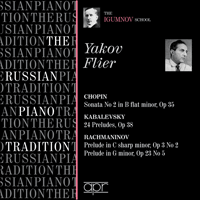

This is a recording from Appian Publications & Recordings Ltd (to quote the full title)—the label invariably more familiarly known simply as "APR".
Since its foundation in 1986, APR has won an enviable reputation as a quality label devoted predominantly—though not exclusively—to historic piano recordings. In particular APR has won countless laurels for the high standard of its 78rpm restoration work—"Transfers of genius" to quote one critic—as well as the detail and content of its booklets.

During Flier’s 40 years at the Moscow Conservatoire – he taught there until his death in 1977 – he was widely regarded as the greatest teacher of his generation. From the very start his pupils were taught to play, listen and conduct themselves as if on the concert platform. Invariably seated at the second of two Bechstein instruments in his classroom, Flier expressed himself with a ready wit and telling comparisons, usually taken from within art and literature. He constantly encouraged his pupils to explore new repertoire. To their amazement, they found him to be totally familiar with every note of whatever they brought to class! In the main he was idolized by his pupils. Rodion Shchedrin, who studied both piano and composition at the Moscow Conservatoire during the 1950s, was in awe from the first time he heard Flier: ‘His playing and his entire make-up simply overwhelmed us. It seemed to us that a god had come down to our school, enabling us to watch his hands, his profile and his carriage from just a few metres away.’ (Flier would also exert a powerful influence upon Shchedrin the composer.) Pupils who were to have prominent careers on the concert platform include Bella Davidovich (who came to Flier after Igumnov’s death in 1948), Irina Zaritskya, Viktoria Postnikova, Vladimir Feltsman, Mikhail Rudy, Mark Zeltser and Mikhail Pletnev. The last is among a minority: even though the programme with which he won the 1978 International Tchaikovsky Competition had been prepared under Flier, Pletnev admitted that they had not had an easy three-and-a-half-year relationship – largely due to an erratic teaching regime caused by the excessive demands made upon Flier’s time and energies. (Pletnev was to enjoy happier times when, after Flier’s death, he worked with Lev Vlasenko. Paradoxically, Vlasenko’s daughter, Natasha, studied congenially with Flier.) Within Russia today Flier’s standing is such that he remains much admired by many of the later generation of Russian pianists, notably Evgeny Kissin. Certainly there is no question that Flier, along with Sviatoslav Richter and Gilels, were the pre-eminent ‘big personality’ pianists of the Soviet era. Despite this Flier endured many setbacks, not least becoming ensnared in the political intrigues that were a poisonous part of everyday life at the Conservatoire. The victim of a trumped-up charge emanating, some maintain, from Yakov Zak, it was only thanks to the intervention of the venerable Alexander Goldenweiser that Flier’s life was spared, together with that of two other noted pianist/pedagogues also involved, Abram Shatskes (a pupil of Medtner who made the first Soviet recordings of his master’s First and Second Piano Concertos), and Maria Nemenova-Luntz. (Tragically, Zak was himself on the receiving end of a later conspiracy and lost his life as a result.) Flier was also forced to retire from the concert platform for a lengthy period (1949–1959) due to a serious hand injury.
Flier’s repertoire was all-embracing and dispatched with heroic confidence and staggering élan. He was particularly persuasive in Romantic music and it is said that Richter side-stepped Rachmaninov’s Concerto No 3 because he considered Flier’s interpretation to be incomparable. The most obvious hallmarks of Flier’s playing are a remarkable yet totally undemonstrative technique, a striking directness in his music-making and an extraordinary dynamic range, as is evident throughout this programme, with hushed, delicately spun pianissimos followed, often in an instant, by deeply resonant fortissimos. For someone of Flier’s stature his recordings are sadly few, due primarily to his enforced absence from performing as already mentioned. Aside from piano-duo recordings with Arnold Kaplin (Mozart) and Igor Aptekarev (Brahms), plus a couple of chamber recordings, including a classic version of the Rachmaninov Cello Sonata with Daniil Shafran, there exist only a handful of solo LPs. The majority are devoted to mainstream repertoire (Mozart, Chopin and Schumann), with just two devoted to Russian/Soviet music: Tchaikovsky’s Children’s Album and the Kabalevsky Preludes included here. Flier’s most familiar recording, the Khachaturian Concerto, is his only studio recording with orchestra.
All the items in this programme are making their first appearance on CD. Flier’s performance of Chopin’s Sonata No 2 is more an illustration of his credentials as an interpreter of the Romantic repertoire than of a Chopin specialist. In devoting the rest of the programme to preludes we are able to hear not only one of Flier’s rare 78-rpm records (with Flier’s fortissimos almost too much for the microphone in Rachmaninov’s Op 3/2!) but also the premiere recording of Kabalevsky’s 24 Preludes. Comprising a prelude in each key of the tempered system and based on Russian folk songs taken from the Rimsky-Korsakov Collection, they deftly demonstrate Kabalevsky’s gift for effortless invention and his total understanding of the piano – the composer was, after all, a dazzling pianist and pupil of Goldenweiser. Equally important, each of these epigrammatic gems provides vivid and contrasting glimpses of Flier’s incomparable art.
Bryan Crimp © 2007
Pendant les quarante années que Flier passa au Conservatoire de Moscou – il y enseigna jusqu’à sa mort en 1977 – il fut considéré comme le plus grand pédagogue de sa génération. Dès le début de son travail avec ses élèves, il leur apprenait à jouer, écouter et se comporter comme s’ils étaient sur scène. Invariablement assis devant l’un des deux pianos Bechstein de sa salle de classe, Flier s’exprimait avec esprit, recourant à des comparaisons généralement empruntées à l’art ou à la littérature. Il encourageait constamment ses élèves à explorer de nouveaux répertoires. À leur grand étonnement, ils s’apercevaient qu’il connaissait parfaitement chaque note des œuvres qu’ils présentaient à son cours. La plupart de ses élèves l’idolâtrait. Rodion Shchedrin, qui étudia le piano et la composition au Conservatoire de Moscou dans les années 1950, fut immédiatement impressionné lorsqu’il entendit Flier pour la première fois: «Son jeu et sa personnalité nous subjugua. Nous avions l’impression qu’un dieu était descendu dans notre école pour nous permettre de voir ses mains, son profil, son maintien, à seulement quelques mètres de lui.» (Flier devait aussi exercer une profonde influence sur Shchedrin le compositeur.) Parmi ses élèves qui eurent une éminente carrière, on citera Bella Davidovich (qui rejoignit la classe de Flier après la mort d’Igumnov en 1948), Irina Zaritskaya, Viktoria Postnikova, Vladimir Feltsman, Mikhail Rudy, Mark Zeltser et Mikhail Pletnev. Ce dernier fait exception: même si le programme qui lui permit de remporter Concours Tchaikovsky en 1978 fut préparé sous la férule de Flier, Pletnev reconnut que les trois ans et demi que dura leur relation connurent des remous. Ceci s’explique par le régime irrégulier d’enseignement que les exigences excessives de sa charge imposèrent sur l’emploi du temps et l’énergie de Flier. (Pletnev connut des jours plus heureux lorsque, après la mort de Flier, il travailla avec Lev Vlasenko. Paradoxalement, la fille de Vlasenko, Natasha, étudia avec bonheur avec Flier.) Le statut de Flier dans son pays natal aujourd’hui est tel qu’il suscite toujours l’admiration de la jeune génération de pianistes russes, notamment Evgeny Kissin. Il ne fait aucun doute que Flier, aux côtés de Sviatoslav Richter et d’Emil Gilels, figurait parmi les «grandes personnalités» pianistiques de l’ère soviétique. Malgré cela, Flier connut de nombreux déboires et fut notamment pris dans le piège des intrigues qui empoisonnaient la vie quotidienne au Conservatoire. Il fut notamment la victime de fausses accusations émanant, d’après certains, de Yakov Zak. Ce n’est que grâce à l’intervention du vénérable Alexander Goldenweiser que la vie de Flier fut épargnée ainsi que celles de deux autres pianistes-pédagogues également mis en cause: Abram Shatskes, un élève de Medtner, qui réalisa le premier enregistrement soviétique des premier et second concertos de son maître, et Maria Nemenova-Luntz. (Tragiquement, Zak fut plus tard à son tour victime d’un complot qui lui coûta la vie.) Flier dut également se retirer de la scène pendant une longue période (1949–1959) en raison d’une sérieuse lésion à la main.
Flier possédait un répertoire extraordinairement vaste qu’il interprétait avec une assurance héroïque et un élan incroyable. Il se montrait particulièrement convaincant dans le répertoire romantique et l’on dit même que Richter renonça à jouer le troisième Concerto de Rachmaninov parce qu’il considérait l’interprétation de Flier comme inégalable. Parmi les qualités les plus évidentes du jeu de Flier, on soulignera sa technique remarquable dénuée de tout aspect démonstratif, son approche directe de la musique et son extraordinaire éventail dynamique, dont témoigne ce programme où des pianissimos murmurés et tissés avec délicatesse sont suivis, souvent instantanément, par des fortissimos profonds et résonants. Pour quelqu’un de la stature de Flier, ses enregistrements sont trop peu nombreux. Ceci s’explique surtout par la lésion qui l’empêcha de jouer dont nous avons fait mention. Outre des duos pianistiques, enregistrés avec Arnold Kaplin (Mozart) et Igor Aptekarev (Brahms), et deux enregistrements de musique de chambre, dont une version de référence de la Sonate pour violoncelle de Rachmaninov avec Daniyl Shafran, il n’existe que quelques 33 tours en soliste. La plupart est consacrée au grand répertoire (Mozart, Chopin et Schumann) à l’exception de deux disques de musique russo-soviétique: L’Album pour les enfants de Tchaïkovsky et les Préludes de Kabalevsky présentés ici. L’enregistrement le plus connu de Flier, celui du Concerto de Khatchaturian, constitue son seul disque réalisé en studio avec orchestre.
Tous les enregistrements figurant sur ce programme sont disponibles pour la première fois en CD. L’enregistrement par Flier de la deuxième sonate de Chopin illustre davantage ses qualités d’interprète du répertoire romantique que de spécialiste de Chopin. Le reste du programme réunit des préludes, donnant l’occasion d’entendre quelques-uns des 78 tours les plus rares de Flier (dont l’op.3/2 de Rachmaninov où les fortissimos de Flier sont presque trop puissants pour les micros!) ainsi que le premier enregistrement des 24 Préludes de Kabalevsky. Chaque prélude est composé dans l’une des tonalités du système tempéré et s’inspire de chants populaires russes qu’avait réuni Rimsky-Korsakov. Ils démontrent le talent de Kabalevsky à créer sans effort et en manifestant une parfaite compréhension du piano. Le compositeur fut, après tout, un formidable pianiste qui avait étudié auprès de Goldenweiser. Par ailleurs, chacun de ces joyaux épigrammatiques permet d’entendre des aspects variés et vivants de l’art incomparable de Flier.
Bryan Crimp © 2007
Français: Pierre-Martin Juban
Während der 40 Jahre Fliers am Moskauer Konservatorium – er unterrichtete dort bis zu seinem Tod 1977 – wurde er allgemein als der bedeutendste Lehrer seiner Generation angesehen. Zuallererst brachte er seinen Schülern bei, so zu spielen, zuzuhören und sich zu geben, als seien sie auf dem Konzertpodium. Dabei saß Flier ausnahmslos am zweiten von zwei Bechsteinflügeln in seinem Unterrichtsraum und äußerte sich humorvoll und mit treffenden Vergleichen, die er gewöhnlich der Kunst und Literatur entnahm. Er ermunterte seine Schüler ständig, sich mit neuen Kompositionen zu beschäftigen. Zu ihrem Erstaunen mussten sie feststellen, dass er von all dem, was sie in den Unterricht mitbrachten, jede Note kannte! Von vielen seiner Schüler wurde er vergöttert. Rodion Schtschedrin, der in den 1950ern am Moskauer Konservatorium sowohl Klavier als auch Komposition studierte, verehrte Flier vom ersten Augenblick an, als er ihn hörte, zutiefst: „Sein Spiel und seine ganze äußere Erscheinung überwältigten uns einfach. Wir glaubten, dass ein Gott in unsere Schule hernieder gekommen sei, der es möglich machte, seine Hände, sein Profil, seinen Wagen aus wenigen Metern Entfernung zu betrachten.“ (Flier hatte auch einen entscheidenden Einfluss auf Schtschedrin als Komponisten.) Unter seinen Schülern, die später herausragende Konzertkarrieren machten, waren Bella Davidovich (die 1948 nach Igumnovs Tod zu Flier kam), Irina Zaritskya, Viktoria Postnikova, Vladimir Feltsman, Mikhail Rudy, Mark Zeltser und Mikhail Pletnev. Letzterer gehört zu einer Minderheit; denn auch wenn sein Programm, mit dem er 1978 den Internationalen Tschaikowsky-Wettbewerb gewonnen hatte, unter Flier vorbereitet worden war, musste Pletnev zugeben, dass ihre dreieinhalbjährige Zusammenarbeit nicht immer leicht war. Die Umstände, unter denen der Unterricht stattfand, waren nämlich recht chaotisch wegen der immensen Anforderungen an Fliers Zeit und Schaffenskraft. Pletnev fühlte sich deutlich wohler, als er nach Fliers Tod mit Lev Vlasenko zusammenarbeiten konnte. (Paradoxerweise studierte Vlasenkos Tochter bei Flier völlig problemlos.) Auch im modernen Russland hat Flier einen hohen Stellenwert behalten und wird von vielen der späteren russischen Pianistengeneration, z.B. von Jewgenj Kissin, immer noch sehr bewundert. Es steht sicher außer Frage, dass Flier, zusammen mit Svjatoslav Richter und Emil Gilels, die herausragende Pianisten-Persönlichkeit der Sowjet-Ära war. Trotzdem musste er viele Rückschläge hinnehmen, nicht zuletzt, weil er in politische Intrigen verwickelt wurde, die teilweise den Alltag am Konservatorium vergifteten. Als er Opfer einer erfundenen Anschuldigung wurde, die, wie einige behaupteten, von Yakov Zak ausging, verdankte er allein der Intervention des angesehenen Alexander Goldenweiser, dass er mit dem Leben davonkam, zusammen mit zwei anderen in den Fall verwickelten, bekannten Klavierpädagogen, nämlich Abram Schatskes, einem Schüler Medtners, der die ersten sowjetischen Aufnahmen des ersten und zweiten Klavierkonzertes seines Lehrers machte, und Maria Nemenova-Luntz. (Tragischerweise war Zak einer der Leidtragenden einer späteren Intrige und verlor dabei sein Leben.) Für eine längere Zeit, von 1949–1959, musste sich Flier zudem wegen einer ernsthaften Handverletzung vom Konzertpodium zurückzuziehen.
Fliers Repertoire war umfassend, und er trug es mit unerschütterlichem Selbstbewusstsein und mitreißendem Elan vor. Er überzeugte vor allem beim Repertoire der Romantik. Es heißt, Richter habe sich an Rachmaninows drittes Klavierkonzert nicht herangetraut, weil er Fliers Interpretation für unerreichbar gehalten habe. Das deutlichste Markenzeichen von Fliers Spiel ist eine bemerkenswerte, aber völlig unspektakuläre Technik, eine auffällige Unmittelbarkeit des Musizierens und ein ungewöhnlich weit gefächertes dynamisches Spektrum, wie man es durch dieses ganze Programm hindurch deutlich erkennen kann. Kaum hörbare, delikate Pianissimos stehen oft unvermittelt neben kräftigen und sonoren Fortissimos. Für jemanden von Fliers Qualitäten existieren beklagenswert wenige Aufnahmen, vor allem wegen der schon erwähnten erzwungenen Aufnahmepause. Abgesehen von Duo-Aufnahmen mit Arnold Kaplin (Mozart) und Igor Aptekarev (Brahms) und einer Reihe von Kammermusikaufnahmen, darunter eine Referenzaufnahme von Rachmaninows Cellosonate mit Daniel Schaffran, gibt es nur eine Handvoll Einspielungen auf LPs. Die Mehrzahl ist dem gängigen Repertoire gewidmet (Mozart, Chopin und Schumann); gerade zwei russisch-sowjetische sind darunter: Tschaikowskys Kinderalbum und die Preludes von Kabalewsky. Fliers bekannteste Aufnahme, das Chatschaturian-Konzert, ist seine einzige Studio-Einspielung mit Orchester.
Alle Aufnahmen in der vorliegenden Sammlung sind Ersteinspielungen auf CD. Fliers Aufnahme der zweiten Sonate von Chopin ist eher ein Beweis für seine Fähigkeiten als Interpret des romantischen Repertoires denn als Chopin-Spezialist. Der Rest des Programms ist der Form des Preludes gewidmet. Dabei können wir nicht nur eine der seltenen 78er Aufnahmen von Flier hören (sein Fortissimo bei Rachmaninows op.2/3 ist fast zu kräftig für das Mikrophon), sondern auch die Ersteinspielung der 24 Preludes von Kabalewsky. Diese umfassen Stücke in jeder Tonart des temperierten Systems und basieren auf russischen Volksliedern aus der Sammlung Rimsky-Korsakows. Sie sind Zeugnis für Kabalewskys mühelose Erfindungsgabe und sein perfektes Gespür für das Klavier; der Komponist war schließlich ein glänzender Pianist und Schüler von Goldenweiser. Und was genauso wichtig ist: jeder dieser epigrammatischen Edelsteine gibt lebendige und unterschiedliche Blicke auf Fliers unvergleichliche Kunst.
Bryan Crimp © 2007
Deutsch: Ludwig Madlener
