Welcome to Hyperion Records, a British classical label devoted to presenting high-quality recordings of music of all styles and from all periods from the twelfth century to the twenty-first.
Hyperion offers both CDs, and downloads in a number of formats. The site is also available in several languages.
Please use the dropdown buttons to set your preferred options, or use the checkbox to accept the defaults.
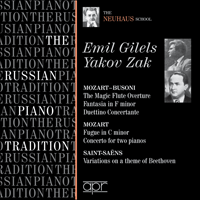


This is a recording from Appian Publications & Recordings Ltd (to quote the full title)—the label invariably more familiarly known simply as "APR".
Since its foundation in 1986, APR has won an enviable reputation as a quality label devoted predominantly—though not exclusively—to historic piano recordings. In particular APR has won countless laurels for the high standard of its 78rpm restoration work—"Transfers of genius" to quote one critic—as well as the detail and content of its booklets.

Certainly the two pianists had much in common. Both were Jewish, born in Odessa just three years apart. Both studied at the Odessa Conservatoire, albeit with different tutors – Zak with Maria Starkhova, Gilels with Berta Reingbald – and both moved to Moscow to complete their studies with Heinrich Neuhaus. There must have been shared opinions on music and music-making as a result of their similar backgrounds. But there were also vital differences. Gilels was unquestionably cast in the high-powered, virtuosic mould, someone born to conquer and captivate international audiences, though not someone ideally suited to passing on his knowledge via a conservatoire post. By contrast Zak, a prodigious performer though at a less incandescent level than Gilels, was a natural pedagogue and was therefore prepared to spend much of his time within the Soviet Union long after the Cold War was over. (Significantly Gilels made his USA debut in 1955; Zak did not venture there until a decade later.) Their differences did much to give the duo its striking individuality and flair: both pianists might have been technically impregnable and stylistically attuned but their contrasting temperaments brought rare yet complementary qualities to their interpretations which are exceptional in their effortless ebb and flow, drama and lyricism, wit and pathos. The duo inevitably wound down once Gilels was able to start taking the world by storm, culminating in his conquering of the USA in 1955, after which his international commitments were more or less all-consuming.
The choice of the duo’s recorded repertoire is interesting. Its first recording, the Mozart Double Piano Concerto in 1949, is an obvious choice – though there is nothing obvious about the extraordinarily effective cadenzas which have never been credited! It is possible that Gilels’s connection with the French school via his first teacher Yakov Tkatch, a pupil of Raoul Pugno, resulted in the choice of Saint-Saëns for its next major recordings – the ‘Beethoven’ Variations and Carnival of the Animals. The latter – despite, or perhaps because of, the somewhat serious nature of the ‘humour’; though with the glamour of having Daniyl Shafran as solo cellist in ‘The Swan’ – proved something of a best-seller within the USSR. It was not possible to include both works in this programme and preference has been given to the duo’s truly astonishing performance of Saint-Saëns’s equally astonishingly inventive Variations. Gilels – that rarity among Soviet/Russian pianists, a convincing Mozartean – might also have been behind the choice of the more esoteric Mozart and Mozart-Busoni titles that complete their recorded repertoire and upon which the duo lavish so much attention. The Mozart-Busoni pieces were new to the Soviet catalogue.
Emil Gilels
Gilels’s early years closely parallel those of Zak, though by the time he entered Neuhaus’s class in Moscow in 1935 he was already a noted prize-winner, with the 1931 Ukrainian Competition and the First All-Union Contest of Musicians and Performers of 1933 under his belt. During the difficult war years, aside from his duo appearances with Zak, Gilels premiered several new Soviet works and played much chamber music, frequently appearing with his sister Yelisaveta, brother-in-law Leonid Kogan and Mstislav Rostropovich. His international career eventually began in 1947 with concert appearances in Eastern Europe. He made his first UK appearance, a somewhat low-key affair, in 1952. As mentioned, Gilels was not a born teacher; he briefly joined the staff of the Moscow Conservatoire in 1938 and rejoined it in 1952 during which time he influenced, among others, Vladimir Block, Marina Mdivani and Igor Zhukov. Above all Gilels is best and rightly remembered as a lion among pianists active during the second half of last century: an unusually powerful and muscular player who simultaneously enabled passages of poetry and lyricism to take wing.
Yakov Zak
Zak studied with Heinrich Neuhaus at the Moscow Conservatoire between 1933 and 1935. Immediately after his graduation Zak made his mature debut and began the teaching career which kept him at his alma mater for the rest of his life, being appointed full professor in 1947 and granted a chair in 1965. His most noted pupils include Nikolai Petrov, Yevgeni Mogilevsky, Lyubov Timofeveya, Alexander Toradze and Youri Egorov.
Zak was one of the great Chopin players of his era but he also did his part in furthering contemporary Soviet music, notably premiering Kabalevsky’s third Piano Sonata in Moscow in 1947, as well as works by Yevgeni Golubev and Yuri Levitin. In 1951 he performed an all-Prokofiev recital before the composer to celebrate his sixtieth birthday. (Both Chopin and Kabalevsky will feature in an imminent CD devoted to this much underrated pianist.) His death in 1976 was sudden and unexpected. Apparently well-founded rumours attributed his demise to a heart attack brought on after a prolonged spell of interrogation by the KGB.
Bryan Crimp © 2007
Les deux pianistes avaient bien des choses en commun. D’origine juive, ils naquirent à Odessa à trois ans d’intervalle. Chacun étudia au Conservatoire d’Odessa, mais avec deux professeurs différents: Zak avec Maria Starkhova, Gilels avec Berta Reingbald. Ils vinrent tous deux à Moscou pour parachever leurs études auprès de Heinrich Neuhaus. Il est certain qu’ils eurent alors l’occasion de partager leur point de vue sur la musique et l’interprétation à la lumière de leur parcours similaire. Mais bien des différences les séparaient aussi. Gilels était sans conteste un virtuose puissant, né pour conquérir et captiver le public du monde entier, mais n’était pas le plus disposé à transmettre son savoir au sein d’un conservatoire. À l’inverse, Zak – prodigieux interprète sans se situer au niveau incandescent de Gilels – était un pédagogue né qui était préparé à passer la plupart de son temps en Union Soviétique bien après que la mort de Staline eût amorcé un apaisement de la guerre froide. (Ainsi, Gilels fit-il ses débuts aux États-Unis en 1955, tandis que Zak ne s’y rendit qu’une décennie plus tard.) Leurs différences firent beaucoup pour conférer son individualité et sa sensibilité au duo: les deux pianistes ne pouvaient pas être pris en défaut techniquement et étaient en harmonie sur le plan stylistique. Leurs tempéraments apportaient des qualités rares et complémentaires à leurs interprétations exceptionnelles auxquelles le duo savait insuffler souplesse, drame et lyrisme, esprit et pathos. Le duo réduisit inévitablement ses activités lorsque Gilels prit le monde d’assaut, faisant culminer son parcours avec la conquête des États-Unis en 1955. Après cette date, ses engagements internationaux accaparèrent quasiment tout son temps.
Il est intéressant d’examiner le répertoire que le duo choisit d’enregistrer. Leur premier disque – le Double Concerto pour Piano de Mozart en 1949 – semblait aller de soi même si le choix des formidables cadences, dont l’auteur reste inconnu, n’avait quant à lui rien d’évident. Il est possible que la relation qu’avait Gilels à l’école française par le biais de son premier professeur Yakov Tkatch, un élève de Raoul Pugno, l’ait incité à choisir Saint-Saëns pour leur second enregistrement important: les Variations «Beethoven» et le Carnaval des Animaux. Cette dernière œuvre, en dépit (ou grâce à) la nature quelque peu sérieuse de son humour, renforcée par le prestige de Daniyl Shafran comme violoncelliste solo pour «Le Cygne», devint un best-seller en URSS. Nous n’avons pu intégrer les deux œuvres à ce programme et avons opté pour l’interprétation véritablement étonnante des inventives Variations de Saint-Saëns. C’est peut-être encore Gilels, rare mozartien inspiré parmi les pianistes de la Russie soviétique, qui proposa les œuvres plus ésotériques de Mozart et Mozart-Busoni qui complètent leur répertoire enregistré et auxquelles le duo consacra beaucoup d’attention. Les pièces de Mozart-Busoni étaient alors des nouveautés dans le catalogue soviétique.
Emil Gilels
La jeunesse de Gilels a suivi un cours parallèle à celle de Zak même si, lorsqu’il intégra la classe de Neuhaus à Moscou en 1935, il s’était déjà fait remarquer comme lauréat du Concours Ukrainien de 1931 et du Premier Concours des Musiciens et Interprètes de l’Union en 1933. Pendant les difficiles années de guerre, outre ses apparitions en duo avec Zak, Gilels créa plusieurs œuvres soviétiques nouvelles et joua beaucoup de musique de chambre, notamment avec sa sœur Yelisaveta, son beau-frère Leonid Kogan et Mstislav Rostropovitch. Sa carrière internationale se développa véritablement à partir de 1947 avec des concerts en Europe de l’Est. Il fit des débuts relativement discrets au Royaume-Uni en 1952. Comme nous l’avons mentionné, Gilels n’était pas un pédagogue né: il rejoignit brièvement le corps enseignant du Conservatoire de Moscou en 1938 puis y revint en 1952 influençant notamment le développement de Vladimir Block, Marina Mdivani et Igor Zhukov. À juste titre, on se souvient surtout de Gilels comme une figure léonine parmi les pianistes de la seconde moitié du siècle dernier: un interprète musclé, d’une puissance inhabituelle, qui savait aussi donner vie aux passages poétiques et lyriques.
Yakov Zak
Zak étudia auprès de Heinrich Neuhaus au Conservatoire de Moscou entre 1933 et 1935. Après l’obtention de son diplôme, Zak fit ses débuts et commença sa carrière de pédagogue au sein cette même institution où il demeura jusqu’à la fin de sa vie, prenant le titre de professeur en 1947 et se voyant décerner une chaire en 1965. Parmi ses élèves les plus notables, on citera Nikolai Petrov, Yevgeni Moguilevsky, Lyubov Timofeveya, Alexander Toradze et Youri Egorov.
Zak fut l’un des grands interprètes de Chopin de son époque mais il œuvra aussi pour faire connaître la musique soviétique contemporaine en créant notamment la troisième Sonate pour Piano de Kabalevsky à Moscou en 1947, ainsi que des œuvres de Yevgeni Golubev et Yuri Levitin. En 1951, il donna un récital entièrement consacré à Prokofiev à l’occasion du soixantième anniversaire du compositeur. (Des œuvres de Chopin et Kabalevsky seront prochainement représentées dans un CD consacré à ce pianiste trop méconnu.) Sa mort en 1976 fut soudaine et inattendue. Des rumeurs émanant de sources fiables attribuent son décès à un infarctus consécutif à un long interrogatoire par le KGB.
Bryan Crimp © 2007
Français: Pierre-Martin Juban
Sicher hatten die zwei Pianisten viele Gemeinsamkeiten. Beide hatten am Konservatorium in Odessa studiert, wenn auch bei verschiedenen Lehrern – Zak bei Maria Starkowa, Gilels bei Berta Reingbald –, und beide waren nach Moskau gegangen, um sich bei Neuhaus den letzten Schliff zu holen. Es musste also wegen ihres ähnlichen Hintergrunds gemeinsame Auffassungen von Musik und Musizieren gegeben haben. Aber es gab auch wesentliche Unterschiede. Gilels war zweifellos festgelegt auf die kraftvolle und virtuose Schiene, einer, der geboren ist, ein internationales Publikum zu erobern und zu fesseln, aber auch einer, der nicht ideal dafür geschaffen ist, sein Können als Lehrer an einem Konservatorium weiterzugeben. Ganz im Gegensatz dazu war Zak, der ein erstaunlicher Interpret, wenn auch nicht auf dem glanzvollen Niveau wie Gilels, war, ein pädagogisches Naturtalent und verbrachte daher zwangsläufig einen großen Teil seines Lebens in der Sowjetunion, auch lange nach dem Ende des Kalten Krieges. (Bezeichnenderweise machte Gilels sein USA-Debut 1955, Zak erst zehn Jahre später.) Ihre Unterschiedlichkeit trug viel zum aufregenden individuellen Flair ihres Duos bei. Beide Pianisten mochten technisch perfekt und stilistisch aufeinander abgestimmt sein; aber ihr unterschiedliches Temperament verlieh ihren Interpretationen, die mit ihrer mühelosen Mischung aus An- und Abschwellen, dramatischen und lyrischen Elementen, Witz und Pathos außergewöhnlich waren, einen seltenen, sich ergänzenden Charakter. Das Duo löste sich unvermeidlich auf, als Gilels sich daran machte, die Welt im Sturm einzunehmen, mit dem Höhepunkt der Eroberung der USA 1955, nach der ihn seine internationalen Verpflichtungen mehr oder weniger total vereinnahmten.
Interessant ist die Wahl des Repertoires, das das Duo für seine Aufnahmen aussuchte. Ihre erste Aufnahme 1949, das Doppelkonzert von Mozart, liegt eher im Bereich der üblichen Literatur, obwohl die außerordentlich wirkungsvollen Kadenzen, deren Urheber nie festgestellt wurde, alles andere als gängig sind! Möglicherweise führte die Verbindung von Gilels zur französischen Schule über seinen ersten Lehrer Tkatsch, einen Schüler von Raoul Pugno, zur Wahl von Saint-Saëns für ihre nächsten größeren Aufnahmen, die „Beethoven“-Variationen und den Karneval der Tiere. Letzterer entwickelte sich trotz (oder vielleicht wegen?) seiner irgendwie seriöseren Art von Humor und mit dem Zugpferd Daniel Schaffran als Solocellisten im „Schwan“ zu einer Art Bestseller in der UdSSR. Es war nicht möglich, beide Werke in dieses Programm aufzunehmen. So wurde der wirklich wundervollen Interpretation von Saint-Saëns’ ebenso wundervollen wie erfindungsreichen Variationen der Vorzug gegeben. Gilels, diese Ausnahmeerscheinung unter den sowjetischen und russischen Pianisten, war auch ein überzeugender Mozartspieler und könnte deshalb hinter den esoterischen Mozart- und Mozart-Busoni-Stücken gestanden sein, die die Reihe ihrer Aufnahmen komplettieren und denen das Duo so viel Aufmerksamkeit geschenkt hat. Die Mozart-Busoni-Stücke waren übrigens neu im Sowjet-Katalog.
Emil Gilels
Gilels’ frühe Jahre nehmen nahezu den gleichen Verlauf wie die von Zak, obwohl Gilels zu der Zeit, als er 1935 in die Klasse von Neuhaus in Moskau eintrat, als Sieger im Ukrainischen Wettbewerb und dem Ersten All-Union Wettbewerb schon ein bekannter Preisträger war. Während der schwierigen Kriegsjahre machte Gilels neben seinen Duo-Auftritten mit Zak Uraufführungen einiger neuer Werke sowjetischer Komponisten und spielte oft Kammermusik, wobei er immer wieder mit seiner Schwester Elisabetha, seinem Schwager Leonid Kogan und Mstislaw Rostropowitsch auftrat. Seine internationale Karriere begann schließlich 1947 mit Konzertauftritten in Osteuropa. Sein erstes Konzert in England 1952 stieß allerdings auf keine größere Resonanz. Wie erwähnt, war Gilels kein geborener Lehrer. 1938 war er kurz Mitglied des Kollegiums am Moskauer Konservatorium und dann wieder 1952. In dieser Zeit übte er Einfluss u.a. auf Vladimir Block, Marina Mdivani und Igor Schukow aus. Vor allem bleibt Gilels bestens und zu Recht in Erinnerung als ein Löwe unter den Pianisten der zweiten Hälfte des vorigen Jahrhunderts, ein ungewöhnlich kraftvoller und muskulöser Spieler, der aber auch in der Lage war, poetische und lyrische Passagen zum Schwingen zu bringen.
Jakov Zak
Zak studierte zwischen 1933 und 1935 bei Neuhaus am Moskauer Konservatorium. Unmittelbar nach dem Examen machte er sein Debut als fertiger Pianist und begann eine Karriere als Lehrer, die ihn für den Rest seines Lebens an seine Alma Mater band. Dort wurde er 1947 zum ordentlichen Professor ernannt und erhielt 1965 einen Lehrstuhl. Seine bekanntesten Schüler waren Nikolai Petrow, Jewgenj Mogilewsky, Ljubov Timofejewa, Alexander Toradze und Juri Egorov.
Zak war einer der großen Chopin-Spieler seiner Zeit, aber er trug auch zur Verbreitung der zeitgenössischen sowjetischen Musik bei. Hervorzuheben ist die Uraufführung der 3. Klaviersonate von Kabalewsky 1947 in Moskau ebenso wie von Werken von Jewgenj Golubew und Juri Levitin. 1951 gab er einen reinen Prokofiew-Abend in Anwesenheit des Komponisten zur Feier von dessen 60. Geburtstag. (Chopin und Kabalewsky werden Inhalt einer künftigen CD sein, die diesem arg unterschätzten Pianisten gewidmet ist.) Sein Tod 1976 war plötzlich und unerwartet. Offensichtlich wohlbegründete Gerüchte bringen sein Ableben in Zusammenhang mit einem Herzanfall als Folge einer überlangen Vernehmung durch den KGB.
Bryan Crimp © 2007
Deutsch: Ludwig Madlener