Welcome to Hyperion Records, a British classical label devoted to presenting high-quality recordings of music of all styles and from all periods from the twelfth century to the twenty-first.
Hyperion offers both CDs, and downloads in a number of formats. The site is also available in several languages.
Please use the dropdown buttons to set your preferred options, or use the checkbox to accept the defaults.
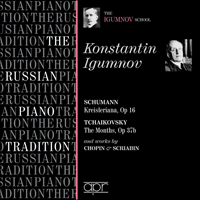

This is a recording from Appian Publications & Recordings Ltd (to quote the full title)—the label invariably more familiarly known simply as "APR".
Since its foundation in 1986, APR has won an enviable reputation as a quality label devoted predominantly—though not exclusively—to historic piano recordings. In particular APR has won countless laurels for the high standard of its 78rpm restoration work—"Transfers of genius" to quote one critic—as well as the detail and content of its booklets.

After gaining a diploma at the 1895 Anton Rubinstein International Competition in Berlin, Igumnov returned to Russia to make his Moscow and St Petersburg debuts. He was quickly recognized as a champion of the music of his friends and contemporaries – he premiered Rachmaninov’s Sonata No 1 and Glazunov’s Concerto No 1 – and eventually became a noted interpreter of the classics, in particular the last three Beethoven sonatas, Liszt’s Sonata and Schumann’s Fantasie. By the mid-1920s Moscow critics were hailing Igumnov as a ‘phenomenon’. In particular they admired his reluctance to revel in the ‘sheer power of his technique’, and his uniquely intimate style of performing. While this is apparent from some of his recordings it appears to have been hypnotically potent in the concert hall, where each member of the audience basked in the impression that Igumnov was playing exclusively for them.
Igumnov’s career as a pedagogue began in 1898 when he joined the staff of the Music School in Tiflis, possibly as a result of an introduction from Ippolitov-Ivanov, who had been Director there until 1893. However within a year, aged 26, Igumnov was back in Moscow; he had been invited to join the Moscow Conservatoire as a professor of piano. He remained there until his death on 24 March 1948, during which time he also acted as the Conservatoire’s Principal (1924–9), a period when the institute became notably more democratic. (Igumnov relinquished the post on account of the heavy burden of administration.) Among the earliest of an estimated five hundred pupils to work with him were Elena Bekman-Shcherbina, Jakob Weinberg (also a Leschetitzky pupil), Nikolai Orlov, Pierre Luboschutz, Jakov Milstein, Aleksander Wielhorski, the composer Anatoli Alexandrov and the conductor Issay Dobrowen. When Lev Oborin captured the headlines in 1927 by winning first prize at the inaugural International Chopin Competition in Warsaw (ahead of two Polish entrants, Stanislaw Szpinalski and Roza Etkin-Moszkowska, as well as fellow Soviet entrant, Grigory Ginzburg), Igumnov’s reputation soared. But, despite Oborin’s success, it was Jakov Flier who appears to have been regarded by his peers as Igumnov’s greatest pupil. Prominent among Igumnov’s later pupils are Maria Grinberg and Bella Davidovich (both of whom will be represented in this series along with Bekman-Shcherbina and Flier), David Rabinovich, Naum Shtarkman, Oleg Boshnyakovich, Vladimir Agarkov, Arno Babadjanian and the tragic figure of Boleslaw Kon, a Polish pianist of legendary gifts who committed suicide in 1936 at the age of thirty, leaving behind no recordings.
In old age Igumnov admitted that his entire life had been one long cultural journey. During his early years, when he was associating with such luminaries as Rachmaninov, Scriabin and Tolstoy, his inclinations were decidedly academic. Later, influenced more by the Russian painters and poets of his time, he veered towards revolutionary trends. Finally, he became more concentrated, more severe, but always intensely sympathetic towards his charges to whom he would inevitably repeat one of his favourite mantras: ‘Music should sound like poetry, like a human language’.
Regrettably, we will never hear Igumnov in his prime in acceptable sound. All his life he resisted the recording studio’s microphone in the belief that the process stifled spontaneity and of-the-moment inspiration. He did venture into the Welte-Mignon studio in 1910 to make piano roll recordings, all devoted to the Russian repertoire, but it was not until 1935 that Igumnov recorded a few 78-rpm sides, two of which open this programme. Igumnov’s Chopin credentials, in particular his seamless legato, are instantly confirmed by his interpretation of the Mazurka, Op 56 No 1, though they are perhaps more obviously evident in the work of some of his pupils, significantly Flier, Bekman-Shcherbina and Davidovich. Igumnov’s poetic, elusive interpretation of Scriabin’s Poème, Op 32 No 1, is far removed from Vladimir Sofronitsky’s distinctly hallucinogenic take on the composer’s music, one which many in the West have come to regard as ‘authentic’, largely because of Sofronitsky’s family connection with the composer. But there are Russian pianists who are inclined to view Sofronitsky’s Scriabin as over-emphatic and too full-blooded. For them Igumnov and Neuhaus were the composer’s finest early exemplars.
In 1939 and 1941 Igumnov recorded, respectively, Tchaikovsky’s Piano Trio (with David Oistrakh and Sviatoslav Knushevitsky) and Schumann’s Kreisleriana on ‘ton film’, a short-lived recording medium which, despite the advantage of vision, proved incapable of reproducing the finer sonic nuances of a performance. Kreisleriana is included here and, for all the obvious limitations of the sound, comes close to representing Igumnov in his prime. It was not until the last two years of his life, when he was in obvious failing health, that Igumnov was recorded extensively. Poor quality acetate discs capture a recital given at the Moscow Conservatoire’s Small Hall in 1946 devoted exclusively to music composed by Igumnov’s teachers or fellow-pupils. Then, on 3 December 1947, what was to be his final concert was recorded on tape in its entirety. For an elderly and ailing man it was an astonishingly demanding programme, one which included Beethoven’s Sonata, Op 10 No 3, Chopin’s Sonata No 3 and Tchaikovsky’s Grand Sonata. Ironically, although Igumnov was captured in the best sound ever granted him, he laboured the entire night with a high fever and his obvious noble intentions were inevitably seriously undermined. We are consequently left with two 1947 studio recordings: Schumann’s Dichterliebe, in which Igumnov partners the tenor Ivan Kozlovsky, and Tchaikovsky’s The Months. Quite how Igumnov, at this late stage in his career, was persuaded to re-enter the studio is unknown. Certainly he had an obvious fondness for Tchaikovsky’s enchanting (in Igumnov’s hands at least) suite, one which he performed regularly throughout his life despite it being largely ignored by others. Strangely, only selected movements were released on shellac discs with others appearing on an early Melodiya LP. Despite the indifferent recording and a piano which resembles a period instrument, this is the finest example we have of Igumnov’s uniquely intimate style of performance.
Bryan Crimp © 2007
Après avoir obtenu un diplôme lors du Concours International Anton Rubinstein de Berlin en 1895, Igumnov retourna en Russie pour faire ses débuts à Moscou et Saint-Pétersbourg. Il s’imposa rapidement comme l’un des meilleurs interprètes de la musique de ses amis et de ses contemporains: il créa la 1ère sonate de Rachmaninov et le 1er concerto de Glazounov. Il devint par la suite un éminent interprète des classiques, notamment des trois dernières sonates de Beethoven, de la Sonate de Liszt et de la Fantaisie de Schumann. Au milieu des années vingt, les critiques moscovites décrivaient Igumnov comme un «phénomène». Ils admiraient notamment son refus de se reposer uniquement sur «la toute puissance de sa technique», ainsi que l’intimité unique de son style interprétatif. Si cela transparaît dans certains de ses enregistrements, il semble que ces qualités revêtaient un caractère hypnotique en concert où chaque membre de l’auditoire avait le sentiment qu’Igumnov jouait exclusivement pour eux.
La carrière d’Igumnov comme pédagogue débuta en 1898 lorsqu’il intégra l’École de Musique de Tiflis. Il fut sans doute recommandé par Ippolitov-Ivanov qui en avait été le directeur jusqu’en 1893. Toutefois, dès l’année suivante, Igumnov, alors âgé de 26 ans, était de retour à Moscou où il fut invité à rejoindre le Conservatoire en qualité de professeur de piano. Il y demeura jusqu’à sa mort le 24 mars 1948, assumant même la direction du Conservatoire de 1924 à 1929 – période durant laquelle un vent plus démocratique souffla sur l’institution (Igumnov renonça à ce poste en raison de la charge administrative que celui-ci engendrait). Parmi les premiers des quelques cinq cents élèves qui devaient travailler avec lui, on compte Elena Bekman-Shcherbina, Jakob Weinberg (qui fut également élève de Leschetizky), Nikolai Orlov, Pierre Luboschutz, Jakov Milstein, Aleksander Wielhorski, le compositeur Anatoli Alexandrov et le chef d’orchestre Issay Dobrowen. Lorsque Lev Oborine fit la «une» en 1927 en remportant le 1er prix du premier Concours International Chopin à Varsovie (devant deux compétiteurs polonais, Stanislaw Szpinalski et Roza Etkin-Moszkowska, ainsi que son compatriote Grigory Ginzburg), la réputation d’Igumnov connut un nouvel essor. Cependant, malgré le succès d’Oborine, c’est Jakov Flier qui semble avoir été considéré par ses pairs comme le plus grand élève d’Igumnov. Plus tard, les élèves les plus importants d’Igumnov furent Maria Grinberg et Bella Davidovich (qui figureront dans la présente collection aux côtés de Bekman-Shcherbina et Flier), David Rabinovich, Naum Shtarkman, Oleg Boshnyakovich, Vladimir Agarkov, Arno Babadjanian et la figure tragique de Boleslaw Kon, un pianiste polonais aux dons légendaires qui se suicida en 1936, à l’âge de 30 ans, ne laissant aucun enregistrement derrière lui.
À la fin de sa vie, Igumnov reconnut que toute son existence ne fut qu’un long voyage culturel. Dans sa jeunesse, alors qu’il côtoyait des personnalités aussi lumineuses que Rachmaninov, Scriabine ou Tolstoï, ses goûts le portaient vers un certain académisme. Plus tard, influencé par les peintres et poètes de son temps, il subit une tendance plus révolutionnaire. À la fin, il devint plus concentré, plus sévère mais conservant une sympathie à l’égard de ses détracteurs à qui il répétait invariablement l’une de ses devises favorites: «La musique doit sonner comme de la poésie, comme un langage humain.»
Malheureusement, nous ne pourrons jamais entendre Igumnov au sommet de son art avec une qualité sonore acceptable. Toute sa vie, il rechigna à enregistrer en studio, considérant que les micros bridaient la spontanéité et l’inspiration du moment. Il s’aventura dans les studios de Welte-Mignon en 1910 pour enregistrer des rouleaux, tous consacrés au répertoire russe, mais ce n’est qu’en 1935 qu’Igumnov grava quelques 78 tours, dont deux inaugurent le présent programme. Les qualités d’Igumnov dans Chopin, en particulier la fluidité de son legato, sont immédiatement confirmées par son interprétation de la Mazurka, op. 56 no1, même si celles-ci se manifestent de façon peut-être plus évidente sous les doigts de certains de ses élèves, notamment Flier, Bekman-Shcherbina et Davidovich. L’interprétation poétique et insaisissable du Poème, op. 32 no1, de Scriabine par Igumnov est bien éloignée de l’approche hallucinée de Vladimir Sofronitsky que beaucoup à l’Ouest considèrent aujourd’hui comme «authentique», en raison notamment des liens familiaux que Sofronitsky avait avec le compositeur. Mais certains pianistes russes sont enclins à considérer que le Scriabine de Sofronitsky est trop emphatique et vigoureux. Pour eux, Igumnov et Neuhaus étaient les meilleurs interprètes de Scriabine de cette époque.
En 1939 et 1941, Igumnov enregistra, respectivement, le trio avec piano de Tchaïkovsky (avec David Oïstrakh et Sviatoslav Knushevitsky) et les Kreisleriana de Schumann sur «tonfilm», un procédé qui fut brièvement utilisé et qui, malgré l’avantage de l’image, s’avéra incapable de restituer les nuances sonores les plus subtiles d’une interprétation. L’enregistrement des Kreisleriana inclus dans ce programme est le document – malgré les limitations sonores – qui donne la meilleure idée de ce que fut Igumnov à son apogée. Ce n’est que deux ans avant sa mort, alors que sa santé était évidemment déclinante, qu’Igumnov fut abondamment enregistré. Des disques acétate de piètre qualité ont conservé son récital donné dans la Petite Salle du Conservatoire de Moscou en 1946. Le programme y était entièrement consacré à des œuvres des professeurs ou condisciples d’Igumnov. Puis, le 3 décembre 1947, le récital qui s’avéra être son dernier fut intégralement enregistré sur bande magnétique. Pour un homme âgé et souffrant, il s’agissait d’un programme exigeant, qui comprenait la Sonate op, 10 no3 de Beethoven, la Sonate no3 de Chopin et la Grande Sonate de Tchaïkovsky. Paradoxalement, s’il s’agissait de la meilleure qualité d’enregistrement dont Igumnov avait pu bénéficier dans sa carrière, il lutta toute la soirée contre une forte fièvre et ses intentions musicales en souffrirent inévitablement. Il ne nous reste donc que deux enregistrements réalisés en studio en 1947: les Dichterliebe de Schumann, qu’Igumnov interprète avec Ivan Kozlovsky, et Les Saisons de Tchaïkovsky. On ne sait pas comment Igumnov fut persuadé, si tard dans sa carrière, de retourner en studio. Il appréciait certainement beaucoup la charmante suite (du moins sous les doigts d’Igumnov) de Tchaïkovsky, œuvre qu’il interpréta régulièrement tout au long de sa vie bien qu’elle fut largement ignorée par les autres pianistes. Bizarrement, seuls quelques mouvements furent publiés sur disques 78 tours tandis que le reste fut publié par Melodiya à l’avènement du 33 tours. Malgré une qualité d’enregistrement qui laisse à désirer et un piano ressemblant à un instrument d’époque, il s’agit du plus bel exemple en notre possession du style de jeu particulièrement intime d’Igumnov.
Bryan Crimp © 2007
Français: Pierre-Martin Juban
Nachdem Igumnov 1895 beim Internationalen Anton-Rubinstein-Wettbewerb in Berlin ein Diplom gewonnen hatte, kehrte er nach Russland zurück, um dort in Moskau und St. Petersburg zu debütieren. Schnell fand er als Verfechter der Musik seiner Freunde und Zeitgenossen große Anerkennung. Er spielte die Uraufführung von Rachmaninows erster Sonate und Glasunows erstem Klavierkonzert und wurde schließlich ein anerkannter Interpret der Klassiker, speziell der drei letzten Beethoven-Sonaten, der Liszt-Sonate und der Schumann-Fantasie. Mitte der 20er Jahre priesen die Moskauer Kritiker Igumnov als „Phänomen“. Besonders bewunderten sie seinen Verzicht, sich an der schieren Kraft seiner Technik zu berauschen, und seinen unverwechselbar intimen Vortragsstil. Während dies schon in einigen seiner Aufnahmen deutlich wird, muss es offensichtlich im Konzertsaal in hypnotisierender Weise präsent gewesen sein, wo jeder einzelne Zuhörer sich in dem Gefühl sonnte, dass Igumnov nur für ihn spielte.
Igumnovs pädagogische Karriere begann 1898, als er Mitglied des Lehrkörpers an der Musikschule in Tiflis wurde, möglicherweise aufgrund einer Empfehlung von Ippolitov-Ivanov, der dort bis 1893 Direktor gewesen war. Trotzdem war Igumnov, mittlerweile 26 Jahre alt, schon nach einem Jahr wieder in Moskau; er war eingeladen worden, sich als Klavierprofessor dem Moskauer Konservatorium anzuschließen. Dort blieb er bis zu seinem Tod am 24. März 1948. Während dieser Zeit war er auch Chef des Konservatoriums (1924–9), in einer Zeit, in der das Institut deutlich demokratischer wurde. (Wegen der schweren Belastung durch die Verwaltungsarbeit gab Igumnov den Posten schließlich wieder auf). Unter den ersten der schätzungsweise 500 Schüler, mit denen er arbeitete, waren Elena Bekman-Schtscherbina, Jakob Weinberg (auch ein Leschetizky-Schüler), Nikolai Orlov, Pierre Luboschutz, Jakov Milstein, Alexander Wielhorski, der Komponist Anatoli Alexandrov und der Dirigent Issay Dobrowen. Als Lev Oborin 1927 als erster Preisträger des ersten Internationalen Chopin-Wettbewerbes in den Schlagzeilen stand (vor zwei polnischen Teilnehmern, Stanislaw Szpinalski und Roza Etkin-Moszkowska und auch seinem sowjetischen Kollegen Gregory Ginzburg), stieg Igumnovs Ansehen deutlich. Aber trotz Oborins Erfolg war es Jakov Flier, der von seinen Kollegen offenbar als Igumnovs bedeutendster Schüler angesehen wurde. Prominente Schüler aus der späteren Zeit Igumnovs sind Maria Grinberg und Bella Davidovich (beide werden in dieser Reihe zusammen mit Bekman-Schtscherbina und Flier berücksichtigt werden), Naum Shtarkman, Oleg Boshnyakowich, Vladimir Agarkov, Arno Babadjanian und die tragische Gestalt von Boleslaw Kon, einem polnischen Pianisten mit legendärer Begabung, der 1936 im Alter von 30 Jahren Selbstmord beging, ohne eine einzige Aufnahme hinterlassen zu haben.
In seinen späten Jahren bekannte Igumnov, dass sein ganzes Leben eine einzige lange Kulturreise gewesen sei. Während seiner frühen Jahre, als er noch im Kreis von Lichtgestalten wie Rachmaninow, Skrjabin und Tolstoi war, tendierte er eindeutig zum Akademismus. Später wandelte er sich unter dem Einfluss der russischen Maler und Dichter seiner Zeit eher zu einem Revolutionär. In seinen letzten Jahren widmete er sich intensiver seinen Schülern, wurde strenger, blieb ihnen gegenüber aber immer äußerst mitfühlend. Dabei wiederholte er unverdrossen sein wichtigstes Credo: „Musik sollte immer klingen wie Dichtung, wie menschliche Sprache.“
Bedauerlicherweise werden wir Igumnov in Bestform nie mehr in einem annehmbaren Klang hören. Sein ganzes Leben lang wehrte er sich gegen das Aufnahme-Mikrophon im Studio, weil er der Meinung war, dass diese Prozedur die Spontaneität und Inspiration des Augenblicks ersticken würde. 1910 wagte er sich ins Studio von Welte-Mignon, um Aufnahmen auf Piano-Rollen zu machen, die sämtlich dem russischen Repertoire gewidmet waren; aber erst 1935 nahm Igumnov einige wenige 78er Seiten auf, von denen zwei dieses Programm eröffnen. Igumnovs Qualitäten als Chopin-Spieler, besonders das nahtlose Legato, werden sofort bestätigt durch die Interpretation der Mazurka, Op. 56 Nr. 1, auch wenn vielleicht diese Vorzüge im Spiel einiger seiner Schüler, von allem von Flier, Bekman-Schtscherbina und Davidovich noch deutlicher werden. Die poetische, schemenhafte Interpretation von Skrjabins Poème, Op. 32 Nr. 1 durch Igumnov ist weit entfernt von Vladimir Sofronitzkis deutlich rauschhaftem Zugang zur Musik dieses Komponisten, die manche aus dem Westen vor allem wegen der familiären Verbindung Sofronitzkis mit dem Komponisten als authentisch betrachten. Es gibt aber russische Pianisten, die dazu tendieren, Sofronitzkis Skrjabin als zu emphatisch und blutvoll zu sehen. Für sie waren Igumnov und Neuhaus die frühen Musterbeispiele für eine Skrjabin-Interpretation.
Jeweils 1939 und 1941 nahm Igumnov Tschaikowskys Klaviertrio (mit David Oistrakh und Svjatoslav Knussevitzky) und Schumanns Kreisleriana auf Tonfilm auf, ein kurzlebiges Aufnahmemedium, das sich trotz des optischen Vorteils als ungeeignet erwies, feinere Klangnuancen einer Interpretation wiederzugeben. Die Kreisleriana wurde in diese Sammlung aufgenommen und zeigt Igumnov bei allen offensichtlichen Einschränkungen des Klangs annähernd in Bestform. Erst in seinen zwei letzten Lebensjahren, als er deutlich gesundheitlich angeschlagen war, wurden von Igumnov häufiger Einspielungen gemacht. Auf Azetat-Platten von schlechter Qualität wurde ein Klavierabend aufgenommen, der 1946 im Kleinen Saal des Moskauer Konservatoriums stattfand und ausschließlich Kompositionen von Lehrern und Mitschülern Igumnovs enthielt. Außerdem wurde am 3. Dezember 1947 das Konzert, das sein letztes werden sollte, in voller Länge auf Band aufgezeichnet. Für einen älteren und leidenden Mann war es mit Beethovens Sonate Op. 10 Nr. 3, Chopins dritter Sonate und Tschaikowskys Großer Sonate ein erstaunlich anspruchsvolles Programm. Es ist eine Ironie des Schicksals, dass Igumnov, gerade als die für ihn besten Aufnahmebedingungen zur Verfügung standen, den ganzen Abend unter hohem Fieber litt und so zwangsläufig seine offensichtlich edlen Absichten ernsthaft zunichte gemacht wurden. Uns bleiben folglich nur zwei Studioaufnahmen von 1947: Schumanns Dichterliebe mit dem Tenor Ivan Kozlovsky als Partner und Tschaikowskys Jahreszeiten. Wie Igumnov wirklich in dieser späten Phase seiner Karriere überredet werden konnte, noch einmal das Studio zu betreten, ist unbekannt. Sicher hatte er eine offensichtliche Vorliebe für Tschaikowskys (zumindest unter Igumnovs Händen) bezaubernde Suite, die er sein ganzes Leben lang regelmäßig spielte, obwohl sie von anderen weitgehend vernachlässigt wurde. Eigenartigerweise erschienen nur ausgewählte Sätze auf Schellack-Platten zusammen mit anderen Stücken auf einer frühen Melodija-LP. Trotz der mittelmäßigen Aufnahme und eines Flügels, der ein schon recht betagtes Instrument gewesen zu sein scheint, ist dies das wunderbarste Beispiel, das wir von Igumnovs einmalig intimem Interpretationsstil haben.
Bryan Crimp © 2007
Deutsch: Ludwig Madlener
