Welcome to Hyperion Records, a British classical label devoted to presenting high-quality recordings of music of all styles and from all periods from the twelfth century to the twenty-first.
Hyperion offers both CDs, and downloads in a number of formats. The site is also available in several languages.
Please use the dropdown buttons to set your preferred options, or use the checkbox to accept the defaults.
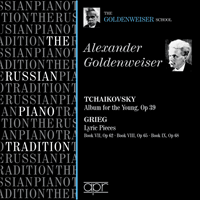

This is a recording from Appian Publications & Recordings Ltd (to quote the full title)—the label invariably more familiarly known simply as "APR".
Since its foundation in 1986, APR has won an enviable reputation as a quality label devoted predominantly—though not exclusively—to historic piano recordings. In particular APR has won countless laurels for the high standard of its 78rpm restoration work—"Transfers of genius" to quote one critic—as well as the detail and content of its booklets.

After early lessons with Vasilly Prokunin, the young Goldenweiser was fortunate to enter the Moscow Conservatoire during its golden age; his fellow students and soon-to-be staunch friends included Alexander Scriabin, Sergei Rachmaninov and Nicolai Medtner. After piano studies with Alexander Siloti and Pabst he graduated in 1895 and went on to study composition with Mikhail Ippolitov-Ivanov, Anton Arensky and Sergei Taneyev for two years. Like Neuhaus, Goldenweiser was a nervous stage performer and early on in his professional life decided to devote most of his energies to teaching. In January 1906, after a spell at the Moscow Nikolai Institute, Goldenweiser commenced a near-56-year reign as ‘the maker of Russian pianists’ at the Moscow Conservatoire. During this period, he twice acted as the Conservatoire’s Director – from 1922–24 (as the first post-revolution director) and between 1939–1942 (until he was evacuated to the North Caucasus as a result of the Second World War). Goldenweiser was to exert a profound influence upon more than 200 pianists, among whom the most celebrated are Grigori Ginzburg, Samuil Feinberg, Rosa Tamarkina and Tatiana Nikolayeva (all of whom will be represented in this series), as well as Lazar Berman, Dmitri Bashkirov, Isabella Vengerova, Oxana Yablonskaya and Dmitri Paperno. It was also on Goldenweiser’s initiative that the Central School of Music (CSM) was established in Moscow in 1932 (with Leningrad and Kiev soon following suit). Attached to the ‘parent’ conservatoire, these CSMs gave exceptionally gifted children specialist music training as well as an all-round education. Goldenweiser was the Moscow school’s first artistic director.
Goldenweiser taught in the same studio (No 42) during his entire time at the Conservatoire. We learn from Paperno that it contained two Bechstein instruments, one of which Goldenweiser always ‘locked upon leaving the studio, and an armchair for him in a remote corner by the window. Sofas and chairs lined the walls – several students were always waiting their turn to play.’ His lessons were as stimulating as they were varied; one day the emphasis might be on phrasing, another day the concern would be articulation or dynamics. He was a firm believer that the scrupulous observation of the composer’s indications in no way compromised a student’s creativity or individuality. He was correct of course – this belief is not only reflected in the playing of his finest pupils (Tamarkina, Nikolayeva, Feinberg, Ginzburg and Berman) but also in his own recordings. Goldenweiser was paternally fond his pupils, frequently exerting as great an influence upon their minds as their fingers, none more so than Ginzburg, to whom he became a surrogate father and, later, Berman whose studies with Goldenweiser were ‘extended’ for some 18 years, so saving his most outstanding pupil of the time from being drafted into the army. It was Berman who confirmed that, unlike Neuhaus, Goldenweiser would give technical advice, though admittedly his words of wisdom were frequently sphinx-like: ‘to play with the pedal means knowing how not to play with the pedal’! Bashkirov, among the last generation of Goldenweiser pupils and who also served as his assistant, was strikingly objective in his assessment of his mentor. He considered Goldenweiser to be ‘a great musician, unbelievably clever, educated, and analytical in his thinking … [yet] very orthodox, very precise, not very artistic, and without fantasy or temperament’. Goldenweiser could also be irascible, his outbursts apparently being more frequent as he became older. Small wonder, given all the uncertainties he experienced during his later years at the Conservatoire when it was plagued with persecution campaigns conducted by rumour, innuendo, even sheer terror. He nevertheless frequently sailed dangerously close to wind, speaking out if he felt a pupil had been unfairly treated, yet somehow managing to evade the kind of fate that befell Neuhaus who was imprisoned by the KGB in 1943 before being exiled to Sverdlovsk. Goldenweiser also saved Yakov Flier from suffering the same fate as Yakov Zak, who was tortured to death by the KGB in 1976.
Despite his stage nerves Goldenweiser appeared comfortable in the recording studio, as a result of which his discography is relatively extensive – though a surprisingly large proportion was released only after his death. The majority of his recordings were made during the earliest days of the LP era when he was in his seventies and his playing inevitably lacked the ‘sparkle’ of earlier years. Even so, as is apparent in this programme, his playing is illuminated by a telling fusion of simplicity and subtlety. For Goldenweiser rhythm was the foundation of all music-making, a rhythm that was both flexible and varied. As a result his rubato is uniquely refined and expressive. Naturally, for one so steeped in the culture of his own time and place, the Russian repertoire features prominently in his discography, with solo piano music by his friends and acquaintances Arensky, Medtner and Scriabin, as well as Borodin, Glinka, Tchaikovsky and Prokofiev. And there is much Rachmaninov: the celebrated duo recordings with Ginzburg of the six Duets and two Suites, the second of which was dedicated to Goldenweiser, as well as 78-rpm recordings of the Cello Sonata (with Sviatoslav Knushevitsky) and the Piano Trio (with Dmitri Tziganov and Sergei Shirinsky). Other chamber music recordings feature him with David Oistrakh (Catoire and Medtner violin sonatas) and with Leonid Kogan and Mstislav Rostropovich in his own massive, single-movement Piano Trio, written in memory of Rachmaninov and recorded just months before his death. Goldenweiser was a prolific composer, his output includes three operas, a string quartet and a considerable amount for solo piano, notably 24 Preludes, Fugues and Canons of 1931. He also had a pronounced fondness for Grieg, recording what appears to have been the first complete traversal of the Lyric Pieces, here represented by Books 7 and 9, and extracts from Book 8. Alongside the disarming directness of his interpretations we are able to savour Goldenweiser’s remarkably varied tonal and dynamic palette, this despite the relatively primitive recording and the poor quality of early Soviet LP pressings. Goldenweiser’s self-effacing playing in Tchaikovsky’s Children’s Suite, avoiding even a hint of faux naïveté, perfectly captures the innocence of these epigrammatic gems.
Goldenweiser’s death preceded the passing of his pianistic son, for many his greatest pupil, Grigory Ginzburg, by just days. It brought to an end to one of the most lengthy and influential chapters in the history of the Moscow Conservatoire.
Bryan Crimp © 2008
Après avoir commencé ses études auprès de Vassily Prokunin, le jeune Goldenweiser eut la chance d’intégrer le Conservatoire de Moscou pendant son âge d’or: ses condisciples – qui devinrent rapidement des amis indéfectibles – furent Alexandre Scriabine, Sergueï Rachmaninov et Nikolaï Medtner. Après avoir étudié avec Alexander Siloti et Pabst, il obtint son diplôme en 1895, puis étudia la composition avec Mikhail Ippolitov-Ivanov, Anton Arensky et Sergueï Taneyev pendant deux ans. A l’instar de Neuhaus, Goldenweiser avait le trac et décida très tôt de consacrer la plus grande partie de son énergie à l’enseignement. En janvier 1906, après une courte période passée à l’institut Nikolaï de Moscow, Goldenweiser commença un règne de près de 56 ans où il fut un «faiseur de pianistes russes» au sein du Conservatoire de Moscou. Durant cette période, il fut par deux fois directeur de l’institution: de 1922 à 1924 (premier directeur après la révolution) et entre 1939 et 1942 (jusqu’à ce qu’il soit évacué dans le nord du Caucase en raison de la Seconde Guerre mondiale). Goldenweiser exerça une profonde influence sur les quelques 200 pianistes qu’il forma dont les plus célèbres furent Grigori Ginzburg, Samuel Feinberg, Rosa Tamarkina et Tatiana Nikolayeva (qui figureront tous dans la présente série) ainsi que Lazar Berman, Dmitri Bashkirov, Isabella Vengerova, Oxana Yablonskaya et Dmitri Paperno. C’est également à l’initiative de Goldenweiser que fut établit l’Ecole Centrale de Musique (ECM) à Moscou en 1932 (puis à Leningrad et Kiev). Affiliées aux conservatoires, ces ECM proposent une éducation musicale spécialisée ainsi qu’un enseignement général aux enfants les plus doués. Goldenweiser fut le premier directeur artistique de l’école de Moscou.
Goldenweiser enseigna toujours dans le même studio (no42) tout au long de sa carrière au Conservatoire. Dmitri Paperno rapporte qu’il contenait deux pianos Bechstein dont l’un que Goldenweiser «refermait toujours à clé avant de quitter le studio, un fauteuil pour lui dans un coin près de la fenêtre. Un canapé et des chaises alignés contre le mur – et toujours plusieurs étudiants qui attendaient leur tour pour jouer devant lui.» Ses leçons étaient aussi stimulantes qu’elles étaient variées: un jour l’accent était mis sur le phrasé, un autre son attention portait sur l’articulation ou les dynamiques. Il croyait fermement que le respect scrupuleux des indications du compositeur ne compromettait nullement la créativité ou l’individualité de l’étudiant. Il avait bien sûr raison: non seulement cette conviction se retrouve dans le jeu de ses meilleurs élèves (Tamarkina, Nikolayeva, Feinberg, Ginzburg et Berman) mais également dans ses propres enregistrements. Goldenweiser éprouvait une affection paternelle pour ses élèves, exerçant souvent une influence aussi grande sur leur esprit que sur leurs doigts. Ceci est particulièrement vrai de Ginzburg pour lequel il devint un père de substitution et, plus tard, Berman dont les études avec Goldenweiser «s’étirèrent» sur plus de 18 années pour éviter à son élève le plus doué d’être enrôlé dans l’armée. C’est Berman qui confirma que, à l’inverse de Neuhaus, Goldenweiser donnait des conseils techniques bien que ceux-ci furent parfois sibyllins: «jouer avec de la pédale c’est savoir comment jouer avec de la pédale»! Bashkirov, qui appartint à la dernière génération des élèves de Goldenweiser et qui fut également son assistant, était étonnamment objectif dans l’évaluation de son mentor. Il considérait Goldenweiser comme «un grand musicien, incroyablement intelligent, éduqué, emprunt d’une pensée analytique … [néanmoins] très orthodoxe, très précis, peu artistique, et sans fantaisie ni caractère». Goldenweiser pouvait également se montrer irascible. Ses accès de colère devinrent plus fréquents à la fin de sa vie. Ceci n’est par surprenant si l’on considère les incertitudes qu’il dut affronter au cours de ses dernières années au Conservatoire où les campagnes de persécutions étaient relayées par les rumeurs, les insinuations et la terreur. Cependant, il navigua souvent courageusement dans ces vents tumultueux, n’hésitant pas à s’exprimer en faveur d’un étudiant traité injustement. Il réussit pourtant à éviter le sort d’un Neuhaus qui fut emprisonné par le KGB en 1943 avant d’être exilé à Sverdlovsk. Goldenweiser épargna également à Yakov Flier de connaître le même sort que Yakov Zak qui fut torturé à mort par le KGB en 1976.
Malgré son trac, Goldenweiser semblait être à l’aise dans un studio d’enregistrement. Aussi, sa discographie est-elle relativement vaste bien qu’une large proportion d’entre elle ait été publiée seulement après sa mort. La majorité de ses enregistrements fut réalisée au début du microsillon alors qu’il avait déjà plus de soixante-dix ans et que son jeu n’avait naturellement plus «l’éclat» de sa jeunesse. Malgré cela, comme en témoigne ce programme, son jeu est illuminé par une fusion éloquente entre simplicité et subtilité. Pour Goldenweiser, le rythme constituait le fondement de la musique, un rythme à la fois souple et varié. Ainsi, son rubato est unique par son raffinement et son expressivité. Naturellement, pour quelqu’un d’aussi profondément immergé dans la culture de son époque et de son pays, le répertoire russe tint une place prépondérante dans sa discographie où l’on recense la musique pour piano de ses amis et fréquentations: Arensky, Medtner et Scriabine ainsi que Borodine, Glinka, Tchaikovsky et Prokofiev. On y retrouve également beaucoup d’œuvres de Rachmaninov: le célèbre enregistrement en duo avec Ginzburg des six Duos et deux Suites, dont la seconde est dédiée à Goldenweiser, ainsi que des gravures 78 tours de la Sonate pour Violoncelle (avec Sviatoslav Knushevitsky) et du Trio avec Piano (avec Dmitri Tziganov et Sergei Shirinsky). D’autres enregistrements en musique de chambre lui permirent de retrouver David Oistrakh (sonates pour violon de Catoire et Medtner), ainsi que Leonid Kogan et Mstislav Rostropovich pour interpréter son imposant Trio avec Piano en un seul mouvement, composé en souvenir de Rachmaninov et enregistré quelques mois seulement avant sa mort. (Goldenweiser fut un compositeur prolifique dont les œuvres comprennent trois opéras, un quatuor à cordes, et des quantités considérables de compositions pour piano seul dont 24 Préludes, Fugues et Canons datant de 1931.) Il avait également un goût prononcé pour Grieg qui l’incita à enregistrer le premier cycle complet des Pièces lyriques, représenté ici pas les Recueils no7 et no9 et des extraits du Recueil no8. Outre le caractère désarmant de son interprétation sans fard, on peut également apprécier la remarquable variété de sonorités et la palette dynamique de Goldenweiser, malgré l’enregistrement relativement primitif et la piètre qualité des premiers pressages des microsillons soviétiques. L’interprétation de Goldenweiser de la Suite pour enfants de Tchaïkovsky, où le pianiste s’efface devant son sujet, évitant toute fausse naïveté, saisit parfaitement l’innocence de ses joyaux épigrammatiques.
La mort de Goldenweiser précéda de quelques jours seulement celle de Grigori Ginzburg, son héritier pianistique que beaucoup considérait comme son plus grand disciple. Elle mit fin à l’un des plus longs et plus influents chapitres de l’histoire du Conservatoire de Moscou.
Bryan Crimp © 2008
Français: Pierre-Martin Juban
Nach ersten Stunden bei Vasily Prokunin hatte Goldenweiser das Glück, in das Moskauer Konservatorium während dessen goldener Zeit eintreten zu können. Unter seinen Mitstudenten und zukünftigen treuen Freunden waren Alexander Skrjabin, Serge Rachmaninow und Nikolai Medtner. Nach Klavierstudien bei Alexander Siloti und Paul Pabst machte er 1895 seine Abschlussprüfung und setzte seine Studien zwei Jahre lang bei Michail Ippolitov-Ivanov, Anton Arensky und Sergej Tanejew fort. Wie Neuhaus war Goldenweiser auf der Konzertbühne von Lampenfieber geplagt und entschloss sich deshalb schon früh in seiner professionellen Laufbahn, fast seine gesamte Arbeitskraft dem Unterrichten zu widmen. Nach einem Gastspiel im Moskauer Nikolai-Institut begann Goldenweiser im Januar 1906 eine fast 56 Jahre währende Herrschaft als „Macher russischer Pianisten“ am Moskauer Konservatorium. In diesem Zeitraum wirkte er zweimal als Direktor, und zwar von 1922–1924 als der erste Chef nach der Revolution und 1939–1942, bis er als Folge des 2. Weltkriegs in den Nord-Kaukasus evakuiert wurde. Goldenweiser sollte einen entscheidenden Einfluss auf mehr als 200 Pianisten ausüben, unter ihnen Grigori Ginzburg, Samuil Feinberg, Rosa Tamarkina und Tatjana Nikolajewa (sie alle werden in dieser Reihe vorgestellt werden), ebenso wie Oxana Jablonskaya und Dimitri Paperno, um nur die berühmtesten zu nennen. Auch die Einrichtung der Zentralen Musikschule in Moskau (CSM) 1932 (Leningrad und Kiew folgten kurz darauf) ging auf Goldenweisers Initiative zurück. Sie waren dem Mutterkonservatorium angeschlossen und boten hochbegabten Kindern ein spezielles Musiktraining, aber auch eine Allgemeinerziehung. Goldenweiser war der erste künstlerische Direktor der Moskauer Schule.
Goldenweiser hielt seinen Unterricht im Konservatorium die ganze Zeit im selben Studio ab. Von Paperno wissen wir, dass sich darin zwei Bechstein-Flügel befanden, von denen Goldenweiser immer „einen absperrte, wenn er das Studio verließ, und ein Armsessel für ihn in einer entfernten Ecke nahe dem Fenster. An der Wand entlang standen Sofas und Stühle, auf denen immer Studenten warteten, bis sie zum Spielen drankamen.“1 Seine Stunden waren anregend und abwechslungsreich. An einem Tag konnte der Schwerpunkt auf der Phrasierung liegen, an einem anderen galt das Interesse der Artikulation und Dynamik. Er glaubte fest daran, dass die gewissenhafte Beachtung der Vorschriften des Komponisten die Kreativität und Individualität des Studenten in keiner Weise einschränkte. Natürlich war er genau, und diese Einstellung spiegelt sich nicht nur im Spiel seiner Meisterschüler (Tamarkina, Nikolajewa, Feinberg, Ginzburg und Berman), sondern auch in seinen eigenen Aufnahmen wider. Goldenweiser war zu seinen Schülern von väterlicher Güte und übte häufig genauso großen Einfluss auf ihre Persönlichkeit wie auf ihre Finger aus, in besonderem Maß auf Ginzburg, für den er zum Ersatzvater wurde, und später auf Berman, dessen Studien bei Goldenweiser auf fast 18 Jahre „verlängert“ wurden, womit er seinen damals bedeutendsten Schüler vor dem Militärdienst bewahrte. Berman war es, der bestätigte, dass Goldenweiser im Gegensatz zu Neuhaus auch technische Ratschläge gab, obwohl seine weisen Worte zugegebenermaßen häufig recht kryptisch waren: „Mit Pedal zu spielen bedeutet zu wissen, wie man ohne Pedal spielt!“2 Baschkirov, der letzten Generation der Goldenweiser-Schüler angehörend und auch sein Assistent, war bemerkenswert objektiv in der Einschätzung seines Mentors. Er betrachtete Goldenweiser als „einen großen Musiker, unglaublich intelligent, gebildet und ein analytischer Denker, … [aber] sehr orthodox, sehr penibel, kein wirklicher Künstler und ohne Fantasie und Temperament.“3 Goldenweiser konnte auch jähzornig sein, wobei sich die Ausbrüche in seiner späteren Zeit häuften. Das kann kaum verwundern, wenn man die Turbulenzen bedenkt, unter denen er in seinen letzten Jahren am Konservatorium litt, als er Verfolgungskampagnen ausgesetzt war durch Gerüchte, Andeutungen, ja durch schieren Terror. Trotzdem segelte er häufig hart am Wind, da er immer wieder offene Worte fand, wenn er das Gefühl hatte, dass ein Schüler unfair behandelt worden war. Er schaffte es aber doch irgendwie, dem Schicksal zu entkommen, das Neuhaus zustieß, als er vom KGB 1943 eingesperrt wurde, bevor er ins Exil nach Swerdlowsk gehen musste. Goldenweiser rettete auch Yakov Flier davor, dasselbe Los zu erleiden wie Yakov Zak, der 1976 vom KGB zu Tode gefoltert wurde.
Trotz seines Lampenfiebers auf der Bühne schien sich Goldenweiser im Aufnahmestudio wohl zu fühlen, was dazu führte, dass seine Diskographie relativ umfänglich ist, obwohl ein überraschend großer Teil davon erst nach seinem Tod erschien. Die Mehrzahl seiner Aufnahmen wurde in den Anfangstagen der LP-Ära gemacht, als er schon gut 70 Jahre alt war und sein Spiel unvermeidlich den Glanz der frühen Jahre verloren hatte. Aber auch so zeichnet es sich, wie dieses Programm zeigt, durch eine wirkungsvolle Mischung aus Schlichtheit und Raffinesse aus. Für Goldenweiser war der Rhythmus die Grundlage allen Musizierens, einer, der sowohl flexibel als auch variabel war. Das Ergebnis ist ein außerordentlich kunstvolles und ausdrucksstarkes Rubato. Natürlich ist bei jemandem, der so tief in der Kultur seiner Zeit und seines Kulturkreises verwurzelt war, in der Diskographie das russische Repertoire mit Klaviermusik seiner Freunde und Bekannten Arensky, Medtner, und Skrjabin, aber auch von Borodin, Glinka, Tschaikowsky und Prokofiew, stark vertreten. Auch einiges von Rachmaninow ist dabei: die gefeierten Aufnahmen der sechs Stücke op.12 und der zwei Suiten, deren zweite Goldenweiser gewidmet ist, ebenso wie die 78er Aufnahmen der Cellosonate (mit Svjatoslav Knuschewitzky) und des Klaviertrios (mit Dimitri Ziganow und Sergej Schirinsky). Weitere Kammermusikaufnahmen zeigen ihn mit David Oistrach (die Violinsonaten von Catoire und Medtner) und mit Leonid Kogan und Mstislav Rostropowitsch in seinem eigenen, gewaltigen einsätzigen Klaviertrio, geschrieben zum Gedenken an Rachmaninow und nur wenige Monate vor seinem Tod aufgenommen. (Goldenweiser war ein fruchtbarer Komponist. Sein Werkkatalog umfasst drei Opern, ein Streichquartett und eine beträchtliche Zahl von Stücken für Klavier solo, darunter 24 Präludien, Fugen und Kanons aus dem Jahr 1931.) Er hatte auch eine ausgesprochene Schwäche für Grieg und machte offensichtlich die erste Gesamtaufnahme der Lyrischen Stücke, die hier durch Buch 7 und 9 und eine Auswahl aus Buch 8 vertreten sind. Neben der entwaffnenden Direktheit seiner Interpretationen können wir Goldenweisers erstaunlich variable Ton- und Dynamikpalette genießen, und das trotz der relativ primitiven Aufnahme und der schlechten Qualität der frühen sowjetischen LP-Pressungen. Goldenweisers zurückhaltendes Spiel bei den Kinderstücken von Tschaikowsky, mit dem er auch nur einen Hauch von falscher Naivität vermeidet, wird der Schlichtheit dieser epigrammatischen Edelsteine perfekt gerecht.
Goldenweiser starb nur wenige Tage vor seinem pianistischen Ziehsohn Grigori Ginzburg, für viele sein berühmtester Schüler. Damit ging eines der längsten und einflussreichsten Kapitel in der Geschichte des Konservatoriums zu Ende.
Bryan Crimp © 2008
Deutsch: Ludwig Madlener
