
Welcome to Hyperion Records, a British classical label devoted to presenting high-quality recordings of music of all styles and from all periods from the twelfth century to the twenty-first.
Hyperion offers both CDs, and downloads in a number of formats. The site is also available in several languages.
Please use the dropdown buttons to set your preferred options, or use the checkbox to accept the defaults.
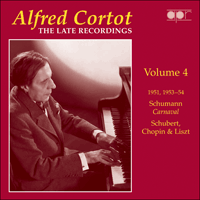


This is a recording from Appian Publications & Recordings Ltd (to quote the full title)—the label invariably more familiarly known simply as "APR".
Since its foundation in 1986, APR has won an enviable reputation as a quality label devoted predominantly—though not exclusively—to historic piano recordings. In particular APR has won countless laurels for the high standard of its 78rpm restoration work—"Transfers of genius" to quote one critic—as well as the detail and content of its booklets.

The omens were good when Cortot began recording at Abbey Road in May 1953. Gone, at last, was the process of recording in 78-rpm ‘segments’, be it on wax masters or tape, which required the performer to start and stop every four-and-a-half minutes or so. The advantages of magnetic tape were now belatedly recognized: uninterrupted recording for subsequent release on LP disc began. (‘Highlights’ from these tapes would be released on 45-rpm 7-inch vinyl discs as well as the now old-fashioned 78-rpm shellac disc.) Tape enabled and liberated both artist and record producer and Cortot embraced these new opportunities with characteristic stamina and élan. Many full-scale works which the pianist had long wanted to record were tackled: Weber’s Second Sonata; Chopin’s two mature sonatas along with the Préludes, Ballades and Études; Schumann’s Carnaval, Symphonic Études, Kreisleriana and Fantasiestücke (Op 12). However, as the accompanying discography reveals, success proved elusive although it certainly was not for the want of endeavour or commitment on either side. Interpretatively, Cortot’s music-making was as passionate and virile as ever. Never one to dawdle, even in old age he had no truck with sedate tempi or ‘emergency rubati’ in the more technically demanding passages – the ‘Paganini’ movement of Schumann’s Carnaval being a rare if obvious exception. But, as is apparent from this programme, although Cortot more than squared up to the demands of the chosen repertoire his always fallible fingers were at this time further undermined by illness. As a consequence, the majority of his last London recordings remain unpublished, justifiably so as they reflect little glory on either pianist or recording company which, it should be mentioned, put enormous effort into assembling master tapes. Only after this had been achieved was it really possible to determine whether the resultant performances would withstand artistic scrutiny. That stated, it has not been difficult to compile this programme from the published recordings of 1953/4. It is one which fully supports the claim of the late Thomas Manshardt, one of Cortot’s last pupils, that this period of Cortot’s career ‘is his greatest in thought and warmth and mastery, never mind the progress of Parkinson’s disease’.
Nevertheless, there are moments of glittering delicacy allied to crystal transparency – Cortot’s performances of Chopin’s Études Opp 10/5 & 25/2 and, perhaps, the Tarantelle, are remarkable for any pianist in his late-70s. And, of course, in slower movements Cortot’s ardent lyricism and poetry, his luminous and kaleidoscopic tone colours now captured as never before, remain undimmed and unmatched. Small wonder then, that in 1959 HMV took what at first might appear to be a bizarre decision to publish a coupling of the slow movements from Cortot’s Chopin sonata recordings. And there are other significant treasures not least a major Schumann work, teeming with life and character, as well as the pairing of Cortot’s fifth (and surely finest) published recording of his much-loved transcription of Schubert’s Litanie with his seductive and fearless despatch of Liszt’s Hungarian Rhapsody.
The documentation of this series has previously been confined to Cortot and his relationship with HMV from 1947 and it is surely opportune to conclude with a reminder of some of the pianist’s most remarkable achievements. We are inclined to forget that he was so much more than the pianist we know on record. After a brilliant start – as a pupil of Decombes (himself a pupil of Chopin) and Diémer, the nineteen-year-old Cortot easily won the premier prix at the Paris Conservatoire in 1896 – he then neglected his instrument in pursuit of Wagner. In 1898 Cortot went to Bayreuth and acted as répétiteur at the festivals there for three years before returning home to conduct the first Paris performances of Götterdämmerung, Tristan und Isolde and Parsifal (as well as Liszt’s St Elisabeth and Brahms’s Requiem). It was not until 1905 (when he teamed up with Jacques Thibaud and Pablo Casals to form what became the most acclaimed trio of the first half of the last century) that the piano fully re-entered his professional life. In 1919 he co-founded a new and influential conservatoire, the École Normale de Musique. As for repertoire, despite some claims to the contrary, Cortot embraced most of the piano literature of nineteenth- and twentieth-century Western Europe, displaying a unique empathy for Chopin and Schumann. There were also forays into the unexpected. A decade or so before it was appropriated by Horowitz, Cortot championed Rachmaninov’s Third Piano Concerto. Remarkably, he conducted a performance with Horowitz as soloist in 1932 although it appears that neither musician was overly impressed with the other. Even more extraordinary, from the 1924 edition of Dent’s Dictionary of Modern Music and Musicians, we learn from a contributor – Philip Heseltine (aka Peter Warlock) no less – that Cortot had ‘expressed a desire to take up one of the concertos and the First Sonata of Kaikhosru Sorabji’!
Alfred Denis Cortot (1877– 1962) pianist and conductor, teacher and scholar, editor and author, was not only a protean musician but one of the last exponents of a highly personal, subjective style of performance. Fortunately his vast discography will always be with us.
Bryan Crimp © 2010
Les séances d’enregistrements de Cortot à Abbey Road de mai 1953 se présentèrent sous les meilleurs auspices. L’enregistrement par «segment» de 78 tours, sur cire ou bande, imposant à l’interprète de s’interrompre toutes les quatre minutes trente environ, appartenait désormais au passé. Les avantages de la bande magnétique étaient enfin reconnus: celle-ci permettait un enregistrement ininterrompu en vue d’une publication sur 33 tours. (Les meilleures prises furent néanmoins publiées sur disques 45 tours vinyles de 21 cm ainsi qu’en 78 tours.) Les bandes constituèrent une libération tant pour les directeurs artistiques que pour les artistes et Cortot se saisit avec son énergie et son élan habituels des possibilités qui lui étaient offertes. De nombreuses œuvres de grandes envergures que le pianiste souhaitait aborder depuis longtemps furent enregistrées: la deuxième Sonate de Weber, les deux Sonates de la maturité ainsi que les Préludes, Ballades et Études de Chopin, le Carnaval, les Études symphoniques, les Kreisleriana et les Fantasiestücke (op. 12) de Schumann. Cependant, sa discographie en témoigne, la réussite ne fut pas toujours au rendez-vous en dépit des efforts et de la bonne volonté de chacun. Sur le plan interprétatif, les exécutions de Cortot se montraient toujours aussi passionnées et viriles. Refusant de se ménager malgré son âge avancé, il renonça à adopter des tempi mesuré ou à recourir au rubato pour «sécuriser» les passages les plus exigeants techniquement. Seul «Paganini», extrait du Carnaval de Schumann, fait exception à cette règle.
Comme le montre ce programme, bien que Cortot satisfasse aux exigences du répertoire sélectionné, ses doigts déjà faillibles étaient fragilisés par la maladie. Ceci explique que la majorité des œuvres de ces dernières séances londoniennes ne furent pas publiées: elles n’auraient fait honneur ni au pianiste ni à sa maison de disque qui, il faut le souligner, ne ménagea pas ses efforts pour monter les bandes master. Ce n’est qu’après avoir effectué ce travail qu’il fut réellement possible de déterminer si les interprétations étaient acceptables sur le plan artistique. Il fut cependant aisé de choisir le programme pour ce disque parmi les enregistrements effectués en 1953/54. Cette sélection illustre l’affirmation du regretté Thomas Manshardt, l’un des derniers élèves de Cortot, selon laquelle cette période de la carrière de Cortot fut «la plus imposante sur le plan de la pensée, de la chaleur et de la maîtrise, malgré la progression de sa maladie de Parkinson».
On y retrouve des moments qui mêlent étincelante délicatesse et transparence cristalline: ses interprétations des Études opp. 10 no5 et 25 no2 de Chopin et, peut-être aussi, la Tarentelle, sont remarquables pour un pianiste de plus de soixante-quinze ans. Naturellement, dans les mouvements plus lents, le lyrisme et la poésie ardente de Cortot, sa palette de couleur lumineuse et kaléidoscopique, saisis ici comme jamais, demeurent inaltérés et insurpassables. On ne sera donc pas surpris que HMV ait pris la décision, a priori étonnante, de publier en 1959 un disque réunissant les mouvements lents des deux Sonates de Chopin interprétés par Cortot. D’autres trésors importants parurent parmi lesquels une œuvre majeure de Schumann qui fourmille de vie et de caractère, ainsi que la cinquième (et certainement la meilleure) version publiée de sa transcription de la Litanie de Schubert qui fut couplée avec sa lecture séduisante et téméraire de la Rhapsodie hongroise no11 de Liszt.
Les précédents livrets de cette série ont évoqué la relation qu’entretint Cortot avec HMV à partir de 1947. Il est sans doute opportun de conclure par un rappel des faits marquants de la carrière du pianiste. Il ne faut pas oublier qu’il fut bien davantage que le pianiste que nous connaissons par le disque. Après des débuts brillants – il étudia avec Decombes (un élève de Chopin) et Diémer – Cortot emporta à 19 ans le premier prix du Conservatoire de Paris en 1896. Il délaissa un temps son instrument pour assouvir sa passion wagnérienne. En 1898, Cortot se rendit à Bayreuth où il travailla comme répétiteur pendant trois années avant de revenir en France où il dirigea la création parisienne du Crépuscule des Dieux, de Tristan et Isolde ainsi que de Parsifal (mais aussi de St Elisabeth de Liszt et du Requiem de Brahms). Ce n’est qu’en 1905, lorsqu’il se joignit à Jacques Thibaud et Pablo Casals pour former le trio le plus acclamé de la première moitié du vingtième siècle, que le piano revint au centre de son activité professionnelle. En 1919, il fut le cofondateur d’un conservatoire nouveau et influent: l’École Normale de Musique. En matière de répertoire, bien qu’on ait prétendu le contraire, Cortot aborda pratiquement toute la littérature pianistique d’Europe occidentale du 19ème et 20ème siècle, manifestant une affinité unique pour Chopin et Schumann. Il fit également des incursions dans des univers inattendus: une décennie avant Horowitz, Cortot se fit le champion du Troisième Concerto pour piano de Rachmaninov. Il dirigea même cette œuvre avec Horowitz au piano en 1932, même s’il semble qu’aucun des musiciens ne garda un souvenir impérissable de l’autre. Encore plus remarquable, on peut lire dans l’édition 1924 du Dent’s Dictionary of Modern Music and Musicians, un article signé Philip Heseltine (compositeur et critique également connu sous le nom de Peter Warlock) relatant que Cortot avait «exprimé le désir de jouer les concertos et la Première sonate de Kaikhosru Sorabji»!
Alfred Denis Cortot (1877–1962), pianiste, chef d’orchestre, professeur, érudit, éditeur et auteur, ne fut pas seulement un musicien protéiforme mais également le dernier représentant d’un style d’interprétation subjectif et très personnel. Heureusement, son legs discographique continue de témoigner de son art.
Bryan Crimp © 2010
Français: Pierre-Martin Juban
Die Zeichen standen gut, als Cortot im Mai 1953 seine Aufnahmetätigkeit an der Abbey Road begann. Die Aufnahmetechnik in 78rpm-Segmenten, sei es auf Wachsmatrizen oder auf Band, bei der der Pianist ungefähr alle viereinhalb Minuten unterbrechen musste, gehörte endgültig der Vergangenheit an. Die Vorzüge des Tonbands waren, wenn auch etwas verspätet, mittlerweile anerkannt: angesagt waren jetzt Aufnahmen ohne Unterbrechung mit anschließender Veröffentlichung auf LP. (Die Highlights von diesen Bändern erschienen immer wieder sowohl auf 45er Vinyl-Platten als auch auf den heute altmodischen 78ern Schellack-Scheiben). Das Tonband gab dem Künstler wie auch dem Produzenten ungeahnte Perspektiven und Freiheiten, und Cortot begrüßte diese neuen Möglichkeiten mit dem ihm eigenen Stehvermögen und Schwung. Viele Gesamtwerke, die der Pianist schon lange hatte aufnehmen wollen, wurden in Angriff genommen: Webers zweite Sonate, Chopins zwei spätere Sonaten nebst den Préludes, Balladen und Etüden; Schumanns Carnaval, die Symphonischen Etüden, die Kreisleriana und die Fantasiestücke Op. 12. Allerdings war, wie aus der beigefügten Diskographie hervorgeht, der Erfolg des Projekts eher fraglich, was sicher nicht an einem Mangel an Einsatz und Engagement auf beiden Seiten lag. Cortots Interpretationen waren so leidenschaftlich kraftvoll wie immer. Zögerlichkeit war nicht seine Sache; sogar im fortgeschrittenen Alter wollte er nichts wissen von behäbigen Tempi oder von Not-Rubati in den technisch anspruchsvolleren Passagen, mit der nachvollziehbaren Ausnahme des „Paganini“ in Schumanns Carnaval. Aber obwohl Cortot, wie man an diesem Programm erkennen kann, den Anforderungen des gewählten Repertoires voll gewachsen war, war die immer schon anfällige Notensicherheit seiner Finger damals noch mehr eingeschränkt durch seine Erkrankung. Die Folge davon war, dass der größere Teil seiner letzten Aufnahmen in London zu Recht unveröffentlicht blieb, weil sie weder dem Pianisten noch der Plattenfirma Ehre machen, die sich, was nicht unerwähnt bleiben soll, größte Mühe gab, Master-Bänder herzustellen. Nur dadurch war es überhaupt möglich zu entscheiden, ob die vorliegenden Interpretationen einer künstlerischen Prüfung standhalten würden. Damit war es dann nicht mehr schwer, dieses Programm aus den veröffentlichten Aufnahmen von 1953/54 zusammen zu stellen. Es bestätigt voll die Behauptung des verstorbenen Thomas Manshardt, eines der letzten Schüler Cortots, dass dieser Abschnitt von Cortots Karriere „der bedeutendste ist, was Gedankentiefe, Wärme und Meisterschaft betrifft, trotz seiner fortschreitenden Parkinson-Erkrankung“.
Nichtsdestotrotz sind da wirklich Augenblicke glitzernder Delikatesse, gepaart mit glasklarer Transparenz: Cortots Interpretationen der Chopin-Etüden Op. 10/5 und Op. 25/2 und vielleicht auch der Tarantelle würden jedem Pianisten Ende 70 zur Ehre gereichen. In den langsamen Sätzen bleiben natürlich Cortots leidenschaftliche Lyrik und Poesie, seine leuchtenden und schillernden Tonfarben, die nun so gut wie nie zuvor festgehalten sind, von unerreichter Leuchtkraft. So kann es kaum verwundern, dass HMV 1959 eine auf den ersten Blick groteske Entscheidung traf, nämlich die langsamen Sätze aus Cortots Aufnahmen der Chopin-Sonaten als separate Gruppe herauszugeben. Und es gibt noch weitere bemerkenswerte Schätze, nicht zuletzt ein größeres Schumann-Werk, voll von Lebendigkeit und Charakter; außerdem Cortots fünfte (und sicher schönste) Einspielung seiner heiß geliebten Transkription von Schuberts Litanei zusammen mit seiner faszinierenden und furchtlosen Darbietung von Liszts Ungarischer Rhapsodie.
Das Material für diese Serie war bisher beschränkt auf Cortot und seine Beziehung zu HMV aus dem Jahr 1947, und es ist sicher angebracht, an einige der bemerkenswertesten Leistungen dieses Pianisten zu erinnern. Wir vergessen leicht, dass er so viel mehr war als der Pianist, den wir von den Aufnahmen kennen. Nach einem brillanten Start als Schüler von Decombes (selbst Schüler von Chopin) und Diemér, gewann der 19jährige 1896 mühelos den ersten Preis am Pariser Conservatoire, vernachlässigte dann aber sein Instrument und wandte sich Wagner zu. 1898 ging Cortot nach Bayreuth und betätigte sich dort drei Jahre lang als Korrepetitor des Festivals. Nach seiner Rückkehr leitete er die Pariser Erstaufführung der Götterdämmerung, von Tristan und Isolde und Parsifal (ebenso von Liszts St. Elisabeth und des Requiems von Brahms). Erst 1905, als er sich mit Jacques Thibaud und Pablo Casals zu einem Klaviertrio zusammentat, welches das berühmteste der ersten Hälfte des vorigen Jahrhunderts werden sollte, wurde das Klavier wieder zum Mittelpunkt seiner Karriere. 1919 war er Mitbegründer eines neuen und einflussreichen Konservatoriums, der École Normale de Musique. Was das Repertoire betrifft, so beschäftigte sich Cortot trotz einiger gegenteiliger Behauptungen mit dem größten Teil der westeuropäischen Klavierliteratur des 19. und 20. Jahrhunderts, wobei er sich eindeutig zu Chopin und Schumann hingezogen fühlte. Er machte aber auch Ausflüge in unerwartete Gefilde. So setzte sich Cortot schon ungefähr zehn Jahre, bevor es von Horowitz vereinnahmt wurde, für das 3. Klavierkonzert von Rachmaninow ein. In diesem Zusammenhang ist es erwähnenswert, dass er 1932 eine Aufführung dieses Konzerts dirigierte, und zwar mit Horowitz als Solisten; offensichtlich aber war keiner der beiden Musiker vom anderen sonderlich beeindruckt. Noch außergewöhnlicher ist, was wir von einem Mitverfasser von Dent’s Dictionary of Modern Music and Musicians (keinem Geringeren als Philip Heseltine alias Peter Warlock) erfahren, dass nämlich Cortot „den Wunsch geäußert habe, eines der Konzerte und die 1. Sonate von Kaikhosru Sorabji in Angriff zu nehmen“!
Alfred Denis Cortot (1877–1962), Pianist und Dirigent, Pädagoge und Gelehrter, Herausgeber und Autor, war nicht nur eine vielseitige Musikerpersönlichkeit, sondern auch einer der letzten Exponenten eines höchst persönlichen und subjektiven Klavierstils. Es ist ein Glück, dass wir seine riesige Diskographie für immer besitzen.
Bryan Crimp © 2010
Deutsch: Ludwig Madlener



