Welcome to Hyperion Records, a British classical label devoted to presenting high-quality recordings of music of all styles and from all periods from the twelfth century to the twenty-first.
Hyperion offers both CDs, and downloads in a number of formats. The site is also available in several languages.
Please use the dropdown buttons to set your preferred options, or use the checkbox to accept the defaults.
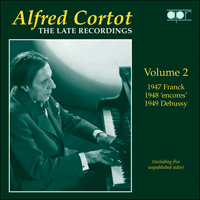


This is a recording from Appian Publications & Recordings Ltd (to quote the full title)—the label invariably more familiarly known simply as "APR".
Since its foundation in 1986, APR has won an enviable reputation as a quality label devoted predominantly—though not exclusively—to historic piano recordings. In particular APR has won countless laurels for the high standard of its 78rpm restoration work—"Transfers of genius" to quote one critic—as well as the detail and content of its booklets.

Many complex factors lay at the root of this disappointment. On a personal level Cortot was a far from well seventy-year-old. Physically perhaps his greatest handicap at this time was a cataract in his left eye. Mentally he had endured untold tribulations as a result of some ill-advised wartime activities, added to which was the strain of his second wife’s continuing poor health. Even professionally Cortot the pianist was obliged to revise his long-established approach to the recording process. In the past Cortot, always a spontaneous interpreter, might have secured a successful take only after a dozen or more waxes had been made. Now, prevailing post-war restrictions meant that raw materials were so scare that artists were obliged to restrict themselves to a very limited number of ‘takes’ per 78-rpm side.
Despite this new regime, Cortot’s ‘failures’ were rarely calamitous, as is evident from the recording of Franck’s Prélude, Aria et Final included here, the most extended work (spread across six sides) waxed during the 1947 sessions. Cortot’s approval of his recordings appears to have been primarily governed by interpretative considerations and he was certainly surprised when the Franck was considered to be unacceptable by his producer, David Bicknell. Now that we can hear this recording for the first time we can, perhaps, understand Cortot’s disappointment as we admire the manner in which the lyrical moments are so beautifully nuanced and how the score is so masterfully structured. Yet we can also comprehend Bicknell’s reluctance to release a recording, dating from an era when technical perfection had taken precedence over spontaneous interpretation, which has its obvious ‘troubled moments’. (We have to thank Malcolm Binns for placing the five surviving test pressings of this recording at APR’s disposal. Side two, the second half of the Prélude, has never been located and so Cortot’s earlier recording has been inserted in lieu. Every effort has been made to ease the transition from and to the Steinway of 1947 and the Blüthner of 1932!)
Despite the dissatisfaction surrounding the 1947 sessions EMI agreed to record Cortot the following year. From their standpoint Cortot, for all the problems associated with recording him, was still an artist indelibly associated with HMV and if his initial post-war recordings revealed a diminution of his always erratic technique, the radiant poetry of his interpretations and the kaleidoscopic range of his tone colours and dynamics had been captured more faithfully than at any time in Cortot’s near thirty year recording career. Furthermore, and difficult as it might be to comprehend given the ruthless commercialism of today’s record industry, EMI was then a caring company, one that was genuinely concerned about its most prestigious and loyal artists. In short, Cortot could not be abandoned.
There is no evidence that there had been any differences between Cortot and his new producer during the 1947 sessions—David Bicknell was too much a diplomat and a gentleman for unpleasantness—though his disenchantment with Cortot’s work was common knowledge within EMI, as was later to be apparent from a memo he wrote after attending the first of Cortot’s two London Chopin recitals in 1949. It would, he wrote, be ‘a waste of time and money to invite [Cortot] to play any difficult works’. He was convinced (rightly at this time—1948) that Cortot’s wish to commence the re-recording of Chopin’s complete works for solo piano in time for the centenary of the composer’s death in 1949 was a total non-starter. With materials in short supply and of erratic quality (see below) and Cortot in fragile form, Bicknell decided that the best way to proceed was to halve the number of sessions scheduled for 1948 to just two and to restrict the repertoire to short, technically undemanding lyrical pieces, which could be accommodated on 10-inch waxes. Cortot’s feelings regarding these restrictions can only be imagined but he must have been buoyed on entering the studio to begin the first of two morning-only sessions to find Fred Gaisberg, his producer in countless pre-war sessions, at the helm. (Bicknell joined the pair for the second session.) Of the nine sides recorded in 1948—unidentified parts of which were also recorded simultaneously on tape—six were released between September 1948 and November 1949, carefully cultivating the impression that Cortot remained an active HMV recording artist. Miniatures they might be, but these recordings are devastating examples of Cortot’s lyric playing and his unique sound.
Perhaps because of an improvement in Cortot’s overall condition—his cataract had been successfully removed in July—EMI imposed no restrictions for the 1949 sessions: indeed, there were regular exchanges with regard to the choice of repertoire. Initially Cortot had wanted to record as much as possible from the repertoire of his two imminent London all-Chopin recitals. Bicknell considered this an overly ambitious and expensive project. When Cortot countered with the suggestion of the complete Chopin Waltzes, Bicknell reminded him that neither the Nouvelles études or the Op 45 Prélude had been successfully recorded in 1947. Such to-ings and fro-ings also reveal that Cortot had a wish to record Fauré’s third Valse-Caprice and two Romances sans paroles—which would have made welcome additions to the Cortot discography had the suggestion been taken up. Four days—4 to 7 November—were allocated for recording; Cortot delayed an Austrian tour. However, hasty rearrangements of the schedule had to be made when Cortot’s wife was taken seriously ill. David Bicknell consequently spread the four sessions across just two days, the complete Book One of Debussy’s Préludes being recorded on 24 October and a selection of Chopin pieces on 4 November, after which Cortot immediately left the UK.
Cortot arrived in London to commence the 1949 sessions just days after his first appearance in France since the demonstrations against him in the capital in January 1947. He had accomplished something particularly dear to him: a major Chopin recital at the Salle Pleyel, Paris on the centenary of the composer’s death, 17 October 1949. Cortot now faced a gruelling few weeks. Aside from recording he was touring the UK, visiting Dublin and giving his London recitals marking the Chopin anniversary. On 11 November his programme contained nothing less than the 24 Preludes, Op 28, Sonata, Op 35, Fantaisie, Op 49, Waltz, Op 64/2, Berceuse, Op 57, Scherzo, Op 31, and Polonaise, Op 53. Two days later he offered the Sonata, Op 58, 4 Ballades, a collection of Études, Nocturnes and Waltzes and, by way of conclusion, the Andante spianato and Grande Polonaise, Op 22!
With David Bicknell recording in Europe and Fred Gaisberg now fully retired, Cortot found the friendly face of Lawrance Collingwood as his producer for the 1949 sessions. Long a stalwart of the Gramophone Company as conductor, artist go-between and producer, Collingwood was of a gentle, sympathetic disposition and formidably experienced when it came to musical and recording matters. Significantly, there were no rejections from either of the 1949 sessions though it is ironic that the sound, with Cortot in finer form than he had been at any time since the war, should have been below the standard established in 1947 and 1948. It has not been possible to determine exactly why this should have been, though during this period several pianists (including Malcuzynski) had their sessions cancelled or delayed as a result of the effect London’s notorious ‘pea soup’ fogs had on the studio pianos. Additionally, as will be evident from the accompanying discography, there was the additional problem of noisy matrices, resulting from inferior raw materials, and the attendant increase in surface noise. EMI, aware of these deficiencies, chose to release the Debussy Préludes only on automatic sequenced 78-rpm records available to ‘special order’. When they were issued on LP in July 1953 (BLP 1006) from tape masters, the sound revealed little improvement. (The Chopin titles recorded in November 1949 will be included in the third volume in this series.)
In October 1954 HMV released an 12-inch LP (ALP 1197) exclusively confined to shorter works, so maintaining Cortot’s profile in the new and rapidly expanding microgroove catalogue. These laudable intentions were somewhat undermined by the lacklustre programming of an LP which was, unbelievably, initially to be called A Bunch of Celebrated Encores! In its final form, as Alfred Cortot plays Popular Encores, the LP comprised mostly Chopin miniatures recorded that year although these were preceded by the 1948 ‘encore’ pieces with the exception of Cortot’s arrangement of Schubert’s Litanie. It would seem that transferring these titles from the approved 78-rpm masters proved impracticable due to the technical imperfections inherent in the masters—as can readily be heard in Schumann’s Vogel als Prophet, complete with motor rumble and swish—and so new ‘takes’ were compiled from taped material from the sessions. The three interpretations which differ most from the original 78-rpm records make up the ‘appendix’ to this programme.
Bryan Crimp © 2005
De nombreux facteurs expliquent cette déception. Sur le plan personnel, Cortot atteignait l’âge de soixante-dix ans. Physiquement, son plus grand handicap à l’époque était sans doute la cataracte qui affectait son œil gauche. Moralement, il endurait les conséquences des choix mal inspirés qu’il avait faits au cours de la guerre, sans compter la pression à laquelle le soumettait la santé précaire de sa seconde femme. Même sur le plan professionnel, le pianiste dut revoir son approche de l’enregistrement. Dans le passé, Cortot, qui fut toujours un interprète spontané, n’obtenait une prise satisfaisante après qu’au moins une douzaine de cires aient été gravées. Désormais, les restrictions d’après-guerre rendaient la matière première était si rare que les artistes devaient se limiter à un nombre très limité de prises pour chaque face de 78 tours.
Malgré ce nouveau régime, les «insuffisances» de Cortot étaient rarement calamiteuses, comme en témoigne son enregistrement du Prélude, Aria et Final de Franck qui figure sur ce disque, l’œuvre la plus importante (six faces) gravée au cours de ces séances de 1947. L’approbation que donna Cortot à cet enregistrement semble avoir été surtout motivée par des considérations interprétatives et il fut sans doute surpris d’apprendre que son directeur artistique, David Bicknell, jugea cette gravure de Franck inacceptable. Maintenant qu’il nous est donné d’entendre cet enregistrement pour la première fois, on peut comprendre la déception de Cortot. On ne peut qu’y admirer la façon dont il nuance les moments lyriques et structure magistralement la partition. Cependant, on imagine également les réticences de Bicknell à sortir cet enregistrement à une époque où la perfection technique prenait le pas sur la spontanéité de l’interprétation jamais exempte de quelques «moments troubles». (Nous sommes redevables à Malcolm Binns d’avoir mis les cinq pressages tests qui ont survécus à la disposition d’APR. La seconde face, correspondant à la deuxième partie du Prélude, n’a pu être retrouvée et a été remplacée par le premier enregistrement de Cortot. Tout a été fait pour atténuer la transition entre le Steinway de 1947 et le Blüthner de 1932!)
Malgré le mécontentement qui entoura les séances de 1947, EMI accepta d’enregistrer Cortot l’année suivante. De leur point de vue, Cortot, quelque furent les problèmes liés à ses enregistrements, était un artiste indéfectiblement associé à HMV. Si ses gravures d’avant-guerre révélaient une diminution de sa technique qui avait toujours été incertaine, la poésie rayonnante de ses interprétations et l’éventail kaléidoscopique des couleurs sonores et des dynamiques étaient restitués plus fidèlement qu’au cours des trente dernières années de la carrière discographique de Cortot. De plus, aussi étonnant cela puisse paraître à la lumière de la course au profit de l’industrie du disque actuelle, EMI était alors une société bienveillante, qui se préoccupait sincèrement de ses artistes les plus prestigieux et les plus loyaux. En bref, Cortot ne pouvait être abandonné.
Il n’existe pas de preuve d’un différend entre Cortot et son nouveau directeur artistique pour ces séances de 1947—David Bicknell était trop diplomate et «gentleman» pour se montrer déplaisant—même si son désenchantement avec Cortot était connu au sein d’EMI, comme le laisse entendre le mémorandum qu’il écrivit après avoir assisté au premier des deux récitals Chopin que Cortot donna à Londres en 1949. Ce serait, indiqua-t-il, une «perte de temps et d’argent que d’inviter [Cortot] à jouer des œuvres difficiles». Il était convaincu (à juste titre à cette époque—1948) que le souhait de Cortot d’enregistrer à nouveau toutes les œuvres pour piano seul de Chopin juste à temps pour le centenaire de la mort du compositeur en 1949 constituait un projet irréaliste. Avec une matière première en quantité limitée et de qualité inégale (voir ci-dessous) et Cortot connaissant une forme précaire, Bicknell décida qu’il valait mieux réduire de moitié les séances prévues pour 1948 afin de n’en conserver que deux tout en restreignant le répertoire à des pièces lyriques, courtes, peu exigeantes sur le plan technique, pouvant se graver sur des cires de disques 25 cm. On peut imaginer ce qu’éprouva Cortot en apprenant ces restrictions mais il dut se sentir rasséréné de trouver Fred Gaisberg, le directeur artistique d’un nombre incalculable de ses séances d’enregistrements d’avant-guerre, présider à la première de ses deux matinées d’enregistrements. (Bicknell les rejoignit pour la deuxième séance.) Parmi les neuf faces gravées en 1948—dont une partie non-identifiée fut également enregistrée simultanément sur bande—six furent commercialisées en septembre 1948 et novembre 1949, cultivant soigneusement l’impression que Cortot était toujours un artiste activement enregistré par HMV. Bien qu’il s’agisse de miniatures, ces gravures constituent des exemples foudroyants du jeu lyrique et de la sonorité unique de Cortot.
Peut-être est-ce l’amélioration de la condition physique de Cortot—sa cataracte ayant été opérée avec succès en juillet—qui incita EMI à ne poser aucune restrictions pour les séances de 1949: les échanges furent en effet réguliers en ce qui concerne le choix du répertoire. Initialement, Cortot souhaitait enregistrer autant d’œuvres que possible issues du programme des deux récitals Chopin qu’il allait bientôt donner à Londres. Bicknell considéra le projet trop ambitieux et trop coûteux. Lorsque Cortot répliqua en suggérant l’intégrale des Valses de Chopin, Bicknell lui rappela que ni les Nouvelles études, ni le Prélude, op.45, n’avaient été gravés avec succès en 1947. Ce va-et-vient de lettres révèle que Cortot proposa la troisième Valse-Caprice et deux Romances sans paroles de Fauré qui auraient constituées des nouveautés dans la discographie de Cortot si la suggestion avait été acceptée. Quatre jours—du 4 au 7 novembre—furent retenus pour l’enregistrement ce qui contraignit Cortot à différer une tournée en Autriche. Cependant, il fallut redéfinir en hâte ce calendrier lorsque l’épouse de Cortot tomba sérieusement malade. David Bicknell répartit alors les quatre séances sur seulement deux journées. Le Premier Livre des Préludes de Debussy fut enregistré le 24 octobre et une sélection d’œuvres de Chopin le 4 novembre, après quoi Cortot quitta immédiatement le Royaume-Uni.
Cortot arriva à Londres pour aborder les séances de 1949 quelques jours seulement après avoir donné son premier concert en France depuis les manifestations d’hostilité qu’on lui manifesta dans la capitale en janvier 1947. Il venait de réaliser un projet qui lui était cher: donner un important récital Chopin à Paris, salle Pleyel, à l’occasion du centenaire de la mort du compositeur, le 17 octobre 1949. Plusieurs semaines d’activités harassantes attendaient Cortot. Outre les enregistrements, sa tournée au Royaume-Uni devait le conduire à Dublin et comporter des récitals à Londres marquant l’anniversaire de Chopin. Le 11 novembre, son programme ne contenait pas moins que les 24 Préludes, op.28, la Sonate, op.35, la Fantaisie, op.49, la Valse, op.64/2, la Berceuse, op.57, le Scherzo, op.31, et la Polonaise, op.53. Deux jours plus tard, il proposait la Sonate, op.58, les 4 Ballades, une sélection d’Études, des Nocturnes et des Valses et, en guise de conclusion, l’Andante spianato et Grande Polonaise, op.22!
David Bicknell étant parti enregistrer en Europe et Fred Gaisberg désormais à la retraite, Cortot trouva le sympathique Lawrance Collingwood au poste de directeur artistique pour les séances de 1949. Pilier de la Gramophone Company en qualité de chef d’orchestre, intermédiaire avec les artistes et directeur artistique, Collingwood était de nature accommodante et compréhensive et se montrait formidablement expérimenté en matière de musique et d’enregistrement. D’ailleurs, aucune œuvre de ces séances de 1949 ne fut rejetée bien que, paradoxalement, le son de ces gravures fut de moins bonne qualité qu’en 1947 et 1948, même si Cortot se trouvait en meilleure forme qu’il n’avait été depuis la guerre. Nous n’avons pu en déterminer la raison précise même si l’on sait que plusieurs pianistes durant cette période (dont Malcuzynski) virent leur séance annulée ou reportée à cause de l’effet sur les pianos du fameux brouillard londonien. De plus, comme le montre la discographie ci-jointe, les matrices se révélèrent bruyantes en raison d’une matière première de moins bonne qualité générant des bruits de surfaces plus importants. EMI, conscient de ces défauts, choisit de sortir les Préludes de Debussy sur 78 tours pour platine à changement automatique disponibles seulement sur commande. Lorsqu’ils furent commercialisés en 33 tours en juillet 1953 (BLP 1006) à partir des bandes originales, le son ne se révéla qu’à peine meilleur. (Les œuvres de Chopin enregistrées en novembre 1949 figureront dans le troisième volume de cette série.)
En octobre 1954, HMV commercialisa un disque 30 cm (ALP 1197) entièrement consacré à des œuvres courtes, conservant ainsi le nom de Cortot dans le catalogue nouveau et en rapide expansion du microsillon. Ces louables intentions furent quelque peu sapées par le programme sans lustre de ce 33 tours qui—c’est invraisemblable—devait s’intituler à l’origine Un bouquet de bis célèbres! Dans sa forme finale, sous le titre de Alfred Cortot interprète des bis célèbres, le 33 tours réunit la plupart des miniatures de Chopin enregistrés cette année-là précédés de deux «bis» de 1948 en excluant l’arrangement par Cortot de la Litanie de Schubert. Il est apparu que le report de ces titres à partir des matrices des 78 tours approuvés s’est avéré impossible en raison des imperfections techniques inhérentes aux matrices—comme on peut l’entendre dans Vogel als Prophet de Schumann où l’on discerne les grondements et crissements d’un moteur. Aussi de nouvelles «prises» furent compilées à partir des bandes enregistrées au cours de ces mêmes séances. Les trois interprétations qui diffèrent le plus des 78 tours originaux figurent en complément de ce programme.
Bryan Crimp © 2005
Français: Pierre-Martin Juban
Dieser Enttäuschung lagen viele komplexe Faktoren zugrunde. Cortot, damals siebzig Jahre alt, war nicht wohlauf. Physisch gesehen war sein vielleicht größtes Handicap ein Katarakt im linken Auge. Auf mentaler Ebene hatte er unsagbare Leiden (aufgrund von schlecht beratenen Tätigkeiten während des Krieges) durchstanden und hinzu kamen noch die anhaltenden gesundheitlichen Probleme seiner zweiten Frau. Selbst auf professioneller Ebene sah Cortot der Pianist sich dazu genötigt, seine viel erprobte Aufnahmemethode neu zu gestalten. Zuvor konnte Cortot, stets ein spontaner Interpret, einen erfolgreichen „Take“ aufnehmen, nachdem vielleicht ein Dutzend Wachsplatten gemacht worden waren. Nun jedoch waren aufgrund der Einschränkungen der Nachkriegszeit die Rohmaterialien so knapp, dass die Künstler sich mit einer sehr kleinen Anzahl von „Takes“ pro 78er Plattenseite zufrieden geben mussten.
Trotz diesen neuen Arbeitsbedingungen waren Cortots „Misserfolge“ nur selten verheerend, wie durch die hier vorliegende Einspielung des Prélude, Aria et Final von Franck—das längste Werk, das während der Aufnahmesessions 1947 entstand und sich über sechs Seiten erstreckt—deutlich wird. Cortots Zustimmung zu seinen Aufnahmen scheint in erster Linie von der Interpretation abhängig gewesen zu sein und er war sicherlich verblüfft darüber, dass sein Tonmeister, David Bicknell, die Franck-Aufnahme als inakzeptabel betrachtete. Jetzt, da diese Einspielung zum ersten Mal zu hören ist, wird Cortots Enttäuschung möglicherweise verständlich, wenn wir die wunderschön nuancierten lyrischen Passagen und die meisterhafte Strukturierung des Werks bewundern können. Doch können wir auch Bicknells Bedenken verstehen, eine solche Aufnahme zu einer Zeit zu veröffentlichen, als die technische Makellosigkeit bereits wichtiger als spontane Interpretation geworden war, da in dieser Einspielung offensichtliche „problematische Momente“ sind. (Wir haben es Malcolm Binns zu verdanken, dass die fünf existierenden Test-Pressungen APR zur Verfügung gestellt wurden. Die zweite Seite, auf der die zweite Hälfte des Prélude aufgenommen ist, ist bisher noch nicht aufgetaucht und daher musste stattdessen Cortots frühere Aufnahme eingefügt werden. Man hat sich sehr darum bemüht, den Übergang von dem Steinway von 1947 zu dem Blüthner von 1932 so eben wie möglich zu gestalten!)
Trotz der Unzufriedenheit, von der die Aufnahmesessions von 1947 umgeben waren, erklärte sich EMI dazu bereit, im folgenden Jahr weitere Aufnahmen mit Cortot zu machen. Für EMI war Cortot trotz aller Probleme, die seine Aufnahmen mit sich brachten, immer noch unauslöschlich mit HMV verbunden, und wenn seine ersten Einspielungen nach dem Krieg eine leichte Minderung seiner stets unberechenbaren Technik aufwiesen, so waren doch die strahlende Poesie seiner Interpretationen und die kaleidoskopische Palette seiner Klangfarben und seiner Dynamik hier originalgetreuer festgehalten als in anderen Einspielungen seiner Aufnahmekarriere, die fast 30 Jahre andauerte. Außerdem war EMI, so unglaublich wie es angesichts des schonungslosen Kommerzes der heutigen Plattenindustrie scheinen mag, zu der damaligen Zeit noch ein fürsorgliches Unternehmen, das sich wirklich um seine renommierten und treuen Künstler kümmerte. Kurz gesagt, Cortot konnte nicht im Stich gelassen werden.
Es gibt keine Hinweise darauf, dass es 1947 irgendwelche Auseinandersetzungen zwischen Cortot und seinem neuen Tonmeister gegeben hätte—David Bicknell war viel zu diplomatisch und gentlemanlike um Unstimmigkeiten entstehen zu lassen—doch war seine Enttäuschung über Cortots Arbeit bei EMI allgemein bekannt, wie aus einem Memo ersichtlich wird, das er schrieb, nachdem er 1949 zwei der Chopin Klavierabende Cortots in London besucht hatte. Es wäre, so schrieb er, „eine Vergeudung von Zeit und Geld [Cortot] zu bitten, schwierige Werke zu spielen“. Er war davon überzeugt (was zu der Zeit, 1948, durchaus richtig war), dass Cortots Wunsch, die gesamten Werke Chopins für Soloklavier anlässlich des 100jährigen Todesjahres des Komponisten 1949 neu aufzunehmen, ein absoluter Misserfolg sein würde. Angesichts der Tatsache, dass immer noch eine Knappheit an Materialien herrschte und diese von sehr unterschiedlicher Qualität waren (s.u.) und dass Cortot sich einem fragilen Zustand befand, entschied Bicknell, dass es die beste Lösung sei, die für 1948 vorgesehenen Aufnahmesessions zu nur zwei zu reduzieren und das Repertoire auf kurze, lyrische und technisch nicht anspruchsvolle Stücke zu beschränken, die auf 10-Zoll Wachsplatten passen würden. Cortots Reaktion auf solche Einschränkungen kann man sich nur ausmalen, doch muss es ihm Auftrieb gegeben haben, bei der ersten Session im Studio Fred Gaisberg, seinen Tonmeister zahlloser Vorkriegsaufnahmen, vorzufinden. (Bicknell kam in der zweiten Session hinzu.) Von den neun Seiten, die 1948 eingespielt wurden—von denen bisher unidentifizierte Teile gleichzeitig auch auf Band aufgenommen wurden—wurden sechs zwischen September 1948 und November 1949 veröffentlicht, so dass der Eindruck, dass Cortot nach wie vor für HMV aufnahm, aufrechterhalten werden konnte. Miniaturen mögen diese Einspielungen schon sein, doch sind sie auch umwerfende Beispiele für das lyrische Spiel und den einzigartigen Ton Cortots.
Vielleicht aufgrund einer allgemeinen Verbesserung der Lage Cortots—sein Katarakt war im Juli erfolgreich entfernt worden—ordnete EMI für die Aufnahmesessions 1949 keinerlei Einschränkungen an; stattdessen wurde wie gewöhnlich die Wahl des Repertoires erörtert. Zunächst hatte Cortot so viel wie möglich von dem Repertoire seiner beiden bevorstehenden reinen Chopin-Klavierabende in London aufnehmen wollen. Bicknell betrachtete dies als ein zu ehrgeiziges und kostspieliges Projekt. Als Cortot daraufhin eine Gesamtaufnahme der Chopin Walzer vorschlug, erwiderte Bicknell, dass 1947 weder die Nouvelles études noch das Prélude op. 45 erfolgreich eingespielt worden war. Dieser Korrespondenz ist ebenfalls zu entnehmen, dass Cortot gerne Faurés dritte Valse-Caprice und zwei Romances sans paroles aufnehmen wollte, die willkommene Ergänzungen zu Cortots Diskographie gewesen wären, wenn der Vorschlag weiterverfolgt worden wäre. Vier Tage (der 4. bis 7. November) wurden für die Aufnahmen reserviert, für die Cortot eine Konzertreise nach Österreich verschob. Jedoch mussten diese Pläne kurzfristig geändert werden als Cortots Frau ernstlich erkrankte. David Bicknell verteilte daraufhin die vier Aufnahmesessions über nur zwei Tage, so dass das gesamte Erste Buch der Préludes von Debussy am 24. Oktober und eine Auswahl von Chopin Stücken am 4. November eingespielt wurden, nachdem Cortot Großbritannien sofort verließ.
Cortot begann seine Aufnahmesessions 1949 in London nur wenige Tage nach seinem ersten Konzert in Frankreich seit den gegen ihn gerichteten Demonstrationen in der Hauptstadt im Januar 1947. Er hatte sich einen ganz besonderen Wunsch erfüllt, nämlich einen großen Klavierabend in der Salle Pleyel in Paris mit Werken von Chopin anlässlich des 100. Todestages (17. Oktober 1949) des Komponisten zu geben. Darauf standen Cortot mehrere strapaziöse Wochen bevor. Neben seinen Aufnahmen waren Klavierabende in London und Dublin geplant, mit denen er das Chopin-Jubiläum beging. Am 11. November standen nicht weniger als die 24 Préludes op. 28, die Sonate op. 35, die Fantasie op. 49, der Walzer op. 64/2, die Berceuse op. 57, das Scherzo op. 31 und die Polonaise op. 53 auf dem Programm. Zwei Tage später präsentierte er die Sonate op. 58, 4 Balladen, eine Reihe von Etüden, Nocturnes und Walzer und schloss mit dem Andante spianato und Grande Polonaise op. 22!
Da David Bicknell nun im Ausland tätig und Fred Gaisberg endgültig in den Ruhestand getreten war, fand Cortot nun den freundlichen Lawrance Collingwood als seinen Tonmeister vor. Collingwood war lange Zeit als Dirigent, Vermittler zu Künstlern und Tonmeister tätig gewesen, hatte ein sanftes, verständnisvolles Naturell und besaß einen großen Erfahrungsschatz was musikalische und aufnahmetechnische Dinge anbetraf. Interessanterweise wurde nicht ein „Take“ dieser Aufnahmesessions zurückgewiesen, doch die Ironie des Schicksals wollte es, dass die Klangqualität nun, da Cortot sich in weitaus besserer Verfassung befand, schlechter war als bei den Aufnahmen von 1947 und 1948. Es ist unmöglich zu sagen, woran das genau gelegen haben mag, doch wurden zu der Zeit mehrere geplante Aufnahmen mit einer Reihe von Pianisten (darunter auch Malcuzynski) aufgrund des Effekts, den der notorische Londoner Nebel auf die Studio-Flügel hatte, abgesagt oder verlegt. Außerdem, und das wird durch die dazugehörige Diskographie deutlich, waren die Matrizen dieser Aufnahmen von minderer Qualität und hatten daher mehr Nebengeräusche. EMI war sich dieser Mängel bewusst ließ die Debussy Préludes nur auf 78er Platten für automatische Wechsler auf Bestellung hin verkaufen. Als sie im Juli 1953 auf LP (BLP 1006), der auf Tonbänder aufgenommenes Material zugrunde lagen, herauskamen, war die Klangqualität kaum besser. (Die Chopin Titel, die im November 1949 eingespielt wurden, erscheinen auf der dritten CD in dieser Reihe.)
Im Oktober 1954 gab HMV eine 12-Zoll LP (ALP 1197) heraus, die ausschließlich kürzeren Werken gewidmet war und damit Cortots Profil in dem neuen und schnell wachsenden Katalog von Microrillen-Platten aufrechterhalten sollte. Diese löblichen Intentionen wurden jedoch durch das etwas glanzlose Programm der LP untergraben, die zunächst den unglaublichen Titel A Bunch of Celebrated Encores (Eine Reihe von berühmten Zugaben) bekommen sollte! Letztendlich kam die LP mit dem Titel Alfred Cortot plays Popular Encores (Alfred Cortot spielt beliebte Zugaben) heraus und bestand zum größten Teil aus Chopin Miniaturen, die in dem Jahr eingespielt worden waren, denen jedoch die „Zugaben“ von 1948, mit der Ausnahme von Cortots Bearbeitung der Litanei von Schubert, vorausgingen. Wahrscheinlich war es nicht praktikabel, diese Titel von den freigegebenen 78er Mutterbändern aufgrund der technischen Mängel zu überspielen—diese sind in Schumanns Vogel als Prophet zu hören, das mit Motorbrummen und Rascheln ertönt—und daher wurden neue „Takes“ von dem Material auf Band zusammengestellt. Die drei Interpretationen, die sich am meisten von den ursprünglichen 78er Platten unterscheiden, liegen im „Appendix“ vor.
Bryan Crimp © 2005
Deutsch: Viola Scheffel



