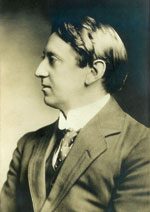
The pigeon-holing mentality may always have been with us in one form or another. The Swedish symphonist Franz Berwald became ‘The Berlioz of the North’, just as Bruges is sometimes compared in similar terms with Venice, or St Petersburg with Buenos Aires. ‘Wagner is the Puccini of music’, allegedly wrote J B Morton with mischief firmly in mind, and the jibe has been widely quoted since, both ways about. In similar vein, York Bowen has acquired an ‘English Rachmaninov’ label. Although there is some demonstrable justice in this where the fifth and sixth piano sonatas are concerned, it represents but a part of the truth and oversimplifies the climate of Bowen’s formative years.
Edwin Yorke Bowen was born on 22 February 1884 at Crouch Hill, London, the third son of the founder of Bowen & McKechnie, whisky distillers. After piano studies with Alfred Izard at Blackheath Conservatoire, in 1898 Bowen won the Erard Scholarship of the Royal Academy of Music, with which he was to remain associated for the rest of his life. Dropping his baptismal name and the ‘e’ of ‘Yorke’ early in his career, he became a devoted student of the famously eccentric Tobias Matthay (1858–1945).
Bowen was also an accomplished violist and horn player, in the latter capacity joining the regimental band of the Scots Guards at the start of the Great War. Invalided home with pneumonia in 1916, he became one of many for whom the harsh realities of the time brought artistic disappointment. Having married in 1912, Bowen spent his remaining years in faithful service to the RAM as a professor of piano, where, endearingly, his earlier discarding of ‘Edwin’ gave rise to the affectionate nickname ‘Uncle Yobo’ among generations of students. He died suddenly in November 1961 during a brief shopping excursion from his home, active to the last as a pianist and pedagogue, but also as a composer whose idiom had remained largely unaffected by the passage of years since his first successes. In this respect he invites comparison with his exiled Russian counterpart Nikolai Medtner.
When Bowen left the RAM in 1905 Liszt had been dead for only nineteen years and the reputations of many of his illustrious pupils were at their zenith. One must consider Liszt’s impact in terms of both pianistic innovation and personal charisma, adding to that a sense of the heady aesthetic which had led to such conceptions as Liszt’s Faust Symphony, Wagner’s Tristan, and the early tone poems of Richard Strauss. It is then easy to sense the zeal and excitement from a shared ideal which gripped many of Bowen’s generation. (‘Superb! I feel like climbing up the pillars’, exclaimed Holbrooke to the Bantock family after a London appearance by Strauss conducting his own music.) Disillusioning obscurity had not yet confronted them with Debussy’s eventual rejection of the Wagnerian ideal as ‘the twilight mistaken for the dawn’.
Bowen was esteemed ‘the most remarkable of the young British composers’ by Saint-Saëns: an encomium arguably significant when coming from a composer who once averred that he himself composed ‘as easily as an apple tree produces apples’. While facility may be admired on one level, on another it becomes a risky label implying a lack of depth. Nonetheless, the stage was Bowen’s and he responded with three piano concertos between 1904 and 1908, performing Nos 1 and 3 under Hans Richter in the Promenade Concerts at The Queen’s Hall. By 1912 two symphonies had received favourable public notices. A fourth piano concerto followed in 1929. Bowen’s pianistic distinction, which surmounted the formidable demands of Lyapunov’s Transcendental Études and of Chopin, Liszt and Medtner, remained a focus for adulation in many quarters. However, in the years after 1912, Bowen’s position as a composer had changed drastically. The European musical establishment had been rocked by the scandalous 1913 premiere of Stravinsky’s Le sacre du printemps in Paris and by the advent of Schoenberg’s then notorious Pierrot lunaire the year before. Britain’s insularity might have put off the evil hour for latter-day romantics such as Bowen but for the apocalyptic shadow of the Great War, which effectively silenced even so great a voice as Elgar’s. Those who could not—or would not—swim sank, while Frank Bridge, a man of moral courage and creative resilience, found himself ultimately marginalized for his newly uncompromising utterance by a society still unable to bear very much reality.
from notes by Francis Pott © 2020
Le catalogage, sous une forme ou sous une autre, est une manie que nous avons sans doute toujours eue. Le symphoniste suédois Franz Berwald est devenu «le Berlioz du Nord», tout comme Bruges est parfois comparée en termes analogues à Venise, ou Saint-Pétersbourg à Buenos Aires. J. B. Morton aurait écrit avec beaucoup de malice que «Wagner est le Puccini de la musique», boutade qui a été largement reprise depuis lors, dans un sens ou dans l’autre. Dans la même veine, York Bowen a acquis l’étiquette de «Rachmaninov anglais». Si cette appellation est justifiée en ce qui concerne les cinquième et sixième sonates pour piano, elle ne représente qu’une partie de la vérité et simplifie à l’excès l’atmosphère de ses années de formation.
Edwin Yorke Bowen est né le 22 février 1884 à Crouch Hill, à Londres; il est le troisième fils du fondateur de Bowen & McKechnie, une distillerie de whisky. Après avoir étudié le piano avec Alfred Izard au Conservatoire de Blackheath, Bowen obtient en 1898 la bourse Erard de la Royal Academy of Music, à laquelle il restera associé jusqu’à la fin de sa vie. Au début de sa carrière, il renonce à son nom de baptême ainsi qu’au «e» de «Yorke» et devient un fervent disciple du célèbre excentrique Tobias Matthay (1858–1945).
Bowen était aussi un altiste et un corniste accompli; il est enrôlé comme corniste dans la fanfare du régiment des Scots Guards au début de la Grande Guerre. Réformé à la suite d’une pneumonie en 1916, il rentre chez lui et fait partie des nombreuses personnes pour lesquelles les rudes réalités de cette époque ont été la cause de déceptions artistiques. Marié en 1912, il est resté fidèlement au service de la Royal Academy of Music jusqu’à la fin de sa vie comme professeur de piano; et, ce qui est assez touchant, le fait qu’il ait abandonné auparavant le prénom d’«Edwin» a donné lieu au surnom affectueux d’«Uncle Yobo» que lui ont donné des générations d’étudiants. Il est mort subitement en novembre 1961 en faisant des courses; il est resté actif jusqu’au dernier moment comme pianiste et comme pédagogue, mais également comme compositeur et son langage n’a presque pas été affecté par le passage du temps depuis ses premiers succès. À cet égard, on peut le comparer à son homologue russe exilé Nikolaï Medtner.
Lorsque Bowen quitta la RAM en 1905, Liszt était mort depuis seulement dix-neuf ans et la réputation de beaucoup de ses illustres élèves était à son apogée. Il faut considérer l’impact de Liszt en termes d’innovation pianistique comme de charisme personnel, en y ajoutant un sens de l’esthétique grisante, autant d’éléments qui avaient donné naissance à des créations comme la Faust Symphonie de Liszt, Tristan de Wagner et les premiers poèmes symphoniques de Richard Strauss. Il est donc facile de se faire une idée de l’ardeur et de l’enthousiasme émanant d’un idéal partagé qui s’empara de nombreux musiciens de la génération de Bowen («Superbe! J’ai cru atteindre le nirvana», cria Holbrooke à la famille Bantock après une apparition londonienne de Strauss dirigeant sa propre musique). Les ténèbres pleines de désillusion ne les avaient pas encore confrontés au rejet final par Debussy de l’idéal wagnérien qui le considérait comme «un beau coucher de soleil que l’on a pris pour une aurore».
Saint-Saëns considérait Bowen comme «le plus remarquable des jeunes compositeurs britanniques»: un panégyrique sans doute important puisqu’il émanait d’un compositeur qui affirma un jour que lui-même composait «aussi facilement qu’un pommier produit des pommes». Si la facilité peut faire l’objet d’admiration, elle comporte aussi des risques en impliquant un manque de profondeur. Néanmoins, Bowen avait le vent en poupe et il répondit avec trois concertos pour piano entre 1904 et 1908, jouant le premier et le troisième sous la direction de Hans Richter aux Concerts Promenade au Queen’s Hall. Dès 1912, deux symphonies reçurent un accueil favorable du public. Un quatrième concerto pour piano suivit en 1929. La réputation pianistique de Bowen, qui maîtrisait les redoutables difficultés des Études d’exécution transcendante de Liapounov et celles de Chopin, Liszt et Medtner, resta un objet d’adulation dans beaucoup de milieux. Cependant, après 1912, en l’espace de quelques années, son statut de compositeur changea radicalement. L’establishment musical européen avait été ébranlé par la création à scandale du Sacre du printemps de Stravinski à Paris, en 1913, et par l’avènement l’année précédente du Pierrot lunaire de Schoenberg, bientôt célèbre. L’insularité de la Grande-Bretagne aurait pu remettre à plus tard le moment fatidique pour les romantiques des temps modernes comme Bowen s’il n’y avait pas eu l’ombre apocalyptique de la Grande Guerre, qui réduisit vraiment au silence même une grande voix comme celle d’Elgar. Ceux qui ne pouvaient—ou ne voulaient—pas nager coulèrent, alors que Frank Bridge, un homme d’une grande force morale et d’une grande détermination créatrice, se trouva finalement marginalisé par une société encore incapable de supporter plus qu’une petite dose de réalité à cause de la nouvelle intransigeance de son expression créatrice.
extrait des notes rédigées par Francis Pott © 2020
Français: Marie-Stella Pâris
Möglicherweise ist das Kategorisieren schon immer eine menschliche Eigenschaft gewesen. Der schwedische Symphoniker Franz Berwald wurde als „Berlioz des Nordens“ bezeichnet und Brügge wird manchmal in ähnlicher Weise mit Venedig und Sankt Petersburg mit Buenos Aires verglichen. „Wagner ist der Puccini der Musik“, soll J. B. Morton mit einer gewissen Boshaftigkeit geschrieben haben und sein Spott ist seitdem oft—in beiderlei Richtung—zitiert worden. Ebenso wurde auch York Bowen als „englischer Rachmaninow“ charakterisiert. Zwar ist dies im Falle der fünften und sechsten Klaviersonate durchaus zutreffend, aber eben nicht in einem umfassenden Sinne; außerdem wird so das Klima von Bowens Entwicklungsjahren allzu sehr vereinfacht.
Edwin Yorke Bowen wurde am 22. Februar 1884 in Crouch Hill in London als dritter Sohn geboren. Sein Vater war der Gründer der Whisky-Brennerei Bowen & McKechnie. Nachdem er Klavierunterricht bei Alfred Izard am Blackheath Conservatoire erhalten hatte, wurde Bowen 1898 das Erard-Stipendium für die Royal Academy of Music (RAM) verliehen, der er dann für den Rest seines Lebens angehörte. Schon früh ließ er seinen Taufnamen und das „e“ von „Yorke“ weg und wurde ein treuer Schüler von Tobias Matthay (1858–1945), der für seinen Exzentrismus berühmt war.
Bowen war auch ein begabter Bratscher und Hornspieler und als ein solcher trat er zu Beginn des Ersten Weltkrieges der Regimentskapelle der Scots Guards bei. 1916 kehrte er als Invalide mit Lungenentzündung heim und war einer von vielen, für die die raue Realität jener Zeit künstlerische Enttäuschung brachte. Er hatte 1912 geheiratet und verbrachte den Rest seines Lebens als treuer Klavierprofessor an der RAM, wo er aufgrund der Tatsache, dass er seinen einen Vornamen „Edwin“ abgelegt hatte, unter Generationen von Studenten liebevoll als „Onkel Yobo“ bekannt war. Im November 1961 starb er unvermutet während eines kurzen Einkaufsausflugs. Bis zum Schluss war er als Pianist, Lehrer und auch als Komponist tätig gewesen, dessen Tonsprache sich im Laufe der Zeit und nach seinen ersten Erfolgen kaum wandelte. In dieser Hinsicht ähnelt er seinem russischen, im Exil lebenden Kollegen, Nikolai Medtner.
Als Bowen 1905 die RAM verließ, lag Liszts Tod erst 19 Jahre zurück und viele seiner illustren Schüler befanden sich auf dem Höhepunkt ihrer musikalischen Laufbahnen. Man muss sich Liszt Einfluss sowohl hinsichtlich seiner pianistischen Neuerungen als auch seiner persönlichen Ausstrahlungskraft vor Augen halten, und hinzu kam noch die fast rauschartige Ästhetik, die Werken wie Liszts Faust-Sinfonie, Wagners Tristan sowie den frühen symphonischen Dichtungen Richard Strauss’ zugrunde lag. Dann lässt sich der Eifer und die Begeisterung, die von einem gemeinsamen Ideal herrührten, und von denen viele Menschen in Bowens Generation ergriffen waren, einfach nachvollziehen. („Hervorragend! Ich wollte, ich könnte die Säulen emporklimmen“, rief Holbrooke der Familie Bantock gegenüber aus, nachdem Strauss in London aufgetreten war und seine eigenen Werke dirigiert hatte.) Noch hatte die desillusionierende Verborgenheit sie noch nicht mit Debussys letztendlicher Ablehnung des Wagner’schen Ideals konfrontiert, derzufolge „die Abenddämmerung mit dem Morgenrot verwechselt“ wurde.
Saint-Saëns schätzte Bowen als „den bemerkenswertesten der jungen britischen Komponisten“—ein Lob, das sicherlich bedeutsam war, zumal es von einem Komponisten kam, der einst von sich behauptet hatte, dass ihm das Komponieren so einfach fiele, wie einem Apfelbaum das Hervorbringen von Äpfeln. Während eine solche Fertigkeit zwar bewundert werden kann, ist eine derartige Kategorisierung dennoch riskant, da sie gleichzeitig ein Ausbleiben von Tiefgang impliziert. Nichtsdestotrotz beherrschte Bowen die Bühne und reagierte mit drei Klavierkonzerten, die zwischen 1904 und 1908 entstanden—das erste und dritte führte er unter Hans Richter im Rahmen der Promenade Concerts in der Londoner Queen’s Hall auf. Bis 1912 waren zwei Sinfonien mit Wohlgefallen aufgenommen und rezensiert worden. 1929 folgte ein viertes Klavierkonzert. Bowens erhebliches pianistisches Vermögen—er meisterte die enormen Anforderungen von Ljapunows Études d’exécution transcendante, wie auch diejenigen der Werke Chopins, Liszts und Medtners—brachte ihm große Bewunderung ein. In den Jahren nach 1912 hatte sich jedoch Bowens Position als Komponist drastisch verändert. Das europäische Musikestablishment hatte 1913 durch die skandalöse Premiere des Sacre du printemps von Stravinsky in Paris und von der Ankunft des damals verrufenen Pierrot lunaire von Schönberg im Jahr zuvor erhebliche Erschütterungen erfahren. Die Insellage Großbritanniens zögerte das unvermeidliche Schicksal der Spätromantiker wie Bowen möglicherweise etwas hinaus, doch konnte sich niemand dem apokalyptischen Schatten des Ersten Weltkriegs entziehen, welcher selbst eine so große Stimme wie Elgar praktisch verstummen ließ. Diejenigen, die nicht schwimmen konnten oder wollten, sanken, während Frank Bridge, ein Mann mit Zivilcourage und kreativer Strapazierfähigkeit, letztendlich aufgrund seines neuen konzessionslosen Ausdrucks von einer Gesellschaft, die sich der Realität noch immer nicht stellen konnte, an den Rand gedrängt wurde.
aus dem Begleittext von Francis Pott © 2020
Deutsch: Viola Scheffel