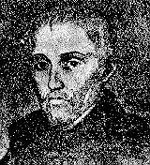
Tomás Luis de Victoria, the greatest composer of the Spanish sixteenth-century ‘golden age’ of polyphonic music, was born in Avila in 1548 and died in Spain in 1611. In about 1558 he became a choirboy in Avila Cathedral, where he received his earliest musical training. When his voice broke he was sent to the Collegium Germanicum at Rome where he was enrolled as a student in 1565. He was to spend the next twenty years in Rome, where he occupied a number of posts of which the most important were at S Maria di Monserrato, the Collegium Germanicum, the Roman Seminary (where he succeeded Palestrina as Maestro di cappella in 1571) and S Apollinare. In 1575 he took holy orders and three years later was admitted to chaplaincy at S Girolamo della Carità. Around 1587 he left Italy and in that year took up an appointment as chaplain to the dowager Empress Maria at the Royal Convent for Barefoot Clarist Nuns, where he acted as maestro to the choir of priests and boys that was attached to the convent.
Victoria’s musical output was relatively small compared with other major Renaissance composers such as Palestrina (who published five times as much music) and Lassus (who published even more), and he published no secular music. The music he did publish, however, shows a generally very high level of inspiration and musical craftsmanship, and it is clear—from the constant revisions he made to the successive editions of his works that appeared during his lifetime and from some of his comments in prefaces to his works—that he adopted a highly critical attitude to what he wrote. In his dedication to Pope Gregory XIII of his 1581 volume of Hymni totius anni, he speaks of music being ‘an art to which I am instinctively drawn, and to the perfection of which I have devoted long years of study, with the help and encouragement of others of critical judgement’.
from notes by Jon Dixon © 2009
Tomás Luis de Victoria, le plus grand compositeur de «l’âge d’or» de la musique polyphonique espagnole du XVIe siècle, est né à Avila en 1548 et mort en Espagne en 1611. Vers 1558, il est entré à la maîtrise de la cathédrale d’Avila, où il a reçu les premières bases de sa formation musicale. Lorsque sa voix a mué, on l’a envoyé au Collegium Germanicum de Rome, où il a été inscrit comme étudiant en 1565. Il allait passer les vingt années suivantes à Rome, occupant plusieurs postes importants, notamment à Santa Maria di Monserrato, au Collegium Germanicum, au Séminaire romain (où il a succédé à Palestrina comme maestro di cappella en 1571) et à San Apollinare. En 1575, il est entré dans les ordres et, trois ans plus tard, a été admis à l’aumônerie de San Girolamo della Carità. Vers 1587, il a quitté l’Italie et, la même année, est devenu le chapelain de l’impératrice douairière Marie au couvent royal des sœurs clarisses (aux pieds nus), tout en dirigeant le chœur de prêtres et de garçons attaché à ce couvent.
L’œuvre musicale de Victoria est relativement restreinte comparée à celle d’autres grands compositeurs de la Renaissance comme Palestrina (qui a publié cinq fois plus de musique) et Lassus (qui en a publié encore davantage); et il n’a laissé aucune œuvre profane. Cependant, la musique qu’il a publiée révèle en général un très haut niveau d’inspiration et de compétence musicale. Les révisions constantes qu’il a apportées aux éditions successives de ses œuvres parues de son vivant et certaines de ses remarques dans des préfaces à ses œuvres montrent à l’évidence qu’il avait une attitude très critique à propos de ce qu’il écrivait. Dans la dédicace au pape Grégoire XIII de son volume d’Hymni totius anni de 1581, il parle de la musique comme d’«un art vers lequel je suis instinctivement attiré et à la perfection duquel j’ai consacré de longues années d’étude, avec l’aide et l’encouragement d’autres personnes au jugement critique».
extrait des notes rédigées par Jon Dixon © 2009
Français: Marie-Stella Pâris
Tomás Luis de Victoria, der größte Komponist des spanischen „goldenen Zeitalters“ polyphoner Musik im 16. Jahrhundert wurde 1548 in Avila geboren und starb 1611 in Spanien. Um 1558 wurde er Chorknabe in der Kathedrale von Avila, wo er seine früheste musikalische Ausbildung erhielt. Als seine Stimme brach, wurde er nach Rom zum Collegium Germanicum geschickt, wo er 1565 als Student eingeschrieben wurde. Er sollte seine nächsten 20 Jahre in Rom verbringen, wo er eine Anzahl verschiedener Positionen inne hatte—die bedeutendsten waren an Santa Maria di Monserrato, dem Collegium Germanicum, dem Römischen Priesterseminar (wo er 1571 die Nachfolge von Palestrina als Maestro di cappella antrat) und San Apollinare. 1575 wurde er ordiniert und drei Jahre später Kaplan an San Girolamo della Carità. Um 1587 verließ er Italien und nahm in diesem Jahr eine Anstellung als Kaplan der Kaiserinwitwe Maria am Königlichen Barfüßer-Klarissenkonvent an, wo er als Maestro des dem Konvent zugehörigen Chors von Priestern und Knaben tätig war.
Im Vergleich zu anderen bedeutenden Komponisten der Renaissance wie etwa Palestrina (der fünf Mal sowie Musik veröffentlichte) und Lassus (der noch mehr publizierte) war Victorias musikalisches Œuvre relativ gering, und er veröffentlichte sogar gar keine weltliche Musik. Die Musik, die er publizierte weist jedoch einen hohen Grad von Inspiration und musikalisch versierter Handwerklichkeit auf, und durch die ständigen Revisionen, die er in den aufeinanderfolgenden Ausgaben seiner zu seinen Lebzeiten erschienenen Werke anlegte, sowie aus einigen Kommentaren in den Vorworten zu seinen Werken wird klar, dass er allem, was er schrieb, eine äußerst kritische Einstellung entgegenbrachte. In seiner Widmung an Papst Gregor XIII. in seinem Band Hymni totius anni von 1581 sagt er, dass Musik „eine Kunst [ist], zu der ich mich instinktiv hingezogen fühle, und um deren Vervollkommnung ich mich mit der Hilfe und Ermutigung anderer kritisch Eingestellter in vielen langen Jahren des Studiums bemühte“.
aus dem Begleittext von Jon Dixon © 2009
Deutsch: Renate Wendel