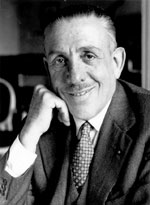
Francis Poulenc (1899–1963) first sprang to the attention of Parisian musical circles as a member of ‘Les Six’, so named by the critic Henri Collet. Les Six began to feature together (initially as ‘Les Nouveaux jeunes’) in the same concert programmes in 1917 and they found a ready spokesman in Jean Cocteau who produced his manifesto
Le Coq et l’arlequin the following year. This aesthetic document rejected romanticism and demanded that music should be overtly nationalistic and should shun foreign influences, particularly the excesses of Wagner. Negro art, the frivolous music of Satie, the music of the circus and jazz band, the primitive, machines, brevity and straightforwardness were all considered art forms or values worthy of admiration and emulation. Everyday life was considered to be a powerful subject matter by Cocteau; but, despite despising the refinement, sophistication and decorative excesses of the nineteenth century, Les Six enjoyed a ‘gastronomic preference for under-done meat and extra-dry wines’.
By 1921 the group had begun to lose cohesion; of all the members of Les Six, Francis Poulenc remained true to the group’s general frivolity; the other members had drifted away. Honegger, for example, never had any sympathy with Erik Satie and therefore with Les Six. Despite the group’s anti-Debussyism which resulted from contact with Satie, Poulenc described how as a child he came close to kissing Debussy’s hat in a shop; in later years he said, ‘Debussy always remained my favourite composer after Mozart. I could not do without his music. It is my oxygen.’
Poulenc was born into a wealthy family. His father was a devout Roman Catholic who had business interests in the pharmaceutical trade; the Rhône-Poulenc Company was one of the largest in Europe. It was his mother who gave him his interest in music and in 1915 he studied piano with Ricardo Viñes. The young composer had had no formal musical training, and felt the need to continue his musical education. He tried unsuccessfully to study with Ravel and Vidal before being taken under the wing of Charles Koechlin. It was Ravel who urged Poulenc to take a lower profile in the avant-garde musical world and to devote more time to his musical technique. It seems that Ravel’s advice came not a moment too soon, for Poulenc was on the verge of becoming inexorably associated with Les Six.
Poulenc was called up into the forces in 1918 and was not demobilized until 1921. He studied with Koechlin between 1921 and 1924, taking time to visit Milhaud in Vienna, expressly to meet Schoenberg, Berg and Webern. On his return, Diaghilev commissioned him to write a ballet which resulted in Les Biches. It was this work which firmly established Poulenc as a composer. This reputation was further enhanced by the Concert champêtre (1929) written for Wanda Landowska. Poulenc wrote that ‘the three great encounters of my life, which have profoundly influenced my art, are those with [the harpsichordist] Wanda Landowska, [the baritone] Pierre Bernac, and [the poet] Paul Éluard.’
from notes by William McVicker © 1994
Francis Poulenc (1899–1963) attira d’abord l’attention des milieux musicaux de Paris en tant que membre des Six—surnom que leur avait donné le critique Henri Collet. Ils commençèrent à figurer au programme des mêmes concerts (s’intitulant à l’origine «Les Nouveaux jeunes») en 1917 et trouvèrent un porte-parole éloquent en la personne de Jean Cocteau qui publia son manifeste
Le Coq et l’arlequin l’année suivante. Ce document esthétique rejetait le romantisme et prônait une musique franchement nationaliste, évitant les influences étrangères, et en particulier les excès de Wagner. L’art nègre, les frivolités de Satie, la musique de cirque et le jazz, les primitifs, les machines, la brièveté et la simplicité étaient considérés comme des formes artistiques ou des valeurs dignes d’admiration et d’émulation. La vie quotidienne constituait un sujet valable pour Cocteau; mais, tout en méprisant le raffinement, la recherche et les décorations excessives du XIXe siècle, les Six avaient une «prédilection gastronomique pour la viande saignante et les vins extra secs».
En 1921, le groupe commençait à se désintégrer; de tous les membres des Six, seul Francis Poulenc restait fidèle aux manifestations de frivolité du groupe; les autres s’étaient dispersés. Honegger, par exemple, n’avait jamais vraiment sympathisé avec Erik Satie, ni par conséquent avec les Six. À cause de ses contacts avec Satie, le groupe était hostile à Debussy, mais Poulenc racontait qu’enfant, il avait failli embrasser le chapeau de Debussy dans un magasin; plus tard, il dirait: «Debussy est toujours resté mon compositeur favori après Mozart. Je ne pouvais pas me passer de sa musique. C’est mon oxygène.»
Francis Poulenc était issu d’une famille riche. Son père était un catholique fervent qui faisait des affaires dans l’industrie pharmaceutique avec la Compagnie Rhône-Poulenc, l’une des plus grandes sociétés d’Europe. C’est sa mère qui lui avait transmis son intérêt pour la musique et, en 1915, il étudia le piano avec Ricardo Viñes. Le jeune compositeur n’avait aucune formation théorique et voulut poursuivre son éducation musicale. Il essaya, sans succès, de devenir l’élève de Ravel et de Vidal, mais c’est finalement Charles Koechlin qui le prit sous sa protection. Ravel conseilla à Poulenc de moins se faire remarquer dans l’avant-garde du monde musical et de consacrer davantage de temps à développer sa technique. Le conseil de Ravel arrivait juste à temps car Poulenc était sur le point de devenir associé inexorablement avec les Six.
Poulenc fut mobilisé de 1918 à 1921. Il fut l’élève de Koechlin de 1921 à 1924 et rendit visite à Milhaud à Vienne, pour y rencontrer Schoenberg, Berg et Webern. À son retour, Diaghilev lui commanda un ballet, Les Biches, qui établit sa réputation de compositeur, réputation qui fut encore affermie par le Concert champêtre (1929), composé pour Wanda Landowska. Poulenc écrivit: «Les trois grandes rencontres déterminantes de ma carrière, celles qui ont influencé profondément mon art, sont celles de Wanda Landowska, de Pierre Bernac et de Paul Éluard.»
extrait des notes rédigées par William McVicker © 1994
Français: Madeleine Jay
Francis Poulenc (1899–1963) erregte erstmals als Mitglied von „Les Six“, die der Kritiker Henri Collet so getauft hatte, die Aufmerksamkeit der Pariser Musikkreise. Les Six traten 1917 zuerst zusammen (anfangs als „Les Nouveaux jeunes“) in den gleichen Konzertprogrammen auf, und sie fanden in Jean Cocteau, der im darauffolgenden Jahr sein Manifest
Le Coq et l’arlequin produzierte, eine bereitwilligen Fürsprecher. Dieses ästhetische Dokument lehnte die Romantik ab und forderte einen offenen musikalischen Nationalismus, bei dem alle ausländischen Einflüsse vermieden werden sollten, insbesondere die Exzesse Wagners. Schwarze Kunst, die frivole Musik von Satie, Zirkusmusik und Jazzbands, die Primitiven, Maschinen, Kürze und Direktheit wurden alle als Kunstformen oder bewunderns- und nachahmenswerte Werte angesehen. Das tägliche Leben wurde von Cocteau als mächtiger zu behandelnder Gegenstand angesehen; doch, obwohl sie die Rafinesse, den Intellektualismus und die dekorativen Exzesse des neunzehnten Jahrhunderts verachteten, hatten „Les Six“ eine „gastronomische Vorliebe für nicht durchgebratenes Fleisch und besonders trockene Weine“.
Im Jahr 1921 hatte sich der Gruppenverband zu lockern begonnen; von allen Mitgliedern von Les Six blieb nur Francis Poulenc der allgemeinen Frivolität der Gruppe treu; die anderen Mitglieder hatten sich davon wegentwickelt; Honegger, zum Beispiel, hatte nie irgendwelche Sympathie für Erik Satie und daher für Les Six übrig. Obwohl die Gruppe gegen Debussy war—was sich aus dem Kontakt mit Satie entwickelt hatte—beschrieb Poulenc, wie der als Kind beinahe Debussys Hand in einem Geschäft geküsst hätte; in späteren Jahren sagte er, „Debussy ist immer mein Lieblingskomponist nach Mozart geblieben: Ich könnte ohne seine Musik nicht auskommen. Sie ist die Luft, die ich zum Leben brauche.“
Poulenc war in eine reiche Familie hineingeboren worden. Sein Vater war ein frommer Katholik, der geschäftliche Interessen im pharmazeutischen Handel hatte; die Firma Rhône-Poulenc war eine der größten in Europa. Es war seine Mutter, der er sein Interesse an der Musik zu verdanken hatte, und 1915 nahm er Klavierunterricht bei Ricardo Viñes. Der junge Komponist besaß keine formelle musikalische Ausbildung, und fand es notwendig, seinen Musikunterricht fortzusetzen. Ohne Erfolg versuchte er Stunden bei Ravel und Vidal zu nehmen, bevor ihn Charles Koechlin unter seine Fittiche nahm. Es war Ravel, der Poulenc drängte, sich in der Avantgarde der Musikwelt etwas zurückzuhalten und seiner musikalischen Technik etwas mehr Zeit zu widmen: Es scheint, daß Ravel keinen Augenblick zu früh kam, denn Poulenc war nahe daran, fest mit Les Six assoziiert zu werden.
Poulenc wurde 1918 vom Militär eingezogen und wurde erst 1921 wieder demobilisiert. Er studiert zwischen 1921 und 1924 bei Koechlin, und nahm sich die Zeit, Milhaud in Wien zu besuchen, ausdrücklich, um Schönberg, Berg und Webern kennenzulernen. Bei seiner Rückkehr gab Diaghilew bei ihm ein Ballett in Auftrag, aus dem Les Biches wurde. Dieses Werk war es, das Poulenc fest als Komponisten etablierte. Dieser Ruf wurde weiter vom Concert champêtre (1929) untermauert, das er für Wanda Landowska komponiert. Poulenc schrieb: „Die drei großen Begegnungen in meinem Leben, die meine Kunst zutiefst beeinflußt haben sind die Begegnung mit [der Cembalospielerin] Wanda Landowska, [dem Bariton] Pierre Bernac und [dem Dichter] Paul Éluard.“
aus dem Begleittext von William McVicker © 1994
Deutsch: Anke Vogelhuber