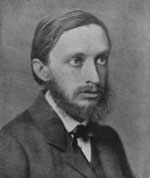
Hermann Goetz was born in 1840 at Königsberg (now Kaliningrad), the son of a brewer. He fulfilled his long-standing desire to become a musician at the age of twenty when he went to Berlin’s Stern Conservatoire in 1860. Of his teachers there, the most significant was the pianist and conductor Hans von Bülow, Liszt’s son-in-law. Three years later Goetz moved to Winterthur in Switzerland as a church organist, but this was also a doomed attempt to cure the tuberculosis he had contracted in childhood. Brahms visited in 1865, and they became uneasy friends (not uncommon in relationships with the greater man), but two years later Goetz enjoyed an annus mirabilis when he married, resumed contact with von Bülow and met Raff, who recommended him to the music publishers Breitkopf und Härtel.
This period of hope and optimism was the time during which he wrote his Piano Concerto in B flat major, Op 18 (he had drafted an earlier piano concerto as a student), and his finest chamber work, the Piano Quartet in E major, Op 6. It was not long before his works included Lieder, choral works and a symphony (of which only a fragment remains). This symphony was played at Basle on 3 March 1867, but it was his opera Der Widerspenstigen Zähmung (produced in Mannheim in 1874), based on Shakespeare’s Taming of the Shrew, which brought him fame both at home and abroad. His Symphony in F major owes much to Beethoven, as most of that genre does in the half-century between Beethoven and Brahms, and was excessively praised by George Bernard Shaw. In 1875 Goetz made a brave attempt at a second opera (Francesca von Rimini), but it was a race against time that he lost the following year when he finally succumbed to his illness four days short of his thirty-sixth birthday. As with so many composers who fail to achieve the highest rank, his music was rarely played after his death. Though overshadowed by many greater composers during his lifetime, and despite being based outside the mainstream of musical activity in his isolated small Swiss town, his distinctive music is full of melodic gift and mastery of form.
from notes by Christopher Fifield © 2010
Hermann Goetz naquit en 1840 à Königsberg (l’actuelle Kaliningrad), d’un père brasseur. En 1860, à l’âge de vingt ans, il put enfin satisfaire son désir de devenir musicien en entrant au Conservatoire Stern de Berlin, où son professeur le plus marquant fut le pianiste et chef d’orchestre Hans von Bülow, le gendre de Liszt. Trois ans plus tard, il s’installa comme organiste d’église à Winterthur, en Suisse, dans une vaine tentative de guérir la tuberculose qu’il avait contractée dans son enfance. En 1865, Brahms lui rendit visite et noua avec lui une amitié difficile (ce qui n’avait rien de rare chez ce grand homme). Deux ans plus tard, Goetz connut une année merveilleuse: il se maria, renoua avec von Bülow et rencontra Raff, qui le recommanda aux éditeurs de musique Breitkopf und Härtel.
Ce fut durant cette période d’espoir et d’optimisme qu’il écrivit son Concerto pour piano en si bémol majeur op. 18 (il avait déjà composé un concerto pour piano en tant qu’étudiant) et son Quatuor avec piano en mi majeur op. 6, sa plus belle œuvre de chambre. Bientôt suivront des lieder, des pièces chorales et une symphonie (dont seul subsiste un fragment). Cette dernière fut jouée à Bâle, le 3 mars 1867, mais ce fut son opéra Der Widerspenstigen Zähmung (produit à Mannheim en 1874), d’après La Mégère apprivoisée de Shakespeare, qui le rendit célèbre, chez lui comme à l’étranger. Comme la plupart des symphonies composées dans le demi-siècle séparant Beethoven de Brahms, sa Symphonie en fa majeur doit beaucoup à Beethoven; elle fut exagérément louée par George Bernard Shaw. En 1875, Goetz s’essaya courageusement à un second opéra (Francesca von Rimini), dans une course contre la montre qu’il perdit finalement l’année suivante, emporté par la maladie quatre jours avant son trente-sixième anniversaire. Comme tant de compositeurs qui n’accédèrent pas au firmament, il fut peu joué après sa mort. Éclipsé, de son vivant, par maints compositeurs plus importants, écarté, dans sa bourgade helvétique isolée, du courant dominant de l’activité musicale, il n’en signa pas moins une musique singulière, où abondent son talent de mélodiste et sa maîtrise de la forme.
extrait des notes rédigées par Christopher Fifield © 2010
Français: Hypérion
Hermann Goetz wurde 1840 in Königsberg (dem heutigen Kaliningrad) als Sohn eines Kaufmanns geboren. 1860, im Alter von zwanzig Jahren, erfüllte er sich den Wunsch, Musiker zu werden, und begann ein Studium am Stern’schen Konservatorium in Berlin. Sein bedeutendster Lehrer war der Pianist und Dirigent Hans von Bülow, Schwiegersohn von Franz Liszt. Drei Jahre später ging Goetz nach Winterthur in der Schweiz, um dort als Kirchenorganist zu arbeiten, aber auch in der letztlich erfolglosen Hoffnung, seine Tuberkulose auszuheilen, an der er als Kind erkrankt war. Brahms besuchte ihn dort im Jahr 1865, woraus eine (bei Brahms nicht unübliche) schwierige Freundschaft entstand. Zwei Jahre später begann für ihn eine wunderbare Zeit: Er heiratete, erneuerte die Verbindung zu Hans von Bülow und lernte Joachim Raff kennen, der ihn beim Musikverlag Breitkopf & Härtel einführte.
In dieser von Hoffnung und Optimismus geprägten Zeit entstanden sein Klavierkonzert in B-Dur op. 18 (ein früheres Klavierkonzert hatte er bereits als Student skizziert) und sein bestes Kammermusikwerk, das Klavierquartett in E-Dur op. 6. Es sollte nicht lange dauern, bis Lieder, Chorwerke und eine am 3. März 1867 in Basel aufgeführte, aber nur als Fragment überlieferte Sinfonie hinzu kamen. Wirklich berühmt jedoch wurde er im In- und Ausland mit seiner 1874 in Mannheim aufgeführten Oper Der Widerspenstigen Zähmung nach Shakespeares The Taming of the Shrew. Seine Sinfonie in F-Dur ist wie viele Werke dieses Genres aus dem halben Jahrhundert zwischen Beethoven und Brahms stark von Beethoven inspiriert und wurde über alle Maßen von George Bernard Shaw gelobt. 1875 machte Goetz den kühnen Versuch, eine zweite Oper (Francesca von Rimini) zu komponieren, doch dies war ein Wettlauf mit der Zeit, den er verlor, als er im folgenden Jahr kurz vor dem sechsunddreißigsten Geburtstag seiner Krankheit erlag. Wie so viele Komponisten, die es nicht bis in die höchsten Höhen schaffen, wurde er nach seinem Tod nur noch selten aufgeführt. Zu Lebzeiten überschattet von größeren Komponisten und weit entfernt von allen bedeutenden Zentren der Musikwelt, komponierte er individuelle Werke voller melodischer Begabung und meisterlicher Formgebung.
aus dem Begleittext von Christopher Fifield © 2010
Deutsch: Henning Weber