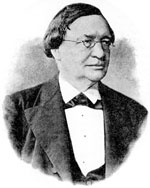
Wilhelm Taubert (1811–1891) was a German conductor, composer and pianist active in Berlin. At the age of twenty he was made assistant conductor and accompanist of the Berlin court concerts. In the next decade, he served as Generalmusikdirektor of Königliche Schauspiele under Mendelssohn and Giacomo Meyerbeer, and was also court Kapellmeister until 1869; he continued to conduct the royal orchestra until 1883. He was also highly regarded as a teacher at the Royal Academy of Arts from 1865.
Taubert was part of a Berlin circle of musicians that included the baritone and writer Eduard Devrient, librettist of two of his operas; Devrient also sang in some of Mendelssohn’s early works. Surviving correspondence between Mendelssohn and Taubert reveals Mendelssohn’s perception of his colleague’s work as lacking ‘impetus and spirit’, which may have prevented Taubert from achieving lasting success as a composer of large works. However, his graceful, almost popular style was well suited to Lieder and short character pieces, such as the Minnelieder Op 16 for piano. This work has been favourably compared with Mendelssohn’s Lieder ohne Worte, and there is some dispute as to who influenced whom. The Kinderlieder Opp 145 and 160 are still performed today. Taubert also composed chamber music, piano sonatas and large orchestral works. As well as two piano concertos, he also wrote a violin concerto and a Bacchanale, Divertissement brillant for piano and orchestra Op 28. As editor of the Neue Zeitschrift für Musik, Robert Schumann reviewed many of Taubert’s compositions, and indicative of the high regard in which Taubert was held is the review of his Piano Duo Op 11 in the Neue Zeitschrift’s inaugural issue of April 1834. Schumann also asked Taubert to contribute to the journal.
from notes by Stephan D Lindemann © 2010
Wilhelm Taubert (1811–1891) était un chef d’orchestre, compositeur et pianiste allemand, actif à Berlin. À l’âge de vingt ans, il a été nommé chef d’orchestre assistant et accompagnateur des concerts de la cour de Berlin. Au cours des dix années suivantes, il a été Generalmusikdirektor du Königliche Schauspiele sous Mendelssohn et Giacomo Meyerbeer; il a également été Kapellmeister de la cour jusqu’en 1869; il a continué à diriger l’orchestre royal jusqu’en 1883. En outre, il jouissait d’une excellente réputation d’enseignant à l’Académie royale des arts, où il a exercé à partir de 1865.
Taubert faisait partie du cercle de musiciens berlinois auquel appartenait le baryton et écrivain Eduard Devrient, librettiste de deux de ses opéras; Devrient a aussi chanté dans certaines œuvres de jeunesse de Mendelssohn. La correspondance entre Mendelssohn et Taubert révèle que Mendelssohn trouvait que l’œuvre de son collègue manquait d’«élan et d’esprit», ce qui explique peut-être pourquoi Taubert n’est pas passé à la postérité comme compositeur d’œuvres d’envergure. Néanmoins, son style élégant, presque populaire, convenait bien aux lieder et aux courtes pièces de caractère, comme les Minnelieder op. 16 pour piano. Cette œuvre a été comparée en termes positifs aux Lieder ohne Worte («Romances sans paroles») de Mendelssohn; lequel a influencé l’autre, c’est un sujet de controverse. Les Kinderlieder opp. 145 et 160 sont encore joués de nos jours. Taubert a aussi composé de la musique de chambre, des sonates pour piano et de grandes œuvres orchestrales. En ce qui concerne les œuvres concertantes, Taubert a écrit deux concertos pour piano, un concerto pour violon et une Bacchanale, Divertissement brillant pour piano et orchestre op. 28. Robert Schumann, qui était rédacteur en chef de la Neue Zeitschrift für Musik, a fait la critique de nombreuses œuvres de Taubert. La critique de son Duo pour piano op. 11 dans le premier numéro de la Neue Zeitschrift, en avril 1834, indique à quel point Taubert était apprécié. Schumann a aussi demandé à Taubert d’écrire dans le journal.
extrait des notes rédigées par Stephan D Lindemann © 2010
Français: Marie-Stella Pâris
Der deutsche Dirigent, Komponist und Pianist Wilhelm Taubert (1811–1891) begann seine Laufbahn im Alter von zwanzig Jahren als Dirigent und Klavierbegleiter der Berliner Hofkonzerte. Im folgenden Jahrzehnt wirkte er als Musikdirektor der Königlichen Oper unter Mendelssohn und Meyerbeer sowie bis 1869 auch als Hofkapellmeister. Die Königliche Hofkapelle dirigierte er bis 1883, und ab 1865 war er auch hoch geachteter Lehrer an der Königlichen Akademie der Künste.
Taubert war Mitglied in einem Berliner Musikerkreis, dem auch der Bariton und Schriftsteller Eduard Devrient angehörte, der zwei Opernlibretti für Taubert verfasste und in einigen frühen Werken von Mendelssohn auftrat. Aus überlieferter Korrespondenz zwischen Mendelssohn und Taubert erfahren wir, dass Mendelssohn fand, das Werk seines Kollegen mangele „Impetus und Geist“, was Tauberts anhaltendem Erfolg als Komponist umfangreicher Werke wenig dienlich gewesen sein mag. Sein graziöser, fast volkstümlicher Stil eignete sich jedoch gut für Lieder und kurze Charakterstücke wie die Minnelieder op. 16 für Klavier, die mit Mendelssohns Lieder ohne Worte vorteilhaft verglichen wurden, und es bleibt ungeklärt, wer sich von wem inspirieren ließ. Die Kinderlieder opp. 145 und 160 werden heute noch aufgeführt. Taubert komponierte auch Kammermusik, Klaviersonaten und umfangreiche Orchesterwerke. Neben den beiden Klavierkonzerten schrieb er ein Violinkonzert und ein Bacchanale, Divertissement brillant op. 28 für Klavier und Orchester. Als Herausgeber der Neuen Zeitschrift für Musik rezensierte Robert Schumann viele Werke von Taubert, und sein hohes Ansehen wird deutlich aus der Rezension seines Klavierduos op. 11 in der Erstausgabe der Neuen Zeitschrift im April 1834. Außerdem wurde Taubert von Schumann eingeladen, Beiträge für seine Zeitschrift zu schreiben.
aus dem Begleittext von Stephan D Lindemann © 2010
Deutsch: Henning Weber