Lithuania, in common with fellow Baltic States Latvia and Estonia, sustains a rich singing tradition, one at the heart of the country’s cultural heritage. This is a choral tradition not confined to churches and concert halls but a part of everyday life and a key part of the national consciousness. A clear indicator of the strength of this phenomenon is the national song festivals drawing upwards of 30,000 participants. Centuries of political and cultural domination from foreign powers largely limited indigenous music-making to rural folk songs. This repression led to the survival of these old genres right into the twentieth century and, as Lithuania began to assert its independence, it was these national songs that drew its people together in an awakening of ethnic consciousness and self-esteem. Throughout the restrictions of Soviet occupation (1940–90), safeguarding the source of folk music’s vitality became art’s most important stimulus, and therefore singing remained central to the cultural life of the country. As time passed the concept of nationalism may have changed but Lithuania’s affinity with folk songs and sense of community through choral singing has remained.
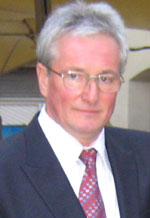
Born in Vilnius in 1954, Vytautas Miškinis is the doyen of current Lithuanian choral culture. For thirty years he has been the artistic director of the award-winning Lithuanian boys’ choir Azuoliukas. It was with this choir that Miškinis began his musical career as a treble aged seven. While still a student he worked as an accompanist and conductor for the choir’s founder Hermanas Perelsteinas before taking over the artistic direction of the choir himself at the age of twenty-five. Since 1979 this ‘little oak tree’ (as the choir’s name translates) has grown into a school of music for 450 young musicians.
Miškinis has always had a broad and eclectic interest in choral music. His lessons in composition, taken independently from the state system, encouraged a greater degree of artistic freedom. His music, while bearing identifiable Lithuanian roots, is a synthesis of different influences carefully shaped and moulded with an experienced understanding of choral orchestration. Like many other Baltic composers of the same generation, Miškinis takes an essentially diatonic approach but with much overlaying of harmonies and coloured cluster-chords. Chords resonate with many perfect fifths and fourths reinforcing the harmonic series. What makes the music unmistakably Lithuanian is the influence of two folk-song genres: one, a homophonic type in which harmonies are created from the first, fourth and fifth notes of the scale, and the other an interestingly dissonant contrapuntal type from north-eastern Lithuania called sutartine, in which the individual lines together form a chain of unresolved seconds. Sutartines have been crucial in the reinvention of folk music as high art.
Repetition permeates much of Miškinis’s music but he is not to be considered a minimalist. Vocal textures are certainly enhanced by a judicious use of carefully controlled aleatoric effects and ostinatos, however coloration of the text remains at the heart of Miškinis’s creative spirit: ‘I do not experiment with the sound. The essential for me is the meaning of the lyrics. The content. For that reason I accept any means of expression that refers to the meaning of a word.’ Lithuania, like its vast neighbour Poland, is largely Catholic. Although brought up a Catholic, Miškinis no longer considers himself a strong believer and yet he is drawn to many liturgical texts for their universal ideals, their ‘unique poetry’.
from notes by Rupert Gough © 2010
A l’instar des autres pays baltes que sont la Lettonie et l’Estonie, la Lituanie préserve, au cœur de son héritage culturel, une riche tradition de chant choral qui, loin de se confiner aux églises et aux salles de concert, fait partie intégrante de la vie quotidienne et est un élément clé de la conscience nationale—comme l’attestent les festivals de chant capables de drainer jusqu’à trente mille participants. Des siècles de domination politico-culturelle étrangère ont largement cantonné la musique autochtone aux chants traditionnels ruraux. Cette répression fit que ces genres anciens survécurent jusqu’au XXe siècle et, lorsque le pays commença d’affirmer son indépendance, ce furent ces chants nationaux fédérateurs qui éveillèrent chez les Lituaniens conscience ethnique et estime de soi. Au cœur des restrictions de l’occupation soviétique (1940–1990), sauvegarder la source de la vitalité de la musique folklorique devint le stimulant artistique primordial et chanter demeura essentiel à la vie culturelle du pays. Et si le concept de nationalisme put évoluer au fil du temps, l’affinité de la Lituanie avec les chants traditionnels perdura, tout comme le sentiment de communauté à travers le chant choral.
Né à Vilnius en 1954, Vytautas Miškinis est l’actuel doyen de la culture chorale lituanienne. Pendant trente ans, il a été le directeur artistique d’Azuoliukas, un chœur, primé, de garçons lituanien dans lequel il commença sa carrière musicale comme soprano, à l’âge de sept ans. Encore élève, il fut d’abord accompagnateur et chef pour Hermanas Perelsteinas, fondateur de ce chœur dont il reprit la direction artistique en 1979, à l’âge de vingt-cinq ans. Depuis, ce «petit chêne» (c’est ce que signifie Azuoliukas) est devenu une école accueillant quatre cent cinquante jeunes musiciens.
Miškinis s’est toujours intéressé à la musique chorale avec un grand éclectisme. Les leçons de composition, qu’il prit en dehors du système étatique, encouragèrent en lui une plus grande liberté artistique. Sa musique, tout en arborant de nettes racines lituaniennes, synthétise diverses influences forgées et moulées soigneusement, avec une intelligence éprouvée de l’orchestration chorale. Comme nombre de ses confrères baltes, Miškinis adopte une approche fondamentalement diatonique, mais généreusement recouverte d’harmonies et d’accords en clusters hauts en couleurs. Les accords résonnent de maintes quintes et quartes justes renforçant la série d’harmoniques. Ce qui rend cette musique indéniablement lituanienne, c’est l’influence de deux genres de chants traditionnels: l’un, de type homophonique, où les harmonies sont obtenues à partir des première, quatrième et cinquième notes de la gamme, l’autre de type contrapuntique, aux dissonances intéressantes et où les lignes, prises ensemble, forment une chaîne de secondes non résolues. Ce chant-là, venu du nord-est de la Lituanie et baptisé sutartine, joua un rôle essentiel dans la réinvention de la musique traditionnelle en tant qu’art noble.
Bien que la répétition imprègne une large part de sa musique, Miškinis ne doit pas être considéré comme un minimaliste. Ses textures vocales ont beau être rehaussées par un judicieux usage d’effets aléatoires soigneusement maîtrisés et d’ostinatos, c’est la coloration du texte qui demeure au cœur de son esprit créatif: «Je n’expérimente pas le son. L’essentiel, pour moi, c’est le sens du texte. Le contenu. C’est pourquoi j’admets n’importe quel moyen d’expression renvoyant au sens d’un mot.» Comme son grand voisin la Pologne, la Lituanie est essentiellement catholique. Élevé dans cette foi, Miškinis ne se considère cependant plus comme un fervent croyant, même s’il demeure attiré par les idéaux universels, la «poésie unique» de nombreux textes liturgiques.
extrait des notes rédigées par Rupert Gough © 2010
Français: Hypérion
Litauen pflegt ebenso wie die beiden anderen baltischen Staaten Lettland und Estland eine reiche Gesangstradition, die im Zentrum der Kultur des Landes steht und nicht auf Kirchen und Konzertsäle beschränkt, sondern Bestandteil des täglichen Lebens und ein Schlüsselelement des Nationalbewusstseins ist. Die Stärke dieses Phänomens lässt sich an den nationalen Gesangsfestivals mit mehr als 30.000 Teilnehmern ablesen. Jahrhunderte politischer und kultureller Bevormundung durch ausländische Mächte beschränkte die einheimische musikalische Betätigung weitgehend auf ländliche Volkslieder, und diese Unterdrückung wiederum hatte das Überleben der alten Genres bis weit in das 20. Jahrhundert hinein zum Ergebnis. Als Litauen dann begann, seine Unabhängigkeit durchzusetzen, sammelte sich die Bevölkerung im Erwachen von Nationalbewusstsein und Selbstachtung um diese nationalen Lieder. Während der sowjetischen Besatzung von 1940 bis 1990 wurde die Pflege lebendiger Volksmusik zum bedeutendsten künstlerischen Stimulans, so dass Gesang ein zentrales Element von Litauens Kulturleben bleibt. Das Verständnis von Nationalismus mag sich im Lauf der Zeit gewandelt haben, doch Litauens Liebe zum Volkslied und das durch Chorgesang vermittelte Gefühl der Zusammengehörigkeit sind erhalten geblieben.
Vytautas Miškinis wurde 1954 in Vilnius geboren und ist heute tonangebend in Litauens Kultur des Chorgesangs. Er ist seit dreißig Jahren künstlerischer Leiter des preisgekrönten litauischen Knaben- und Jugendchors Azuoliukas („kleine Eiche“), bei dem er als siebenjähriger Sopran seine musikalische Laufbahn begann. Während seiner Studienzeit arbeitete er als Begleiter und Dirigent für den Chorgründer Hermanas Perelsteinas, bevor er von ihm im Alter von fünfundzwanzig Jahren die künstlerische Leitung übernahm. Seit 1979 hat sich der Chor zu einer Musikschule für 450 junge Musiker entwickelt.
Miškinis hatte von jeher ein breites und eklektisches Interesse an Chormusik. Sein unabhängig vom staatlichen Schulsystem erteilter Kompositionsunterricht hat die künstlerische Freiheit gefördert. Seine Musik ist zwar erkennbar in Litauen verwurzelt, aber eine sorgfältig mit auf Erfahrung beruhendem Verständnis von Chorkomposition gestaltete und ausgeformte Synthese verschiedener Einflüsse. Wie viele andere baltische Komponisten seiner Generation hat Miškinis eine im wesentlichen diatonische Methode, jedoch mit vielen harmonischen Überlagerungen und farbenfrohen Akkordbündeln. Akkorde mit vielen reinen Quinten und Quarten stärken den harmonischen Fortschritt. Miškinis’ Musik ist so unmissverständlich litauisch aufgrund der Einflüsse von zwei Arten von Volkslied: Die eine ist homophoner Natur, in der die Harmonien vom ersten, vierten und fünften Ton der Tonleiter gebildet werden, und die andere namens Sutartine aus dem Nordosten von Litauen ist von bemerkenswert dissonantem Kontrapunkt geprägt, in dem die einzelnen Stimmen eine Kette unaufgelöster Sekunden formen. Sutartines haben entscheidende Bedeutung für die Neuerfindung der Volksmusik als hoher Kunst.
Miškinis’ Musik ist stark geprägt von Wiederholungen, doch gilt er nicht als Minimalist. Die Vokalstruktur wird sicherlich erweitert durch abgewogene Verwendung scheinbar zufälliger, aber sorgfältig kontrollierter Effekte und Ostinati, doch die Färbung des Texts bleibt im Mittelpunkt von Miškinis’ kreativem Anspruch: „Ich experimentiere nicht mit dem Klang. Für mich ist die Bedeutung des Texts, des Inhalts vorrangig. Deshalb sind mir alle Ausdrucksmittel mit Bezug auf die Wortbedeutung recht.“ Lithuania ist wie sein sehr viel größerer Nachbar Polen überwiegend katholisch, und Miškinis wuchs zwar im katholischen Glauben auf, betrachtet sich jedoch nicht mehr als stark gläubig, wenngleich er liturgische Texte wegen ihrer universellen Ideale, ihrer „einzigartigen Posie“ verarbeitet.
aus dem Begleittext von Rupert Gough © 2010
Deutsch: Henning Weber