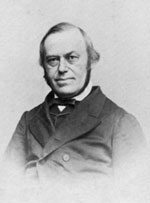
The German violin virtuoso and composer Ferdinand David was born in Hamburg on 19 June 1810, the son of a prosperous businessman. (Older dictionaries give 19 January, but this appears to be an error.) By a remarkable coincidence, he came into the world in the same house in which Felix Mendelssohn, with whom his career would become entwined, had been born a year before. Like Mendelssohn, David was Jewish by birth, though later in life he converted to Christianity. He showed prodigious talent from an early age. From 1823 to 1824, in Kassel, he studied with the violinist-composers Louis Spohr and Moritz Hauptmann, and in 1825 made his public debut in Leipzig, performing with his sister Louise (1811–1850), who was a talented pianist. During the next two years he and Louise played also in Copenhagen, Dresden and Berlin. In 1827–8 he became a violinist in the orchestra of Berlin’s Königsstädtisches Theater, and it was at this time that he first made the acquaintance of Mendelssohn, with whom he played chamber music. In 1829 he became the leader of a string quartet in Dorpat in Livonia (now Tartu, Estonia) that was retained by a wealthy amateur, Baron von Liphardt (whose daughter Sophie he subsequently married). Having by this time made a name as a star violinist he undertook concert tours as far afield as Riga, St Petersburg and Moscow.
Following this period, largely spent in Russia, in 1835 David answered a call from Mendelssohn, who had been appointed conductor of the Gewandhaus concerts in Leipzig. He became the Konzertmeister (lead violinist and orchestra leader), a position he retained for the rest of his life; he also took charge of church music in the city, and from 1843, after two tours in England, he became professor of violin at the newly opened Leipzig Konservatorium. In 1845 David, playing on his 1742 Guarneri violin, gave the premiere of Mendelssohn’s Violin Concerto, which had been written for him (Mendelssohn had consulted him extensively on the solo part). Mendelssohn’s death in 1847 came as a severe blow to David, who served as a pall-bearer at the funeral. At the request of Mendelssohn’s brother Paul he cooperated with Moscheles, Hauptmann and Julius Rietz in editing the dead composer’s manuscripts.
Following Mendelssohn’s death David remained in Leipzig and through his influence made that city the internationally recognized centre of violin playing in Europe. His many pupils included Joseph Joachim, August Wilhelmj, Henry Schradieck, Ludwig Abel, Engelbert Röntgen (father of the composer Julius Röntgen) and Wagner’s nephew Alexander Ritter. In his later decades he was more active as a conductor, finding violin playing difficult due to various nervous complaints, while chest ailments sometimes made it difficult for him to breathe. David died suddenly of a heart attack on 18 July 1873 near Klosters, Switzerland, while on the Silvretta Glacier with his family.
He wrote about forty works, including an opera titled Hans Wacht (which he withdrew after its two performances in 1852), two symphonies, five violin concertos, a string sextet, quartets, several sets of variations (some of them on national airs) and volumes of studies for violin, choral works and some Lieder. His two concertinos, one for trombone and orchestra, Op 4 (1837), the other for bassoon (or viola) and orchestra, Op 12—both significant contributions to a limited repertoire, especially the former, one of the first solo works for trombone ever composed—are prized by players of those instruments. It was largely due to David that much early music of the Italian, French, and German schools was preserved. Not only was he active in editing works by Haydn, Beethoven and others, but he edited and published, for purposes of study, a significant proportion of the Classical repertoire of the violin. He prepared editions of studies by Kreutzer, Rode, Fiorillo, Gaviniés and Paganini, of concertos by Kreutzer and Rode, and published the first practical edition of J S Bach’s unaccompanied violin works, which he often played in public. His most celebrated feat of editing is Die Hohe Schule des Violinspiels: Werke Berühmter Meister des 17ten und 18ten Jahrhunderts, which contains selections from Porpora, Tartini, Vivaldi, Leclair, Bach and many others.
David’s playing was said to combine the emotional qualities of Spohr with the increased brilliance and technical skill of his contemporaries. But though a virtuoso of the highest calibre, David did not prize virtuosity for its own sake, and he was almost universally esteemed by his composer-contemporaries: not only Mendelssohn but Berlioz, and later Brahms, for example. It is nevertheless probably true that he was more admired as a performer than a composer, and is remembered most for his editorial activities. Yet his works had considerable success in his lifetime, and their revival reveals highly attractive music of phenomenal accomplishment. Bearing in mind David’s close affinity with Mendelssohn it is hardly surprising that some of his music has a fairly Mendelssohnian character. This extends to the skilful handling of Classical forms with a rather more Romantic palette, but there is also an amiable individual character at work which produces music rich in wit and sentiment.
from notes by Calum MacDonald © 2010
Fils d’un riche homme d’affaires, le violoniste virtuose et compositeur allemand Ferdinand David naquit à Hambourg le 19 juin 1810 (les vieux dictionnaires donnent la date du 19 janvier, mais il semble que ce soit une erreur). Coïncidence remarquable, il vint au monde dans la maison où était né, un an plus tôt, celui dont la carrière s’entremêla à la sienne: Felix Mendelssohn. Comme ce dernier, il était juif de naissance, même s’il se convertit, par la suite, au christianisme. Très tôt, il montra un talent prodigieux. De 1823 à 1824, il étudia à Kassel avec les violonistes-compositeurs Louis Spohr et Moritz Hauptmann et, en 1825, il débuta en public à Leipzig avec sa sœur Louise (1811–1850), pianiste talentueuse. Dans les deux années suivantes, il joua avec elle à Copenhague, Dresde et Berlin. En 1827–8, il devint violoniste à l’orchestre du Königsstädtischen Theater de Berlin, et ce fut à cette époque qu’il fit la connaissance de Mendelssohn, avec qui il joua de la musique de chambre. En 1829, en Dorpat en Livonie (dans l’actuelle Tartou estonienne), il devint le premier violon d’un quatuor à cordes entretenu par un riche mécène, le baron von Liphardt (dont il épousera la fille Sophie). S’étant désormais fait un nom comme violoniste vedette, il partit en tournée jusqu’à Riga, Saint-Pétersbourg et Moscou.
Passé cette période essentiellement russe, David répondit, en 1835, à une offre de Mendelssohn, le nouveau chef d’orchestre du Gewandhaus de Leipzig: il devint Konzertmeister (premier violon et directeur de l’orchestre) et le resta jusqu’à sa mort; il prit également en charge la musique liturgique de la ville et, à partir de 1843, après deux tournées en Angleterre, il devint professeur de violon au Konservatorium, qui venait d’ouvrir. Sur son violon Guarneri de 1742, David créa en 1845 le Concerto pour violon que Mendelssohn lui avait écrit (en le consultant très largement pour la partie solo). La mort de Mendelssohn, en 1847, lui porta un coup sévère—il tint les cordons du poêle lors des funérailles. À la demande de Paul, le frère de Mendelssohn, il collabora avec Moscheles, Hauptmann et Julius Rietz à l’édition des manuscrits du compositeur défunt.
Après la mort de Mendelssohn, David resta à Leipzig et usa de son influence pour faire de cette ville le centre, internationalement reconnu, du jeu de violon en Europe. Joseph Joachim, August Wilhelmj, Henry Schradieck, Ludwig Abel, Engelbert Röntgen (le père du compositeur Julius Röntgen) et Alexander Ritter, le neveu de Wagner, furent parmi ses nombreux élèves. Dans ses vingt dernières années, il se concentra sur la direction d’orchestre—souffrant de diverses affections nerveuses, la respiration gênée par des douleurs à la poitrine, jouer du violon lui était devenu difficule. Il mourut subitement d’une crise cardiaque le 18 juillet 1873, alors qu’il se trouvait en famille au glacier de Silvretta, près de Klosters, en Suisse.
Il écrivit une quarantaine d’œuvres, dont un opéra intitulé Hans Wacht (qu’il retira au bout de deux représentations, en 1852), deux symphonies, cinq concertos pour violon, un sextuor à cordes, des quatuors, plusieurs corpus de variations (parfois sur des hymnes nationaux), mais aussi des volumes d’études pour le violon, des œuvres chorales et quelques lieder. Ses deux concertinos, l’un pour trombone et orchestre op. 4 (1837), l’autre pour basson (ou alto) et orchestre op. 12—deux importantes contributions à un répertoire restreint, surtout l’op. 4, une des premières pièces pour trombone—sont prisés des instrumentistes. On lui doit l’essentiel de la préservation d’une très grande partie de la musique ancienne des écoles italienne, française et allemande. Il participa à l’édition d’œuvres de Haydn et de Beethoven, entre autres, tout en agençant et en publiant, à des fins d’étude, de très nombreuses pièces violonistiques du répertoire classique. Il prépara les éditions des études de Kreutzer, Rode, Fiorillo, Gaviniés et Paganini, des concertos de Kreutzer et de Rode, et publia la première édition pratique des œuvres pour violon solo de J. S. Bach, qu’il interpréta souvent en concert. Son chef-d’œuvre éditorial demeure Die Hohe Schule des Violinspiels: Werke Berühmter Meister des 17ten und 18ten Jahrhunderts, où se côtoient des œuvres de compositeurs comme Porpora, Tartini, Vivaldi, Leclair ou Bach.
Son jeu passait pour combiner les qualités émotionnelles de Spohr avec le brio accru et la maîtrise technique de ses contemporains. Mais être un virtuose de la plus haute trempe ne lui faisait pas pour autant priser la virtuosité pour la virtuosité et il faisait presque l’unanimité parmi ses confrères compositeurs—Mendelssohn mais aussi Berlioz et, plus tard, Brahms, par exemple. Reste qu’il fut sûrement davantage admiré comme interprète que comme compositeur et qu’il demeure surtout connu pour ses activités éditoriales. Pourtant, ses œuvres eurent, en leur temps, un succès considérable, et leur résurrection nous révèle une musique fort séduisante, d’un accomplissement phénoménal. Vu son étroite affinité avec Mendelssohn, sa musique est, on ne s’en étonnera guère, parfois passablement mendelssohnienne. Cela va jusqu’à l’habile traitement des formes classiques, avec une palette sonore un peu plus romantique, même si une amène individualité est également à l’œuvre, pour une musique riche d’esprit et de sentiment.
extrait des notes rédigées par Calum MacDonald © 2010
Français: Hypérion
Der deutsche Geigenvirtuose und Komponist Ferdinand David wurde am 19. Juni 1810 in Hamburg als Sohn eines erfolgreichen Geschäftsmannes geboren. (In älteren Nachschlagewerken ist der 19. Januar angegeben, doch scheint das ein Fehler zu sein.) Dank einem außergewöhnlichen Zufall kam er im selben Haus zur Welt, in dem Felix Mendelssohn, der im Laufe seiner Karriere eine wichtige Rolle spielen sollte, ein Jahr zuvor geboren worden war. Ebenso wie Mendelssohn war David ein gebürtiger Jude, der dann später zum Christentum konvertierte. Schon früh wies er beträchtliches Talent auf. Von 1823 bis 1824 studierte er bei den Geiger-Komponisten Louis Spohr und Moritz Hauptmann in Kassel und 1825 gab er sein öffentliches Debüt in Leipzig, wobei er zusammen mit seiner Schwester Louise (1811–1850) auftrat, die eine begabte Pianistin war. Im Laufe der folgenden beiden Jahre spielten er und Louise auch in Kopenhagen, Dresden und Berlin. 1827/28 nahm er eine Stelle als Geiger im Orchester des Königsstädtischen Theaters in Berlin an und in dieser Zeit lernte er auch Mendelssohn kennen, mit dem er Kammermusik spielte. 1829 übernahm er die Position des ersten Geigers in einem Streichquartett in Dorpat in Livland (im heutigen Tartu in Estland), das von einem reichen Laienmusiker, Baron von Liphardt (dessen Tochter Sophie er später heiraten sollte), unterhalten wurde. Er machte sich als Stargeiger einen Namen und unternahm Konzertreisen, die ihn bis nach Riga, St. Petersburg und Moskau führten.
Nach dieser Zeit, die er hauptsächlich in Russland verbrachte, folgte er 1835 dem Ruf von Mendelssohn nach Leipzig, als dieser zum Gewandhauskapellmeister ernannt worden war, und wurde dort Konzertmeister—eine Stelle, die er für sein restliches Leben behalten sollte. Er übernahm zudem die Leitung der Kirchenmusik in der Stadt und ab 1843, nach zwei Englandtourneen, wirkte er als Violinprofessor an dem neugegründeten Leipziger Konservatorium. 1845 gab David die Premiere des Violinkonzerts von Mendelssohn (er spielte dabei sein Guarneri-Instrument von 1742), das für ihn komponiert worden war—Mendelssohn hatte ihn bezüglich des Soloparts mehrmals zu Rate gezogen. Mendelssohns Tod im Jahre 1847 war ein schwerer Schlag für David, der bei der Beerdigung einer der Sargträger war. Auf die Bitte von Mendelssohns Bruder Paul hin gab er zusammen mit Moscheles, Hauptmann und Julius Rietz die Manuskripte des verstorbenen Komponisten heraus.
David blieb auch nach Mendelssohns Tod in Leipzig und durch seinen Einfluss wurde die Stadt zu dem international anerkannten Zentrum des Violinspiels in Europa. Zu seinen vielen Schülern gehörten Joseph Joachim, August Wilhelmj, Henry Schradieck, Ludwig Abel, Engelbert Röntgen (Vater des Komponisten Julius Röntgen) sowie Wagners Neffe Alexander Ritter. In seinen späteren Jahren wirkte er mehr als Dirigent, da verschiedene Nervenleiden ihm das Violinspiel erschwerten; zudem litt er aufgrund von Brustleiden zuweilen an Atemnot. Am 18. Juli 1873, als er sich mit seiner Familie auf dem Silvretta-Gletscher in der Nähe von Klosters in der Schweiz aufhielt, starb David plötzlich an einem Herzinfarkt.
Er schrieb etwa vierzig Werke, darunter eine Oper mit dem Titel Hans Wacht (die er nach zwei Aufführungen im Jahr 1852 jedoch wieder zurückzog), zwei Symphonien, fünf Violinkonzerte, ein Streichsextett, Streichquartette und mehrere Variationenzyklen (zum Teil über Nationalmelodien) und Bände von Violinetüden, Chorwerken sowie einige Lieder. Seine beiden Concertinos, eines für Posaune und Orchester, op. 4 (1837) und das andere für Fagott (oder Bratsche) und Orchester, op. 12—beides wichtige Beiträge zu einem begrenzten Repertoire, besonders im Falle des ersteren, da dies eines der ersten Solowerke überhaupt für die Posaune war—werden von den Ausführenden dieser Instrumente besonders geschätzt. Es war hauptsächlich Davids Verdienst, dass ein wirklich umfangreiches Werkkorpus der alten Musik aus Italien, Frankreich und Deutschland bewahrt wurde. Er engagierte sich nicht nur besonders bei der Herausgabe von Werken von Haydn, Beethoven und anderen, sondern bearbeitete und gab auch—zu Studienzwecken—einen großen Teil des klassischen Violinrepertoires heraus. Er bereitete Ausgaben von Etüden von Kreutzer, Rode, Fiorillo, Gaviniés und Paganini, sowie von Solokonzerten von Kreutzer und Rode vor und gab die erste praktische Edition der Solowerke für Violine von J. S. Bach heraus, die er oft öffentlich aufführte. Seine gefeiertste Edition ist Die Hohe Schule des Violinspiels: Werke Berühmter Meister des 17ten und 18ten Jahrhunderts, in der Stücke von Porpora, Tartini, Vivaldi, Leclair, Bach und vielen anderen aufgeführt sind.
Davids Geigenspiel wurde als Kombination der emotionalen Eigenschaften Spohrs mit der verstärkten Brillanz und dem technischen Geschick seiner Zeitgenossen beschrieben. Doch obwohl er höchst virtuos spielte, schätzte David die Virtuosität als Selbstzweck nicht und er wurde fast durchgängig von den zeitgenössischen Komponisten geachtet: nicht nur von Mendelssohn, sondern beispielsweise auch von Berlioz und später auch Brahms. Trotzdem ist es wahrscheinlich so, dass ihm als Ausführender mehr Anerkennung zuteil wurde denn als Komponist, und dass er heutzutage hauptsächlich als Herausgeber bekannt ist. Doch waren seine Werke zu seinen Lebzeiten erfolgreich und ihre Wiederbelebung offenbart höchst reizvolle Musik, die mit phänomenalem Geschick komponiert ist. Wenn man sich Davids Seelenverwandtschaft zu Mendelssohn vor Augen hält, so ist es kaum überraschend, dass seine Musik teilweise deutlich an Mendelssohn erinnert. Das äußert sich etwa in der gewandten Handhabung der klassischen Formen mit einer eher romantischen Klangpalette, doch ist gleichzeitig ein reizender individueller Wesenszug spürbar, der für besonderen Esprit und große musikalische Empfindung sorgt.
aus dem Begleittext von Calum MacDonald © 2010
Deutsch: Viola Scheffel