In 1773 the English music historian Charles Burney cautioned that the works of CPE Bach were ‘so uncommon, that a little habit is necessary for the enjoyment of [them]’. In fact, he claimed, many critics faulted Bach for writing works that were ‘fantastical’ and ‘far-fetched’. Burney, however, then rushed to Bach’s defence. ‘His flights are not the wild ravings of ignorance or madness, but the effusions of cultivated genius. His pieces … will be found, upon a close examination, to be so rich in invention, taste, and learning, that … each line of them, if wire-drawn, would furnish more new ideas than can be discovered in a whole page of many other compositions.’
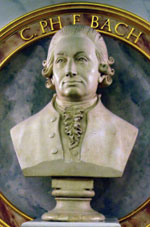
Indeed, Carl Philipp Emanuel Bach (1714–1788), second son of Johann Sebastian, was both revered and criticized by his contemporaries for his bold departures from conventional modes of musical expression. During his years as ‘first harpsichordist’ at the court of Frederick the Great of Prussia, and later as music director of the principal churches in Hamburg, Bach perfected a highly original and intensely personal compositional style known as the empfindsamer Stil (literally, the ‘sensitive style’). Bach’s approach to musical expressiveness found voice in frequent mood changes, wide melodic leaps, abundant rests and ‘sighing’ motifs, irregular phrase structures, the juxtaposition of contrasting rhythmic figures, deceptive cadences, and dramatic, rhetorical harmonic interjections. Bach became particularly renowned for his ability to improvise fantasias—seemingly free-form, stream-of-consciousness flights of fancy characterized by unmeasured rhythm and distant harmonic excursions. Yet underlying even the most improvisatory of his compositions is a coherent structure. Bach himself instructed his students to construct such fantasias by first devising a strict harmonic foundation, and he even published an analysis of one of his own pieces in which he presented the skeletal framework lying beneath its surface irregularity.
Emanuel Bach’s music thus breaks dramatically away from, yet also builds upon, the early eighteenth-century style perfected by his father. His compositions mark one of the first—and among the most inspired—repudiations of the Baroque aesthetic, in which a single unified mood dominates each movement. Significantly, however, Bach does not simply contrast two emotional states, as is typical in later Classical works, but rather explores a multitude of affects juxtaposed in close proximity and often set off by rests or dynamic changes. In fact, CPE Bach not only set in motion many of the changes that would become manifest in the music of Haydn and Beethoven, but also looked beyond the Classical period to many of the ideals of the nineteenth century.
from notes by Leta Miller © 2010
En 1773, l’historien de la musique anglais Charles Burney écrivait que les œuvres de C.P.E. Bach étaient «si singulières qu’un peu d’habitude était nécessaire pour [y] prendre plaisir». En fait, il affirmait que de nombreux critiques avaient reproché à C.P.E. Bach d’écrire des œuvres «invraisemblables» et «tirées par les cheveux». Burney s’est toutefois empressé de prendre la défense de C.P.E. Bach. «Ses envolées ne sont pas les divagations délirantes de l’ignorance ou de la folie, mais les effusions d’un génie cultivé. Après un examen attentif, ses pièces … seront jugées si riches sur le plan de l’invention, du goût et de l’érudition, que … chaque ligne, si on l’exploitait au maximum, fournirait davantage de nouvelles idées qu’on ne peut en découvrir dans une page entière de bien d’autres compositions.»
En effet, Carl Philipp Emanuel Bach (1714–1788), deuxième fils de Johann Sebastian, était à la fois vénéré et critiqué par ses contemporains pour ses entorses aux modes conventionnels d’expression musicale. Au cours des années qu’il a passées comme «premier claveciniste» à la cour de Frédéric le Grand de Prusse, puis comme directeur musical des principales églises de Hambourg, C.P.E. Bach a mis au point un style de composition très original et profondément personnel connu sous l’appellation empfindsamer Stil (littéralement, le «style sensible»). L’approche de C.P.E. Bach de la force expressive de la musique a trouvé sa voix dans de fréquents changements d’atmosphère, de larges sauts mélodiques, des silences abondants et des motifs «soupirants», des structures de phrase irrégulières, la juxtaposition de figures rythmiques contrastées, des cadences trompeuses et des interjections harmoniques rhétoriques dramatiques. C.P.E. Bach est devenu particulièrement célèbre pour sa capacité à improviser des fantaisies—forme apparemment libre, élans d’imagination issus de la vie mouvante et insaisissable de la conscience caractérisés par un rythme libre et des excursions harmoniques éloignées. Pourtant une structure cohérente sous-tend ses compositions les plus proches de l’improvisation. C.P.E. Bach lui-même demandait à ses élèves de construire de telles fantaisies en commençant par concevoir un fondement harmonique strict et il a même publié une analyse de l’une de ses propres pièces, où il présente le cadre squelettique situé sous son irrégularité superficielle.
La musique Carl Philipp Emanuel Bach rompt radicalement avec le style du début du XVIIIe siècle perfectionné par son père, tout en se basant sur lui. Ses compositions marquent l’un des premiers rejets—et parmi les plus inspirés—de l’esthétique baroque, dans laquelle une seule atmosphère unifiée domine chaque mouvement. Fait révélateur, néanmoins, C.P.E. Bach ne fait pas simplement contraster deux états émotionnels, comme c’est souvent le cas dans les œuvres classiques ultérieures, mais explore plutôt une multitude d’émotions juxtaposées de manière très rapprochée et souvent déclenchées par des silences ou des changements de dynamique. En fait, C.P.E. Bach a non seulement mis en route un grand nombre des changements qui allaient devenir manifestes dans la musique de Haydn et de Beethoven, mais il s’est également tourné, au-delà de la période classique, vers les idéaux du XIXe siècle.
extrait des notes rédigées par Leta Miller © 2010
Français: Marie-Stella Pâris
Im Jahr 1773 äußerte sich der Musikhistoriker Charles Burney zu den Werken Carl Philipp Emanuel Bachs und beschrieb sie als „derart außerordentlich, dass ein bisschen Gewöhnung nötig ist, wenn man sie genießen will“. Tatsächlich, so Burney, monierten viele Kritiker Bachs, dass seine Werke „fantastisch“ und „weithergeholt“ seien. Burney jedoch verteidigte Bach: „Seine Höhenflüge sind keine wahnsinnigen oder ignoranten Fantasien sondern die Ergüsse eines kultivierten Genies. Wenn man seine Stücke genau untersucht, so entpuppen sie sich als derart reich an Eingebung, Geschmack und Gelehrtheit, dass wenn die einzelnen Linien aus Draht gezogen wären, sich darin mehr neue Ideen fänden als in einer ganzen Seite von vielen anderen Kompositionen.“
Tatsächlich wurde Carl Philipp Emanuel Bach (1714–1788), der zweitälteste Sohn Johann Sebastians, von seinen Zeitgenossen für seine kühnen und ungewöhnlichen musikalischen Ausdrucksweisen sowohl verehrt wie auch kritisiert. Während seiner Zeit als Kammercembalist am Hof Friedrichs des Großen und auch später, als Musikdirektor der Hauptkirchen in Hamburg, vervollkommnete Bach einen hochoriginellen und sehr persönlichen Kompositionsstil, der als empfindsamer Stil bekannt wurde. Bachs Herangehensweise an den musikalischen Ausdruck darin bestand häufige Stimmungswechsel, große Melodiesprünge, zahlreiche Pausen und Seufzermotive, unregelmäßige Phrasenstrukturen, Gegenüberstellungen unterschiedlicher rhythmischer Figuren, Trugkadenzen und dramatische rhetorische harmonische Einwürfe einzusetzen. Besonders berühmt wurde Bach für seine Fähigkeit, Fantasien zu improvisieren—Höhenflüge in anscheinend freier Form und mit ungleichmäßigen Rhythmen und Ausflügen in harmonisch weit entfernte Gefilde, vergleichbar mit dem, was man in der Literaturwissenschaft „Bewusstseinsstrom“ nennt. Doch liegen selbst seinen Kompositionen, die am meisten einer freien Improvisation ähneln, stets schlüssige Strukturen zugrunde. Bach selbst hielt seine Schüler und Studenten dazu an, für solche Fantasien zuerst eine solide harmonische Grundlage zu schaffen, und er gab sogar eine Analyse seiner eigenen Werke heraus, in der er das Gerüst offenbart, das unterhalb der unregelmäßigen Oberfläche liegt.
C. Ph. E. Bachs Musik wendet sich damit entschieden von dem Stil des frühen 18. Jahrhunderts, den sein Vater perfektioniert hatte, ab, baut jedoch auch darauf auf. Sein Werk stellt eine der ersten—und der inspiriertesten—Zurückweisungen der barocken Ästhetik dar, wo jeder Satz von einer einzelnen und vereinheitlichten Stimmung dominiert wird. Es ist jedoch signifikant, dass Bach nicht einfach zwei emotionale Zustände einander gegenüberstellt, wie es in den späteren klassischen Werken zumeist der Fall ist, sondern eine Vielzahl von Affekten in unmittelbarer Nähe nebeneinander stellt, die oft durch Pausen oder Dynamikwechsel eingeleitet werden. Tatsächlich leitete C. Ph. E. Bach nicht nur viele der Veränderungen ein, die in der Musik von Haydn und Beethoven manifest werden sollten, sondern er nahm auch, über die Klassik hinausweisend, viele Ideale des 19. Jahrhunderts vorweg.
aus dem Begleittext von Leta Miller © 2010
Deutsch: Viola Scheffel