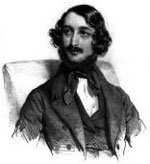
As a virtuoso violinist, the Moravian Heinrich Wilhelm Ernst (1814–1865) was a legend in his own lifetime. He died before the era of sound-recording, and his personal wizardry and magnetism can only dimly be recaptured in the written testimony of his contemporaries. Yet to a surprising extent it lives on in his own works for his instrument: for he was a composer who significantly extended the boundaries and meaning of bravura technique. Unfortunately Ernst has long been the preserve of violin specialists only—unjustly, considering his quality as a musical thinker.
Born in Brno, Ernst swiftly showed signs of talent, first performing in public at the age of nine. He entered the Vienna Conservatory, where he studied the violin with Joseph Böhm and Joseph Mayseder, and composition with Ignaz Xaver von Seyfried. He was fourteen when, in Vienna in 1828, he first heard Paganini play—an experience which transformed his life. He followed the great Italian virtuoso on his travels, absorbing the special features of his technique through close observation, and eventually impressed him by being able to play, by ear, as-yet unpublished works that Paganini was featuring in his programmes. By that time Ernst had started making concert tours on his own account. At the age of eighteen he had settled in Paris, where he made his official concert debut in 1831 and became friendly with the composer-pianist Stephen Heller, who collaborated with him on a set of jointly composed pieces, the Pensées fugitives for violin and piano. Ernst left Paris in 1838. The previous year, aged twenty-three, he had finally appeared in concert with Paganini, in Marseilles; critical opinion agreed that Paganini surmounted the greater range of technical difficulties, but Ernst played with greater feeling.
For the next twenty years Ernst lived the life of an itinerant virtuoso, building a reputation as one of Europe’s greatest violinists, and befriending Berlioz (who conducted him in Harold in Italy in Brussels), Mendelssohn and Joseph Joachim. He travelled as far afield as Moscow, Riga, and eventually London, which he first visited in 1843. It was in London that he settled in 1855 and he continued to perform there regularly until the early 1860s. In Joachim’s opinion, Ernst was the greatest violinist he had ever heard, one who towered above all others. In 1859 Ernst and Joachim were the violinists of what must have been one of the greatest string quartets in history, the Beethoven Quartet Society, along with Henryk Wieniawski (who played as the violist) and the cellist Alfredo Piatti. The last decade of Ernst’s life was a period overshadowed by severe and incurable neuralgia, and in his last years he retired to Nice. There he produced his final compositions and died on 9 October 1865, just fifty-one years old.
from notes by Calum MacDonald © 2008
Violoniste virtuose, le Morave Heinrich Wilhelm Ernst (1814–1865) fut une légende de son vivant. Mais comme il mourut avant l’ère de l’enregistrement sonore, son génie, son magnétisme ne peuvent nous être que faiblement restitués par les témoignages écrits de ses contemporains. Dans une large mesure, cependant, ce génie et ce magnétisme se perpétuent dans les œuvres pour violon de ce compositeur qui repoussa considérablement les frontières et le sens de la bravoure technique. Hélas, il est longtemps demeuré le pré carré des spécialistes du violon—à tort, vu ses qualités de penseur musical.
Né à Brno, Ernst manifesta un talent précoce et joua pour la première fois en public à l’âge de neuf ans. Admis au Conservatoire de Vienne, il étudia le violon avec Joseph Böhm et Joseph Mayseder, et la composition avec Ignaz Xaver von Seyfried. À quatorze ans, découvrir le jeu de Paganini (Vienne, 1828) bouleversa sa vie. À force d’observations scrupuleuses, il assimila les spécificités de la technique du grand virtuose italien, qu’il suivit dans ses voyages et dont il força l’admiration en pouvant jouer à l’oreille des pièces encore inédites, entendues seulement en concert. Bientôt, il se lança dans ses propres tournées. À dix-huit ans, il s’installa à Paris, où il avait officiellement fait ses débuts de concertiste en 1831; là, il devint l’ami du compositeur-pianiste Stephen Heller, avec qui il coécrivit une série de pièces pour violon et piano, les Pensées fugitives. Il quitta Paris en 1838. L’année précédente, à vingt-trois ans, il s’était finalement produit en concert avec Paganini, à Marseille; les critiques s’accordèrent à dire que Paganini avait surmonté le plus large éventail de difficultés techniques, mais qu’Ernst avait joué avec plus de sentiment.
Pendant les vingt années suivantes, Ernst mena une vie de virtuose itinérant et s’affirma comme l’un des plus grands violonistes d’Europe; il se lia d’amitié avec Berlioz (qui le dirigea dans
Harold en Italie, à Bruxelles), Mendelssohn et Joseph Joachim et voyagea jusqu’à Moscou, Riga et enfin Londres, qu’il avait visité pour la première fois en 1843. Ce fut là qu’il s’installa en 1855—il continua de s’y produire régulièrement jusqu’au début des années 1860. Joachim voyait en lui le plus grand violoniste qu’il eût jamais entendu, celui qui surclassait tous les autres. En 1859, les deux hommes furent les violonistes de ce qui a dû être l’un des plus grands quatuors de l’histoire, constitué pour la Beethoven Quartet Society, avec Henryck Wieniawsky à l’alto et Alfredo Piatti au violoncelle. Une névralgie sévère et incurable assombrit les dix dernières années de la vie d’Ernst, qui s’établit à Nice, où il produisit ses ultimes compositions et mourut le 9 octobre 1865, à tout juste cinquante et un ans.
extrait des notes rédigées par Calum MacDonald © 2008
Français: Hypérion
Zu seinen Lebzeiten war der mährische Heinrich Wilhelm Ernst (1814–1865) ein legendärer Geigenvirtuose. Er starb vor der Schallplattenära, und seine persönliche Zauberkunst und Magnetismus lassen sich aus den schriftlichen Zeugnissen seiner Zeitgenossen nur vage erfassen. Doch leben sie in großem Maße in seinen eigenen Werken für sein Instrument fort: als Komponist ging er weit über die Grenzen und die Bedeutung von Bravourtechnik hinaus. Leider blieb Ernst lange allein der Domäne von Violinspezialisten überlassen—zu Unrecht, wenn man seine Qualitäten als musikalischer Denker betrachtet.
Ernst wurde in Brünn geboren; sein Talent zeigte sich früh, und er trat im Alter von neun Jahren zum ersten Mal öffentlich auf. Nach seinem Eintritt ins Wiener Konservatorium studierte er Violine bei Joseph Böhm und Joseph Mayseder und Komposition bei Ignaz Xaver von Seyfried. Als Vierzehnjähriger hörte er 1828 in Wien zum ersten Mal Paganini spielen—eine Erfahrung, die sein Leben transformieren sollte. Er folgte dem großen italienischen Virtuosen auf seinen Reisen, absorbierte die besonderen Merkmale seiner Technik durch genaue Beobachtung und beeindruckte ihn schließlich, indem er ihm aus dem Gedächtnis Werke vorspielte, die Paganini zwar in seinen Programmen aufgeführt hatte, die aber noch nicht veröffentlicht waren. Zu diesem Zeitpunkt unternahm Ernst bereits seine eigenen Konzertreisen. Mit 18 ließ er sich in Paris nieder, wo er 1831 sein offizielles Konzertdebüt machte und sich mit dem Komponisten und Pianisten Stephen Heller befreundete, der mit ihm an einer Serie gemeinsam komponierter Stücke, den Pensées fugitives Violine und Klavier, kollaborierte. 1838 verließ Ernst Paris. Im Jahr zuvor, im Alter von 23, war er endlich in einem Konzert in Marseilles gemeinsam mit Paganini aufgetreten; die Kritiker stimmten überein, dass Paganini eine größere Bandbreite technischer Herausforderungen bewältigte, Ernst aber mit größerer Empfindung spielte.
In den nächsten zwanzig Jahren lebte Ernst als reisender Virtuose, gewann sich den Ruf als einer der größten Geiger Europas, und freundete sich mit Berlioz (der ihn in Brüssel in Harold in Italien dirigierte), Mendelssohn und Joseph Joachim an. Er reiste bis nach Moskau, Riga und schließlich London, das er 1843 zum ersten Mal besuchte. 1855 ließ er sich schließlich in London nieder und trat dort bis Anfang der 1860er Jahre regelmäßig auf. Nach Joachims Ansicht war Ernst der größte Geiger, den er je hörte, und der alle anderen weit überragte. 1859 waren Ernst und Joachim die Geiger in der Beethoven Quartet Society—mit Henryk Wieniawski (der Bratsche spielte) und dem Cellisten Alfredo Piatti dürfte dies eines der größten Streichquartette in der Musikgeschichte gewesen sein. Das letzte Jahrzehnt seines Lebens wurde durch schwere, unheilbare Neuralgien geplagt, und in seinen letzten Jahren setzte er sich in Nizza zur Ruhe, wo er seine letzten Kompositionen schrieb und am 9. Oktober 1865 im Alter von nur 51 Jahren starb.
aus dem Begleittext von Calum MacDonald © 2008
Deutsch: Renate Wendel