It was not until the early 1860s that a formal music conservatoire was established in Russia, initially directed by the great Anton Rubinstein, who founded the St Petersburg Imperial Conservatoire in 1862. His younger brother Nikolai became director of the rival Moscow Conservatoire when it opened in 1866.
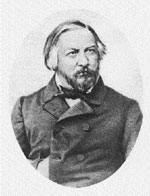
It would be wrong, of course, to assume that no musical education existed before 1862; and if – equally – one cannot claim that no Russian composer flourished before Mikhail Glinka (1804-1857), there is no doubt that he was the first truly important Russian composer, considered by Russians to be the ‘musical acorn’ from which the mighty oak tree of Russian music was to grow.
When Louis Spohr visited St Petersburg in 1802 he was surprised to learn that the city’s musical life was dominated entirely by foreign musicians. More than a century earlier the Eastern Orthodox Church, which remained a powerful governing force, had proclaimed a ukase which instructed that ‘musical instruments were to be broken up and burned’ – and not merely, it seemed, in places of worship (although the Church does not permit musical instruments to this day). It was into this ethnically empty musical world that Mikhail Glinka was born in 1804. Fortunately, his father’s wealth and cultural aspirations enabled him to study music after a fashion, but the youth was determined, if possible, to bring a Russian character into the music which he wanted to write. This was not easy; nor was it soon achieved.
from notes by Robert Matthew-Walker © 2001
Ce ne fut qu’au début des années 1860 que fut inauguré le premier Conservatoire russe de musique sous l’impulsion et la direction du grand Anton Rubinstein qui fonda le Conservatoire impérial de Saint-Pétersbourg en 1862. Son plus jeune frère, Nikolaï, devint directeur de l’établissement rival, le Conservatoire de Moscou, qui ouvrit ses portes en 1866.
Il serait faux de croire qu’avant 1862 il n’existait aucune éducation musicale. Et si – de même – on ne peut déclarer qu’aucun compositeur ne se soit épanoui avant Mikhaïl Glinka (1804-1857), il ne fait aucun doute qu’il fut le premier compositeur russe d’importance, considéré par les Russes comme le «gland musical» d’où allait pousser le puissant chêne de la musique russe.
Quand Louis Spohr se rendit à Saint-Pétersbourg en 1802, il fut surpris d’apprendre que la vie musicale de la ville était dominée par des musiciens étrangers. Plus d’un siècle auparavant, la très puissante Eglise orthodoxe d’Orient avait proclamé un oukase par lequel «les instruments musicaux devaient êtres détruits et brûlés», pas seulement semble-t-il dans les lieux de cultes (même si l’Eglise n’y autorise aucun instrument jusqu’à ce jour). C’est dans cet univers vide d’un point de vue ethnique que Mikhaïl Glinka vit le jour en 1804. Fort heureusement, la richesse et les aspirations culturelles de son père lui permirent d’étudier la musique en suivant la mode, mais le jeune homme était résolu à apporter- si possible – un caractère russe à la musique qu’il désirait écrire. Ce n’était pas chose aisée et il n’y parvint pas du jour au lendemain.
extrait des notes rédigées par Robert Matthew-Walker © 2001
Français: Isabelle Battioni
Erst in den frühen 1860er Jahren wurde in Rußland ein offizielles Konservatorium eingerichtet, und zwar zunächst unter der Leitung des großen Anton Rubinstein, der 1862 das Kaiserliche Konservatorium in St. Petersburg gründete. Sein jüngerer Bruder Nikolai wurde Direktor des konkurrierenden Moskauer Konservatoriums, als es 1866 seine Pforten öffnete.
Es wäre natürlich falsch, anzunehmen, es habe vor 1862 überhaupt keine Musikausbildung gegeben. Ebenso wenig kann man – aus dem gleichen Grund – behaupten, daß sich vor Michail Glinka (1804-1857) kein anderer russischer Komponist hervorgetan hätte, und dennoch besteht kein Zweifel, daß er der erste wahrhaft bedeutende russische Komponist war, den die Russen als „musikalische Ecker“ ansahen, aus der die mächtige Eiche der russischen Musik wachsen sollte.
Als Louis Spohr im Jahr 1802 St. Petersburg besuchte, war er überrascht, zu erfahren, daß das Musikleben der Stadt ganz von ausländischen Musikern beherrscht wurde. Über ein Jahrhundert zuvor hatte die russisch-orthodoxe Kirche, die eine dominierende Macht war und blieb, eine Verordnung erlassen, die befahl, daß „Musikinstrumente zerbrochen und verbrannt“ werden sollten – und zwar augenscheinlich nicht nur in Gotteshäusern (bis heute sind dort im Gottesdienst keine Musikinstrumente erlaubt). In dieses Vakuum ethnisch eigenständiger Musik wurde 1804 Michail Glinka hineingeboren. Glücklicherweise gestatteten es ihm der Wohlstand und das kulturelle Engagement seines Vaters, so gut es ging Musik zu studieren, wobei er jedoch schon als Jugendlicher entschlossen war, soweit möglich der Musik, die er zu komponieren gedachte, einen russischen Charakter zu verleihen. Das war nicht leicht; und es war auch nicht rasch zu bewerkstelligen.
aus dem Begleittext von Robert Matthew-Walker © 2001
Deutsch: Anne Steeb/Bernd Müller